+91-98558-85133
 +1(702)760-3099

AI Workforce Operating System
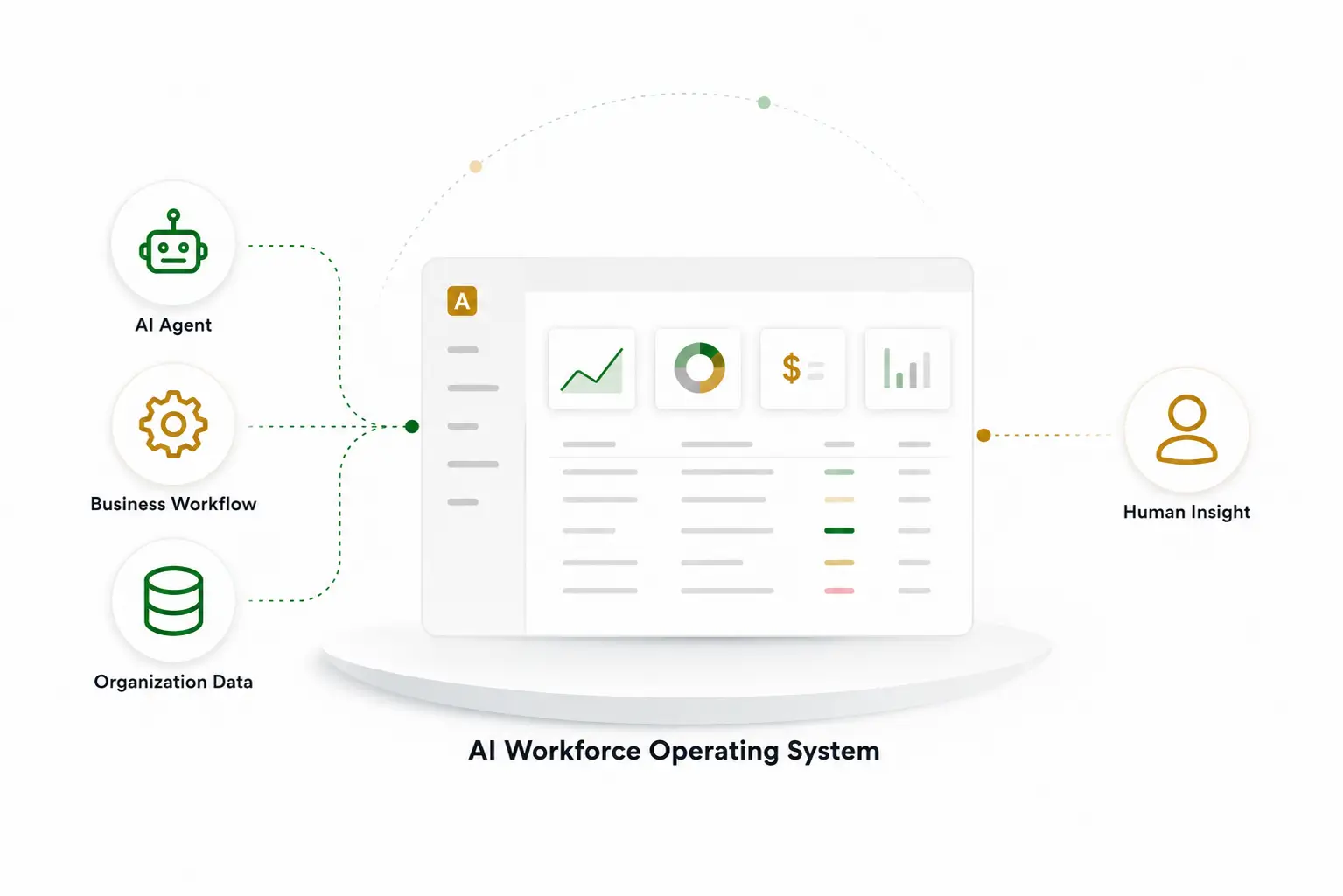
The AI Workforce Operating System is the operating layer for enterprise AI workforces. It acts as the control plane that runs, governs, measures, and optimizes AI agents across every workflow they touch, the same way a business already runs, measures, and manages its human teams.
The platform manages agent deployment, coordinates work between agents, enforces governance policies, tracks cost and business outcomes, and routes decisions back to humans whenever oversight is required.
It isn't a chatbot, a single AI tool, or another automation script. It's infrastructure, built for enterprises that have already adopted AI agents and now need a real system to run them like a workforce, not a collection of disconnected experiments.
Objective
The objective was straightforward. Give enterprises a single system to run AI agents the way they already run people.
That means clear ownership of who or what is doing a task, a way to measure whether the work got done well, and a way to catch problems before they reach a customer, a regulator, or a balance sheet.
Most enterprise AI programs can already do the first half of that job: deploying agents into workflows. Almost none can do the second half: operating, governing, and optimizing those agents once they're live.
That's the specific gap this system closes.
The Problem for Enterprises Running AI Agents
Industry data puts the failure-to-scale rate for enterprise AI projects at 95%, and the reason is rarely the model itself. In practice, the gap between deploying an agent and actually running it shows up in six specific places.

No Orchestration
Agents get deployed one at a time, each solving a narrow task. Without a layer to coordinate them, enterprises end up with a pile of single-agent tools instead of workflows that actually run themselves end to end.

No AI Economics
Most enterprises can't say what an agent costs to run, what it returns, or whether one version of an agent is outperforming another. Without cost-per-run and ROI-per-agent data, AI spend stays a black hole instead of a line item you can defend.

No Governance or Control
Without clear policy on what an agent can and can't do, enterprises are exposed to decisions they can't explain, risks they can't predict, and outputs they can't fully trust.

No Auditability
When something goes wrong, teams often can't reconstruct what happened, why a decision was made, or which agent was responsible for it. Traditional logs tell you something happened. They rarely explain why it happened.

No Workforce Visibility
Most enterprises know exactly how many people handled a process, how long it took, and what it cost. Very few have the same visibility into AI agents. Leaders can't see utilization, throughput, workload distribution, or idle capacity across their AI workforce.

No Human Oversight System
AI agents are making decisions inside real workflows with no structured way for a human to review, approve, or step in. That's not a governance gap alone. It's a missing layer of collaboration between people and agents.

Individually, each gap slows one part of the business down. Together, they're why enterprises can deploy AI agents but can't yet operate them as a real workforce.
Our Approach
Instead of adding another point tool to the stack, this system sits above the agents an enterprise already has and continuously runs four operating loops.
Track
Every action an agent takes, every decision it makes, and every output it generates is recorded as a structured event.
Coordinate
Agents hand work to each other through orchestrated workflows rather than isolated prompts and disconnected tools.
Govern
Policies, permissions, escalation paths, and approval requirements are enforced in real time while work is happening.
Measure
Cost, output quality, throughput, and business impact are rolled into metrics enterprises can actually use to improve operations.
That loop — track, coordinate, govern, measure — is what turns a collection of AI agents into something a business can manage the same way it manages any other operating function.
Platform Features

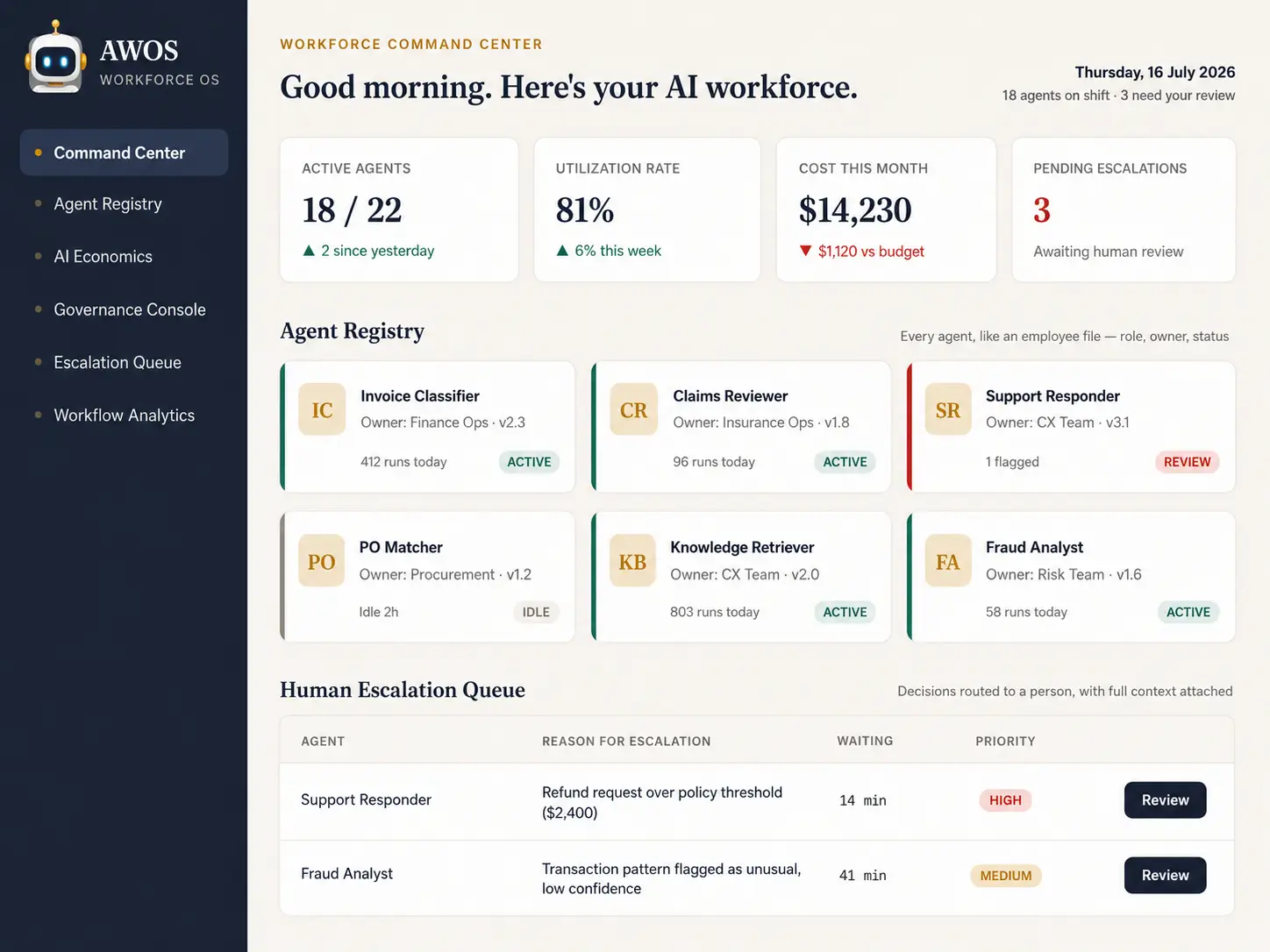
Workforce Command Center
A centralized dashboard showing active agents, workflow health, utilization rates, throughput, and business impact across the entire AI workforce.

Agent Registry
A single inventory of every deployed agent, including ownership, permissions, objectives, model versions, and deployment history.

AI Economics Dashboard
Track cost per run, cost per workflow, ROI per agent, token consumption, and comparative performance across different models and configurations.

Governance Console
Define policies, approval requirements, escalation rules, and access controls that apply consistently across every AI workflow.

Human Escalation Queue
Workflows requiring review automatically route to the right human stakeholder with complete decision history and supporting context.

Workflow Analytics
Measure throughput, bottlenecks, completion rates, and failure patterns across multi-agent workflows in real time.

Workforce Observability
Capture every action, decision path, and handoff between agents so teams can reconstruct exactly what happened and why.
Technology Stack
LLM Observability & Tracing
 Langfuse
 Langfuse
LLM Gateway / Routing
 LiteLLM
 LiteLLM
Agent Orchestration
 LangGraph
 LangGraph
Governance / Guardrails
 NeMo Guardrails
 NeMo Guardrails
Backend
 Node.js
 Python
 Node.js
 Python
Frontend
 Angular
 Angular
Event Streaming
 Kafka
Kafka
 Kafka
KafkaTime-Series / Metrics Store
 ClickHouse
 ClickHouse
Relational Database
- PostgreSQL
 PostgreSQL
Vector Database
- Qdrant
 Qdrant
Caching
 Redis
Redis
 Redis
RedisInfrastructure
 Kubernetes
 Kubernetes
Monitoring & Alerting
 Prometheus
 Grafana
 Prometheus
 Grafana
Security & Access Control
 Role-Based Access Control
 OAuth2 / JWT
 Role-Based Access Control
 OAuth2 / JWT
Cloud Storage
 AWS S3
 AWS S3
Results Delivered
70%
faster issue resolution through end-to-end workflow traceability and decision reconstruction.
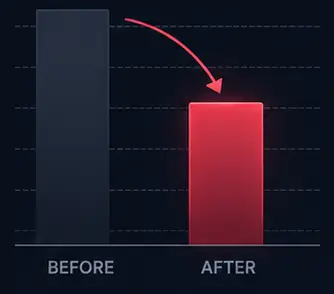
55%
greater visibility into AI workforce performance, utilization, and business impact.
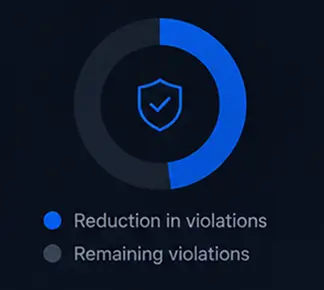
60%
reduction in manual oversight requirements through governance automation and intelligent escalation workflows.

Why Enterprises Need an AI Workforce Operating System
Most organizations already have systems for managing employees, contractors, and vendors.
As AI agents become part of day-to-day operations, enterprises need equivalent systems for managing digital workers with the same level of accountability, visibility, and oversight.
That's the role this platform is built to play.