performance icon
Top IT Services Company 2025 Top Software Developers 2025 Top Generative AI Company 2025 G2 High Performer Winter 2025 G2 Leader Winter 2025 AI Deployment Company 2024 Top Software Development Company in USA for 2024 Top ReactJs Company in USA for 2024
trigma-logo

A Strategic Guide to Outsourcing Your MVP Development

Building a Minimum Viable Product (MVP) has become a critical step for entrepreneurs aiming to validate their concepts and enter the market quickly. However, not all startups have the in-house resources or expertise to develop an MVP from scratch. This is where outsourcing comes into play. GoodFirms research shows that 91% of the businesses have already launched their product through the MVP approach, contributing significantly to their success. Outsourcing to an MVP development agency can provide numerous benefits, from cost savings to access to specialized skills. This article will explore how to effectively outsource your MVP development while ensuring a successful outcome.
A Strategic Guide to Outsourcing Your MVP Development
Understanding the MVP Concept

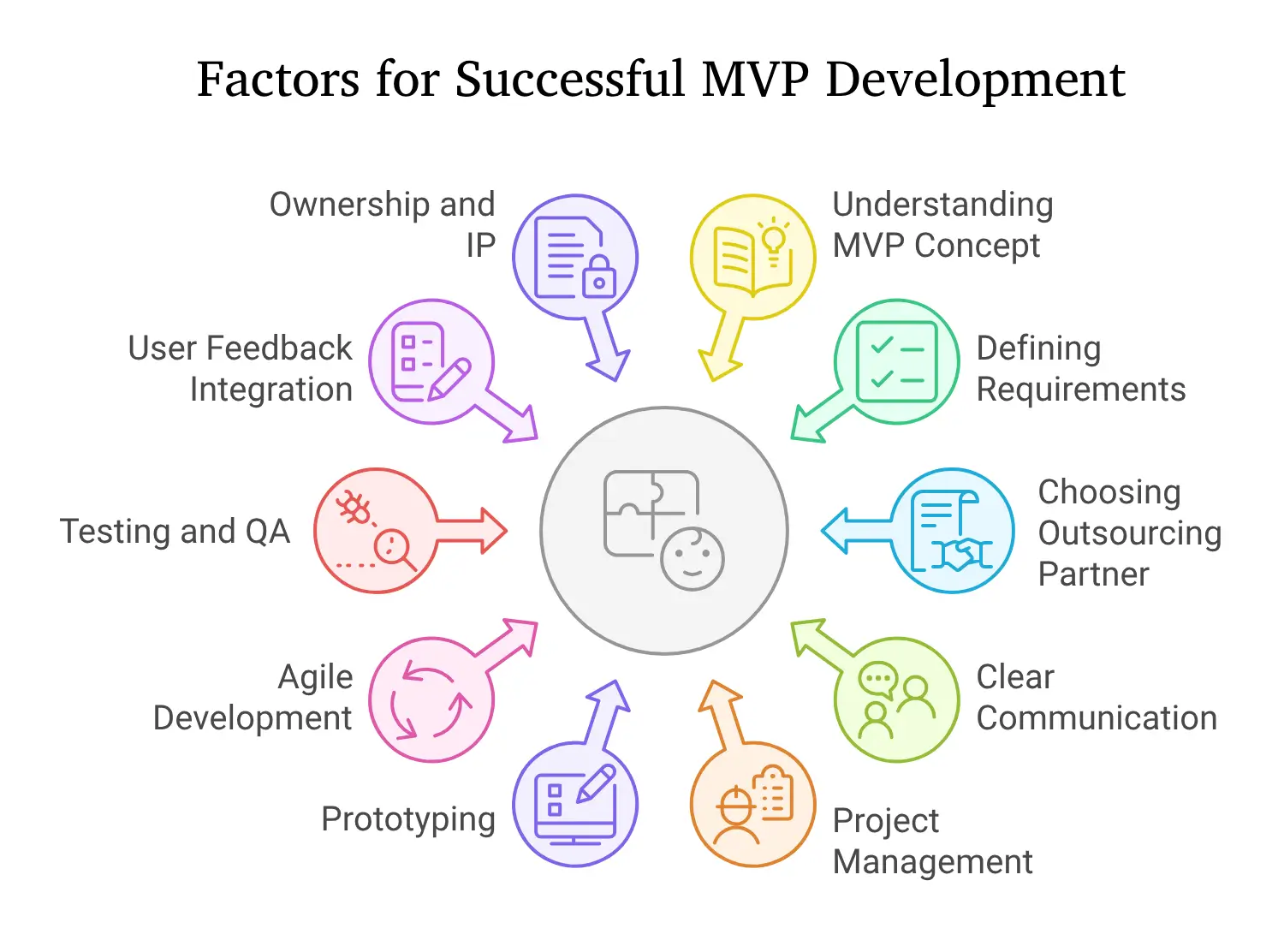
1. Understanding the MVP Concept

Before embarking on the outsourcing journey, it's crucial to clearly understand the MVP concept. An MVP is a simplified version of your product that includes only its core features. It's designed to validate your idea, gather user feedback, and make iterative improvements. With this understanding in mind, you can communicate your vision effectively to the outsourcing partner.

Defining Your Requirements

2. Defining Your Requirements

The success of outsourcing hinges on defining your requirements clearly. Start by outlining the core features and functionalities you want in your MVP for software development. Create detailed user stories and use cases that highlight the user experience you're aiming for. A well-defined scope ensures that both you and your outsourcing partner are on the same page and can work towards a common goal.

Right Outsourcing Partner

3. Choosing the Right Outsourcing Partner

Selecting the right outsourcing partner is a critical step in the process. Look for a partner with a proven track record in software development. Check their portfolio and client testimonials to gauge their expertise. The partner should also have experience in your industry or a similar domain, as this will enable them to understand the nuances of your project more effectively.

Clear Communication

4. Clear Communication

Effective communication is the foundation of successful outsourcing. Clearly communicate your project goals, requirements, and expectations to your outsourcing partner. Maintain an open line of communication throughout the project to address any questions, concerns, or changes that may arise. Regular updates and status reports keep both parties aligned and informed.

Project Management

5. Project Management

Assign a project manager from your side to oversee the outsourcing process. This individual will act as a bridge between your startup and the outsourcing team. Regular meetings, status updates, and progress reports ensure that the project is on track and that any potential roadblocks are addressed promptly.

Prototyping and Wireframing

6. Prototyping and Wireframing

Before diving into full-scale development, consider creating prototypes and wireframes of your MVP. These visual representations clearly understand the user interface and user flow. Prototyping helps visualize the end product and make necessary adjustments early in the process, reducing the risk of costly changes later.

Agile Development

7. Agile Development Approach

Adopting an agile development approach is highly beneficial when outsourcing MVP software development. Agile methodologies involve iterative and incremental development, allowing for frequent testing, feedback, and adjustments. This approach facilitates rapid adaptation to changing requirements and ensures that the final product meets user needs effectively.

Testing and Quality Assurance

8. Testing and Quality Assurance

Quality assurance is paramount in the MVP development process. Define a testing strategy to ensure that the MVP functions as intended and is free from critical bugs. Collaborate with your outsourcing partner to establish testing processes and guidelines. Conduct thorough testing at each stage of development to identify and resolve issues early.

User Feedback Integration

9. User Feedback Integration

One of the primary goals of an MVP is to gather user feedback for improvements. Ensure that your outsourcing partner is capable of integrating user feedback seamlessly into the development process. Regularly analyze user insights to make informed decisions about feature enhancements, bug fixes, and iterative improvements.

Ownership and Intellectual Property

10. Ownership and Intellectual Property

Clearly define ownership and intellectual property rights in the outsourcing contract. Specify the terms regarding code ownership, licensing, and confidentiality. This step ensures that there are no legal or ownership disputes down the line.

Conclusion

Outsourcing MVP development can provide startups with the expertise, resources, and speed they need to successfully bring their ideas to market. You can confidently navigate the outsourcing journey by understanding the MVP concept, defining requirements, selecting the right partner, communicating effectively, and following an agile approach. Remember that outsourcing is a collaborative effort, and maintaining a strong partnership with your chosen provider is key to achieving your MVP development goals efficiently and effectively.

Our Global Impression

Hear What Our Clients Are Saying

Client testimonials

We are very happy with the team's flexibility with the fact that they always deliver the tasks on time

Trigma Solutions developed a website for a content outsourcing company. The team built the project management site from scratch, providing both front- and backend development. Trigma Solutions provides project management tools to ensure a smooth workflow. The team is reliable, attentive, and knowledgeable.

PAUL AGABIN
CEO, Agabin Interactive (Manila, Philippines)

They are cooperative, hardworking, and really imaginative.

Thanks to Trigma's efforts, the client was able to develop modules and troubleshoot their services. The team's superb organizational skills and initiative allowed the project to become a success. Overall, end users give positive and satisfactory feedback on the project.

PARK MIN HO
VP of Operation, AI Dashcam Manufacturer
(Seoul, Korea)

They were quick to understand what we needed and delivered it.

They were able to deliver a high-functioning site because of their transparent responsiveness and outstanding customer support. The new platform built by Trigma Solutions exceeded the internal stakeholders' expectations. As a result, they plan to continue collaborations on future projects.

HEATHER J. SUAREZ
Founder, StallionMexSearch
(Jacksonville, Florida)

They have managed everything properly.

Trigma Solutions executed a successful project that's seen high levels of user engagement. While there were some obstacles related to COVID-19, the team managed the workflow well. They've secured future work with the client for further app development.

GOWRI SHANKAR
Account Manager, Digitally Squared PR & News
(Karnataka, India)

Their sheer level of skill and ‘can do‘ attitude stood out to me.

The productive discussions we've had with Trigma Solutions have made our specs better and ultimately improved the software. Great Team and Value for money work done

RICHKO

These guys are problem solver and they are pretty fast at it

The team we worked with at Trigma was so calm in dealing with the integration hurdles they faced while connecting to our master distribution system that we nicknamed them the .. 'Problem solver'

KATHERINE BONELLO

Got an idea?

Tell us and we will build the right solution for your needs.

British Council
British Council
British Council
British Council

Got An Idea?

Tell us and we will build the right solution for your needs.

Turn your dreams into reality with us!

Please fill in the details below to talk to our expert
and discuss your project.

    MVP vs. Full Product Development: Pros and Cons for Startups

    Amongst thousands of business ideas being brought back to actualisation, choosing between building a Minimum Viable Product (MVP) and diving into full product development is a critical decision. Both approaches offer distinct advantages and drawbacks, shaping the trajectory of a startup's growth. In this article, we'll delve into the world of MVP app development for startups, exploring the benefits and challenges it presents compared to full product development.

    Understanding the MVP Approach

    An MVP is a streamlined version of a product that includes only the most essential features required to solve a specific problem for the target audience. The primary objective is to validate the core concept, gather user feedback, and make informed decisions for further development. Let's examine the key advantages and disadvantages of this approach:

    MVP Product Development

    Pros of MVP App Development

    Faster Time-to-Market

    Building an MVP allows startups to launch their product idea quickly, enabling them to seize early opportunities and gain an initial user base.

    Cost-Effective

    MVP development focuses on the core functionalities, reducing development costs and resource allocation. This is particularly beneficial for startups with limited budgets.

    User-Centric Development

    MVPs encourage direct interaction with users, providing valuable insights into their preferences, pain points, and needs. This user feedback guides iterative improvements.

    Risk Mitigation

    By testing the market with an MVP, startups can identify potential flaws or shortcomings in the concept before investing heavily in full product development.

    Cons of MVP App Development

    Limited Features

    MVPs may lack some features that users expect, potentially leading to initial disappointment and lower retention rates.

    First Impression Matters

    While MVPs are designed for testing, a poor initial experience could harm a startup's reputation if users find it too basic or buggy.

    Competitive Landscape

    If competitors offer more feature-rich alternatives, users might choose those over an MVP, making it challenging to attract and retain users.

    The Case for Full Product Development

    Opting for full product development involves creating a comprehensive, feature-rich application from the outset. While this approach requires a more significant investment of time, resources, and effort, it offers its own set of advantages and challenges:

    Full Product Development

    Pros of MVP App Development

    Comprehensive User Experience

    A fully developed product can provide a more complete and satisfying user experience, leading to higher initial adoption rates.

    Differentiation

    In a competitive market, a feature-rich product can stand out from the crowd, attracting users seeking comprehensive solutions.

    Long-Term Vision

    Full product development enables startups to establish a clear brand identity and long-term vision, signaling commitment to users.

    Cons of Full Product Development

    Extended Development Time

    The time required to build a full product can delay market entry, potentially missing out on early opportunities.

    Higher Costs

    Developing a full product demands more resources, including development, testing, and marketing expenses, which might strain limited budgets.

    Risk of Overengineering

    Without user feedback, there's a risk of developing features that users don't actually need or want, leading to wasted effort and resources.

    Choosing the Right Path: Balancing Act

    Ultimately, the decision between MVP app development and full product development hinges on the startup's unique circumstances. For startups with limited resources and a need for rapid market entry, an MVP can offer a valuable testing ground for refining the concept. Conversely, those with a clear vision and ample resources might opt for full product development to establish a comprehensive presence in the market.

    Whichever path a startup chooses, it's crucial to remain agile, responsive to user feedback, and ready to pivot based on market realities. The success of both approaches lies in the ability to learn, adapt, and iterate to meet the evolving needs of the target audience.

    In the dynamic world of startup development, the choice between MVP and full product development is not a binary decision; it's a nuanced balance that requires strategic thinking, a deep understanding of the market, and a willingness to embrace change. By carefully evaluating the pros and cons of each approach, startups can chart a course toward growth, innovation, and success. Contact us if you need tech help from an experienced service provider!

    Our Global Impression

    Hear What Our Clients Are Saying

    Client testimonials

    We are very happy with the team's flexibility with the fact that they always deliver the tasks on time

    Trigma Solutions developed a website for a content outsourcing company. The team built the project management site from scratch, providing both front- and backend development. Trigma Solutions provides project management tools to ensure a smooth workflow. The team is reliable, attentive, and knowledgeable.

    PAUL AGABIN
    CEO, Agabin Interactive (Manila, Philippines)

    They are cooperative, hardworking, and really imaginative.

    Thanks to Trigma's efforts, the client was able to develop modules and troubleshoot their services. The team's superb organizational skills and initiative allowed the project to become a success. Overall, end users give positive and satisfactory feedback on the project.

    PARK MIN HO
    VP of Operation, AI Dashcam Manufacturer
    (Seoul, Korea)

    They were quick to understand what we needed and delivered it.

    They were able to deliver a high-functioning site because of their transparent responsiveness and outstanding customer support. The new platform built by Trigma Solutions exceeded the internal stakeholders' expectations. As a result, they plan to continue collaborations on future projects.

    HEATHER J. SUAREZ
    Founder, StallionMexSearch
    (Jacksonville, Florida)

    They have managed everything properly.

    Trigma Solutions executed a successful project that's seen high levels of user engagement. While there were some obstacles related to COVID-19, the team managed the workflow well. They've secured future work with the client for further app development.

    GOWRI SHANKAR
    Account Manager, Digitally Squared PR & News
    (Karnataka, India)

    Their sheer level of skill and ‘can do‘ attitude stood out to me.

    The productive discussions we've had with Trigma Solutions have made our specs better and ultimately improved the software. Great Team and Value for money work done

    RICHKO

    These guys are problem solver and they are pretty fast at it

    The team we worked with at Trigma was so calm in dealing with the integration hurdles they faced while connecting to our master distribution system that we nicknamed them the .. 'Problem solver'

    KATHERINE BONELLO

    Got an idea?

    Tell us and we will build the right solution for your needs.

    British Council
    British Council
    British Council
    British Council

    Got An Idea?

    Tell us and we will build the right solution for your needs.

    Turn your dreams into reality with us!

    Please fill in the details below to talk to our expert
    and discuss your project.

      9 Benefits of an MVP in Software Development

      In the rapidly evolving landscape of software development, the concept of the Minimum Viable Product (MVP) has emerged as a game-changer. An MVP software is a stripped-down version of a product that includes only the essential features necessary to deliver value to users. This approach offers numerous advantages that can significantly impact the success of a software project. In this blog, we'll delve into the 9 key advantages of utilizing an MVP in custom software development.

      1. Faster Time-to-Market

      Developing using an agile development process full-featured software product can be a time-consuming endeavor. By focusing on the core functionalities in an MVP, development time is significantly reduced. This allows you to launch a functional product faster, gaining an early entry into the market and seizing the opportunity to address user needs ahead of competitors. Good Software development companies understand the simplified nature of an MVP means that decisions can be made more swiftly. Teams can avoid prolonged discussions about non-essential features and instead focus on the immediate value the MVP should provide, which accelerates the decision-making process.

      2. Validating Market Demand

      An MVP software serves as a litmus test for your software idea. By releasing a basic version and observing user engagement and feedback, you can validate whether there's a genuine demand for your product. This approach helps you avoid investing time and resources into a product that might not resonate with your target audience.

      3. Cost Efficiency

      Developing a comprehensive software product requires substantial resources. MVP development streamlines the process and reduces costs. The MVP software approach forces teams to allocate resources more efficiently. By focusing on core functionalities, development efforts are concentrated, reducing the need for extensive resources on peripheral features that might not deliver proportional value. This cost-effective approach is especially beneficial for startups and small businesses with limited budgets.

      4. User-Centric Development

      Launching an MVP enables you to gather invaluable feedback at an early stage. It forces you to prioritize user needs and preferences. By concentrating on the essential features, you create a product that directly addresses user pain points. This user-centric approach increases the chances of creating a product that users truly value. And, the feedback gathered by software development companies provides insights into user behavior, preferences, and pain points. Armed with this information, you can iterate and refine the product based on actual user experiences, leading to a better final product.

      5. Reduced Risk of Failure

      Rushing into full-scale development without validation poses a high risk of failure. An MVP mitigates this risk by allowing you to test assumptions and hypotheses in a controlled environment. If an MVP doesn't gain traction, the loss is minimized compared to investing in a complete product.

      6. Opportunity for Iterations

      The iterative nature of MVP development means you can continuously improve the product based on user feedback and changing market conditions. This flexibility ensures that your software remains relevant and adaptable, enhancing its chances of long-term success. After receiving user feedback, you can make necessary changes, enhancements, and additions to the product in subsequent iterations. Iteration allows you to focus on targeted enhancements. Instead of overhauling the entire product, you can address specific issues or introduce features that align with user needs and preferences. 

      Over time, as you iterate on the MVP, you can gradually expand the feature set based on user demand and feedback. This approach ensures that the added features have a clear purpose and value.

      7. Resource Allocation and Prioritization

      The concept of an MVP forces you to identify and prioritize the most crucial features of your software. This clarity in feature selection helps your development team allocate resources more efficiently and deliver a product that aligns with your vision.

      8. Early User Acquisition

      With an MVP in hand, you can start acquiring early adopters and building a user base even before the complete product is ready. This early acquisition sets the stage for a successful product launch, as you've already generated interest and anticipation among potential users.

      9. Learning and Adaptation

      An MVP software journey is a learning experience. It allows you to gather insights into market dynamics, user behavior, and your own assumptions. This learning empowers you to make informed decisions for future product development, pivoting if necessary to meet evolving user needs.

      Conclusion

      The advantages of employing an MVP in software development are undeniable. From accelerating time-to-market and validating market demand to fostering a user-centric approach and reducing the risk of failure, the MVP strategy is a powerful tool that aligns with the fast-paced, dynamic nature of the tech industry. By embracing these advantages, software developers and businesses can position themselves for success by delivering impactful products that resonate with users and stand out in a competitive landscape. Contact us to know more about your MVP development process!

      Our Global Impression

      Hear What Our Clients Are Saying

      Client testimonials

      We are very happy with the team's flexibility with the fact that they always deliver the tasks on time

      Trigma Solutions developed a website for a content outsourcing company. The team built the project management site from scratch, providing both front- and backend development. Trigma Solutions provides project management tools to ensure a smooth workflow. The team is reliable, attentive, and knowledgeable.

      PAUL AGABIN
      CEO, Agabin Interactive (Manila, Philippines)

      They are cooperative, hardworking, and really imaginative.

      Thanks to Trigma's efforts, the client was able to develop modules and troubleshoot their services. The team's superb organizational skills and initiative allowed the project to become a success. Overall, end users give positive and satisfactory feedback on the project.

      PARK MIN HO
      VP of Operation, AI Dashcam Manufacturer
      (Seoul, Korea)

      They were quick to understand what we needed and delivered it.

      They were able to deliver a high-functioning site because of their transparent responsiveness and outstanding customer support. The new platform built by Trigma Solutions exceeded the internal stakeholders' expectations. As a result, they plan to continue collaborations on future projects.

      HEATHER J. SUAREZ
      Founder, StallionMexSearch
      (Jacksonville, Florida)

      They have managed everything properly.

      Trigma Solutions executed a successful project that's seen high levels of user engagement. While there were some obstacles related to COVID-19, the team managed the workflow well. They've secured future work with the client for further app development.

      GOWRI SHANKAR
      Account Manager, Digitally Squared PR & News
      (Karnataka, India)

      Their sheer level of skill and ‘can do‘ attitude stood out to me.

      The productive discussions we've had with Trigma Solutions have made our specs better and ultimately improved the software. Great Team and Value for money work done

      RICHKO

      These guys are problem solver and they are pretty fast at it

      The team we worked with at Trigma was so calm in dealing with the integration hurdles they faced while connecting to our master distribution system that we nicknamed them the .. 'Problem solver'

      KATHERINE BONELLO

      Got an idea?

      Tell us and we will build the right solution for your needs.

      British Council
      British Council
      British Council
      British Council

      Got An Idea?

      Tell us and we will build the right solution for your needs.

      Turn your dreams into reality with us!

      Please fill in the details below to talk to our expert
      and discuss your project.

        A Step-by-Step Guide to Build An MVP

        Every business aims to avoid spending money on a product that lacks market demand. To tackle this challenge and foster innovative product development, creating a Minimum Viable Product (MVP) has gained immense popularity. Renowned companies like Dropbox, Figma, and Uber have effectively utilized MVP as their launch strategy. Instead of rushing into full-scale development, building an MVP first has proven successful.

        What is an Minimum Viable Product (MVP)?

        An MVP, or minimum viable product, is a basic, launchable version of a product with minimum features to substantiate a product idea early in the product development cycle and attract early-adopter customers. It is built for marketing, attracting lighthouse customers, and achieving product-market fit quickly and from early on.

        The MVP development concept is perceived as a combination of the "minimum essentials." The next step usually involves taking feedback that will help future product development. This new product version allows a business to collect a good amount of learning about customers with the least or the most necessary effort.

        In today's fast-paced business world, building a Minimum Viable Product (MVP) has become crucial for startups and entrepreneurs to validate their ideas, gather feedback, and identify potential market opportunities. An MVP is a simplified product version that contains only its core features, allowing you to test your assumptions without investing excessive time and resources. This guide will help you understand the process of creating a successful MVP.

        Define Your Vision

        Vision

        Begin by defining the core problem or pain point your product intends to solve. Articulate the issue your target users face and how your product will solve it. A well-defined problem statement helps stakeholders and development teams understand the purpose of the MVP. Identify your target audience and outline the primary value your product will deliver to them. Keep your vision concise and focused, as it will guide your MVP's development. Also, define the unique value your MVP will offer to its users. Communicate the advantages and benefits users will gain from using your product. This value proposition should differentiate your MVP from existing solutions in the market.

        Identify Core Features

        Core Features

        The key to a successful MVP lies in simplicity. Identifying your most important needs by conducting surveys, research, and interviews is essential. Collect insights into what functionalities are most beneficial and directly assess their needs. Avoid adding bells and whistles that might complicate the development process or distract from the primary purpose of the MVP. Remember, less is more. Avoid feature bloat in your MVP. Remove any functionalities that are not directly related to solving the core problem. Keep the MVP simple and focused, expediting development and improving user experience.

        Conduct Market Research

        Market Research

        Conduct thorough market research to analyze your competitors and the current market landscape. Identify & analyze their strengths and weaknesses, pricing strategies, unique selling points, potential gaps, and opportunities for your product. Study your competitors' products that address a similar problem or target the same audience. 

        This will help you refine your MVP idea, differentiate your MVP and identify opportunities to offer a better solution and give you insights into what users expect from similar products.

        Create a Prototype

        Prototype

        Before diving into full-scale development, create a prototype or mockup of your MVP. This can be a simple clickable prototype that allows users to interact with the core features or wireframe. Prototyping will help you visualize your product and make necessary adjustments early.

        Build the MVP

        MVP

        Now, it's time to start building your MVP. Focus on developing the core features identified earlier and ensure they function as intended. Utilize agile development methodologies to maintain flexibility and adapt to changing requirements and user feedback. MVP product development is similar to software product development in general. The steps of both processes are similar, but the goals and speed range are different. A prototype is an early effort to visualize a working solution, whereas an MVP is a raw form of the software product that does all the fundamental target actions. A prototype helps you put the functionalities and design into perspective and validates UI & UX, so you can accumulate quality feedback for improvements and additions that your MVP will have. ‍

        Test and Gather Feedback

        Gather Feedbacks

        When you have a functional MVP, start testing it with real users. Gather feedback from early adopters and target users to better understand their requirements and pain points. This feedback will be invaluable in refining your product and validating your assumptions. With the help of the feedback received, iterate and improve your MVP. Continuously refine the features and user experience to align with user preferences and expectations. Keep the development cycles short to incorporate changes quickly.

        Monitor Key Metrics

        Key Metrics

        Identify the key standards that will help you measure the success of your MVP. This could include user engagement, retention rate, conversion rate, or any other relevant metrics. Analyze the data regularly to gain insights into your product's performance.

        Prepare for Scaling

        Scaling

        As your MVP gains traction and positive feedback, be prepared for scaling. Address any technical or infrastructure limitations in advance to handle increased user demand—plan for additional features and functionalities to meet the maturing needs of your users. A successful MVP addresses the major pain points, even if it does not have all of the features of the finished product. MVP users may pay with the idea that it will be upgraded to the full version whenever your offering goes from MVP to the final product. If you wish to use your MVP to analyze your pricing estimates, keep track of visitors and conversions. Study when does the traffic start to diminish at a certain pricing level? This type of study can help you determine what pricing model the market will accept once the final product is ready to compete with the big name.

        Launch and Market

        Launch and Market

        Once you have a stable MVP that addresses the core problem and resonates with your target audience, it's time for the official launch. Create a marketing plan to aggressively market your product and reach your potential customers.

        Listen and Adapt

        Listen and Adapt

        After the launch, continue to gather user feedback and listen to your customers. Be ready to make adjustments based on their suggestions and needs. The MVP phase is an ongoing learning process informing your product development strategy.

        Conclusion

        Building a Minimum Viable Product is an essential step in the product development journey. It allows you to test your ideas in the real world, gather feedback, and iterate quickly. Following this step-by-step guide, you can build an MVP that validates your product's viability and sets you on the path to success. Remember, simplicity, user-centricity, and continuous improvement are the keys to a successful MVP. Good luck!

        Got an idea?

        Tell us and we will build the right solution for your needs.

        Samsung (dark logo)
        Abbott logo dark
        Shell
        history (dark logo)
        UNDP (dark logo)
        Whirlpool (dark logo)
        hero logo dark
        Suzuki logo dark
        icarasia logo dark
        Alere (dark logo)
        Pernod (dark logo)
        Ridein
        british logo dark
        Govt. of India
        Walmart (dark logo)
        Reserve Bidding (dark logo)
        Search & settle (dark logo)
        Silverback hosts (dark logo)

        Turn your dreams into reality with us!

        Please fill in the details below to talk to our expert
        and discuss your project.

          How Can Startups Accelerate Growth with Agile Software Development?

          In the fast-paced and competitive world of startups, the ability to adapt quickly and deliver innovative solutions is crucial for success. Enter Agile Software Development – a game-changing approach that empowers startups to accelerate growth and gain a competitive edge. In this blog, we'll explore how Agile Development can revolutionize the way startups handle IT consulting and product development, driving them toward unprecedented achievements.

          Understanding Agile Software Development

          Before diving into the advantages for startups, let's briefly grasp what Agile Software Development is all about. Unlike traditional Waterfall methodologies, Agile emphasizes flexibility, collaboration, and customer-centricity. It breaks down the development process into smaller iterations, called sprints, where teams deliver functional increments at the end of each cycle. This iterative and incremental approach ensures continuous feedback, allowing startups to respond to changing market needs rapidly.

          Fostering Innovation and Experimentation

          Fostering Innovation and Experimentation

          Startups thrive on innovation and the pursuit of groundbreaking ideas. Trigma perfectly aligns with this mindset, creating an environment that encourages experimentation and creativity. By adopting Agile practices, startups can swiftly turn their visions into tangible products or services, validate them with Minimum Viable Products (MVPs), and gather real-world feedback from early adopters.

          In this context, Agile Software Development empowers startups to make data-driven decisions and iterate based on actual user experiences. This approach significantly reduces the risk of investing time and resources in products or features that may not resonate with the target audience. The ability to experiment, learn, and adapt on the fly can be the difference between startup success and failure.

          Customer-Centricity: A Key Differentiator

          Customer-Centricity

          Understanding customers' needs and preferences is at the core of every successful startup. Agile Software Development fosters a customer-centric culture by integrating customers into the development process. Frequent demos, user feedback sessions, and continuous collaboration enable startups to prioritize features that bring the most value to their target market.

          By actively involving customers throughout the product development journey, startups can create solutions that truly resonate with their users, leading to higher satisfaction and loyalty. This customer-driven approach also enhances the likelihood of creating successful products that meet market demand and drive organic growth through word-of-mouth referrals.

          Efficiency and Time-to-Market

          Efficiency and Time-to-Market

          In the competitive startup landscape, speed is of the essence. An iterative nature enables startups to deliver functional product increments in shorter cycles. This accelerated time-to-market allows startups to gain a foothold in the market faster and stay ahead of the competition.

          Furthermore, Agile practices promote streamlined workflows and reduce unnecessary bureaucracy, leading to improved overall efficiency. Cross-functional teams collaborate closely, breaking down communication barriers and fostering a shared understanding of project goals. This synergy translates into faster decision-making and seamless execution, maximizing the productivity of limited resources, a typical scenario for startups.

          Adapting to Changing Requirements

          Adapting to Changing Requirements

          In the ever-changing startup environment, requirements can shift rapidly. Startups often face evolving market dynamics, emerging technologies, and fluctuating customer preferences. Traditional development methodologies struggle to cope with such changes, often leading to project delays and cost overruns.

          Agile Software Development, on the other hand, embraces change as a natural part of the process. It allows startups to pivot when necessary, making adjustments without derailing the entire project. Agile teams regularly review and reprioritize tasks based on real-time feedback, ensuring that the final product remains relevant to the market's needs.

          Collaboration and Transparency

          Collaboration and Transparency

          For startups to succeed in a fast-paced environment, effective communication and collaboration are paramount. A good software development company promotes transparency among team members, stakeholders, and clients alike. Daily stand-up meetings, regular sprint reviews, and retrospectives foster a culture of open feedback and shared responsibility.

          Through continuous communication and collaboration, IT consulting and product development become more cohesive, aligned, and efficient. This synergy enhances team morale and ensures that everyone is on the same page regarding project goals and progress.

          Conclusion

          In the world of startups, where change is constant and innovation is the driving force, Agile Software Development is a transformative approach that accelerates growth and success. Its customer-centricity, adaptability, and emphasis on efficiency make it the ideal choice for startups looking to turn ideas into reality swiftly.

          By adopting Agile practices, startups can harness the power of collaboration, experimentation, and continuous improvement. As a result, they can build products that resonate with their customers, respond rapidly to market demands, and outmaneuver the competition.

          If your startup is seeking to unlock its full potential and drive accelerated growth, embracing Agile Software Development with our business is the key. Contact us today and book a short appointment to know more!

          Our Global Impression

          Hear What Our Clients Are Saying

          Client testimonials

          We are very happy with the team's flexibility with the fact that they always deliver the tasks on time

          Trigma Solutions developed a website for a content outsourcing company. The team built the project management site from scratch, providing both front- and backend development. Trigma Solutions provides project management tools to ensure a smooth workflow. The team is reliable, attentive, and knowledgeable.

          PAUL AGABIN
          CEO, Agabin Interactive (Manila, Philippines)

          They are cooperative, hardworking, and really imaginative.

          Thanks to Trigma's efforts, the client was able to develop modules and troubleshoot their services. The team's superb organizational skills and initiative allowed the project to become a success. Overall, end users give positive and satisfactory feedback on the project.

          PARK MIN HO
          VP of Operation, AI Dashcam Manufacturer
          (Seoul, Korea)

          They were quick to understand what we needed and delivered it.

          They were able to deliver a high-functioning site because of their transparent responsiveness and outstanding customer support. The new platform built by Trigma Solutions exceeded the internal stakeholders' expectations. As a result, they plan to continue collaborations on future projects.

          HEATHER J. SUAREZ
          Founder, StallionMexSearch
          (Jacksonville, Florida)

          They have managed everything properly.

          Trigma Solutions executed a successful project that's seen high levels of user engagement. While there were some obstacles related to COVID-19, the team managed the workflow well. They've secured future work with the client for further app development.

          GOWRI SHANKAR
          Account Manager, Digitally Squared PR & News
          (Karnataka, India)

          Their sheer level of skill and ‘can do‘ attitude stood out to me.

          The productive discussions we've had with Trigma Solutions have made our specs better and ultimately improved the software. Great Team and Value for money work done

          RICHKO

          These guys are problem solver and they are pretty fast at it

          The team we worked with at Trigma was so calm in dealing with the integration hurdles they faced while connecting to our master distribution system that we nicknamed them the .. 'Problem solver'

          KATHERINE BONELLO

          Got an idea?

          Tell us and we will build the right solution for your needs.

          British Council
          British Council
          British Council
          British Council

          Got An Idea?

          Tell us and we will build the right solution for your needs.

          Turn your dreams into reality with us!

          Please fill in the details below to talk to our expert
          and discuss your project.