+91-98558-85133
 +1(702)760-3099
Micro Models in NLP: A Complete Guide 2026
Every enterprise AI conversation seems to start with an LLM these days, and for a lot of use cases, that's overkill. You don't need a model that can write poetry and debug Python if all you're asking it to do is decide whether a support ticket is “billing” or “technical.” That's where micro models come in: small, narrow, task-specific NLP models built to do one job well instead of everything reasonably. A growing number of enterprises are quietly building their AI stack around them.
What Are Micro Models in NLP?
A micro model is a lightweight NLP model trained or fine-tuned to handle a single, well-defined task — things like intent classification, entity extraction, sentiment scoring, or spam detection. Most sit in the range of a few thousand to a few hundred million parameters, tiny next to the hundreds of billions in a frontier LLM. Scope is what defines them, not parameter count. A micro model doesn't try to understand language broadly; it learns one narrow mapping between input and output, really well, on your data.
Versus SLMs and TLMs: the terms get used loosely, so here's a practical split. Small language models (SLMs), generally 1–13 billion parameters, are still general-purpose: they can hold a conversation and follow varied instructions at a smaller footprint than GPT-class models. TLMs sit between the two, often under a billion parameters and still somewhat generative. Micro models are the narrowest tier: single-task, often non-generative, built to output a label, a score, or a structured field rather than open-ended text.
How Micro Models Work
There are two common starting points
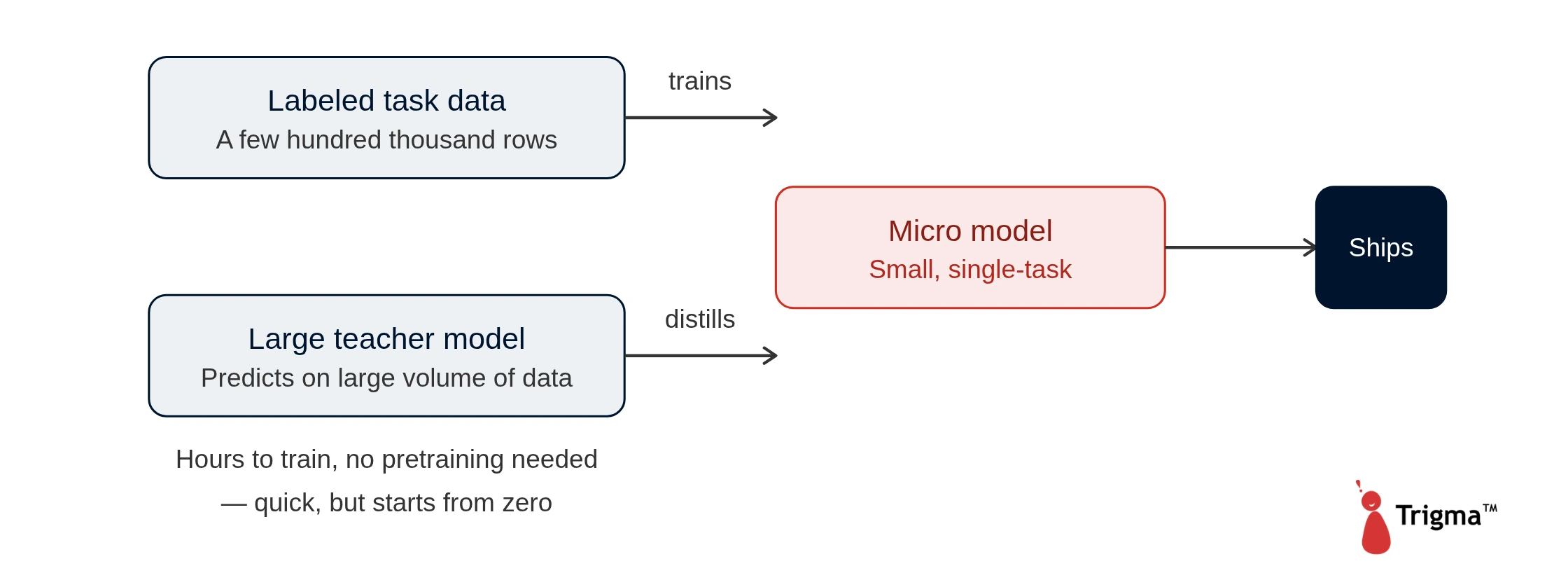
Trained from scratch. You pick a compact architecture and train it directly on labeled data for your task. If the job is “classify whether this insurance claim mentions water damage,” a few hundred thousand good examples and a modest transformer or even an LSTM will usually get you further than fine-tuning a giant model on the same dataset, and it trains in hours, not weeks.
Distilled from a larger model. Here, a big “teacher” model generates predictions on a large volume of data, and a much smaller “student” model is trained to match those predictions rather than raw labels. The student ends up inheriting a surprising amount of the teacher's behavior on that specific task.
The process, at a glance: a teacher model predicts across a large volume of task data, that data trains a much smaller student model, and the student is then compressed further with quantization and pruning before it ships to production.
How Student Models Actually Learn
It's worth pulling this apart a little further, since it's the mechanism that makes micro models possible in the first place.
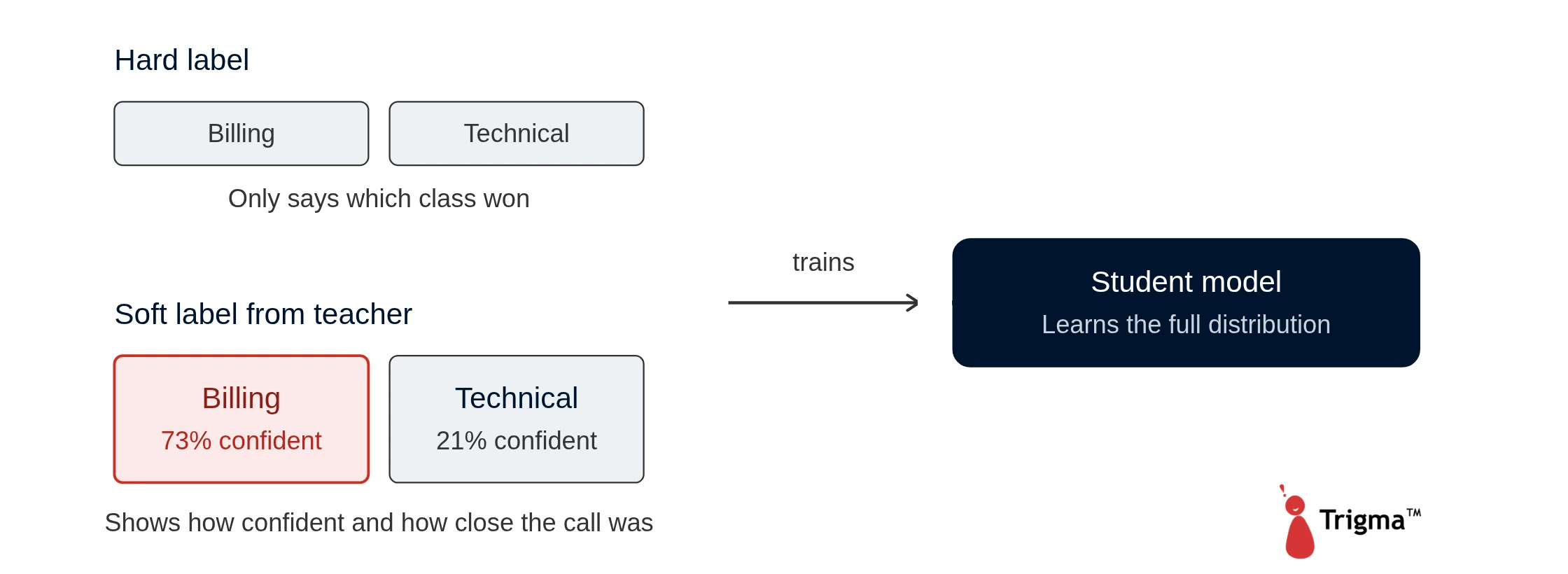
Instead of training on raw labeled data the way a model normally would, a student model trains to match the teacher's outputs — often its full probability distribution across possible answers, not just the final label. If the teacher is 73% confident a support ticket is “billing” and 21% confident it's “technical,” the student learns to reproduce that whole distribution, not just the winning tag. This is called soft-label training, and it carries more signal than a hard yes/no label would, since it captures how confident and how close-a-call each prediction was.
The student architecture itself is chosen deliberately narrow — fewer layers, fewer parameters, sometimes a completely different and simpler architecture than the teacher. It isn't a compressed copy of the teacher's actual weights; it's a fresh, smaller network trained from scratch to mimic the teacher's behavior on the task at hand.
A student model picks up the teacher's task-specific competence remarkably well, often within a few points of accuracy. What it doesn't inherit is the teacher's breadth. A student distilled to classify support tickets has no idea how to summarize a document or hold a conversation — that capability was never part of what it was trained to imitate. This is the tradeoff at the heart of micro models: you give up generality to get speed, cost, and predictability on one narrow job.
DistilBERT is the textbook example of this in practice: according to the original research paper, knowledge distillation makes it possible to reduce a BERT model's size by 40% while retaining 97% of its language understanding capabilities and running 60% faster.
Compressing It Further
Two other techniques usually get layered on top, regardless of which path you take
- Quantization stores model weights in lower precision (8-bit integers instead of 32-bit floats), cutting memory and compute cost without changing the parameter count.
- Pruning removes weights that contribute little to the output, since most networks are overparameterized for any single task anyway.
Stack distillation, quantization, and pruning together and you often end up with a model that's a fraction of the original size and fast enough to run on a CPU, or even a phone.
Micro Models vs LLMs vs Traditional ML
| Factor | Micro Models | LLMs | Traditional ML |
|---|---|---|---|
| Cost | Low, often CPU-only | High, GPU/API costs scale with volume | Low |
| Latency | Single-digit milliseconds | Hundreds of ms to seconds | Milliseconds |
| Accuracy on narrow tasks | High, often matches or beats LLMs | Good but inconsistent without prompting/RAG work | Depends heavily on feature engineering |
| Flexibility | Low, single task only | Very high, general-purpose | Low, single task only |
| Governance | Easier to audit, predictable failure modes | Harder to explain, can hallucinate | Easy to audit but limited language understanding |
Traditional ML (think logistic regression or gradient-boosted trees on hand-built features) is still around for a reason. It's cheap and interpretable, but it usually needs heavier feature engineering and struggles with raw, messy text in a way a small transformer-based model doesn't.
Why Enterprises Are Adopting Micro Models
Faster training and deployment. A domain-specific model trained on a few hundred thousand labeled rows can go from dataset to production in days. There's no lengthy pretraining cycle, and retraining when the data drifts is fast enough to do on a schedule instead of dreading it.
Lower computational cost. This is usually the deciding factor. Gartner has noted that smaller, task-specific models provide quicker responses and use less computational power, reducing operational and maintenance costs compared to running everything through a general-purpose model. When you're processing millions of requests a day, running a model on CPU instead of GPU isn't a minor optimization — it's often the difference between a project that survives its first budget review and one that doesn't.
Easier governance and compliance. A model that only does one thing is easier to explain to a compliance team. Its failure modes are narrow and testable, and it won't wander off-task or generate something unexpected. For regulated industries, that predictability is often what gets a project through legal and compliance review in the first place.. Counterintuitively, small often wins on narrow tasks. Independent research on output drift in regulated financial workflows found that smaller, task-specific models delivered near-perfect output consistency on repeated runs, while a 120-billion-parameter general-purpose model dropped to just 12.5% consistency on the same tasks. That kind of reliability is hard to guarantee with a bigger, more general model that wasn't built around your specific data.
Easier governance and compliance. A model that only does one thing is easier to explain to a compliance team. Its failure modes are narrow and testable, and it won't wander off-task or generate something unexpected. For regulated industries, that predictability is often what gets a project through legal and compliance review in the first place.
Real-World Use Cases
The RAG framework acts as an internal productivity tool for employees to access internal information. Gone are the days when they used to dig for hours to find information from reports or manuals.
1. Legal Document Analysis
Routes a customer message to billing, support, or sales before a human or a larger system ever sees it.
3. Sentiment scoring
Runs lightweight sentiment analysis on product reviews or support transcripts at scale.
2. Contract clause classification
Flags indemnification, termination, or liability clauses across thousands of legal documents.
4. Spam and fraud flagging
Catches abusive or fraudulent content in milliseconds, before it reaches a queue.
5. Chatbot routing
Decides which downstream skill, tool, or larger model should handle a given user turn.
When to Use Micro Models vs a Full LLM
A simple way to decide: if the task is narrow, repetitive, high-volume, and has a low tolerance for latency, a micro model is usually the better fit. If the task requires open-ended reasoning, broad world knowledge, or flexible generation, that's LLM territory
Most enterprises that get this right don't pick one over the other. They run a hybrid stack: a large model for the genuinely open-ended parts of a workflow, and a fleet of small, cheap, fast specialists doing the routine, well-defined steps around it — intent routing, classification, extraction — that don't need a generalist at all. If you're weighing this tradeoff for your own stack, our guide on reducing LLM inference costs walks through the hybrid-architecture pattern in more depth.
Challenges and Limitations
1. Limited flexibility
Routes a customer message to billing, support, or sales before a human or a larger system ever sees it.
3. Not suited for generation
Runs lightweight sentiment analysis on product reviews or support transcripts at scale.
2. Data dependency
Flags indemnification, termination, or liability clauses across thousands of legal documents.
4. Maintenance overhead
Catches abusive or fraudulent content in milliseconds, before it reaches a queue.
The Future of Micro Models in Enterprise AI
Gartner predicts that by 2027, organizations will use small, task-specific AI models at least three times more than general-purpose LLMs. Large models aren't going anywhere, but a growing layer of small, purpose-built models is picking up the routine, high-volume decisions running underneath them. As tooling for distillation, quantization, and fine-tuning keeps improving, the line between “an LLM feature” and “a micro model working quietly in the background” will keep blurring. Most users will never know, or need to know, which one actually answered their request.
Want help figuring out where micro models fit into your AI stack?
Contact our team and we'll walk through your use case together.
FAQs
What are micro models in NLP?
Micro models are small, task-specific natural language processing models trained to perform one narrow job, such as classification, extraction, or scoring, rather than general-purpose language understanding.
Are micro models better than LLMs?
Not universally. On narrow, well-defined tasks with a lot of volume, micro models often match or beat LLMs on accuracy while costing far less and running much faster. For open-ended reasoning or generation, LLMs still win.
How much does it cost to build a micro model?
It depends on data readiness and task complexity, but because micro models are cheap to train and often run on CPU, both development and inference costs are a fraction of what a fine-tuned or hosted LLM setup would run.
Can micro models run on-device?
Yes. Their small footprint, especially after quantization, makes them well suited to on-device and edge deployment, including phones, kiosks, and industrial hardware, without sending data to an external server.
What is the difference between micro models and small language models?
Small language models, roughly 1–13 billion parameters, are still general-purpose and can hold conversations or follow varied instructions. Micro models are narrower still, usually single-task, and often output a label or structured field rather than open-ended text.