
 +91-98558-85133
 +1(702)760-3099

AI Voice Agents for Healthcare Claims Follow-Up
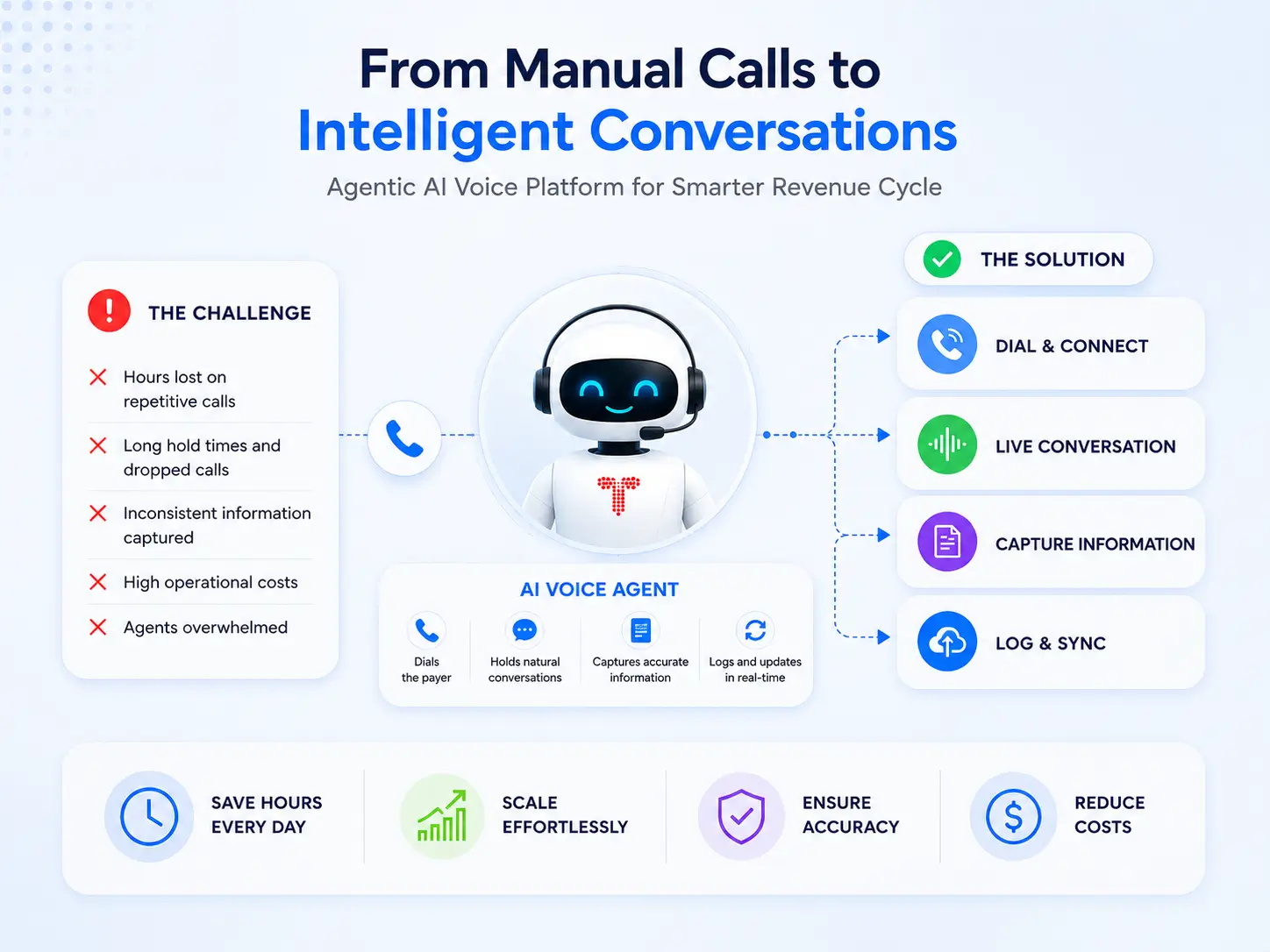
An outbound calling platform that replaces manual claim status calls with AI voice agents. Built for a US-based healthcare revenue cycle management (RCM) company, the system places calls to insurance payers, holds real-time conversations, and captures claim status, denial reasons, and authorization details without a human on the line.
Objective
The client's revenue cycle team was burning hours every day calling payers to check claim status, chase prior authorizations, and confirm eligibility. They needed a way to run this volume of calls without scaling headcount, while keeping the data captured from each call accurate and consistent across payers. Trigma built an agentic AI voice platform that takes over the call itself: dialling, holding a live conversation, and logging the outcome.
Challenges

Manual, Labour-Heavy Claim Follow-Up
Revenue cycle teams spent hours daily on payer calls for claim status updates, driving long call queues, high labour costs, and slow turnaround on every claim.

Inconsistent Data Capture Across Payers
Human agents on repetitive calls missed payer-specific details, denial reasons, pending documents, and adjustment codes, especially under fatigue or when unfamiliar with a payer's process.

Scalability Bottlenecks at Month-End
Call volume spikes during billing cycles, but a human team can't scale up and down on demand, so claim status checks and authorization calls back up during peak periods.

Delayed Authorizations and Eligibility Checks
Long hold times and manual back-and-forth with payers slowed down real-time benefits verification and prior authorization approvals.

Fragmented Tooling
Calls, notes, claim tracking, and reporting lived in separate systems, creating data silos and making it hard to see the full picture of a claim's status.

Our Solution
Trigma built a HIPAA-compliant, agentic AI platform that owns the entire outbound call lifecycle, from dialling to data capture to reporting.

Agentic AI conversation engine.
A GPT-4-powered agent runs the call: asking questions, handling follow-ups, rephrasing when needed, and confirming details back to the payer, the way a trained human agent would.
Automated outbound dialling.
Calls run through Twilio's PSTN network, with webhooks handling call status updates, failure tracking, and escalations automatically.
Real-time speech processing.
Amazon Transcribe converts payer speech to text as the call happens; Amazon Polly turns the AI's responses into natural-sounding speech, keeping response latency under a second.
Parallel batch calling.
Batches of thousands of claims run as separate concurrent call threads, so the system can work through a full claims backlog instead of one call at a time.
Kubernetes-based auto-scaling.
Containerized microservices scale up automatically with call volume and AI/STT/TTS processing load, so month-end spikes don't create backlogs.
Role-based access and monitoring.
Super Admins, Operations Managers, and User Collectors each get a scoped view: live call status, transcripts, recordings, and batch controls to pause, stop, or retry calls in progress.
Technology Stack
Telephony & Call Execution
 Twilio API
 Azure Communication Services
 Twilio API
 Azure Communication Services
AI Engine
 OpenAI GPT-4
 OpenAI GPT-4
Speech Processing
 Amazon Transcribe (STT)
- Amazon Polly (TTS)
 Amazon Transcribe (STT)
Backend
 Node.js
 GraphQL
- Python
 Node.js
 GraphQL
 Python
Frontend
 Angular
 Angular
Databases
 SQL + NoSQL
 SQL + NoSQL
 Infrastructure
 Kubernetes (auto-scaling, load balancing))
 Kubernetes (auto-scaling, load balancing))
Job Scheduling
- ThreadPoolExecutor for parallel batch execution
Cloud Storage
- AWS S3 (call recordings, transcripts)
Security
 Role-Based Access Control
 JWT bearer token validation
 Role-Based Access Control
 JWT bearer token validation
Platform Features

Voice AI Dashboard
Live view of total calls, outgoing calls, in-progress and active calls, plus trend charts for outbound call volume, connection rate, and concurrent call load.

Call Dialer
Up to three simultaneous Twilio lines per user, each with its own caller ID and call script, plus a running log of every call's direction, status, duration, and recording.

Batch Management
Create, search, and restart call batches by client, with live counts of total claims versus completed calls per batch.

Batch Reports
Filterable history of every batch run, by date range, status, and client, showing who executed each batch and its outcome.

Role-based views
- Super Admin: manages teams, users, and platform-wide settings.
- Operations Manager: monitors live call volume, system health, and call flow in real time.
- User Collector: runs assigned batches and works the call dialer directly.
Outcomes
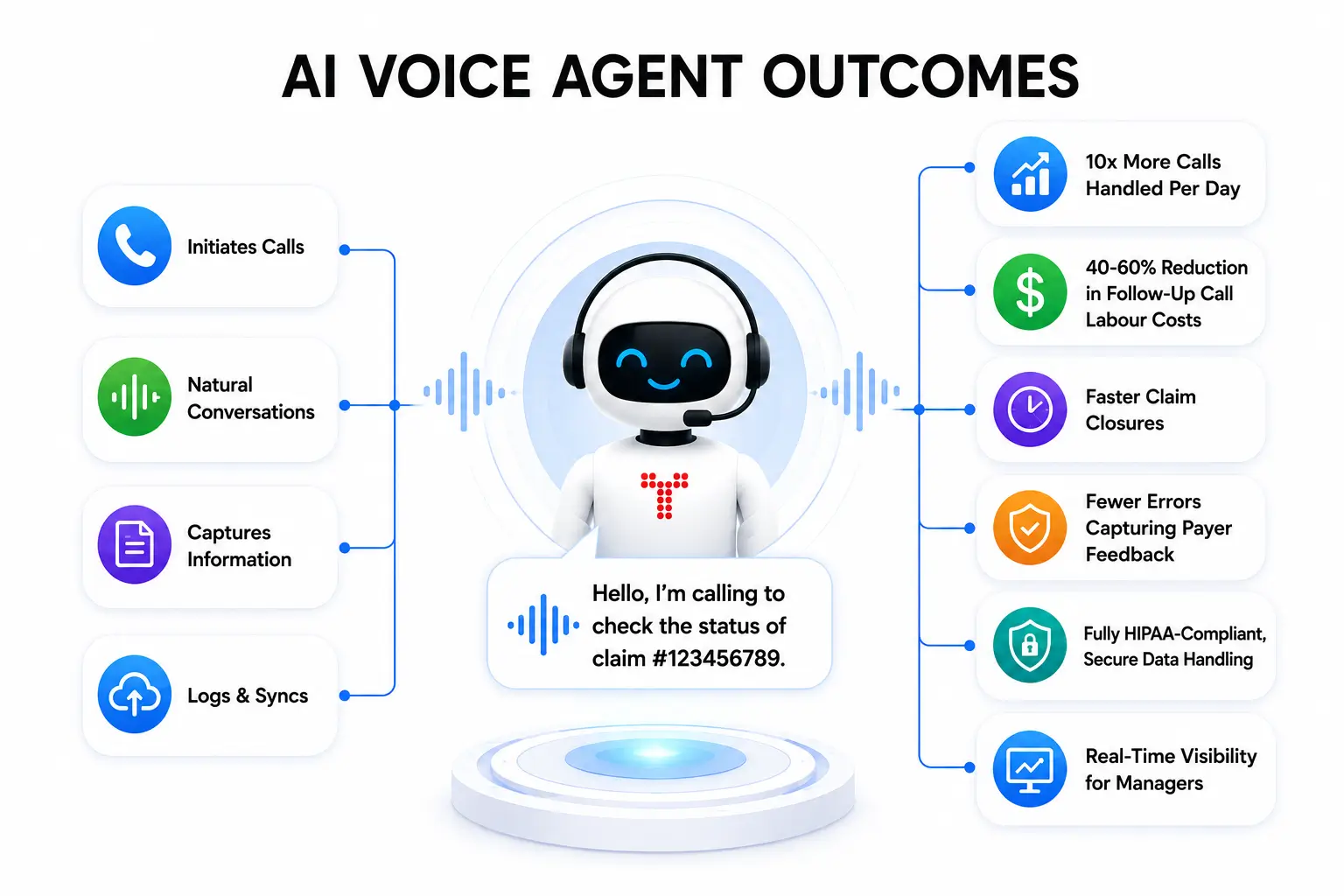
10x
more calls handled per day with the same team size
40-60%
reduction in follow-up call labour costs
- Faster claim closures and improved cash flow
- Fewer errors capturing payer feedback and denial reasons
- Fully HIPAA-compliant, secure data handling throughout
- Real-time visibility for managers tracking claim follow-ups as they happen
What the Client Says
We had a real problem with claim follow-up: a large team making manual calls to payers just to check claim status. We wanted an AI agent to take that on, and that's what brought us to Trigma. They dug into the problem and mapped out a real path to fixing it. The platform is still in its early phase, we've just wrapped phase one, but it's already a solid foundation, and we're planning several more phases ahead.
Product Manager, US-based Healthcare RCM Company


