+91-98558-85133
 +1(702)760-3099

60-Second Summary
- Most AI agents fail in production not because of the model, but because the architecture is wrong.
- Agentic AI architecture gives AI systems the ability to perceive, reason, remember, and act autonomously without constant human oversight.
- Core components like memory, tool execution, decision-making engine, and orchestration are what transform a basic AI model into a truly intelligent agent.
- Design patterns like single-agent, multi-agent, hierarchical, ReAct, and plan-and-execute each serve different levels of task complexity, picking the right one is everything.
- Trigma helps enterprises design and build agentic AI systems with the right architecture so you build once and scale confidently.
Most AI models fail in production not because they’re bad, but because the architecture is wrong. From designing single-agent loops to multi-agent systems, every design pattern you choose should be mapped to real frameworks and enterprise use cases.
This means every business wants to build agents but building agents that actually work is the real challenge. That's where AI agent architecture comes in.
It makes agentic AI systems smarter, helps them maintain context through conversations, make decisions through reasoning engines, and orchestrate with external tools to solve complex tasks.
Let's deep dive into this blog to understand what AI agent architecture is, its components, and the design patterns that speed up the AI agent development process.
An Overview of AI Agent Architecture
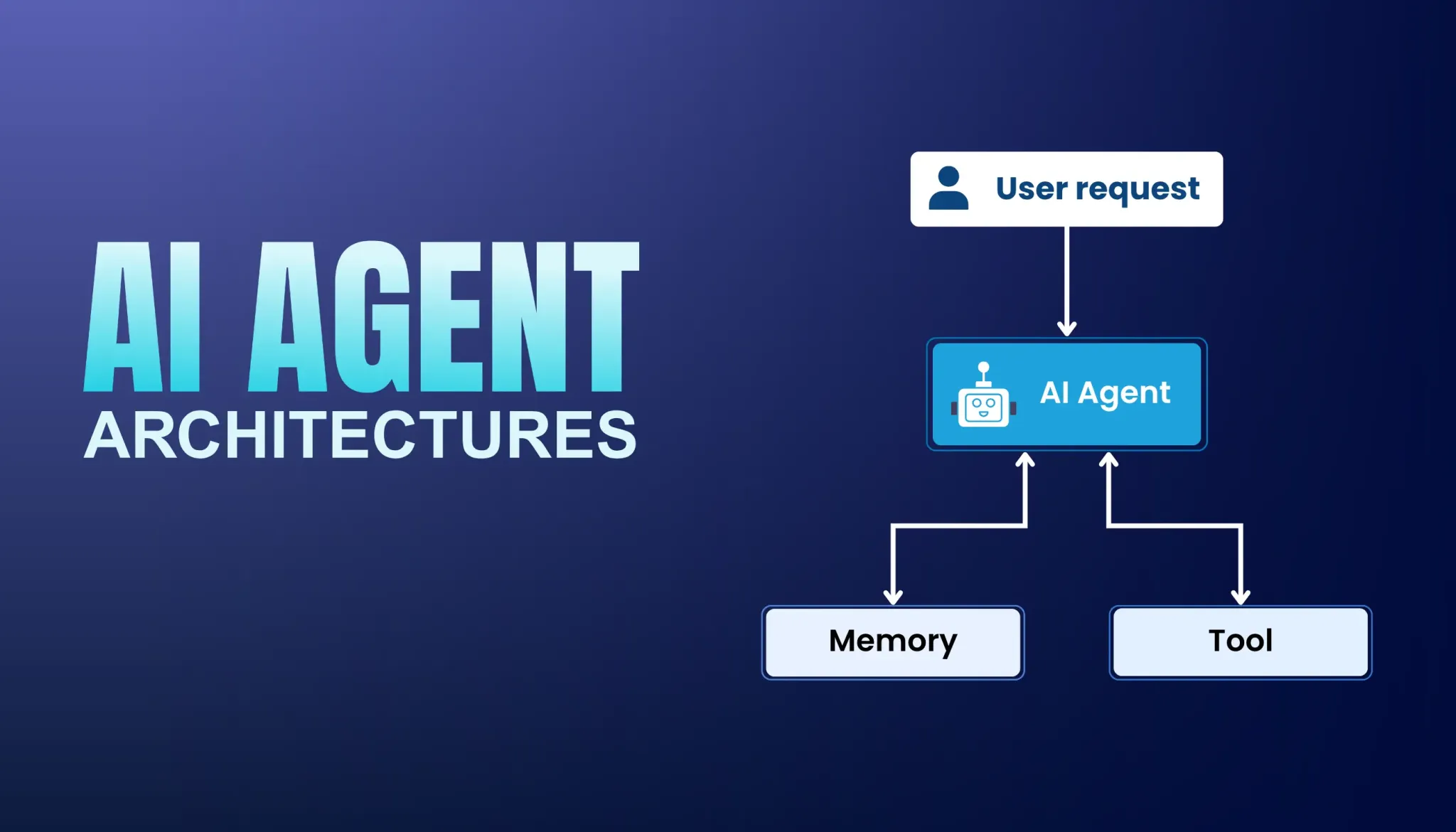
AI agent architecture is a structured and highly intelligent design framework that allows AI systems to act autonomously such as perceiving, reasoning, and acting independently to make goal-driven decisions without human oversight.
Just like humans, AI systems can think and operate with memory, have planning capabilities, and use tools to solve real-world problems effectively.
This architecture creates systems that don't just follow instructions but actually reason through challenges and learn from experience.
AI Agent = Perception + Memory + Tools + Decision-Making + Action
Core Components That Power AI Agent Architecture
Here's a breakdown of each component that transforms a stateless AI model into an agentic system that thinks, acts autonomously, and remembers conversations.
1. Perception
The agent processes inputs (such as text, voice, API calls, and sensor data) from the environment through multiple channels. This component handles language through NLP and visual data through computer vision technology.
It turns raw data into structured information, making it easier for agents to interpret their surroundings and act upon them.
2. Memory
Memory allows agents to maintain continuity across interactions. Agents never start from scratch, as they have knowledge built up over time by storing past experiences and observations to understand context and improve performance.
Result?
Memory turns AI from reactive to proactive.
Without memory, an AI agent would treat every conversation as completely new.
3. Tool Execution
Tools are the suite of capabilities that connect AI agents to external systems, APIs, and databases. These include document analysis, vector search, image analysis, web browsing, and text generation.
Since large language models can't directly access databases, APIs, or the internet, tool execution acts as a bridge between the AI's reasoning and external capabilities.
For example, if a user asks the LLM, "What's the weather today?". The agent uses a weather API (the tool needed) that is integrated into its reasoning before generating the final response.
4. Decision-Making Engine
Once the AI agent analyzes information and observes the environment, it decides what action to take and how to achieve the goal step by step.
The decision-making engine is powered by LLMs and reinforcement learning mechanisms.
5. Orchestration and State Management
Orchestration connects the different components and determines the order in which tasks happen. Tools such as LangGraph help manage complex AI workflows where multiple AI agents work together.
This tool supports features such as saving progress, resuming from checkpoints, and adding human intervention when needed.
This makes complex workflows easier to debug and more reliable for multi-step applications.
6. Action Module
The action module handles the actual execution of tasks the agent needs to carry out. These include interacting with a user interface, calling APIs, triggering system changes, or interacting with other platforms.
7. Communication Interface
A communication interface lets an agent talk to users, other agents, or external systems. This is especially important in multi-agent systems, where different agents need to share tasks, coordinate actions, and solve problems together.
Agents communicate using tools such as APIs, real-time messages, and webhooks to exchange data and work toward a common goal.
Design Patterns in Agentic Architecture
Understanding design patterns becomes critical for handling complexity, scaling systems, and ensuring that agents behave intelligently across different use cases.
These design patterns act as the backbone of agent architectures, helping teams connect capabilities such as reasoning, planning, situational awareness, and real-time data handling.
1. Single Agent Systems
Single-agent systems use one autonomous agent to complete a specific task or workflow. These design patterns are mostly used in environments where tasks are clearly defined and there are few external dependencies.
These agents are designed for scenarios where one AI agent handles everything such as personal productivity tools, automated research assistants, or microservices.
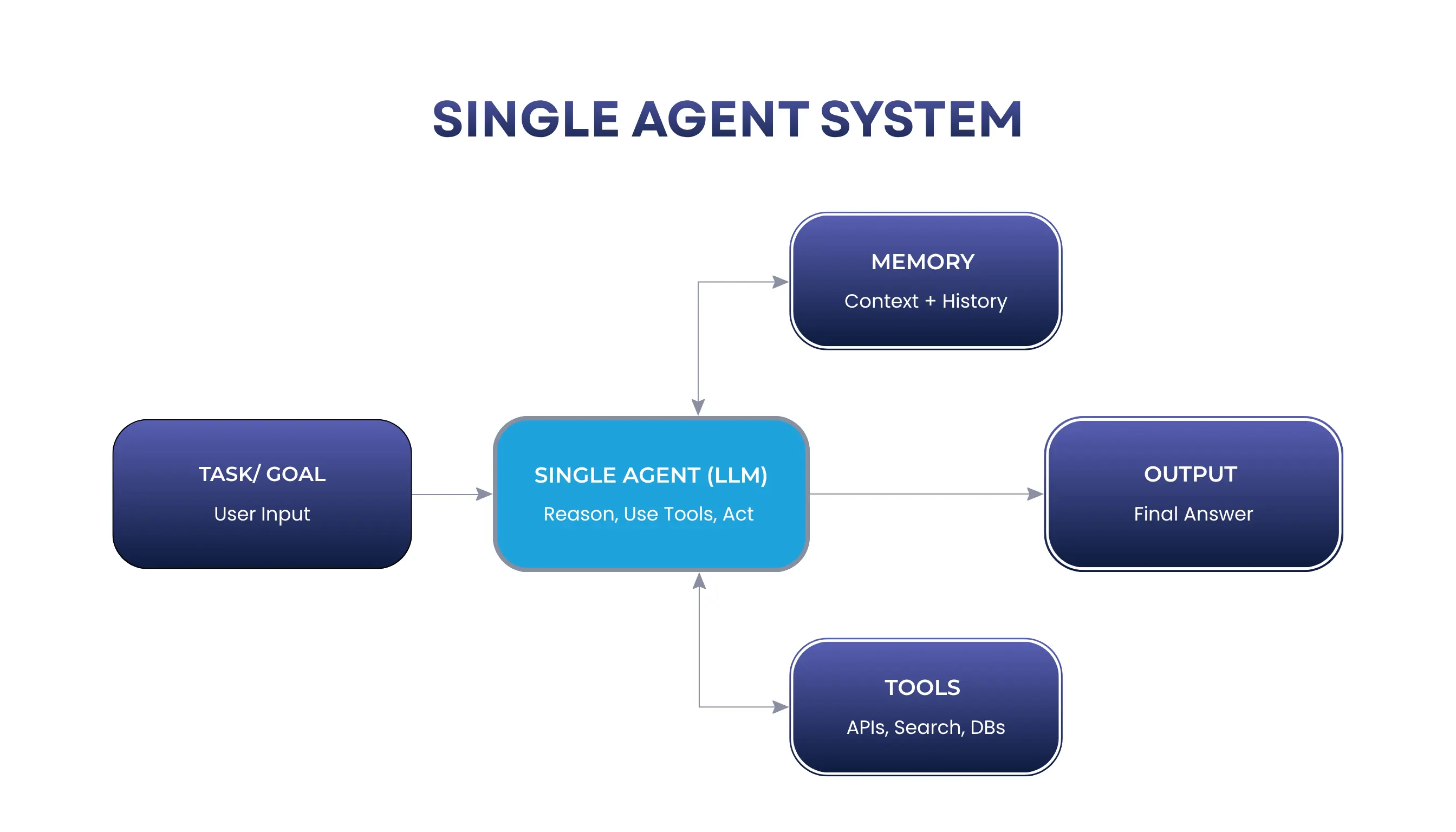
However, single-agent systems may struggle with complex tasks.
2. Multi-Agent Systems
Multi-agent system architecture involves multiple agents working autonomously, each with a unique role and set of capabilities, to achieve shared or individual goals.
This type of architecture works best when tasks are truly independent and parallelizable otherwise, coordination costs will outweigh the benefits.
The defining trait of this architecture is interoperability between agents. They must communicate, share information, negotiate, and assign tasks.
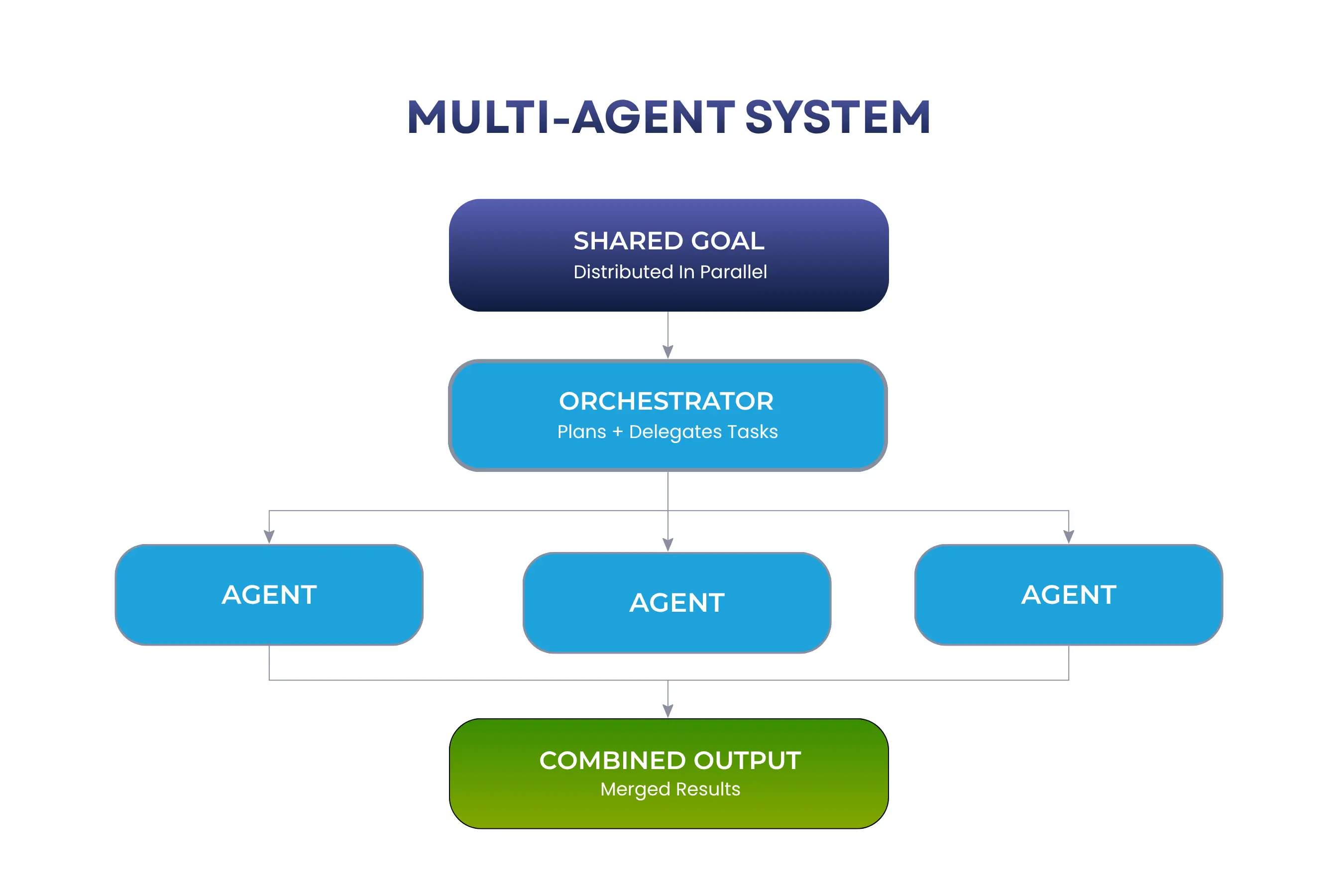
Use cases include smart grid management, collaborative robotics, and distributed business process automation.
3. Hierarchical Structure
In hierarchical agentic models, agents are organized in tree-like structures where higher-level agents (supervisor agents) control lower-level ones. Higher-level agents make strategic decisions and handle long-term planning, while lower-level agents handle tactical decisions.
In this architecture, the supervisor agent controls and coordinates several specialized agents. It receives a query, decides which agent should handle it, and passes the task to the appropriate agent.
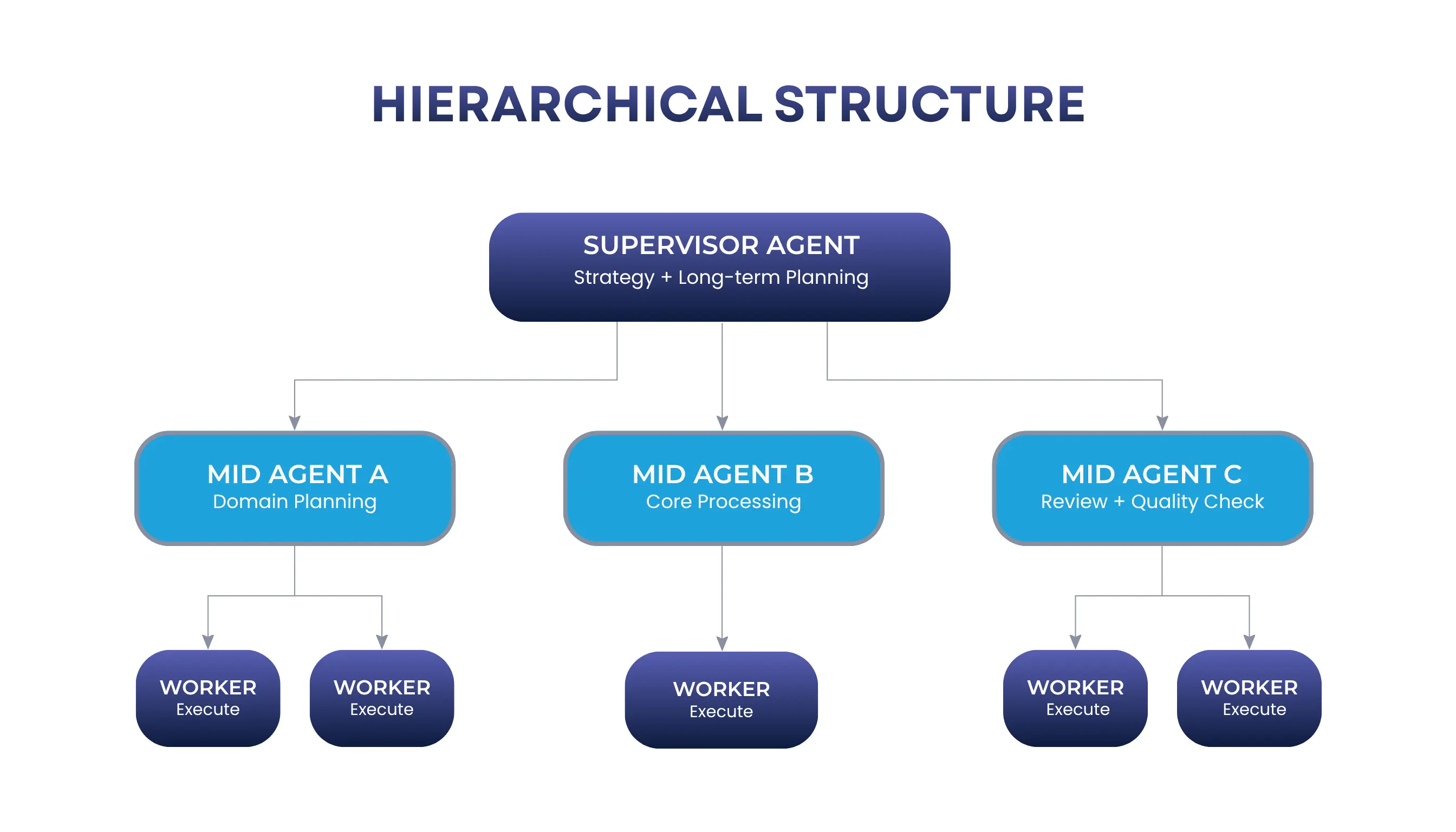
Example
A top-tier agent handles tasks related to product strategy, while mid- and lower-tier agents take care of marketing campaigns and customer outreach.
4. Hybrid Model
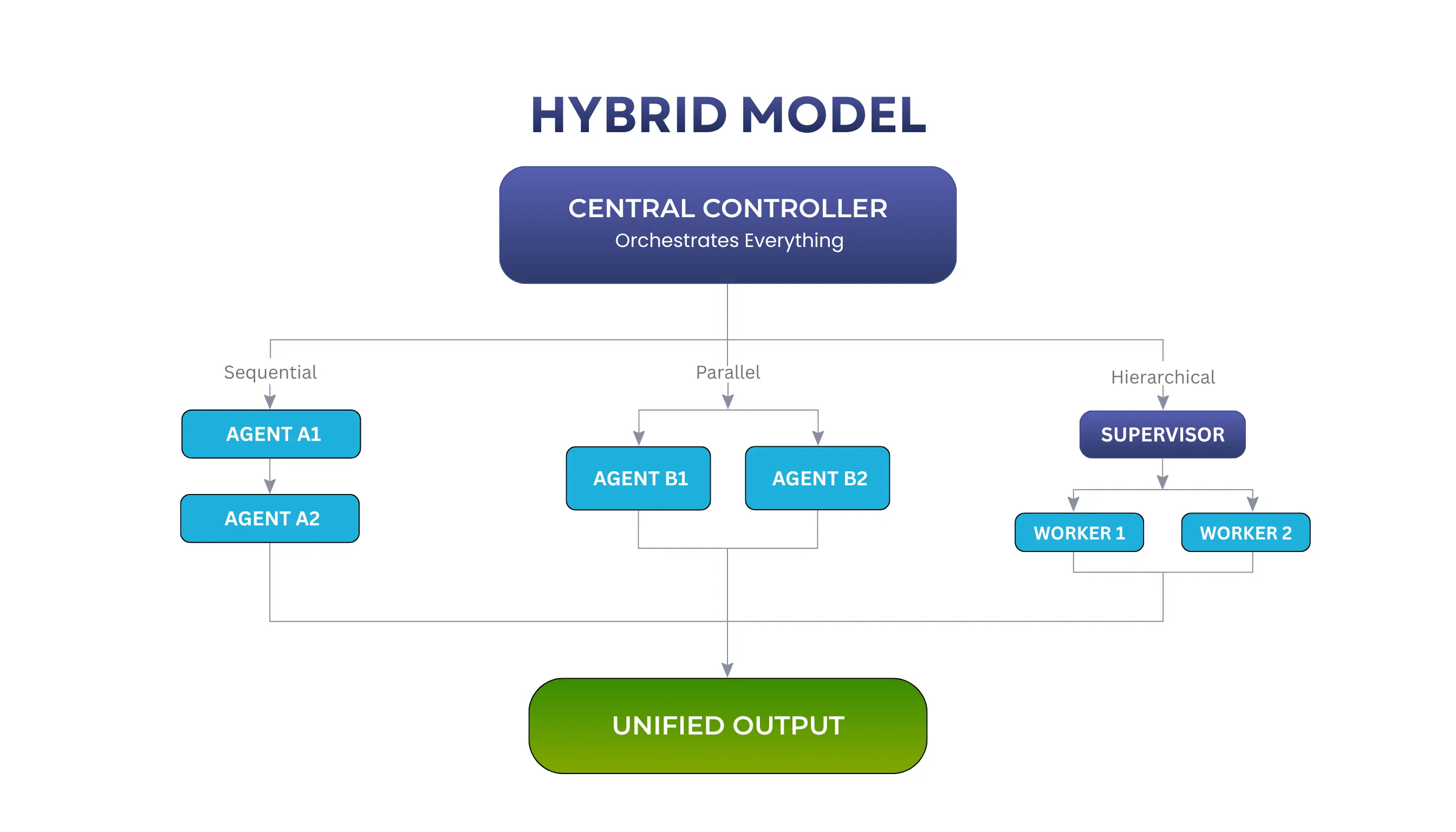
Hybrid agents combine single-agent, multi-agent, and hierarchical design structures. These are primarily used for large or enterprise systems that need both independent agents and centralized control.
5. ReAct Agents
ReAct architecture stands for Reason and Act. These design patterns are suited for tasks that require step-by-step thinking.
Instead of producing an answer all at once, the AI enters a loop like reasoning about what needs to be done next, and then acting on that reasoning by using a tool.
When given a question, it follows a cycle of thought, action, and observation repeating this framework until it arrives at the right answer. Rather than guessing, the agent behaves like an investigator.
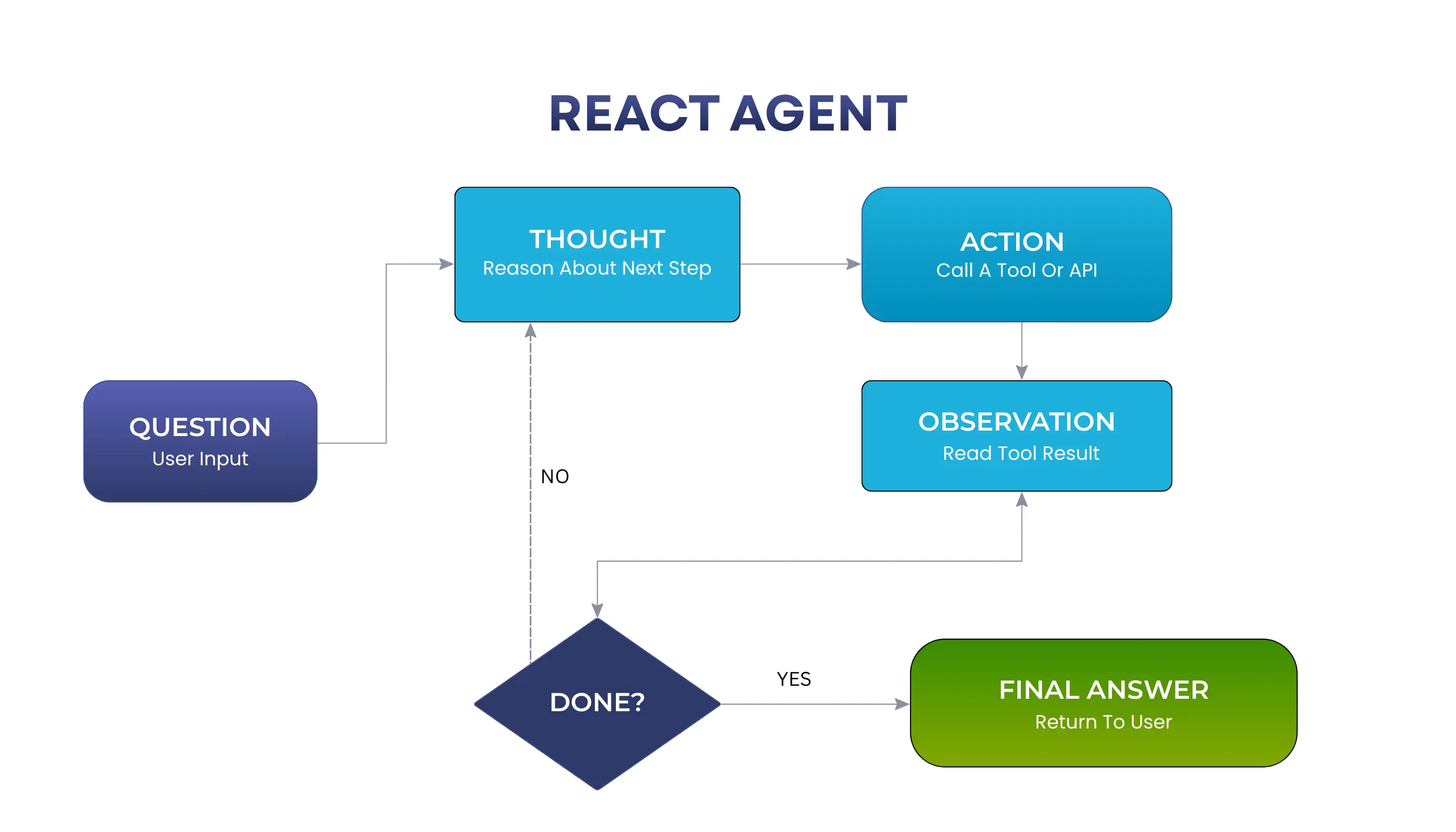
If something goes wrong such as a tool failing or returning unexpected results, the agent can adjust its approach accordingly.
However, this agentic AI architecture consumes more tokens, making costs unpredictable.
6. Plan and Execute Agents
A plan-and-execute agent is an AI system designed to solve complex tasks by first generating a structured plan, then executing each step independently.
It works by understanding the user's request or goal, breaking it down into steps, and executing each one.
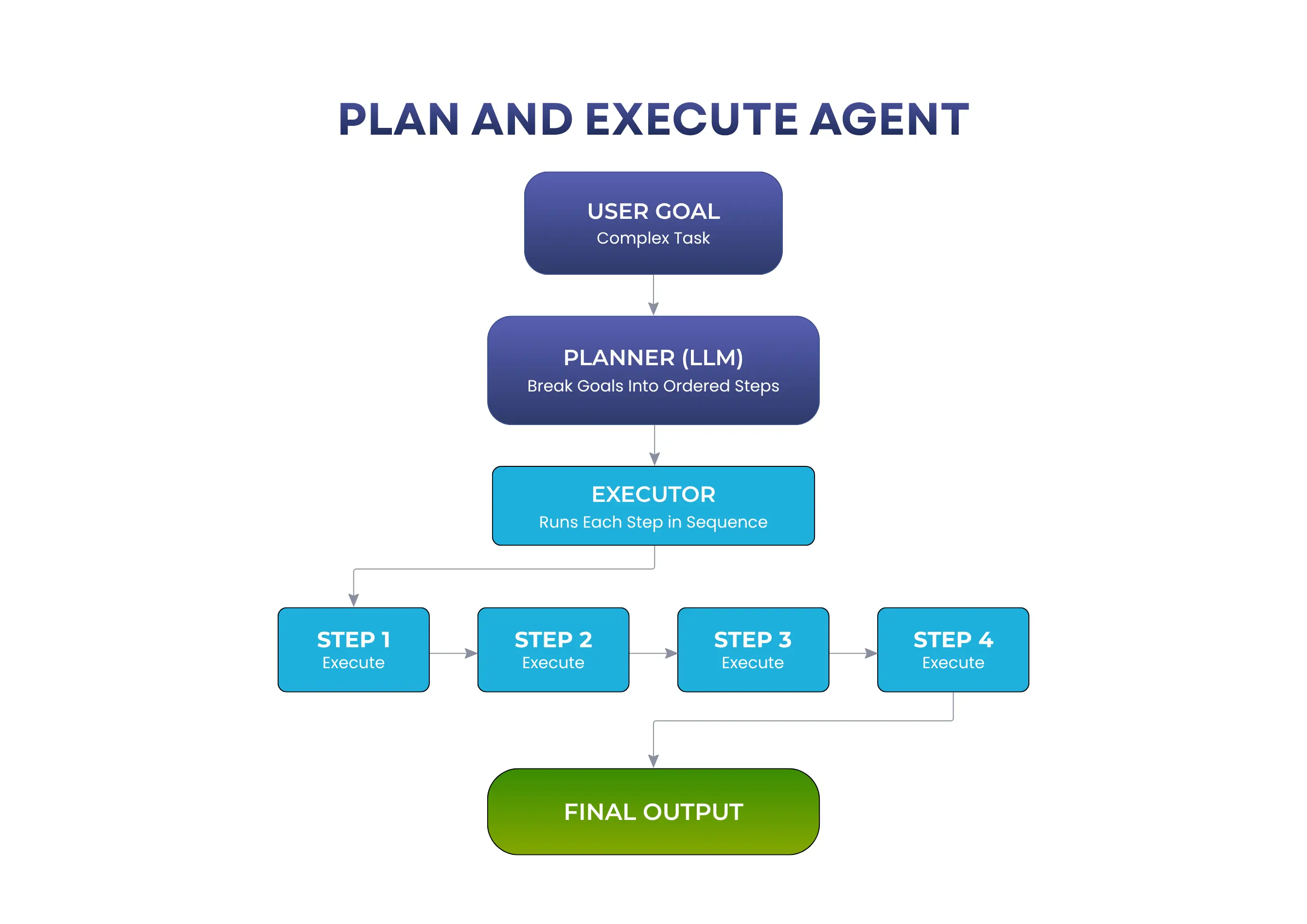
Throughout execution, the agent handles unexpected situations dynamically if things don't go as planned.
This makes these agents faster and more cost-predictable, since they don't rethink the plan after every step.
Downside
If the initial plan is flawed or circumstances change mid-execution, the agent can fail if it isn't able to adjust easily.
How Trigma Can Help You Build Autonomous AI Agents?
Agentic AI architecture is more than just a blueprint or template; it's an approach to building intelligent agents that can reason, remember, and act across tools and environments.
While design patterns continue to emerge, we'd advise you to focus on your use case and the problem you're solving first, then select the design pattern that fits so you can build an agent without rebuilding everything from scratch.
At Trigma, we help you design intelligent systems such as agentic AI that interacts across everything, orchestrates everything, has a reasoning engine for language understanding and decision support, and creates business value by taking action.
Still Have Questions About AI Agent Architecture?
We'll answer your specific questions and help you find the right starting point.
FAQs
What does a production-ready AI agent architecture look like?
An enterprise agent architecture includes the following layers: interface layer, reasoning layer, memory layer, tool layer, and orchestration layer.
Should enterprises use single-agent or multi-agent architecture?
It depends on system complexity. Single-agent architecture is best for single workflows, limited tasks, and internal assistants like customer support agents.
Multi-agent architectures are better suited for complex systems where tasks require specialization. For example, a research agent or data analysis agent.
What is the cost of running AI agents?
The cost of running an AI agent depends on four areas: model inference (LLM tokens), infrastructure, data storage, and one-time development costs.