performance icon
Top IT Services Company 2025 Top Software Developers 2025 Top Generative AI Company 2025 G2 High Performer Winter 2025 G2 Leader Winter 2025 AI Deployment Company 2024 Top Software Development Company in USA for 2024 Top ReactJs Company in USA for 2024
trigma-logo

AI Agent Architecture: Scalable Multi-Agent Design Patterns

60-Second Summary

  • Most AI agents fail in production not because of the model, but because the architecture is wrong.
  • Agentic AI architecture gives AI systems the ability to perceive, reason, remember, and act autonomously without constant human oversight.
  • Core components like memory, tool execution, decision-making engine, and orchestration are what transform a basic AI model into a truly intelligent agent.
  • Design patterns like single-agent, multi-agent, hierarchical, ReAct, and plan-and-execute each serve different levels of task complexity, picking the right one is everything.
  • Trigma helps enterprises design and build agentic AI systems with the right architecture so you build once and scale confidently.

Most AI models fail in production not because they’re bad, but because the architecture is wrong. From designing single-agent loops to multi-agent systems, every design pattern you choose should be mapped to real frameworks and enterprise use cases.

This means every business wants to build agents but building agents that actually work is the real challenge. That's where AI agent architecture comes in.

It makes agentic AI systems smarter, helps them maintain context through conversations, make decisions through reasoning engines, and orchestrate with external tools to solve complex tasks.

Let's deep dive into this blog to understand what AI agent architecture is, its components, and the design patterns that speed up the AI agent development process.

An Overview of AI Agent Architecture

AI agent architecture is a structured and highly intelligent design framework that allows AI systems to act autonomously such as perceiving, reasoning, and acting independently to make goal-driven decisions without human oversight.

Just like humans, AI systems can think and operate with memory, have planning capabilities, and use tools to solve real-world problems effectively.

This architecture creates systems that don't just follow instructions but actually reason through challenges and learn from experience.

AI Agent = Perception + Memory + Tools + Decision-Making + Action

Core Components That Power AI Agent Architecture

Here's a breakdown of each component that transforms a stateless AI model into an agentic system that thinks, acts autonomously, and remembers conversations.

1. Perception

The agent processes inputs (such as text, voice, API calls, and sensor data) from the environment through multiple channels. This component handles language through NLP and visual data through computer vision technology.

It turns raw data into structured information, making it easier for agents to interpret their surroundings and act upon them.

2. Memory

Memory allows agents to maintain continuity across interactions. Agents never start from scratch, as they have knowledge built up over time by storing past experiences and observations to understand context and improve performance.

Result?

Memory turns AI from reactive to proactive.

Without memory, an AI agent would treat every conversation as completely new.

3. Tool Execution

Tools are the suite of capabilities that connect AI agents to external systems, APIs, and databases. These include document analysis, vector search, image analysis, web browsing, and text generation.

Since large language models can't directly access databases, APIs, or the internet, tool execution acts as a bridge between the AI's reasoning and external capabilities.

For example, if a user asks the LLM, "What's the weather today?".  The agent uses a weather API (the tool needed) that is integrated into its reasoning before generating the final response.

4. Decision-Making Engine

Once the AI agent analyzes information and observes the environment, it decides what action to take and how to achieve the goal step by step.

The decision-making engine is powered by LLMs and reinforcement learning mechanisms.

5. Orchestration and State Management

Orchestration connects the different components and determines the order in which tasks happen. Tools such as LangGraph help manage complex AI workflows where multiple AI agents work together.

This tool supports features such as saving progress, resuming from checkpoints, and adding human intervention when needed.

This makes complex workflows easier to debug and more reliable for multi-step applications.

6. Action Module

The action module handles the actual execution of tasks the agent needs to carry out. These include interacting with a user interface, calling APIs, triggering system changes, or interacting with other platforms.

7. Communication Interface

A communication interface lets an agent talk to users, other agents, or external systems. This is especially important in multi-agent systems, where different agents need to share tasks, coordinate actions, and solve problems together.

Agents communicate using tools such as APIs, real-time messages, and webhooks to exchange data and work toward a common goal.

Design Patterns in Agentic Architecture

Understanding design patterns becomes critical for handling complexity, scaling systems, and ensuring that agents behave intelligently across different use cases.

These design patterns act as the backbone of agent architectures, helping teams connect capabilities such as reasoning, planning, situational awareness, and real-time data handling.

1. Single Agent Systems

Single-agent systems use one autonomous agent to complete a specific task or workflow. These design patterns are mostly used in environments where tasks are clearly defined and there are few external dependencies.

These agents are designed for scenarios where one AI agent handles everything such as personal productivity tools, automated research assistants, or microservices.

Single Agent System diagram showing Task Goal as user input flowing into a Single Agent LLM that uses Memory for context and Tools like APIs and databases to produce a Final Output

However, single-agent systems may struggle with complex tasks.

2. Multi-Agent Systems

Multi-agent system architecture involves multiple agents working autonomously, each with a unique role and set of capabilities, to achieve shared or individual goals.

This type of architecture works best when tasks are truly independent and parallelizable otherwise, coordination costs will outweigh the benefits.

The defining trait of this architecture is interoperability between agents. They must communicate, share information, negotiate, and assign tasks.

Multi-Agent System diagram showing a Shared Goal distributed by an Orchestrator to three parallel specialized agents that merge results into a Combined Output

Use cases include smart grid management, collaborative robotics, and distributed business process automation.

3. Hierarchical Structure

In hierarchical agentic models, agents are organized in tree-like structures where higher-level agents (supervisor agents) control lower-level ones. Higher-level agents make strategic decisions and handle long-term planning, while lower-level agents handle tactical decisions.

In this architecture, the supervisor agent controls and coordinates several specialized agents. It receives a query, decides which agent should handle it, and passes the task to the appropriate agent.

Hierarchical Agent Structure showing a Supervisor Agent at the top delegating strategy and planning tasks to Mid Agents A, B, and C, who assign execution tasks to Worker agents below

Example

A top-tier agent handles tasks related to product strategy, while mid- and lower-tier agents take care of marketing campaigns and customer outreach.

4. Hybrid Model

Hybrid agents combine single-agent, multi-agent, and hierarchical design structures. These are primarily used for large or enterprise systems that need both independent agents and centralized control.

Hybrid AI Agent Model diagram showing a Central Controller routing tasks through three patterns — Sequential agents A1 to A2, Parallel agents B1 and B2, and a Hierarchical Supervisor with Worker 1 and Worker 2 — all converging into a Unified Output

5. ReAct Agents

ReAct architecture stands for Reason and Act. These design patterns are suited for tasks that require step-by-step thinking. 

Instead of producing an answer all at once, the AI enters a loop like reasoning about what needs to be done next, and then acting on that reasoning by using a tool.

When given a question, it follows a cycle of thought, action, and observation repeating this framework until it arrives at the right answer. Rather than guessing, the agent behaves like an investigator.

ReAct Agent flowchart showing a Question as user input leading into a Thought-Action-Observation reasoning loop, with a Done decision node that routes to Final Answer on YES or loops back on NO

If something goes wrong such as a tool failing or returning unexpected results, the agent can adjust its approach accordingly.

However, this agentic AI architecture consumes more tokens, making costs unpredictable.

6. Plan and Execute Agents

A plan-and-execute agent is an AI system designed to solve complex tasks by first generating a structured plan, then executing each step independently.

It works by understanding the user's request or goal, breaking it down into steps, and executing each one.

Plan and Execute Agent diagram showing User Goal flowing into a Planner LLM that breaks the goal into ordered steps, an Executor that runs Step 1 through Step 4 in sequence, and a Final Output

Throughout execution, the agent handles unexpected situations dynamically if things don't go as planned.

This makes these agents faster and more cost-predictable, since they don't rethink the plan after every step.

Downside

If the initial plan is flawed or circumstances change mid-execution, the agent can fail if it isn't able to adjust easily.

How Trigma Can Help You Build Autonomous AI Agents?

Agentic AI architecture is more than just a blueprint or template; it's an approach to building intelligent agents that can reason, remember, and act across tools and environments.

While design patterns continue to emerge, we'd advise you to focus on your use case and the problem you're solving first, then select the design pattern that fits so you can build an agent without rebuilding everything from scratch.

At Trigma, we help you design intelligent systems such as agentic AI that interacts across everything, orchestrates everything, has a reasoning engine for language understanding and decision support, and creates business value by taking action.

Still Have Questions About AI Agent Architecture?

We'll answer your specific questions and help you find the right starting point.

FAQs

What does a production-ready AI agent architecture look like?

An enterprise agent architecture includes the following layers: interface layer, reasoning layer, memory layer, tool layer, and orchestration layer.

Should enterprises use single-agent or multi-agent architecture?

It depends on system complexity. Single-agent architecture is best for single workflows, limited tasks, and internal assistants like customer support agents.

Multi-agent architectures are better suited for complex systems where tasks require specialization. For example, a research agent or data analysis agent.

What is the cost of running AI agents?

The cost of running an AI agent depends on four areas: model inference (LLM tokens), infrastructure, data storage, and one-time development costs.

What are Large Language Models (LLMs)?

Over the last decade, artificial intelligence has undergone a massive transformation. Innovation has moved away from determined rule engines, chatbots, and machine learning models into a new era of generative intelligence, enabling systems that are capable of reasoning across various domains and producing human-like responses.

At the center of this transformation lies the Large Language Models (LLMs). LLMs aren’t just an upgrade to Natural Language Processing (NLP), it’s a paradigm shift in how machines understand, generate, and interact with human language. From powering conversational agents to coding copilots, knowledge retrieval, and agentic AI systems, LLMs have become the foundational layer of modern artificial intelligence.

This blog provides a comprehensive explanation of what LLM models are, how they work, and what actually differentiates them from traditional AI systems.

Large Language Models (LLMs) Explained

A large language model is a deep learning model trained on massive volumes of textual data to understand, predict, and generate language learning based on probability patterns. By adapting massive datasets and billions of parameters, LLMs have transformed the way humans interact with technology. LLMs are trained on data that has been gathered from the internet, and crawlers continue to crawl the web for more in-depth research content.

LLMs particularly use a type of machine learning called deep learning in order to understand how words, characters, and sentences work together. Deep learning involves probabilistic modeling of unstructured data to learn language patterns at scale. Model performance is further improved through fine-tuning or prompt engineering, depending on the use case.

Modern LLMs include ChatGPT, Google Gemini, and Claude.

What are Large Language Models Used For?

Below are the most prominent relevant use cases of LLMs.

01. Conversational AI and intelligent agents

Conversational intelligence is one of the most common applications of LLMs. Assistants powered by LLMs are capable of multi-turn contextual reasoning, semantic memory retention, and dynamic response generation. These systems are therefore used in enterprise customer support platforms, internal IT helpdesks, AI copilots for SaaS products, and voice-enabled agents integrated with backend systems.

02. Code generation and automation

In an engineering environment, LLMs are used for code generation in multiple programming languages, bug detection, and testing. These capabilities are embedded within IDE copilots, CI/CD pipelines, and low-code or no-code platforms. By modelling programming languages into structured systems, LLMs significantly reduce cognitive load for developers and deliver without compromising quality.

03. Contextual intelligence

LLMs are widely used for content generation. Whether it’s technical documentation and whitepapers, marketing and brand narrative generation, legal and policy drafting, or financial summaries, LLM adapts tone, structure, and depth dynamically, enabling context-sensitive content generation aligned with brand voice and domain constraints.

04. Automation of business workflows

LLMs play a crucial role in intelligent process automation. When LLMs are integrated with robotic process automation, workflow orchestration tools, and agentic AI frameworks, they deliver contextual decisions, trigger downstream actions, and coordinate across multiple tools & systems.

How Do Large Language Models Work?

To understand how LLMs work, it’s equally important to know the technological foundations they are built on. Here is an in depth explanation of the working.

1. Machine learning: Teaching systems through data

If we talk at the most fundamental level, LLMs are powered by machine learning, a branch of artificial intelligence focused on learning patterns from data rather than relying on programmed rules.

Machine learning systems are exposed to enormous volumes of text and allowed to identify recurring patterns, detect relationships between symbols, and learn statistical regularities on their own.

2. Deep learning: Learning through probability

Deep learning is a more advanced form of machine learning designed to handle complex, high-dimensional data like language. These models learn by observing how patterns occur, estimating probabilities of what occurs next, and continuously refining predictions over time.  

Over time, this enables LLMs to generate better answers to the queries and become exceptionally good at predicting language that behaves like humans.

3. Neural networks: Core of LLMs

To support the contextual level of learning, LLMs are built using artificial neural networks. A neural network consists of an input layer where data enters, multiple hidden layers where patterns are learned, and an output layer where all predictions are generated. 

Each layer processes information and passes it forward when certain activation thresholds are met. As data moves through the networks, it thus transforms into meaningful representations. 

4. Transformer models: Learning the deep context

Like Google, you get the results instantly, and that too personalised as per your query. This is because of transformer architectures. Language is inherently contextual, and the meaning of a word often depends entirely on the words around it, the sentence structure, and the broader conversation. Transformer models address this through a mechanism called self-attention. 

Self-attention allows the model to examine all the words in a sentence at the same time, determine which words are most relevant to each other, and understand how meaning changes based on context. This capability enables LLMs to connect ideas across long passages, understand how sentences relate to each other, and recognize how different sentences influence each other.

That’s how a user gets a response to their query based on intent and contextual understanding. As transformer models are trained on massive datasets, they develop a strong ability to associate words, phrases, and concepts based on how they appear together across millions of examples. 

The combination of machine learning foundations, deep learning, neural network architectures, and transformer-based contextual understanding allows LLMs to function as powerful language intelligence systems rather than simple text predictors. This is the reason why LLMs are capable of adapting to new tasks and topics.

Transform Your Business with Expert AI Integration

Unlock automation, improve efficiency, and accelerate growth with custom AI solutions built specifically for your business.

Retrieval-Augmented Generation (RAG) and Tool-Augmented LLMs

While large language models are trained on static datasets, real-world applications often require access to up-to-date or domain-specific information. Retrieval-Augmented Generation (RAG) addresses this by connecting LLMs to external knowledge sources at inference time, allowing relevant data to be retrieved and added into the prompt before generating a response. This grounding significantly improves accuracy and reduces hallucinations.

In addition, modern LLM systems are frequently enhanced with tool augmentation, enabling models to interact with external APIs, execute functions, or trigger workflows. Together, RAG and tool augmentation make LLM applications more reliable, context-aware, and suitable for production-grade enterprise use cases.

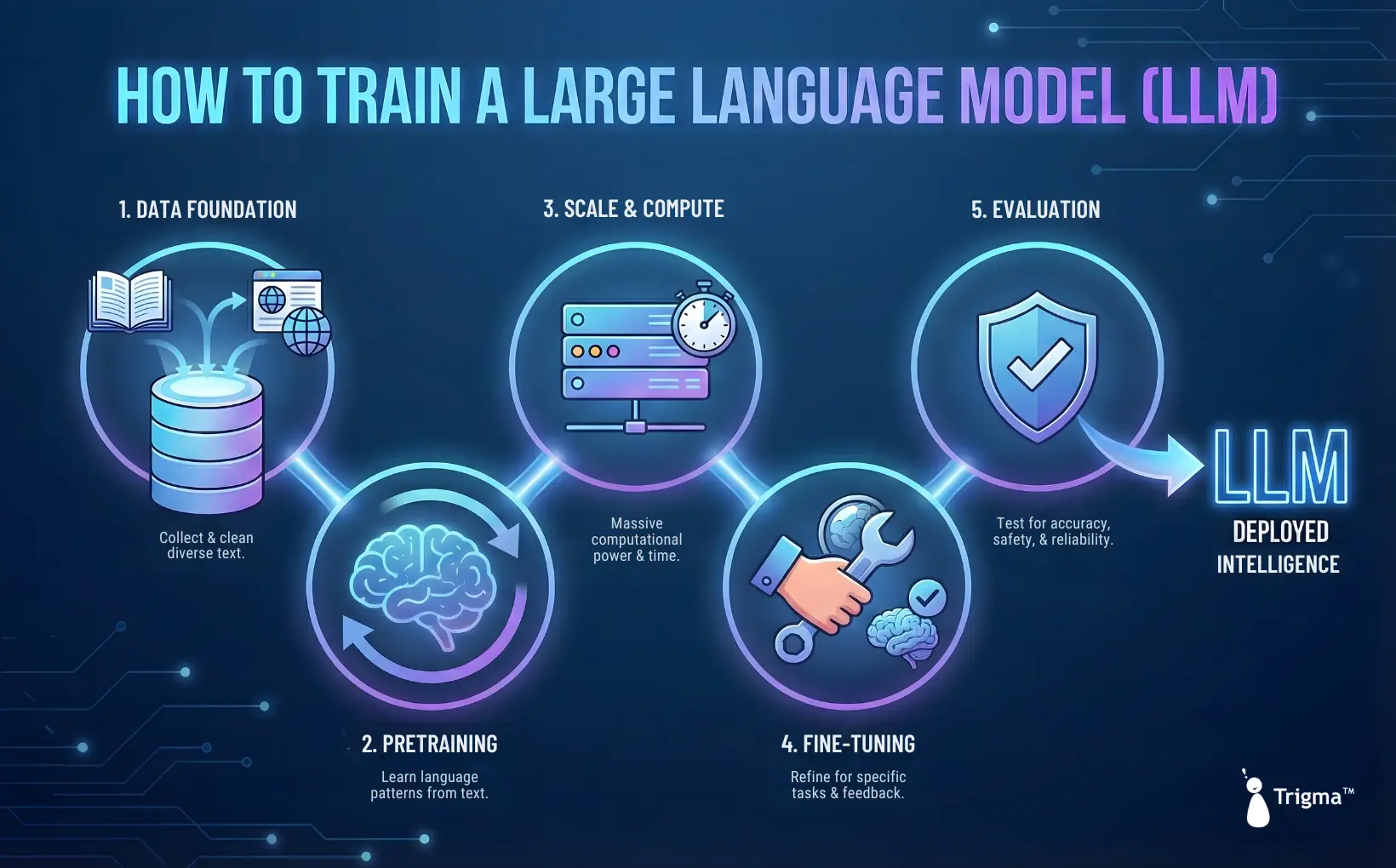
How to Train a Large Language Model (LLM)?

LLM learn language and behavior at scale and with proper interaction. LLMs are not programmed with rules; they are trained to recognize patterns in understanding context by exposure to maximum amounts of data. Here’s how we can train an LLM.
A futuristic digital illustration featuring a glowing cybernetic human head with the text 'LLM' inside the brain area, resting in a robotic hand. The title reads 'What Are Large Language Models? A Simple Guide to How AI Understands Language' against a dark blue background.

1. Data as the foundation

LLM training begins with large, diverse datasets drawn from various sources such as books, articles, technical documentation, code repositories, and public web content. The objective is to expose the model to many ways language is used in domain contexts and writing styles. Before training, data is cleaned and structured to reduce noise and improve learning efficiency.

2. Pretraining: How language works

The core learning phase is pretraining, where the model repeatedly predicts missing or next words in the text. Each incorrect prediction slightly adjusts the model’s internal parameters, thus gradually improving accuracy. With over billions of iterations, the model learns the language patterns but does not instruct or intend.

3. Scale and compute

Pretraining modern LLM requires enormous computational resources, often running thousands of GPUs running for weeks or months. This scale is not optional; many advanced capabilities emerge only when models reach sufficient size and data exposure.

4. Fine-tuning and alignment

Once the model is pretrained, it is refined through fine-tuning, where it is trained on smaller, curated datasets to improve instruction following, response clarity, and practical usefulness. This often includes human feedback where preferred responses are reinforced so the model outputs are most helpful.

5. Evaluation and ongoing improvement

Before deployment, LLMs are tested across benchmarks and real-world scenarios. Even after release, models are updated through fine-tuning and evaluation to improve performance, safety, and reliability.

Difference Between Large Language Models and Traditional AI Systems

Here’s a detailed explanation of how LLM and traditional AI systems differ from each other.

BasisTraditional AI systemsLLM
Core approachRule-based logic or narrowly trained machine learning modelsData-driven probabilistic models trained on massive data
ScopeDesigned for specific & predefined tasksGeneral-purpose language intelligence across domains
Learning methodRequires explicit feature engineering and labeled dataLearns patterns through self-supervised deep learning
Handling languageRelies on keywords matching, intent classification, and templatesUnderstands context, semantics, and nuance through attention mechanisms
Context awarenessLimited or short-term context handlingMaintains rich contextual understanding across long inputs
Response generationPredefined or template-based outputsDynamically generated and human-like responses
System behaviorDeterministic and predictableProbabilistic and flexible
Integration styleOperates on isolated componentsFunctions as an intelligence layer across systems
Maintenance effortHigh, rules, and models must be continuously updatedLower, behavior evolves through training and alignment
Use casesRule engines, basic chatbots, form validation, expert systemsConversational AI, copilots

Summing Up

LLM models represent a massive shift in how artificial intelligence is built and applied. Rather than operating as task-specific tools or rule-based systems, LLMs function as general-purpose intelligence layers, capable of understanding language, reasoning across contexts, and generating meaningful outputs at scale. 

Throughout this blog, we have learned about LLMs. By learning patterns from massive amounts of text, LLMs move beyond rigid automation and give results in a more adaptive and contextually aware decision. As organizations move towards AI native products and agentic systems, LLMs are the backbone of intelligent software. Those who invest in understanding and implementing them thoughtfully will be better positioned to build scalable, resilient, and future-ready solutions.

At Trigma, we help organizations design, build, and scale AI solutions powered by LLMs and Agentic AI frameworks. Whether you’re exploring AI adoption or looking to build intelligent systems, our technical experts ensure your AI strategy is practical, secure, and built long term value.

Ready to Accelerate Your AI Journey?

Explore how Trigma can help you build custom AI solutions, and that too with continuous support.
Hire AI Healthcare App Developers for Startups

The healthcare landscape is evolving faster than ever, driven by the power of Artificial Intelligence. Today, AI healthcare development is no longer just about streamlining clinical workflows; it’s about reimagining how care is delivered, decisions are made, and lives are improved. From predictive diagnosis and personalized care journeys to intelligent triage and remote monitoring, AI is at the core of a smarter, more connected health ecosystem.

For healthcare startups worldwide, partnering with an expert AI healthcare app development company can be the difference between innovation and disruption, enabling you to build solutions that combine data intelligence, medical-grade security, and scalable AI capabilities to transform patient outcomes and redefine the future of care.

This blog will provide a detailed perspective on how partnering with an expert and professional AI healthcare app development company can bring a competitive edge to your business.

Why Startups Should Invest in AI Healthcare Development?

In the era defined by smart hospitals and data-driven care, AI is not just transforming healthcare; it’s reshaping how startups innovate, scale, and deliver value. AI-powered healthcare apps enable intelligent automation, real-time insights, and deeply personalized patient experiences, helping startups accelerate growth without compromising on clinical accuracy or patient safety.

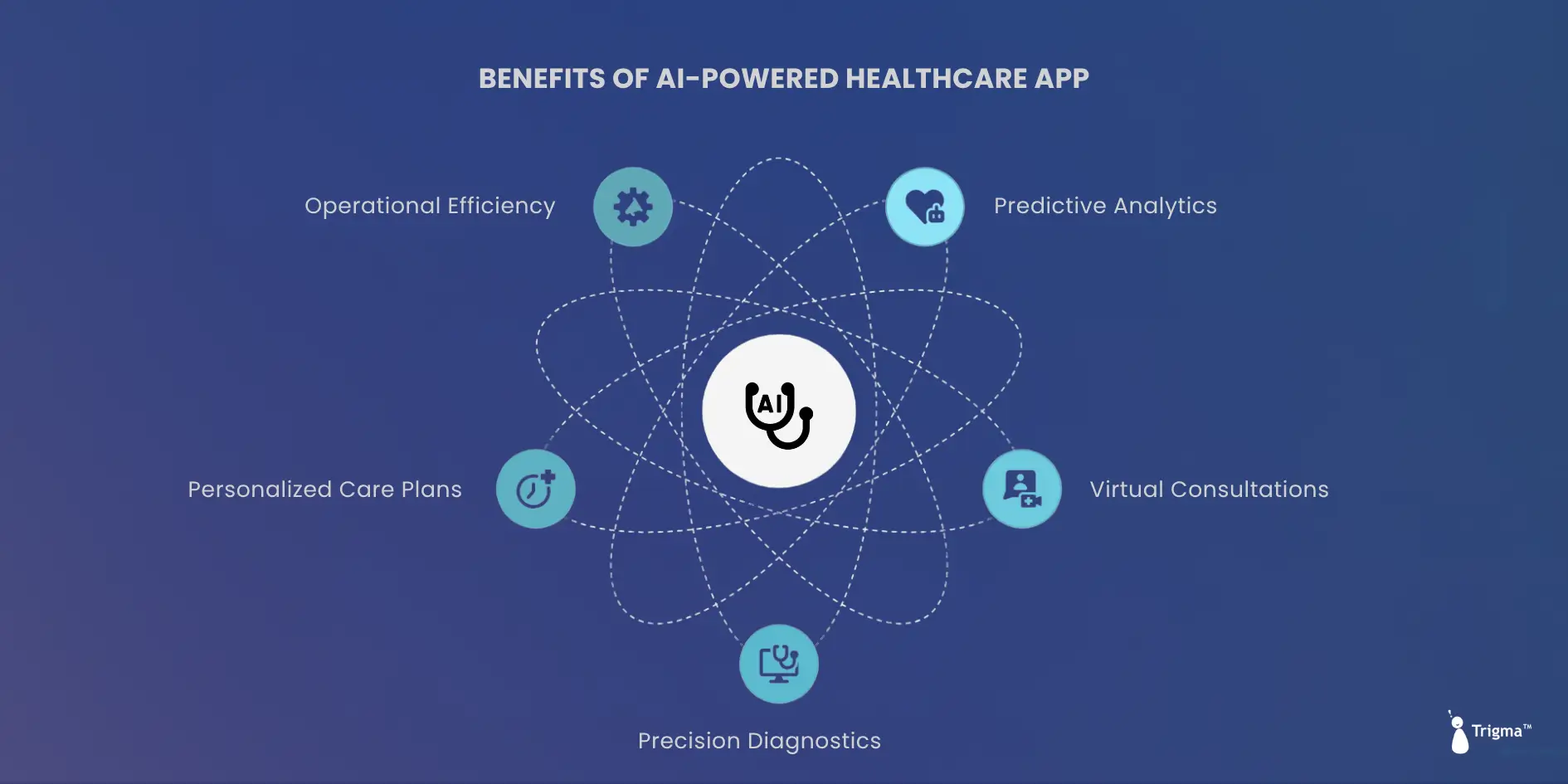
Key Benefits of AI-Powered Healthcare App

Infographic illustrating the benefits of AI-powered healthcare apps including predictive analytics, virtual consultations, personalized care, and operational efficiency.

1. Predictive analytics

Harness deep learning to forecast diseases, detect anomalies early, and enable proactive patient monitoring. 

2. Virtual consultations

Deploy AI chatbots and NLP-based modules that enhance health efficiency and create seamless doctor-patient interactions.

3. Precision diagnostics

Leverage CNNs and advanced image recognition algorithms to uncover patterns in scans, lab results, and pathology reports faster and more accurately than ever.

4. Personalized care plans

Use reinforcement learning models that evolve with patient data, offering treatment recommendations tailored to individual health trajectories.

5. Operational efficiency

Automate administrative workflows, billing, scheduling, and medical record engagement using intelligent RPA, freeing clinicals to focus on what matters the most, ie, care. 

AI Healthcare App Development Process For Startups

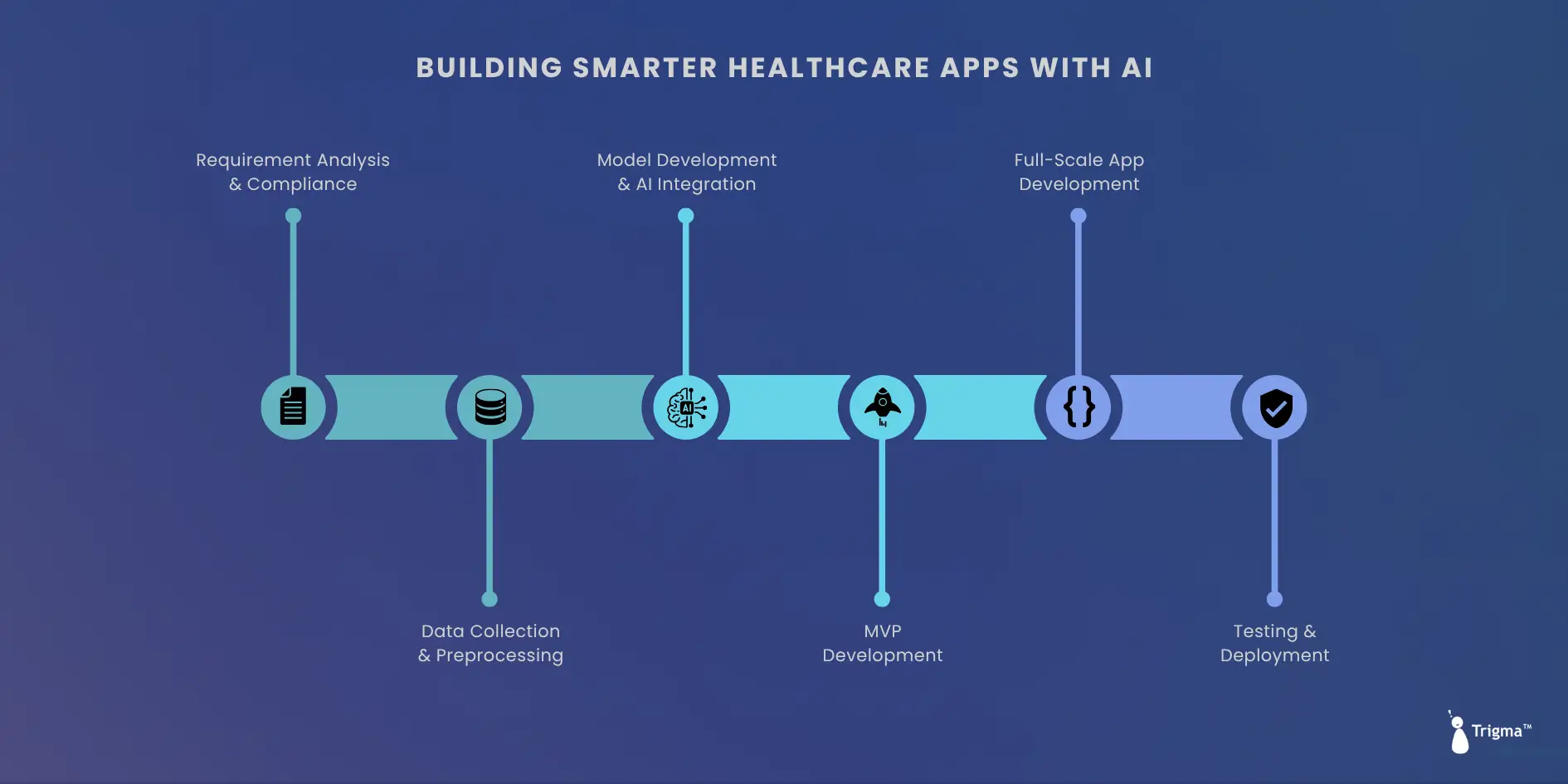
Building an AI-powered healthcare app demands more than just technical skill; rather, it requires precision, compliance, and trust. A professional AI healthcare app development company follows a structured, regulatory-aligned, and data-secure process that ensures every layer, from idea to deployment, meets the standards of healthcare innovation.

AI healthcare app development process infographic showing stages like requirement analysis, data collection, model development, MVP, and testing.

1. Requirement analysis & compliance planning

Every great product begins with clarity. The development team defines your app’s purpose, whether it’s telemedicine, diagnostics, patient monitoring, or engagement, and aligns it with essential healthcare regulations like HIPAA, GDPR, and ISO 27001. This leads to a more secure, compliant architecture blueprint tailored to your business and regulatory landscape.

2. Data collection and preprocessing

AI is only as good as the data it learns from. Experts gather, cleanse, and structure medical datasets using ETL pipelines, anonymization protocols, and feature engineering techniques. This helps in having a high-quality, ML-ready data repository that ensures both accuracy and data integrity.

3. Model development & AI integration

Using advanced models such as Keras, Scikit-learn, and ONNX, data scientists build and train models for diagnostic imaging, predictive analytics, and anomaly detection. The models are then integrated for a seamless and real-time interface within the app.

4. MVP development for AI healthcare startups

Speed and validation matter. A Minimum Viable Product (MVP) helps startups launch faster by testing core AI features like chatbot triage, vitals monitoring, or early disease prediction, without high upfront costs. It’s a critical stage to attract investors, validate AI performance, and refine UX.

5. Full-scale app development

Once validated, the MVP transforms into a robust, production-grade platform built on cloud-native microservices, scalable APIs, and FHIR-compliant architectures. Integration with EHRs, wearables, and IoT devices ensures a truly connected ecosystem.

6. Testing and deployment

Quality and compliance take center stage. Rigorous AI validation cycles assess model performance, security layers, and clinical accuracy through A/B testing, penetration testing, and encryption audits.

Ready to redefine healthcare with AI

Why MVPs Work Best For Healthtech Startups

In the fast-evolving world of healthtech, speed, validation, and smart spending determine who leads the innovation curve. Developing an MVP isn’t about building less; it’s about building strategically. For AI healthcare startups, an MVP accelerates market entry, attracts investors, and minimizes risks while ensuring every feature aligns with real clinical needs.

Here’s why MVP development is the smartest launch strategy for your startup:

Faster time to market

Bring your AI healthcare idea to life in weeks, not months, with a functional prototype ready for early users and testing.

Investor confidence

Showcase a tangible proof of concept and demonstrate clinical and technical feasibility, therefore boosting your product credibility with investors.

Market validation

Engage early adopters such as patients, doctors, and healthcare professionals to gain actionable feedback and refine your product for real-world use.

Cost efficiency

Focus resources on core features that matter most, avoiding overdevelopment until you validate traction and usability.

The real power of an MVP stands as: Start lean, Learn fast, Scale fearlessly

How Much Does It Cost to Develop an AI Healthcare App

The cost to develop an AI healthcare app varies depending on the app’s complexity, AI integration, compliance regulations, data, model, training, and API integration.

However, the estimated cost is presented as follows:

ModelEstimated costTimeline
MVP (Basic AI chatbot, Symptom tracking)$25,000 – $30,0002.5 – 3 months
Full-Scale AI healthcare platform$50,000+6 – 9 months

Expert Advice: Start with an MVP powered by a modular ML architecture and evolve to include RAG pipelines, generative AI models, or predictive diagnostics as your data matures.

Hire AI Developers: Turn Vision Into Scalable Reality

The right AI healthcare development team can transform your idea from concept to a scalable, intelligent, and compliant digital health ecosystem. It’s not just about writing code; it’s about engineering innovation that aligns with clinical precision, data integrity, and long-term scalability.

What to Look For in AI Healthcare Developers

  • Proven expertise
    Choose developers who combine healthcare domain knowledge with deep AI experience, ensuring your app meets both clinical accuracy and user trust.
  • Advanced skillset
    Opt for teams that excel in automation and operational efficiency, enabling continuous model improvement and compliant data workflows.
  • Strong cloud architecture
    Look for experts who can build FHIR-compliant, cloud-native systems that seamlessly integrate with EMRs, wearables, and IoT ecosystems.
  • Robust DevSecOps for End-to-End Security & Monitoring
    Prioritize developers who implement secure CI/CD pipelines, model validation, and proactive threat detection to ensure your app’s reliability at scale.

Why Trigma Is The Best Partner For AI Healthcare App Development?

At Trigma, we don’t just develop apps; we build intelligent healthcare ecosystems that think, adapt, and deliver measurable outcomes. Recognized by Clutch as one of the Top Health & Wellness App Developers 2025, we continue to set benchmarks in AI-driven healthcare innovation.

top-health-and-wellness-app-developers-2025

As one of India’s leading AI healthcare app development companies, we merge deep technical expertise with clinical insight to craft solutions that are as secure as they are transformative.

Here’s why Trigma leads the way:

Z

End-to-end expertise

From data engineering to deployment, we design and implement AI models using TensorFlow, Keras, and PyTorch, built for accuracy, speed, and scalability.

Z

Compliance driven

We build with HIPAA, GDPR, and HL7 standards at the core, ensuring patient data privacy and medical-grade security across every workflow.

Z

Cloud-first, future-ready infrastructure

Seamlessly integrated with AWS HealthLake, Azure Health Data Services, and GCP AI Engine for real-time interoperability and performance.

Z

Continuous intelligence

We deploy MLOps pipelines for ongoing model training, optimization, and monitoring, keeping your app smart, adaptive, and future-proof.

Partner With Trigma - Where Healthcare Meets Intelligence

Build your next-generation AI healthcare product with a partner who understands both code and care.

Final Thoughts

The future of healthcare is AI-driven, data-secure, and patient-centric, and startups are already leading this revolution. From AI-powered MVPs to enterprise-scale digital health platforms, innovation begins with the right development partner who understands both technology and care.

Collaborate with Trigma’s expert AI healthcare developers to turn it into a scalable, data-driven solution that redefines patient outcomes and reshapes the future of care.

How AI Is Transforming Telemedicine in 2026

In the digital healthcare landscape, telemedicine has evolved from a convenient option to an essential pillar of modern care delivery. What was once a simple way to connect patients and doctors virtually has now become a sophisticated ecosystem powered by Artificial Intelligence (AI).

AI is not just enhancing telemedicine; it’s redefining how healthcare is diagnosed, delivered, and personalized. From accelerating accurate diagnoses to designing individualized treatment plans, AI is enabling healthcare providers to offer smarter, safer, and more efficient care, all from the comfort of a patient’s home.

In this blog, we’ll walk you through how AI is redefining telemedicine and uncover the ways AI is changing the future landscape.

The Rising Importance of AI In Telemedicine

The role of Artificial Intelligence (AI) in telemedicine is rapidly expanding, transforming what was once a basic virtual consultation model into an intelligent, data-driven healthcare ecosystem. According to Grand View Research, the global telemedicine market, valued at USD 141.19 billion in 2024, is projected to surpass USD 380.33 billion by 2030, largely driven by the integration of AI and automation.

What makes AI so impactful is its ability to process a vast amount of patient data in real-time, offering insights that enhance both clinical accuracy and the patient experience. AI is strengthening telemedicine in several ways:

  • Streamlining clinical workflows through automation and smart triage.
  • Enhancing diagnostic precision by identifying patterns that often go invisible to humans.
  • Predicting health issues using real-time and historical data.
  • Improving healthcare accessibility in remote areas.

With the major entrance of AI in healthcare, telemedicine is shifting from being just convenient care to intelligent and preventive care. Therefore, every virtual interaction becomes an opportunity for better health outcomes.

ai-telemedicine-cta-trigma

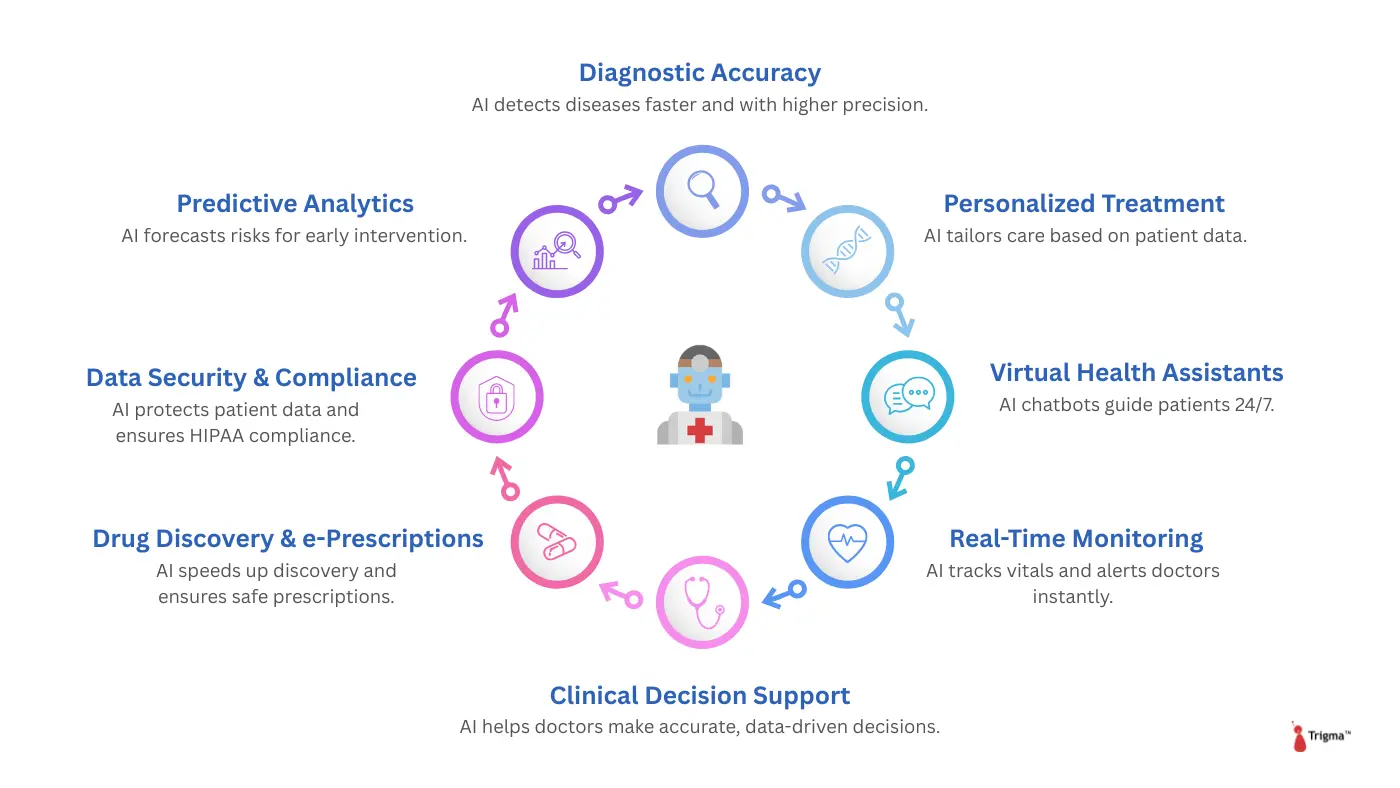
AI In Telemedicine: How It Is Reshaping The Game

Here are the listed ways in which artificial intelligence in telemedicine is transforming the game.

how-ai-is-reshaping-telemedicine-trigma

1. Diagnostic accuracy

One of the most significant advantages of AI in telemedicine is its ability to improve precision. AI can process millions of medical images, lab results, and health records within seconds. It involves AI-powered tools that scan anomalies, AI chatbots that assess symptoms and recommend possible conditions, helping prioritize patients more efficiently. This has helped in detecting diseases at an early stage and providing preventive care for the same.

2. Personalized treatment plans

AI didn’t just excel in diagnosis, but it also helps doctors create personalized treatment plans that are adaptive and effective for a patient, too. AI personalizes care by reviewing EHRs, genetic data, and wearable device information to recommend individual treatments. On the other hand, machine learning continuously monitors patients' progress and modifies care plans in real time.

3. Virtual health assistants

AI-powered virtual health assistants and chatbots are transforming how patients interact with healthcare providers. These tools bridge the gap and provide consistent support without overburdening doctors. From booking appointments & answering basic queries to giving medicine reminders to patients, AI chatbots have become the first touchpoint for patients.

4. Real-time patient monitoring

Real-time activity tracking has always been at the top every time. AI is revolutionizing Remote Patient Monitoring (RPM), especially for patients with chronic illnesses such as diabetes, hypertension, and cardiac conditions. It analyzes a continuous stream of data from wearable or IoT devices to alert healthcare professionals to potential health risks.

5. Enhanced clinical decision support

AI assists healthcare professionals in making faster and more accurate decisions.
Clinical Decision Support Systems (CDSS) analyze patient data, research findings, and medical literature to suggest evidence-based recommendations. This helps doctors choose the best course of treatment with greater confidence and ensures consistency in care delivery, especially during virtual consultations.

6. Drug discovery and remote prescriptions

AI is accelerating the process of drug discovery by analyzing large datasets to identify potential compounds faster than traditional methods. In telemedicine, it also supports doctors in issuing e-prescriptions safely by checking drug interactions, allergies, and dosage accuracy in real time.

7. Data security and compliance management

Telemedicine involves handling sensitive data, and AI strengthens data security through real-time threat detection, anomaly detection, and automated compliance checks for regulations like HIPAA and GDPR. AI-driven encryption systems and federated learning models ensure that patient data remains confidential and protected across all platforms.

8. Predictive analytics for early intervention

AI’s predictive capabilities allow healthcare providers to identify potential health risks before symptoms appear. By analyzing historical patient data, genetics, and lifestyle information, AI can forecast the likelihood of diseases such as heart failure, stroke, or diabetes. This proactive approach enables early intervention, reducing hospitalizations and improving overall patient outcomes.

If you’re also exploring how much it costs to develop an AI-powered healthcare app, check out our detailed guide on AI-Powered Healthcare App Development Cost for better planning.

The Future of AI in Telemedicine

The journey of AI in telemedicine has only just begun. As healthcare systems move forward to more predictive and preventive models, AI will continue to shape the future of virtual care, making it faster, more personalized, and more connected than ever before.

Predictive healthcare models

Using patient data to forecast potential health risks before symptoms appear.

Agentic AI systems

AI agents are capable of autonomously managing scheduling, prescriptions, and coordination among care teams.

Multimodal AI

Integrating voice, text, images, and biometric data for holistic diagnostic insights.

AI & IoT synergy

Combining AI algorithms with IoT sensors for continuous, connected care experiences.

The future of telemedicine isn’t just about digital convenience; it’s about intelligent, proactive, and patient-first healthcare. As AI continues to evolve, it will bridge the remaining gaps in access, accuracy, and empathy, empowering healthcare systems to deliver care that is not only advanced but truly human-centered.

Is your business ready to build the future of telemedicine?

If not, then make it today!

Connect with our experts and design and deploy AI-powered telemedicine solutions that make healthcare smarter, faster, and more human.

Challenges and Ethical Considerations

Despite its vast potential, integrating AI in telemedicine brings challenges that must be addressed carefully:

Algorithmic Bias

Training data lacking diversity can lead to inaccurate predictions.

U

Transparency Issues

Healthcare providers must understand how AI models make decisions.

Human Oversight

AI should assist, not replace, healthcare professionals.

Ensuring ethical implementation and maintaining human empathy in AI-driven care will define the long-term success of telemedicine.

Conclusion

The rise of AI in telemedicine has redefined the healthcare landscape and made the service more convenient, secure, and scalable. It has turned the digital convenience into a smart, data-driven healthcare revolution.

What once seemed futuristic, remote check-ups, virtual health assistants, and predictive analytics, is now the new normal. And as AI continues to advance through machine learning, natural language processing, and agentic automation, telemedicine will only grow smarter, more accessible, and more compassionate.

The real potential of AI in telemedicine lies not just in technology but in empowering doctors and patients alike, bridging gaps in care, saving time, and ultimately improving health outcomes worldwide.

So whether you’re a healthcare provider or a startup, now is the right time to adopt this and redefine the future of digital healthcare.

Healthcare is evolving & your users expect innovation

Bring care closer, faster, and smarter with AI-powered telemedicine.

How Much Does it Cost to Develop an AI-Powered Healthcare App in 2026?

Key Takeways

  • The cost to develop an AI-powered mobile app ranges between $30,000 to $400,000, depending on the complexity and needs.
  • Developing HIPAA-compliant apps is essential to ensure data privacy and security, but it adds to the total cost.
  • Partnering with Trigma ensures reliability, scalability, and compliance-focused healthcare app development.
  • The level of AI integration, such as machine learning, NLP, or medical imaging, directly impacts both pricing and performance.
  • The cost of building a healthcare mobile in 2026 varies based on multiple factors like types, AI features, compliance requirements, and complexity.
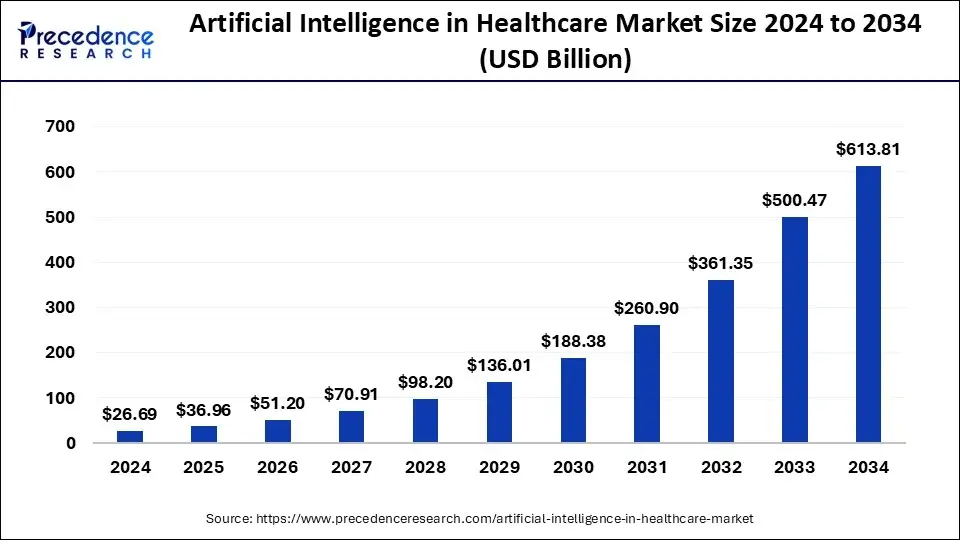
  • The AI in healthcare market is growing rapidly and is expected to reach $613.81 billion by 2034.
  • The future of healthcare apps will focus on personalized care, generative AI, and cloud-based efficiency for better patient outcomes.

When it comes to healthcare app development, this question keeps health tech startups and hospitals awake at night: How much does it cost to build an AI-powered healthcare mobile app that meets today’s standard of innovation, accuracy, and compliance?

However, it’s absolutely a fair concern. Building a healthcare system isn’t just about coding; rather, it’s a fine balance between AI-driven intelligence, user experience, data privacy, regulatory compliance, and budget.

With AI restructuring the landscape of healthcare, it’s crucial to understand the cost structure of such apps in 2026.

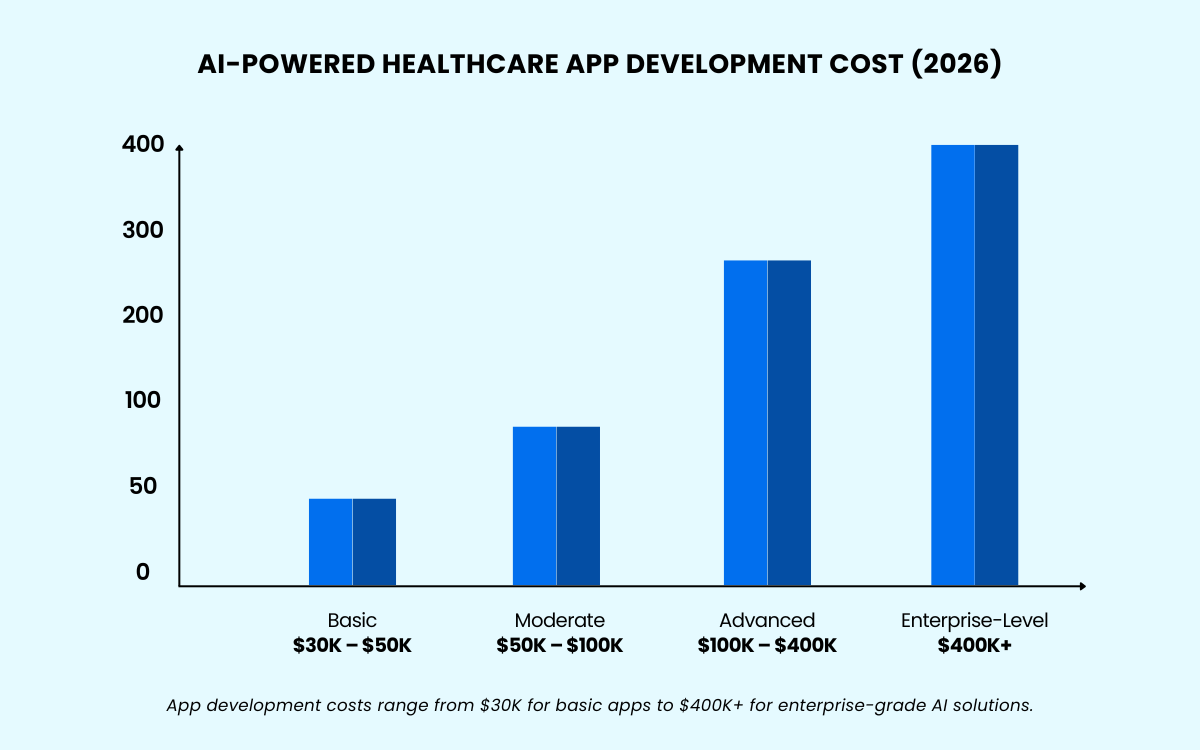
On average, AI-powered healthcare mobile app development in 2026 can range from $30,000 for basic solutions to over $400,000 for complex, HIPAA-compliant healthcare platforms equipped with predictive analytics, IoT integration, and real-time monitoring. For enterprise-level apps, costs may even surpass $400,000, depending on several factors discussed later.

Bar graph showing AI-powered healthcare app development costs in 2026, ranging from $30K for basic apps to over $400K for enterprise-level AI solutions.

Let’s look at these concepts in more detail and build a future-ready, responsive healthcare mobile app in 2026.

Average Cost Breakdown for AI Healthcare App Development

Let’s get straight to the point and discuss the average cost of building a healthcare mobile app. Here is the estimated cost with the required timeline.

App complexityEstimated CostDevelopment Time
Basic Level$30,000 - $50,0003-6 months
Moderate Level$50,000 - $100,0006-9 months
Advanced Level$100,000 +9-12 months

These costs vary as per the complexity and structure of the project.

Factors Affecting AI Healthcare App Development Cost

The cost of developing an AI-powered healthcare app varies based on its complexity, compliance needs, and AI integration depth. Here are the primary factors that determine a project’s overall cost:

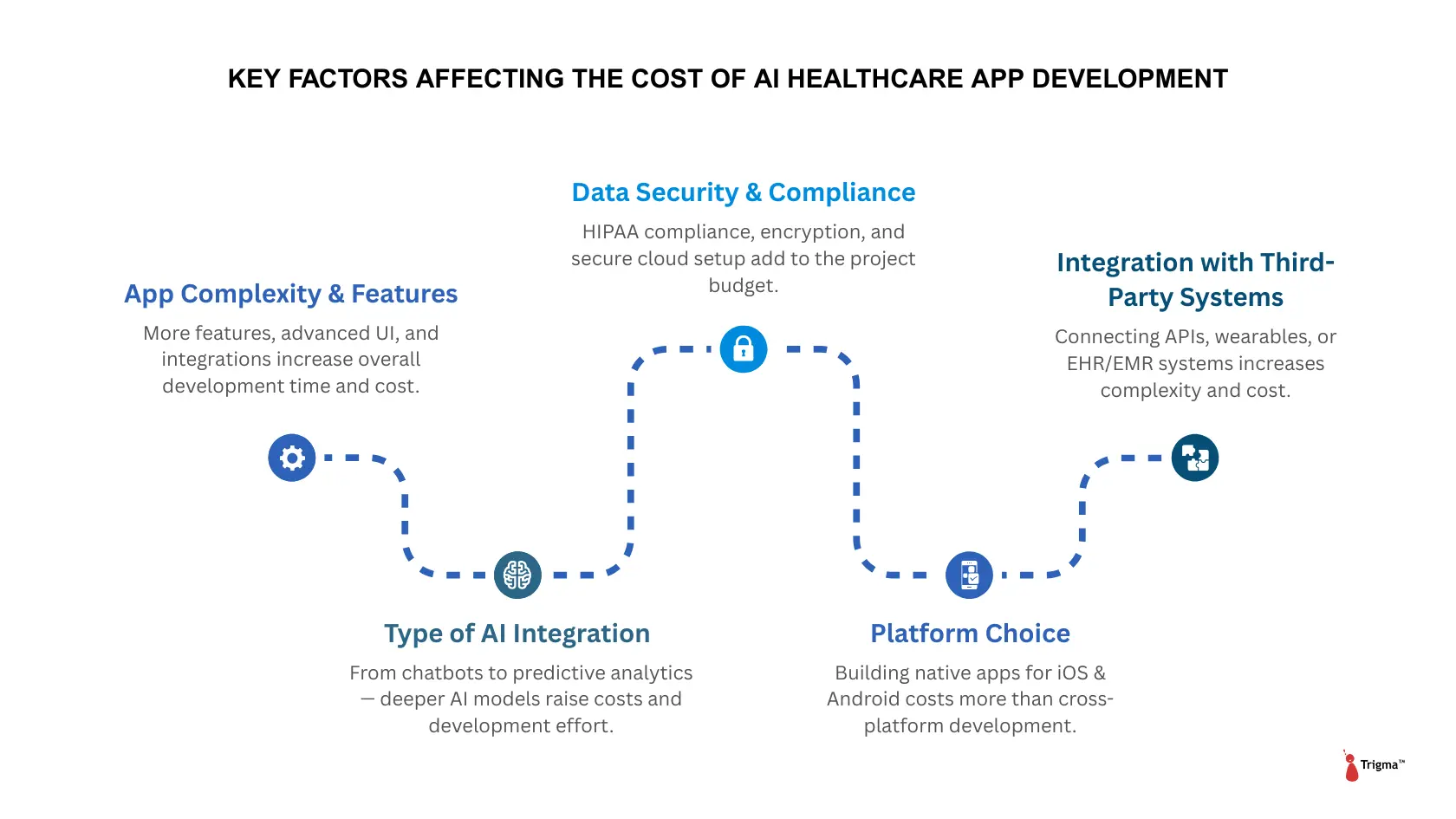
Infographic highlighting five key factors influencing AI healthcare app development cost — features, AI level, compliance, platform, and integrations.

1. App complexity and features

Features in an app usually determine the cost of its development. The more features the app includes, like virtual consultation, AI-based symptom checker, or wearable device integration, the higher the development cost. Simple apps with limited functionality are more affordable, while advanced AI-driven platforms require more time and deep technical expertise.

2. Type of AI integration

The type and depth of AI integration significantly impact costs. Whether it’s about predictive analytics and medical imaging analysis to chatbots and personalized health recommendations, all these affect the cost directly. For example, apps powered by machine learning (ML) and natural language processing (NLP) need custom model training, which can raise the investment.

3. Data security and compliance

Healthcare apps must follow strict data privacy regulations, especially HIPAA-compliant apps designed for the US market. Implementing end-to-end encryption, secure cloud storage, and a user consent management system ensures data safety but also adds to the overall cost.

4. Platform choice

Building separate native apps for iOS and Android increases development time and expense. Many startups prefer cross-platform frameworks like Flutter and React native to balance performance and cost-efficiency.

5. Integration with third-party systems

If your app connects with EHR/ EMR systems, wearable devices, or telemedicine platforms, the integration cost will vary depending on the API complexity and requirements.

ai-healthcare-app-development-cta-trigma

Growing Demand For AI in Healthcare Apps

In recent years, artificial intelligence has significantly revolutionized the healthcare industry, and 2026 is all set to take this transformation even further. From early disease detection to personalized treatment plans, AI is redefining the way care is delivered, accessed, and managed. According to the Precedence Research, the global artificial intelligence (AI) in healthcare market size is expected to reach USD 613.81 billion by 2034. Between 2025 to 2034, this market is expected to mark a growth rate of CAGR of 36.83%.

Growing Demand For AI in Healthcare Apps

With patients demanding more convenient and data-driven solutions, and providers seeking ways to reduce manual workloads, the demand for AI healthcare apps has skyrocketed. Hospitals, healthcare providers, fitness platforms, and even insurance companies are heavily investing in AI mobile apps that deliver faster, scalable, and efficient.

Through machine learning algorithms and predictive analytics, AI can identify health risks, recommend preventive care, and assist doctors in making accurate decisions. These AI-driven apps hold the ability to learn from data and improve the patient experience.

At the same time, maintaining trust and privacy remains essential. Developers must ensure their solutions are HIPAA-compliant apps, equipped with robust data protection measures, encryption standards, and secure cloud storage systems to safeguard sensitive medical information.

As we move toward a more digital and patient-centric healthcare model, AI isn’t just an add-on feature anymore; it’s becoming the foundation of next-generation healthcare solutions. Businesses that invest early in AI-powered healthcare apps are not only staying ahead of the curve but also shaping the future of global health innovation.

Cost Breakdown by App Type

App Type (AI Integrated)AI Integration Level Estimated Cost
Symptom checkerBasic$30,000 - $50,000
Health monitoring appIntermediate$50,000 - $100,000
Diagnostic appAdvanced$120,000 - $250,000
Telemedicine appIntermediate$90,000 - $180,000
Mental health appIntermediate$70,000 - $130,000
Medical imaging appAdvanced$150,000 - $350,000

Wondering where your app fits in this cost range?

Connect with our experts and request a custom quote today

The Future of AI Healthcare Apps in 2026 and Beyond

Here is the breakdown of how AI in healthcare would redefine the coming era.

1. Personalized patient care through predictive analytics

AI will enable hyper-personalized treatment plans by predicting health risks early using real-time patient data, wearables, and genomics. This shift will make AI healthcare app development increasingly data-driven and outcome-focused.

2. Integration of agentic AI for autonomous decision making

Next-gen apps will move beyond reactive systems to agentic AI models that take proactive actions, such as adjusting medication reminders or alerting healthcare providers automatically.

3. Use of generative AI in diagnostic and virtual care

Generative AI will assist doctors in interpreting scans, drafting clinical summaries, and even generating patient education material, significantly improving operational efficiency.

4. Affordable AI solution with cloud edge computing

As cloud and edge AI technologies evolve, healthcare startups and organizations will be able to deploy intelligent, cost-effective apps faster and more securely.

Real World AI Healthcare Apps & Why They Are Costly

Thinking about creating an AI-powered healthcare app, but finding them costly? Let’s explore what makes the innovations truly worth the investment.

Google DeepMind Health

Designed to detect diseases such as diabetic retinopathy and breast cancer with high precision. It requires deep neural networks trained on large datasets, continuous validation, and HIPAA-compliant data handling, which automatically increases its cost.

IBM Watson Health

Uses advanced AI and machine learning to analyze complex medical data and assist in clinical decision-making. It’s costly as it requires massive data integration, regulatory compliance, and ongoing algorithm training to maintain accuracy and reliability.

Ada Health

This offers an AI symptom checker that personalizes health treatments for users. Natural language processing, complex system matching algorithms, and multilingual processing make it costlier.

Buoy Health

This uses conversational AI to guide users through symptom analysis and connect them to appropriate care. It requires real-time AI-driven interactions, extensive backend infrastructure, and regular medical content updates that define its maximized cost.

Path AI

Provides AI-powered pathology solutions for faster and more accurate diagnosis. It is costly as it relies on deep learning models, medical image annotation, and integration with clinical workflows.

Final Thoughts

As AI continues to evolve, healthcare apps will become more autonomous, predictive, and deeply personalized, empowering both patients and providers. The future lies in creating intelligent, HIPAA-compliant apps that combine innovation with trust, ensuring every decision made by the algorithm serves human well-being.

Whether you’re a healthcare startup or an established provider, investing in the development of an AI healthcare app means staying ahead of the curve, where technology meets compassion, and data transforms into care.

If you’re ready to build a future-ready AI-powered healthcare app, our team can help you bring it to life with end-to-end strategy, compliance, and innovation expertise. With over 16+ years of experience in the competitive market, we can help you transform your healthcare business. Book a free consultation call with our AI experts today and let your business take a forward leap.

FAQs

What kind of ROI can you expect from an AI healthcare app?

ROI usually depends upon factors like user adoption, reduction in manual processes, improved patient outcomes, and enhanced operational efficiency. Therefore, ROI can vary, but it must be balanced against the cost of development, compliance, and maintenance.

Are there any recurring costs after the healthcare app is launched?

Absolutely. There are post-launch costs for model retraining, updates, server/cloud hosting, data security upgrades, and user support. These ongoing costs are essential to keep the app effective and secure.

How long does it take to make the app HIPAA compliant?

This depends upon the infrastructure, data architecture, security protocols, legal review, and audit readiness. Building a HIPAA-compliant backend, secure data flows, and user consent mechanisms can add significant development time.

How much does it cost to develop an AI-powered healthcare mobile app?

The average cost ranges from $30,000 to over $400,000, depending on the app’s complexity, AI features, and level of compliance. Basic apps like symptom checkers are more affordable, while advanced solutions with predictive analytics, IoT, and real-time monitoring require a higher investment.

How long does it take to develop an AI healthcare app?

Development time usually ranges between 3 to 12 months, depending on the project size and technical requirements. Simple apps take around 3-6 months, while enterprise-grade, AI-driven platforms can take up to a year or more.

Can AI healthcare apps be customized for hospitals or startups?

Yes, AI healthcare can surely be customized for hospitals or startups. AI-powered healthcare apps can be tailored for hospitals, clinics, telemedicine providers, or startups, depending on their use cases, like patient monitoring, virtual consultations, or diagnostic support.