performance icon
Top IT Services Company 2025 Top Software Developers 2025 Top Generative AI Company 2025 G2 High Performer Winter 2025 G2 Leader Winter 2025 AI Deployment Company 2024 Top Software Development Company in USA for 2024 Top ReactJs Company in USA for 2024
trigma-logo

How AI is Redefining Startup Success in 2025

Artificial Intelligence (AI) has become the backbone of startup innovation, reshaping industries and redefining success in 2025. Here’s how AI is empowering startups to scale faster, optimize operations, and stay ahead of the competition:

The Role of AI in Driving Startup Growth

Efficiency and Automation

AI helps startups automate repetitive tasks like customer support (via chatbots) and data analysis, freeing up valuable time for strategic focus. By handling these tasks efficiently, AI reduces operational costs, boosts productivity, and enhances decision-making. Our AI & ML services help businesses integrate intelligent automation solutions tailored to their needs.

Personalized Customer Experiences

The revolutionary technology allows startups to deliver highly personalized customer experiences by analyzing individual preferences, behaviors, and interactions. With AI-powered recommendations, dynamic content delivery, and user-centric marketing strategies, startups can engage customers more effectively. This level of personalization increases customer satisfaction, loyalty, and retention, helping businesses build stronger relationships with their audience and stand out in a competitive market.

Enhanced Decision Making

For startups, making the right business decisions is crucial to survival and growth. AI's ability to analyze past trends and predict future outcomes helps startups to make smarter, data-driven decisions. By providing valuable insights and identifying potential risks, AI helps mitigate uncertainties, allowing new businesses to take proactive steps. With AI, they can make informed choices that increase their chances of success. Understand how different AI frameworks impact decision-making.

Competitive Edge:

The journey of startups has become very competitive due to the entry of multiple new businesses in every field. By integrating AI into your business you can make it stand out from the competitors. It will also help you increase your user base and make your business more popular amongst the audience.

Cost Effectiveness

Cost saving is a major concern for startup owners, as managing limited resources effectively is crucial for growth. AI plays a key role in achieving this by automating tasks, such as customer service, data analysis, and inventory management, which would otherwise require more manpower. By handling repetitive processes, AI reduces the reliance on manual labor, leading to lower operational costs.

Industry-Wise Impact Of AI on Startups

AI in E-Learning Startups

The E-learning industry is evolving with AI, giving startups the power to create smarter, faster, and more user-focused solutions. AI-based learning systems analyze user behavior and customize content to match individual learning needs, boosting comprehension and retention. Virtual tutors provide 24/7 support, making education interactive, accessible, and personalized.

Growing firms can leverage AI-driven analytics to refine course strategies by identifying gaps and improving content quality. Moreover, emotion-aware AI systems and gamified learning tools enhance engagement, ensuring a unique experience for learners. These trends help e-learning app businesses to deliver smarter, scalable, and impactful solutions in the e-learning sector.

The Global AI in eLearning Market size is expected to be worth around USD 12.2 Billion By 2033, from USD 4.4 Billion in 2023, growing at a CAGR of 10.7% during the forecast period from 2024 to 2033.

Popular AI-Powered E-learning Apps

AI-powered employee training app

AI-powered skill development app

AI in Healthcare Startups

As healthcare forms the backbone of every nation, multiple new businesses are venturing into the sector. These emerging new businesses use innovative technologies like AI to address pressing challenges, enhance patient care, and revolutionize traditional healthcare practices. Predictive analytics enables early disease detection by analyzing patterns in patient data and improving diagnosis accuracy and outcomes. Personalized treatment plans, powered by AI, consider individual patient needs.

AI-driven virtual assistants streamline appointment scheduling, patient communication, and follow-ups, reducing administrative burdens. These days many new businesses are also using AI for drug discovery to improve the process of identifying effective treatments. With smart diagnostic tools and real-time data monitoring, AI has improved healthcare delivery, enabling startups to create scalable, precise, and impactful healthcare solutions.

The global artificial intelligence (AI) in healthcare market size is predicted to increase from USD 19.27 billion in 2023 to approximately USD 613.81 billion by 2034.

Popular AI-powered Healthcare Apps

AI-powered symptom checker app.

Mental health solution provider app

AI in Fintech Startups

AI is bringing a significant transformation in the fintech space, offering new opportunities for startups to reshape traditional financial services. By incorporating AI-driven solutions, these startups are enhancing fraud detection, streamlining credit scoring, and offering personalized financial advice. They are also implementing AI to improve operational efficiency, automate mundane tasks, and predict market trends, all while providing customers with faster, more accurate, and tailored experiences. As AI usage grows, fintech businesses are creating smarter, more secure, and innovative financial products, making them key players in the evolving financial industry.

The Chatbots powered by AI assist customers with inquiries and transaction processing, ensuring improved customer service and operational efficiency, making them Essential for startups entering the fintech space.

The global AI in fintech market is expected to expand from USD 13,515.7 million in 2024 to USD 58,701.4 million by 2034, reflecting a robust CAGR of 15.9%.

Popular AI-powered Fintech Apps.

AI-based credit scoring

AI lending platform

AI in Travel And Tourism Startups

The travel and tourism industry is experiencing a major change with the use of technologies like AI. New startups are entering this growing sector, using AI to improve customer service, simplify travel planning, and increase efficiency. By offering smarter, personalized services, these AI-driven solutions are transforming how we experience travel, making it easier and more enjoyable for customers.

Startups are using AI for tasks such as intelligent chatbots that assist with bookings, dynamic pricing that adjusts based on demand, and predictive analytics to forecast travel trends. AI also helps with managing customer preferences and providing personalized recommendations. AI and VR-powered 360-degree tours are becoming increasingly popular in the travel and tourism industry, offering immersive virtual experiences for travelers. These tours give them detailed and real-time views of the location.

The global generative AI in travel market size is calculated at USD 894.33 million in 2024, grew to USD 1,063.71 million in 2025, and is predicted to hit around USD 5,067.29 million by 2034, expanding at a CAGR of 18.94% between 2024 and 2034.

Popular AI-Powered Travel Apps

AI-Powered trip planner

Hotel booking app powered by AI

Also, Explore how to build an AI-powered travel social media app.

AI in E-Commerce Startups

The e-commerce industry has experienced a wave of technological excellence with the integration of AI. It empowers startups to enhance customer experiences, improve personalization, optimize operations, and enhance growth. With AI tools like recommendation engines, chatbots, and inventory management systems, e-commerce startups are becoming more efficient and customer-centric. Offering personalized shopping experiences has now become easier, as AI tracks user behavior and preferences to suggest best-suited products, boosting sales and customer loyalty.

Additionally, AI is streamlining backend operations and automating tasks such as customer support, pricing strategies, and fraud detection. This massive transformation is making e-commerce more accessible, responsive, and innovative, offering startups a competitive edge in a crowded market. The Virtual Try-On feature uses AI and augmented reality (AR) to allow customers to digitally try products like clothing, shoes, and makeup before purchasing.

The global AI-enabled eCommerce market will be valued at $7.57 billion in 2024. This market is expected to reach $22.60 billion by 2032, driven by a compound annual growth rate of 14.60% from 2023 to 2032.

Popular E-Commerce AI-Based Apps

AI-powered eyewear try-on app

Virtual try-on makeup app.

Ready To Experience The Power Of AI In Your Business?

Wondering how AI can transform your business? Trigma's AI/ML expertise can help you integrate powerful solutions to streamline operations, enhance customer experiences, and drive growth.

Let’s take your business to the next level with AI-powered innovation!
The Impact of AI on Game Design: Creating Dynamic and Engaging Worlds

Artificial Intelligence (AI) is the most talked about technology these days. But, how is it impacting gaming experiences?

In the gaming industry, user experiences are of prime importance. It is simple - The better the players’ experiences, the more players it would attract and generate revenue.

AI plays a major role in creating dynamic and engaging worlds when it comes to the online gaming industry. But how?

Let’s dive into the details.

How AI is Impacting Game Design?

AI in gaming refers to creating immersive and engaging player experiences. It allows game designers and developers to automate various repetitive tasks like character creation, asset design, and level generation, enabling them to focus more on creative aspects like gameplay mechanics and story. Basically, the gaming world is set to evolve using AI. Let’s have a look at different aspects of AI that are revolutionizing game design.

1. Customized Gameplay Options

AI capabilities allow for analyzing data and generating insights about players’ behavior patterns, preferences, and skills. This helps game designers to design game elements that provide personalized experiences. Innovative player experience modeling (PEM) driven by AI data analysis is proven to be useful in including game features that are based on gamer’s capabilities and therefore improve its performance and usability.

2. Automated Game Testing

Before launching a game, it is important to test it thoroughly for identifying glitches, and bugs. Also, knowing how user-friendly the game is becomes significant. Testing games by users can take a lot of time. So, instead, the game is automatically tested using AI tools for game testing. AI based game testing tools can scan thousands of test scenarios within a matter of days and also check out the feasibility of various difficulty levels.

3. Enhanced Storytelling

Every game has its story in which multiple players can take different paths, but ultimately they reach the same destination. With the help of generative AI, game designers can create games that have unlimited different storylines. A player can experience unfolding different scenarios based on the actions they take. Players can actually feel new worlds being created in real-time when AI is used for story creation in games.

4. Intelligent Non-Playable Characters (NPC)

Traditionally, non-playable characters in a game include scripted entities that perform scripted actions. Players didn’t have any control over NPCs. But, now, with AI in gaming, a player can ask questions to non-playable characters and get required responses, directions, and even hints about how to win. As AI in gaming is evolving, interacting with NPCs would seem to be having eccentric conversations and emotional value with a real person.

5. Quick and Easy Asset Creation

In every game, there are a number of art assets like trees, shrubs, cobles, puddles, and more. Creating these assets might seem to be easy, but it takes considerable time and effort. AI can help game designers and artists create these assets flawlessly without putting in manual effort. AI in game design is helping to create engaging and visually appealing gaming worlds with a lot of ease without having to indulge in time-consuming tasks like creating repetitive elements. This helps improve productivity and shift focus from monotonous jobs to creativity.

Now that we have understood how AI is helping evolve and transform game design, let’s examine the different types of AI technologies that make these innovations possible.

Types of AI Technologies Driving Innovation in Game Design

There are different types of AI technologies that guide NPCs to act in certain ways and help them learn quickly from players’ interactions and respond in a manner that keeps the game interesting and running smoothly. Below-mentioned are some of the types of AI technologies that are driving innovation in game design.

1. Rule-based AI

Rule-based AI enables non-playable characters to behave in a consistent manner. When a player tries to interact with an NPC, rule-based AI allows the NPC to behave in a predetermined manner it has been programmed with. This keeps the player engaged with the game for a long period of time.

2. Machine Learning AI

Machine Learning AI allows NPCs to learn from players’ behavior patterns and respond accordingly. So, if the players use the same behavior pattern every time while playing a game, NPCs are likely to pose new challenges to make the game more interesting and avoid it becoming repetitive and boring.

3. Behavior Tree

NPCs follow a hierarchy of behavior that includes specific sequences of actions and situations. For example, if a player doesn’t react in a certain condition, NPCs have a specific sequence of actions that they follow. NPCs may enter a house and shut the door or sit on a bench in the garden, depending on the situation. This type of AI model is making these actions smarter and richer than ever.

4. Pathfinder AI

Pathfinder AI, as the name suggests, provides instructions to NPCs on where to go and how to get there. This means rather than following pre-determined fixed paths, the Pathfinder AI model programs NPCs to be more creative and realistic while navigating each space. For example, taking the best route from point A to point B, walking around the obstacles, and guaging the areas as is done by NPCs just like a real person would do.

5. Finite State Machines (FSM)

This AI model can prompt NPCs to switch from one situation to another instantly, depending on the situation players have created. For example, if a guard is present in a certain area in a game, and as soon as the player approaches, the FSM model programs the guard to respond in a certain way - maybe by attacking, chasing, or searching the player based on the action player takes during that time.

Basically, the impact of AI on game design is immersive, and now, with Artificial Intelligence, it is possible to design smarter and more interactive games. Furthermore, let’s have a look at the benefits of applying AI in the game design process helping game development companies gain a prominent position in their industry and edge over their competitors.

Benefits of AI in Game Design

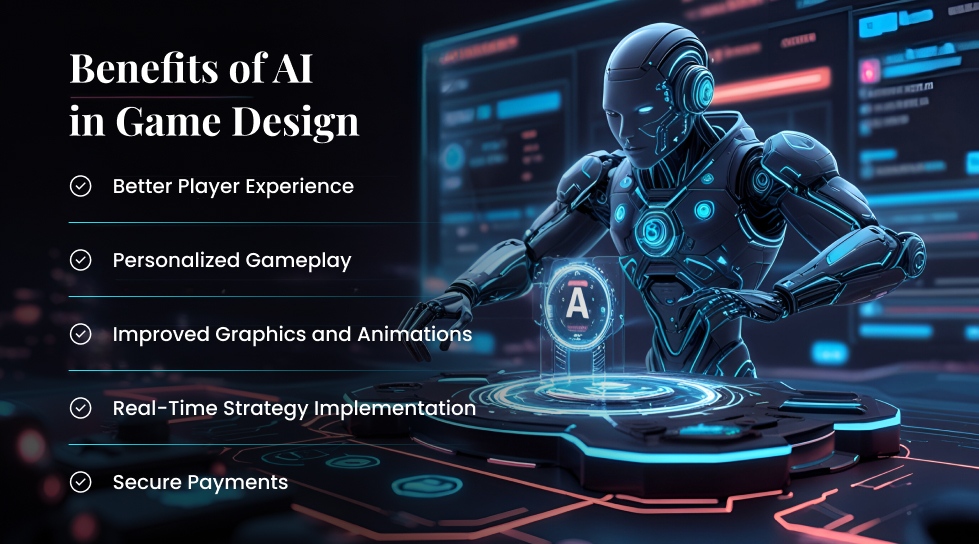
With AI fuelling smart processes, personalization, and data insights in almost every business sector these days, it has numerous benefits in the gaming industry, too. Below-mentioned are some major benefits of AI in game design to be considered.

Benefits of AI in Game Design

Enhances Player Experience: AI in game design eliminates the repetitive and monotonous NPC interactions, making player experiences more interesting and thrilling.

Personalizes Game Play: As AI can predict players’ behavior based on their playing patterns, it can customize the NPC interactions for every player exclusively.

Improves Graphics and Animations: AI in game design helps designers and artists to create highly photo-realistic graphics and animations quickly enabling highly immersive experiences.

Enables Real-Time Strategy Implementation: AI in game design enables real-time strategy implementation based on players' actions in real-time, resulting in enjoyable gameplay.

Secure Payments: AI algorithms can easily predict suspicious activities which keep players’ payment information safe, building trust and improving engagement.

Conclusion: AI is the Future of Game Design

The innovations that AI is bringing into game design are still in the infant stage. Realistically, the potential of AI can uncover many more thrilling innovations in the future. Keeping that in mind many game development companies are integrating AI into their projects and gaining the advantage of being early adopters of this technology. Top players in this industry believe AI when combined with human creativity, can help in creating out-of-the-box gaming experiences.

Therefore, in this era where AI is at the forefront of almost every business sector, game development companies that have not integrated AI into their gaming development will have to leverage AI tools and train their gaming designers, developers, and other professionals to make the best use of this innovative technology.

The fact is AI is the future of game design and reshaping this industry. Henceforth, mobile app development companies specializing in game design are required to embrace AI to implement creative ideas unlock new opportunities, and provide immersive and thrilling experiences ultimately gaining in terms of improved brand popularity and revenue generation.

ready-to-integrate-ai-into-your-game-design

Why React is Ideal for Building Fast and Scalable Web Apps

Web apps today need more than just good performance—they need architectures that can grow with increasing demands. React’s component-based architecture and ecosystem of tools like Redux and Next.js offer unparalleled scalability and maintainability. For anyone planning to develop a web app, React isn’t just another tool in the shed—it’s the secret ingredient that powers some of the most dynamic and scalable web applications worldwide. From startups to tech giants, the dynamic framework has proven its worth. But what makes it the ideal choice for your project? Let’s understand why the framework stands at the forefront of web app development.

According to Statista, React is one of the most used web frameworks among developers worldwide as of 2024. Around 39.5% of developers used it to develop their web apps.

Statista

7 Reasons That Make React The Ideal Choice For Developing Web Apps

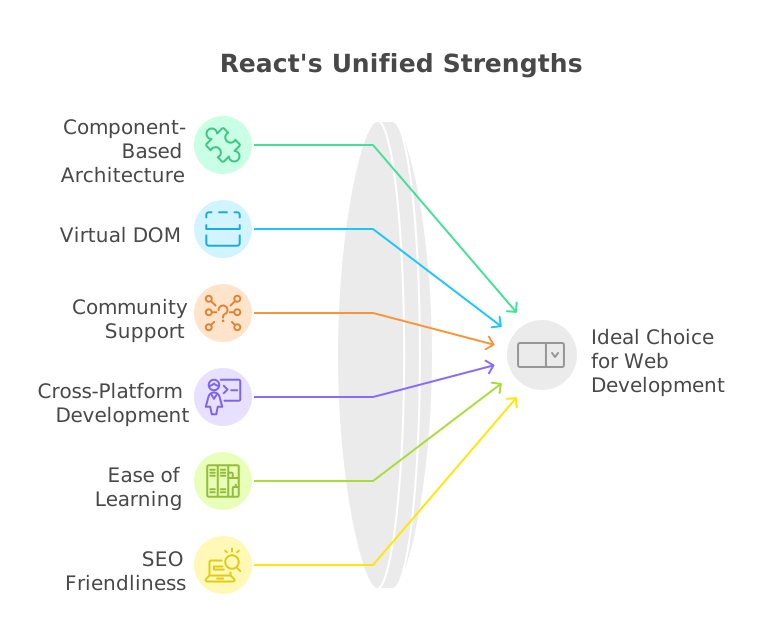
React has rapidly become one of the most popular JavaScript libraries for building web applications. Developed and maintained by Facebook, it is widely adopted by developers due to its efficiency, flexibility, and strong community support. If you’re considering this framework for your next web application, here are the key reasons that make it an ideal choice.

React-unified-strength

1. Component-Based Architecture

The framework follows a component-based architecture, allowing developers to break the user interface into reusable, self-contained components. This approach not only simplifies the development process but also enhances maintainability. For example, you can create a button component and reuse it across different parts of your application without rewriting the code. This modularity improves code organization and fosters collaboration among developers.

2. Virtual DOM for Better Performance

One of React’s standout features is its Virtual DOM, which ensures high performance. When the state of an application changes, React creates a lightweight copy of the actual DOM and compares it with the previous version to identify changes. Only the parts of the real DOM that need updating are modified, minimizing unnecessary re-rendering and boosting app performance. This makes it the best and most effective for dynamic, data-intensive applications.

3. Rich Ecosystem and Community Support

React’s strong community and ecosystem are key to its success. With active developer participation, it offers vast libraries, tools, and resources for building scalable web apps. Regular updates ensure modern features, while open-source collaboration enriches the ecosystem. Abundant learning materials and active community support make it an accessible, future-proof choice for developers of all levels.

4. Cross-Platform Development

React isn’t just limited to web apps. Using this framework Native, developers can build mobile applications using the same principles and syntax. This allows businesses to create cross-platform solutions efficiently, reducing development time and costs. For instance, companies like Instagram and Airbnb have successfully used React and React Native to build seamless user experiences across platforms.

5. Ease of Learning and Adoption

The popular framework is relatively easy to learn compared to other front-end frameworks, especially for developers familiar with JavaScript. Its straightforward syntax and logical structure make it beginner-friendly. Even experienced developers find it convenient to adopt due to its flexibility and minimalistic approach.

6. SEO Friendliness

It supports server-side rendering (SSR) through libraries like Next.js, making it an excellent choice for SEO-focused applications. By rendering pages on the server and delivering fully loaded HTML to the browser, React helps search engines crawl and index your content more effectively, boosting visibility and rankings.

7. Strong Backward Compatibility

React prioritizes backward compatibility, which means you can safely upgrade to newer versions without breaking your existing application. This stability is critical for long-term projects, as it reduces the risk of technical debt and ensures a smoother development lifecycle.

Cost Of Developing Web App With React

The cost of developing a React web app ranges from $10K to $100K, depending on factors like complexity, design, and features. Advanced functionalities, custom designs, and additional features like payment systems or user authentication increase costs. The expertise of the development team and project timeline also influence pricing, with expedited deliveries potentially raising the overall cost.

Summing Up

After reading the blog post you must have understood why you should opt for React if you are planning to develop a futuristic and user–friendly web app. Whether you’re building a small-scale project or a complex enterprise application, It provides the tools and ecosystem to deliver high-quality, scalable solutions. By choosing this user-friendly framework you are aligning your project with a technology that is future-ready and unique.

Transform Challenges into Solutions – Begin Your React Journey Now!

Thinking of building a React web app? Trigma is your perfect partner. Our expert team crafts scalable, innovative apps that blend technical expertise with creativity to bring your ideas to life.

How To Build An E-Learning Saas Platform?

The e-learning industry is experiencing unprecedented growth, with the global market projected to reach over USD 740.46 billion in 2032, growing at a CAGR of 14.02% over the forecast period (2024-32). As businesses, educational institutions, and individual learners continue to shift online, the demand for innovative and scalable learning solutions is increasing. From corporate training to academic courses and specialized skills development, e-learning revolutionizes how users learn.

If you are planning to scale your existing e-learning business, a SaaS-based platform is the key to driving growth. With its flexibility, scalability, and reduced upfront costs, the framework allows you to continuously adapt your platform to meet the evolving needs of learners and stay ahead of emerging technologies. If you're ready to take your platform to the next level, this blog will guide you through the steps to enhance your e-learning business, helping you deliver a dynamic learning experience and drive long-term success.

What Do You Mean By A Saas-Based E-Learning Platform?

A SaaS-based e-learning platform is an online learning system that is hosted on the cloud and offered as a service. SaaS stands for Software as a Service, meaning that users don’t have to install or maintain the software themselves. Instead, they access the platform over the Internet through a subscription or pay-per-use model.

In simple terms, it’s a Cloud-Based E-Learning Platform ready for use by e-learning businesses. Through the platform, students can access courses, manage learning materials, and interact with features like quizzes and videos—all hosted on the Internet.

Examples of successful cloud-based E-learning platforms include Coursera, Thinkifi, and other trending e-learning platforms.

1. Market Research And Niche Identification

The first and most critical step in building an education SaaS-based platform is conducting thorough market research. This ensures the platform addresses a real need, stands out in the competitive landscape, and targets the right audience. Market research provides insights into current e-learning trends undergoing in the e-learning industry. It also involves competitor analysis to identify service gaps and understand user pain points through surveys and feedback.

A strong Unique Value Proposition (UVP) will be researched that can help to make your platform become more popular in the industry.

2. Define Features and Functionality

Once the market research is done by the development company the next step would be deciding the features and functionalities to be integrated into the app. The features should be tailored to address the specific needs of your target audience and provide a seamless learning experience.

Key features to consider include: personalized learning paths, course creation, interactive communication features, cloud-based storage, and other features. These features help create a functional and engaging e-learning platform that meets the needs of both learners and educators.

3. Creating An Impressive UX And UI Design

Creating an impressive UX and UI design for your e-learning SaaS platform is essential for providing a seamless and engaging learning experience. Focus on user-centered design by understanding your audience’s needs and testing usability. Simplify navigation with clear layouts, consistent elements, and easy access to key features like courses, assessments, and progress tracking.

Ensure mobile-first design for accessibility across all devices and prioritize visual appeal with modern aesthetics and multimedia content. Personalize dashboards and learning paths while ensuring accessibility through high contrast, screen reader compatibility, and multi-language support. Optimize loading speeds, incorporate gamification, and include interactive elements to enhance user engagement.

4. Platform Development And Quality Assurance

The e-learning platform development involves building the backend architecture, integrating core features like user management, course creation tools, and payment systems, followed by visual design design implementation. The development process followed by your development partner should be adaptable, allowing for continuous feedback and improvements.

To ensure your e-learning platform performs flawlessly, we focus on key quality assurance stages. These include verifying functionality to confirm features work as intended, assessing performance to handle high traffic seamlessly, and safeguarding security to protect user data. Additionally, we validate usability standards to ensure the platform delivers an intuitive and efficient experience for all users. This comprehensive process guarantees a reliable, scalable, and user-friendly solution.

5. Security Compliance And Deployment

Before launching the scalable e-learning platform, ensuring security compliance is crucial to protect user data and meet industry regulations. Implement data encryption, secure payment gateways, and user authentication mechanisms like two-factor authentication (2FA). Compliance with GDPR, HIPAA, or other regional regulations should be prioritized for data privacy.

Once all security measures are in place, the product development team will hand over the custom e-learning platform to you. This includes admin access, documentation, and post-launch support for smooth deployment, ensuring a secure and scalable learning environment.

Summing Up

The cloud-based e-learning platforms are revolutionizing the education industry, making them highly in demand. Building a customized platform for your business can unlock new growth opportunities, streamline learning experiences, and establish your brand as a leader in education. By delivering scalable, accessible, and engaging solutions, you can cater to a broader audience while staying ahead in this competitive, ever-evolving market.

Change the way the world learns—start your journey with Us!

Ready to boost your e-learning business with SaaS? Trigma offers custom solutions to enhance scalability, efficiency, and growth. Let’s take your business to the next level!

FAQs

Can You Create A Custom SaaS E-Learning Platform For My Business?

Yes, at Trigma, we specialize in creating custom e-learning platforms SaaS platforms designed to your business needs, offering innovative features and scalable solutions to help you excel in the education industry.

How Much Time It Will Take To Build Cloud-Based E-Learning Platforms?

The time to build a cloud-based e-learning platform depends on factors like complexity, required features, and customization. A simple platform may take less time, while advanced platforms with custom functionalities require more development time.

How Do You Ensure Data Security On A SaaS E-Learning Platform?

At Trigma, we implement industry-standard security measures, including data encryption, secure payment gateways, and user authentication. Compliance with regulations such as GDPR and HIPAA ensures the protection of user data and privacy across the platform.

How Do You Ensure The Platform Is User-Friendly?

We focus on a user-centered design approach, testing usability, simplifying navigation, and optimizing for mobile to ensure an intuitive, engaging experience for both learners and educators.

What is the Cost of Building a Web App with ReactJS?

When crafting a web app that is unique and user-centric, ReactJS emerges as a standout choice. Its innovative component-based architecture simplifies development, while the Virtual DOM ensures lightning-fast performance. With unmatched scalability, it empowers you to build dynamic, future-ready applications that seamlessly adapt to user demands and business growth. It’s more than a framework—it’s the toolkit for creating extraordinary digital experiences.

As of 2024, 3,740,236 live websites in the USA use React for their front-end frameworks. The United Kingdom takes the second position with 2,235,462 websites using React.

Understanding the cost of bringing your ReactJS app to life can take time and effort. This blog talks about key cost factors, offering insights to optimize your investment and set realistic expectations for a cost-effective development process.

Cost Of Developing A Web App Using ReactJS

The cost of developing a web app using ReactJS is not fixed, as it depends on several factors such as the type of app, the complexity of features, the expertise of the development team, and more. However, here’s a rough estimate for your reference:

Cost-estimation-infographic

Factors Affecting The ReactJS App Development Cost ‘

Understanding the rough ReactJS app development cost is just the beginning. Here are the critical factors that decide the total development cost of a ReactJS-based web app.

reactJs-Development-cost-factor

App Complexity And Features

The complexity and features of the web app play a significant role in determining the cost of developing a ReactJS app. The more features and functionality your app requires, the more time and resources will be needed for development. Here's how app features and complexity impact cost:

1. Basic App

Simple apps with limited features and straightforward functionality are less expensive to build.

2. Intermediate Apps

Apps with unique features will be costlier as compared to basic apps.

3. Advanced Apps

Highly complex apps with user-centric features are costly as compared to simple apps.

Design & User Experience UX

Design and User Experience (UX) are key cost drivers in ReactJS web app development. Custom, unique designs and complex user interfaces with interactive elements, animations, and dynamic layouts require more time and expertise, increasing development costs. Ensuring a responsive design across devices and conducting thorough UX research, including wireframing and user testing, also adds to the expense. However, investing in high-quality design and UX results in a more engaging, user-friendly, and successful app.

Development Team Location and Expertise

The location of the development team affects pricing, as developers in high-cost regions, like North America or Western Europe, charge more for ReactJS app development services compared to those in lower-cost regions. However, choosing a team in a similar time zone or culturally compatible area may improve communication and coordination.

The team's expertise also plays a critical role. Experienced developers with advanced ReactJS skills may have higher rates, but their efficiency and ability to handle complex features ensure a quality, scalable app, potentially saving costs in the long run.

Platform Requirements

Platform requirements significantly impact ReactJS-based web platform development costs. Focusing on a single platform, like a web app, is generally more affordable. However, using React Native for mobile apps increases costs due to platform-specific adjustments and testing. Targeting multiple platforms—web, iOS, and Android—further raises expenses as each version requires tailored development, cross-platform compatibility, and rigorous testing. The more platforms you need, the more resources are required, resulting in higher development costs.

Third-Party Integrations

Third-party integrations can level up ReactJS web application development costs. Integrating external services like payment gateways, APIs, or analytics tools requires extra development, customization, and security measures. Each integration adds complexity and requires thorough testing to ensure smooth operation. The more third-party services you integrate, the higher the app development cost, as it involves additional time for setup, troubleshooting, and ongoing maintenance to keep everything functioning seamlessly.

Maintenance And Upgradation

Maintenance and upgrades are vital for the success and longevity of a web app. Regular updates are needed for bug fixes, security enhancements, and performance optimization. As technology advances, keeping the app updated with new features, ReactJS improvements, and compliance with regulations is crucial. The cost of maintenance usually depends on the web app’s complexity, update frequency, and the scale of required changes, typically being a percentage of the initial development cost.

Project Industry

The industry you plan to launch your web platform plays a critical role in determining the development cost. Apps for industries like healthcare, finance, or e-commerce often require specialized features, enhanced security, and compliance with industry-specific regulations, which can increase costs. On the other hand, apps for simpler industries like content management or blogging might require fewer customizations, resulting in lower expenses.

Wrapping Up

The ReactJS app cost for startups and large-scale enterprises depends on several factors, from the app's complexity to ongoing maintenance. By understanding these cost drivers and planning accordingly, you can maximize your investment and build a robust, user-friendly web app designed for your business needs. Consult with experts to receive tailored estimates and guidance for your ReactJS project.

Transform Ideas into Impactful Apps with Trigma

Got a unique web app idea? Let Trigma’s expert team bring it to life using ReactJS. We create scalable, high-performance apps that deliver exceptional user experiences.

FAQs

Why Is ReactJS The Best Framework For My Web App

ReactJS is ideal for your web app due to its component-based architecture, fast rendering with Virtual DOM, scalability, and flexibility. It enables efficient development, a seamless user experience, and easy maintenance.

Does Trigma Hold Expertise in Developing ReactJS-based Web Apps?

Yes, Trigma excels in developing ReactJS apps, utilizing its flexibility and scalability to create efficient, high-performance, and user-friendly applications tailored to your business needs.

How Can I Improve the User Experience (UX) with ReactJS?

ReactJS enhances UX by enabling responsive, fast-loading pages and dynamic content updates. By using components for interactive elements like buttons, forms, and models, developers can create an intuitive, fluid user experience.

Do You Provide Support And Maintenance Solutions For React JS web N Apps?

Yes, Trigma offers ongoing support and maintenance for ReactJS web apps, including updates, bug fixes, security enhancements, performance optimization, and adaptation to new technologies, ensuring your app stays efficient and relevant.