+91-98558-85133
 +1(702)760-3099

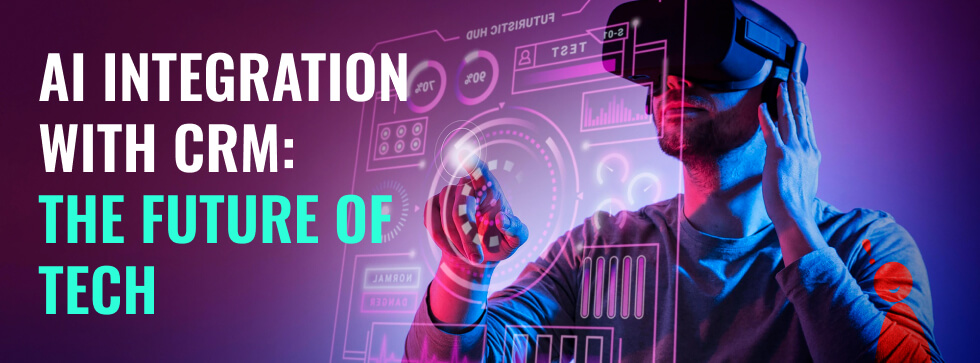
Today, every business aims to provide its users with personalized experiences by understanding and anticipating their needs better. The integration of AI with customer relationship management (CRM) systems acts as a catalyst in this pursuit.
According to a Goodfirms report, 85.8% of respondents agree that AI in CRM can drive more effective customer engagement and make the business more growth-oriented.
In this blog, we'll talk about the fundamentals of CRM, the benefits of AI integration, and delve deeper into CRM integration with AI and its applications in the real estate world.
What is CRM?
CRM stands for Customer Relationship Management. It is the systematic process through which companies manage interactions with both existing and potential customers, fostering transparent communication. In other words, it includes the strategies, practices, and technologies businesses use to analyze customer data and interactions throughout the customer purchase journey. The goal of CRM is to improve customer relationships, boost retention, and drive sales for future growth.
Businesses use various CRM software solutions to manage and regulate their interactions with current and potential customers. Popular CRM software like HubSpot, Salesforce, Zoho CRM, and SugarCRM have shown their effectiveness, with CRM systems reportedly increasing customer retention rates by 27% and improving customer relationships by 72%.
AI integration with CRM
AI integration with CRM is enhancing and transforming the way businesses interact with customers and improve their relationships with them. Here are the key features of AI integration with CRM:

Predictive Analysis
AI algorithms can perform predictive analysis by examining customer data. This helps track customer preferences and predict their behaviors based on their current purchasing patterns. AI optimizes marketing and sales strategies by anticipating customer needs.

Enhanced Lead Scoring
Artificial intelligence assists in lead scoring by analyzing vast amounts of customer data, such as demographics, online history, and user engagement patterns. This analysis helps businesses convert leads into potential customers.

Task Automation
AI excels in handling repetitive and routine tasks typically performed by humans. Tasks such as data entry, follow-up reminders, and task assignment can be automated, freeing up staff to focus on more strategic work. This increases efficiency and productivity.

Chatbots and Virtual Assistants
Routine tasks like answering customer queries or scheduling appointments are managed by AI-powered chatbots and virtual assistants. This enables quicker handling of complex customer queries and allows humans to focus on innovative and creative tasks.

Forecasting Trends
AI models help forecast sales demand and trends. AI-based algorithms study historical data and recommend optimal sales strategies for businesses.

Customer Segmentation
AI segments customers into different groups based on behavior patterns, preferences, and purchase history. This allows companies to target their consumers more effectively and provide the value they need.

Personalized Experiences
AI enhances personalized customer experiences by offering products and services tailored to individual needs and preferences. By analyzing complex data, AI understands consumer behavior patterns and provides relevant recommendations.
How AI-Powered CRM is Helping the Real Estate Industry
CRM integration with AI is a boon for the market. AI-powered integration in CRM has enhanced various aspects of real estate operations. Here are some of the problems solved by AI in real estate:
AI in Real Estate
Property Valuation
- Problem: Accuracy in property valuation is a significant challenge due to factors such as location, property conditions, and market scenarios. Human involvement in property valuation may at times lead to inaccuracies and personal biases.
- Solution: Machine learning algorithms analyze enormous datasets, including market trends and historical sales, to provide accurate property rates. AI has made this process easier with minimal human intervention.
Lead Management
- Problem: Managing and prioritizing leads can be difficult and time-consuming. Human management can make it more complex and inefficient.
- Solution: AI-powered CRM systems automate lead scoring, allowing businesses to focus on high-potential leads with a higher rate of conversions.
Real Estate Marketing
- Problem: Not every person who visits a property is a potential buyer. There are irrelevant visitors who browse properties without the intention to buy.
- Solution: AI integrates data to provide automated potential leads for conversion. It uses Natural Language Processing to identify the top leads for business.
Virtual Tours and Augmented Reality
- Problem: Physical property viewings can be time-consuming and challenging, particularly for an international client base. Managing these logistics can be difficult.
- Solution: AI-powered virtual tours and augmented reality allow potential buyers to explore properties virtually, providing a real-time experience and enhancing satisfaction levels.
Complex Transactions
- Problem: Real estate involves extensive paperwork, which can be frustrating for both buyers and sellers. The process can become more complex due to the volume of paperwork.
- Solution: AI streamlines the documentation process by promoting smooth communication, reducing complex procedures, and improving client satisfaction. AI chatbots reduce the time for each transaction, providing an easy flow of communication with users.
Final Thoughts
Let’s recap! AI is making wonders in the world with its amazing innovations. AI-powered CRM systems represent a revolution in the entire CRM industry. By analyzing data, providing deep insights, and automating tasks, AI enhances user experiences and provides a level of ease.
AI in CRM is not just a technological advancement but also a solution for businesses facing multiple challenges. AI-integrated CRM has benefited many industries, such as real estate, by automating operations and deriving useful insights from complex data. AI's influence is not limited to specific areas; it is expanding and making inroads into various market segments.
At Trigma, we embrace and integrate new technologies into our systems. We assist companies in building their brands with the help of AI technology. Contact us today to embark on your AI-powered transformation journey.