+91-98558-85133
 +1(702)760-3099

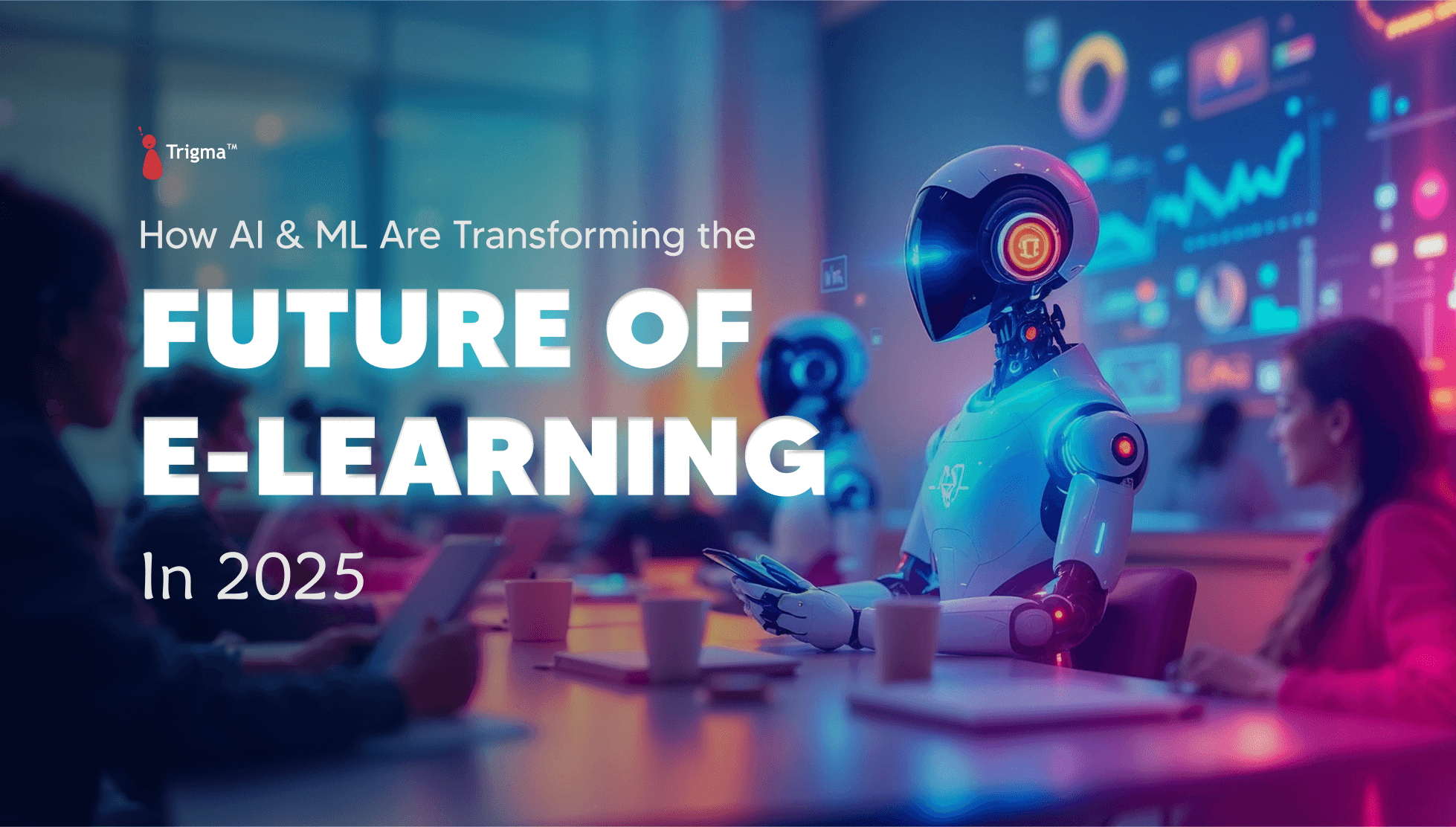
The education sector has become a prime target for innovation, with e-learning leading the charge. Businesses investing in this space are addressing a critical need and tapping into a rapidly growing market. Are you planning to step into this dynamic sector with a futuristic and user-centric e-learning app?
Before proceeding, it’s crucial to assess the evolution of two important technologies—artificial Intelligence (AI) and Machine Learning (ML)—that have completely transformed the landscape of e-learning apps. These technologies empower e-learning apps by providing personalized, adaptive learning experiences and enhancing user engagement.
Wondering how AI and ML have transformed the world of e-learning apps? This blog will guide you through the incredible changes e-learning apps have undergone with the integration of these technologies, revolutionizing how students learn and interact with educational content.
What You Can Expect From Integration Of AI and ML in E-Learning Apps
Imagine learners stepping into a virtual classroom that understands them better than their favorite teacher ever could—knowing not just what they need to learn, but how they learn best. What if an app could adapt in real-time, offering personalized guidance tailored to each learner’s strengths and struggles? Welcome to the AI-ML-powered revolution in e-learning, where education isn’t one-size-fits-all, but as unique as every learner. Let’s explore how these revolutionary technologies can make your e-learning app more competitive, user-centric, and responsive to the needs of learners.
Personalized Learning Paths
By using AI and ML in your e-learning app you can create adaptive learning environments by analyzing each learner’s performance, preferences, and learning styles. This enables the system to automatically adjust content and suggest the most relevant resources, ensuring that each learner receives a customized experience. Whether it’s presenting challenging material or providing easier lessons to reinforce learning, personalized learning paths keep students engaged and progressing at their own pace. This approach boosts retention, maximizes learning outcomes, and ensures that content is both relevant and impactful for every user.
Example
There are various e-learning apps these days that have adopted AI and ML technologies to create personalized learning experiences for their users. These apps analyze individual learning patterns, performance, and preferences, tailoring content to meet specific needs.
This language-learning app uses AI to adjust lesson difficulty, ensuring that learners receive the right level of challenge while offering personalized feedback and tracking progress.
AI Avatars
AI avatars are revolutionizing e-learning by creating an immersive, personalized learning environment. These intelligent digital avatars serve as virtual instructors or assistants, offering real-time, customized support based on each learner’s progress and preferences. Moving beyond traditional methods, AI avatars engage learners with dynamic interactions, adapting their teaching style to keep students motivated, focused, and on track, ensuring a truly unique educational experience. By mimicking human interactions, these avatars can answer questions, give feedback, and explain complex concepts in an intuitive, easy-to-understand manner.
Predictive Analytics for Early Intervention
If you're building a new e-learning app and want to ensure your users get the best possible experience, integrating AI-driven predictive analytics is a game-changer. Imagine having the ability to spot struggling students before they fall too far behind. By analyzing key data like attendance, assignment completion, and online behavior, AI can predict which learners are at risk of falling off track, giving you the chance to intervene early and provide tailored support.
This isn’t just about preventing failure; it’s about helping every student overcome their weaknesses. With AI, you can offer real-time insights into student progress, allowing educators to adjust their teaching methods as needed. This proactive approach not only increases engagement but also helps learners stay motivated and on the path to success.
Example
The following are examples of e-learning platforms that have adopted this revolutionary technology, helping educators shape a brighter future for their students:
Canvas, a popular Learning Management System (LMS), uses predictive analytics to identify at-risk students by analyzing engagement, performance, and attendance data. This allows educators to receive early alerts and intervene promptly, offering support to struggling students for better outcomes.
AR And VR Based E-Learning
Virtual Reality (VR) and Augmented Reality (AR) are transforming e-learning by providing immersive and interactive experiences. VR immerses students in virtual environments, enhancing complex subjects, while AR overlays digital content onto the real world, allowing for hands-on interaction. Both technologies increase engagement, facilitate practical learning, and improve understanding. By integrating VR and AR, e-learning apps create dynamic, memorable learning experiences that boost student retention.
Example
Many e-learning apps have embraced AR and VR technology with the aim of offering students an unforgettable and immersive learning experience. Let’s explore this further with some examples:
zSpace (VR/AR)
Combining both VR and AR, zSpace enables students to immerse themselves in interactive 3D environments. Whether conducting virtual science experiments or exploring engineering simulations, learners gain valuable practical experience in a risk-free, controlled setting.
Emotion Recognition for Better Engagement
With AI algorithms, educators can analyze students' facial expressions, voice tone, and body language during online lessons to assess their emotional engagement. By tracking these emotional cues, AI can identify when students are confused, frustrated, or bored. This data allows educators to adjust teaching methods in real time, tailoring the pace or content of lessons to keep students motivated and actively engaged in their learning journey.
Example
Although emotion recognition is still an emerging phase in e-learning, several innovative apps have already begun to harness this concept to provide their students with an enhanced and more engaging learning experience. Let’s take a look at a few of them:
This personalized learning platform uses AI to track student behavior and engagement. It monitors students' emotional responses through their interactions and provides data-driven feedback to both students and instructors, enabling real-time adjustments to learning paths and activities.
AI-Powered Adaptive Testing and Assessment
AI-powered adaptive testing and assessment revolutionize the way students' skills are measured. By adjusting the difficulty of questions based on a learner's previous responses, AI ensures that tests remain challenging but not overwhelming. This provides a more accurate reflection of a student’s abilities, helping educators identify specific areas for improvement and tailoring further instruction to meet individual needs. The result is a more personalized and effective learning experience.
Example
The e-learning apps using this innovative concept include:
Turnitin is an AI-powered tool widely used in education for plagiarism detection and automated grading. It analyzes assignments, essays, and papers, providing detailed originality reports and assigning grades based on predefined rubrics.
The Future of AI and ML in E-Learning Apps
The usage of AI and ML in e-learning platforms is growing at a very fast pace. These technologies are quickly transforming the way learners engage with content, making education more personalized and adaptive. As AI and ML continue to advance, e-learning platforms will become even more intelligent, offering dynamic learning experiences designed to fulfill learners’ individual needs.
The Global AI in eLearning Market size is expected to be worth around USD 12.2 Billion By 2033, from USD 4.4 Billion in 2023, growing at a CAGR of 10.7% during the forecast period from 2024 to 2033.
As you venture into the crowded e-learning app market, integrating AI and ML will give you the power to craft unique learning experiences that evolve with your users’ needs, making your platform stand out in a competitive field.
Why settle for ordinary when your e-learning platform can be extraordinary?
At Trigma, we don't just build apps; we create dynamic ecosystems that adapt, evolve, and transform learning into an experience worth remembering.
FAQs
Can You Integrate AI And ML In My Existing E-Learning App?
At Trigma, we integrate AI/ML into e-learning apps to deliver personalized learning, AI chatbots, adaptive assessments, smart content, and advanced analytics, ensuring enhanced engagement, efficiency, and an exceptional user experience.
Can You Create A Custom E-Learning App That Suits My Business Needs?
Yes! Trigma crafts custom e-learning apps according to your business, featuring interactive content, AI-powered insights, scalable design, and secure platforms to ensure an engaging and effective learning experience.
On What Tech Stack Do You Build An AI-powered E-Learning App?
At Trigma, we build AI-powered e-learning apps using React.js (frontend), Python (backend), and AWS/Google Cloud for scalability, ensuring seamless, secure, and engaging user experiences.