+91-98558-85133
 +1(702)760-3099


60-Second Summary
- Multi-agent AI uses specialized agents working in parallel — one collects data, one analyzes, one acts — replacing rigid, single-model systems.
- Key strengths include autonomous operation, parallel processing, self-correction through peer review and seamless scalability.
- Agents communicate via structured data (JSON) while an orchestrator coordinates roles, sequencing and error handling.
- Works best for parallelizable tasks and read-heavy workloads like competitive tracking, investment analysis and compliance checks.
- Companies like Tesla already rely on multi-agent systems for real-time decision making on the road.
- Trigma helps you build and deploy multi-agent systems — from workflow deconstruction to full production hardening — integrated with your existing tools like Microsoft 365, HubSpot and Xero.
Your competitors aren't winning because they have more AI tools. They're winning because their AI systems actually work together.
Most enterprises are stuck with two broken approaches: models powerful enough to impress in demos but unreliable at scale, or rigid workflow systems that can't adapt when reality gets messy. Neither was built for the complexity of running a business.
Multi-agent AI changes that. How?
Instead of one system trying to do everything, specialized agents divide the work: one collects data, one analyzes it, one acts. Tesla already does this to keep cars on the road safely.
This blog breaks down what multi-agent AI systems are, how they differ from what you're likely running today and what it takes to implement one that actually delivers.
What is a Multi-Agent AI System?
A multi-agent system involves multiple agents working together in parallel, collaborating to help users make better decisions.
Think of a multi-agent system as a team of specialists where each agent is expert at a specific task, operates independently and reports to a central orchestrator that keeps everything running smoothly.
For example, a multi-agent AI architecture can manage your day-to-day workflows, navigating traffic, playing music, scheduling meetings, sending emails, checking the weather and assisting with online shopping.
Although each agent works autonomously, they coordinate with each other through text, symbols, signals or data.
- Navigation agent – finds the best routes and provides real-time directions
- Music agent – learns your taste and creates personalized playlists
- Calendar agent – reminds you of meetings and schedules events
- Shopping agent – finds deals, compares products and provides purchase suggestions
- Entertainment agent – recommends music, videos and content based on your preferences
How are Multi-Agent Systems Different from Single-Agent AI Systems?
Here's how multi-agent systems outperform single-agent systems across key dimensions:
Basis Single Agent Multi-Agent
Complex multi-step requests One agent handles multiple tasks simultaneously Specialized agents handle specific tasks
Error detection Cannot verify its own output and may be confidently wrong Multiple agents cross-check each other
Large data processing Processes items sequentially Parallel processing across multiple agents
Query complexity Same model used for simple and complex requests Different agents assigned based on complexity and cost
Long conversations Forgets early messages due to context window limits Separate memory and consistency management
Common Characteristics of Multi-Agent AI Systems
Here are the core characteristics that define how specialized agents communicate, make decisions and work autonomously.
1. Autonomy
Each agent operates independently with a defined set of tasks and responsibilities. This makes multi-agent systems particularly well-suited for scenarios like automated trading and logical coordination, where independent decision-making is essential.
2. Distributed Structure
Unlike single-agent systems where one agent handles everything sequentially, multi-agent systems distribute work across specialized agents that collaborate intelligently in parallel.
Through the orchestration layer, agents coordinate via protocols that enable self-organization without a single central authority managing every step.
3. Adaptability
Unlike traditional AI, multi-agent systems adapt quickly to changing environments, scale with ease and power real-world scenarios across industries from traffic management to healthcare and ecommerce.
Their effectiveness increases in complex, high-pressure environments where conditions shift rapidly.
4. Concurrency
Multi-agent systems excel at parallel processing like multiple agents work on different tasks simultaneously.
Single AI agents hit two walls when processing large volumes of data: time limits and context limits. As a single agent processes items one by one, it starts losing earlier information as the context window fills up.
Multi-agent systems solve this by dividing the workload and processing everything simultaneously.
Think of it this way: if you had 500 emails to read, going through them one by one would take hours and by the time you reached the last one, you'd have forgotten the first.
But with three assistants dividing the work, everything gets sorted in a fraction of the time. That's exactly what multi-agent systems do.
5. Openness
Multi-agent systems are built to evolve. Agents can be added or removed as business requirements change, making these agentic workflows highly scalable and adaptable over time.
How Do Multi-Agent AI Systems Work?

Multi-agent AI systems break down complex tasks by distributing them to individual agents, each specialized to handle a specific part of the workflow.
Rather than sending one massive request to a large language model, the workload is divided among agents ; all operating with autonomous capabilities.
1. Agents, Roles and Task Delegation
In multi-agent workflows, each AI agent operates with clear instructions, a defined role and access to a limited set of tools. These boundaries keep agents focused and prevent them from producing responses outside their designated scope.
For example, an extraction agent may have read-only access to a database, allowing it to retrieve records but not modify them.
Once the data is retrieved, an evaluation agent checks it against the company's compliance rules. A third agent then formats the approved information for the end user or client.
2. Communication and Coordination of AI Agents
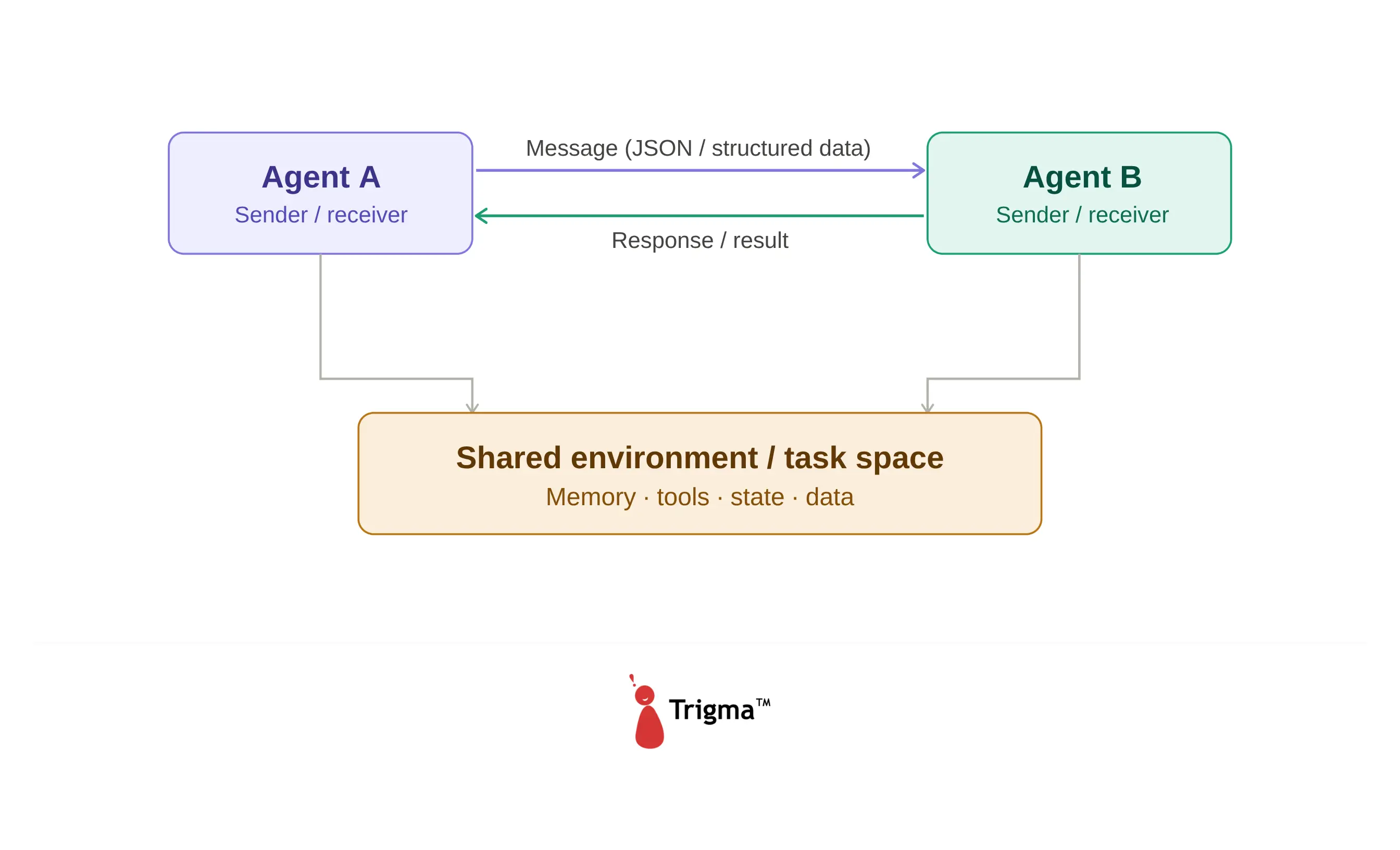
Agents don't communicate in natural language; they exchange structured data, typically in JSON format. This keeps information clear, organized and easy to process automatically.
For example, an extraction agent collects customer data and sends it to an analysis agent in JSON format.
The analysis agent reviews the data and, if a required field is missing, rejects the payload and returns an error code. This triggers the extraction agent to search again, adjust its parameters and resend the corrected data.
3. Orchestration: How the System Decides What Happens Next
Multi-agent systems operate on the principle of orchestration meaning multiple agents working together toward a single goal, managed by a supervisor that calls the right agent at the right time, passes information between them and ensures the final objective is completed.
After each task, the agent returns its results in JSON format. The supervisor then evaluates the output against a set of predefined rules:
- If it meets the criteria, the system moves to the next step
- If it fails, the supervisor rewrites the instructions and sends the task back for correction
When Do Multi-Agent Systems Actually Work Best?
1. Problems That Can Be Parallelized
Multi-agent systems deliver the most value when a problem can be broken into smaller, independent tasks that don't rely on each other's outputs.
For example, if you need to analyze 100 quarterly reports for investment insights, each agent can independently extract key metrics such as revenue growth, profit margins and market position without waiting on another agent.
Once complete, all findings are aggregated into a comprehensive market analysis.
2. Read-Heavy, Write-Light Workloads
When agents are given read-only access to information, they become easier to manage and coordinate. Since they're gathering data independently rather than modifying shared resources, there's minimal back-and-forth between agents.
For instance, if you want to track competitor activity across multiple channels, you could deploy agents as follows —
One monitors news articles, another tracks social media mentions, a third analyzes patent filings and a fourth watches hiring trends. Each agent gathers and prepares its own report independently, with no coordination needed during data collection.
How Trigma Can Help You Build Multi-Agent AI Systems?
As a specialist AI agent development company, Trigma builds and deploys multi-agent systems that integrate seamlessly with your existing infrastructure. Here's how we can help:
- Workflow deconstruction – we turn complex internal processes into clear, step-by-step workflows that AI agents can execute reliably
- Multi-agent orchestration – we build a supervisor agent that enables secure data sharing so multiple AI agents can work together as a coordinated team
- Hybrid planning integration – we combine fixed workflows with autonomous reasoning to handle unpredictable, real-world scenarios
- Production hardening – we add memory databases and scale your infrastructure to handle thousands of interactions across platforms like Microsoft 365, HubSpot and Xero
Whether you're starting from scratch or looking to move beyond basic automation, Trigma can help you design and build the right multi-agent architecture for your business.
FAQs
Is technical knowledge required to operate a multi-agent AI system?
No. Multi-agent systems typically run in the background or through simple chat interfaces, requiring no technical knowledge to use. However, designing, building and maintaining the underlying architecture does require experienced developers.
How much does it cost to build a multi-agent AI system?
Development costs typically range from $30,000 to $600,000, depending on factors such as the number of agents required, the complexity of internal workflows and the external platforms the system needs to integrate with such as a CRM.
Is investing in a multi-agent AI system the right choice for small businesses?
Yes particularly if your business runs repetitive, time-consuming workflows that take up significant staff time.
For example, an SME with around 20 employees handling high volumes of data entry, support tickets or compliance tasks can achieve a strong return on investment by automating these processes and freeing up staff for higher-value work.