performance icon
Top IT Services Company 2025 Top Software Developers 2025 Top Generative AI Company 2025 G2 High Performer Winter 2025 G2 Leader Winter 2025 AI Deployment Company 2024 Top Software Development Company in USA for 2024 Top ReactJs Company in USA for 2024
trigma-logo

How AI Is Transforming Venue Booking into a Seamless, Automated Experience

Finding and booking the right venue for an event has never been easy. From browsing countless options and checking availability to managing continuous calls and unclear pricing, the process is often time-consuming and frustrating. Whether you’re planning a wedding, a business event, or a party, the traditional approach to venue booking is filled with delays, confusion, and unnecessary stress.

However, on the other hand, today’s user demand is for speed, convenience, and personalization. In response, AI-powered event booking software is stepping in as a game changer, transforming how people find, compare, and reserve venues.

The shift isn’t just about technology, but providing users a more convenient and reliable way to book venues.

Let’s discuss in this blog how AI is reshaping the venue booking segment and giving individuals a new and intuitive experience.

Top Ways in Which AI is Transforming the Booking Journey

AI is ruling the entire process of booking a venue. Below are the mentioned areas where artificial intelligence is reshaping venue booking.

1. Smart venue matching

When a user searches for a venue to book parties, AI systems can now process a wide range of inputs like guest counts, location, theme, budget, and preferences to instantly suggest tailored venues. AI systems analyze :

  • Historical preferences and user behavior
  • Match venues by compatibility and availability
  • Recommended packages, layouts, or even nearby vendors

2. Real-time availability and dynamic pricing

This feature eliminates the frustration of users in discovering a perfect venue. AI-integrated platforms sync calendars in real-time to eliminate the guesswork. They provide the exact availability during seasonal trends, peak demand days, and last-minute discounts. This results in transparent pricing and instant confirmation of booking a venue.

3. Natural language search and voice booking

One of the most user-friendly advancements in AI-powered venue booking is the ability to search using natural language or voice commands. Instead of using rigid filters, user can now simply speak their requirements in everyday language and get smart and relevant results instantly. AI systems equipped with Natural Language Processing (NLP) understand the context and intent behind user queries, making the search faster, more intuitive, and accessible to everyone.

4. AI-powered virtual tours and personalization

Choosing a venue without seeing it in person has always been a gamble. With AI-powered virtual tours, users can explore venues in detail from the comfort of their homes. The immersive experience goes beyond static images and is tailored to your event type. The AI ensures that what you see is relevant to your preferences, theme, guest count, and even time of the day.

5. Intelligent follow-ups and reminders

Planning an event involves securing the venue, managing payments, vendors, and timelines. It’s easy to miss a step when everything is juggling manually. However, AI steps in with intelligent follow-ups and automated reminders that keep the process on track without overwhelming you. AI helps you send timely reminders, recommend next steps, and notify you about your last time availability. These smart nudges are designed to reduce stress, improve decision-making speed, and ensure no detail gets overlooked, all while maintaining a smooth, user-friendly experience.

Why Venue Owners Are Adopting AI?

AI isn’t just beneficial for customers. Venue owners and event managers are increasingly embracing event venue booking software with AI capabilities to streamline operations and boost revenue. Here’s how AI is helping:

Lead qualification: AI identifies high-intent leads and prioritizes them for the sales team.

Inventory optimization: By analyzing booking patterns, AI suggests optimal pricing strategies.

Feedback analysis: AI tools analyze post-event reviews to pinpoint areas of improvement.
Do You Own A Venue

Traditional Struggles of Venue Booking

Here are the reasons why change was necessary in the hassle of the venue booking culture.

1. Manual discovery

Browsing dozens of venue websites or contacting multiple vendors individually.

2. Inconsistent communication

Delays in responses, miscommunications, and errors in pricing or availability.

3. Limited personalization

Non-customized options that don’t cater to specific guest counts, budgets, or event types.

4. Fragmented workflows

No centralised dashboards to track enquiries, payments, and planning.

For those who are figuring out how to book a venue for an event, the journey often feels like solving a puzzle without all the pieces.

The Future Landscape

The future of AI in venue booking is headed towards agentic systems, AI that can autonomously handle complex bookings on your behalf. It includes an AI agent that negotiates with venues, builds your entire booking journey, and even integrates your guest listing and preferences. As an AI model becomes more complex or autonomous, the process of booking a wedding venue will be as simple as having a conversation.

Final Thoughts

AI is revolutionizing the way venues are discovered, evaluated, and reserved. It’s no longer about just listing spaces online; it’s about building intuitive, guided experiences that remove friction and add value. If you're still relying on outdated methods or juggling multiple vendors and spreadsheets, it’s time for an upgrade. Leverage the power of AI to transform your event booking from stressful to seamless.

Ready to Upgrade Your Experience?

At Trigma, we offer AI-integrated venue booking solutions to meet the unique needs of event planners, individuals, and venue owners.

Let’s talk about building your AI-powered booking system today.
Build an AI-Powered Custom Software for Real Estate

In the competitive world of real estate, Artificial Intelligence stands as the most impactful innovation in the industry. Moving beyond the realm of hype, AI becomes a practical and result-driven tool for real estate. From automating property listings and enhancing client interactions to predicting market trends and streamlining property management, AI-powered software is revolutionizing how agencies, companies, and investors operate.

According to a report by market.us, the global AI in real estate is estimated to reach USD 41.5 billion in the year 2033, indicating a substantial opportunity for enterprises to jump into this game. The growth is not driven just by numbers but by advancements that are leading the real estate industry.

From enterprises, startups, to mid-sized businesses, who are looking to gain an edge, building a custom AI-enabled software platform is a strategic leap towards long-term growth and efficiency.

But the question is still there: What does it take to build such a platform with advanced AI features? What features should you prioritize? And how do you estimate the cost? In this blog, let’s break it down and find the best pathway to build a custom-based AI app.

Why Real Estate Needs an AI-Powered Software?

Real estate deals with high-value transactions, tons of data, and customer decisions driven by emotion and logic. AI can significantly streamline and improve every stage of this process:

1. Smarter lead management

AI algorithm score leads based on engagement, behavior, and budget, helping sales teams focus on high-conversion prospects.

2. Predictive analytics

AI can forecast property prices, rental yields, and investment potential by analyzing market trends, location trends, and buying behavior.

3. Virtual assistants and chatbots

Offer 24/7 customer service through AI-driven bots that can answer queries, schedule viewings, and even pre-qualify leads.

4. Automated valuations and appraisals

Generate instant, data-driven property valuations that are more accurate than manual estimates.

5. Personalized recommendations

AI suggested listings that can match a buyer's unique preferences, ensuring an increase in engagement and retention.

Types of AI Solutions You Can Build for Real Estate

Depending on your business models, here are some powerful AI integrations to consider:

AI Solution Use Cases
CRM automation Streamline client communication, follow-ups, or reporting
Image recognition Tag property images, detect features automatically
Market intelligence tool Help investors make data-backed decisions
Property management platform Automate rent collection, maintenance requests, and tenant screening
AI-powered mobile app Offers buyers and renters a seamless search and discovery experience

Key Features to Include in Your AI-Driven Real Estate Software

Your AI-powered real estate platform should go beyond traditional functionality. To truly stand out and deliver value, below are the essential features to include:

1. Advanced property filters

Allow users to filter properties by location, budget, number of bedrooms, amenities, property type, and more. With AI, filters can become smarter, learning from user experience and refining results over time for a more personalized search experience.

2. Interactive maps and location intelligence

Helps buyers and renters visualize properties on dynamic maps with layers. AI can enhance this by suggesting emerging hotspots and investment-worthy neighbourhoods based on trends and data.

3. AI chat support

Provide 24/7 virtual assistance through AI-powered chatbots that answer common questions, schedule viewing, collect user data, and guide users through listing, all without human intervention. This improves lead capture and enhances customer experience.

4. Auto price estimation tools

Use machine learning models to evaluate pricing based on property features, market trends, historical data, and location. This helps both buyers and sellers make informed decisions and also supports agents in setting competitive prices.

5. Lead scoring and customer profiling

AI can analyze user behavior, interaction history, and demographic data to automatically score leads and predict which ones are most likely to convert, helping your sales team focus their efforts wisely.

6. Real-time alerts and smart suggestions

Notify users instantly about new listings, price changes, or properties that match their interests. AI makes this smarter by understanding user intent and suggesting listings they didn’t know they were looking for.

7. Admin dashboards and analytics

Give administrators access to powerful dashboards that visualize KPIs like user engagement, top-performing listings, sales pipeline, and campaign performance, all driven by real-time data and AI-generated insights.

8. Integrate with MLS (Multiple Listing Service)

Ensure your platform is always up to date by syncing with MLS feeds or other regional databases. AI can enrich this data by categorizing listings, fixing inconsistencies, and even generating missing descriptions or tags.

Want a feature-rich platform with seamless AI integration?

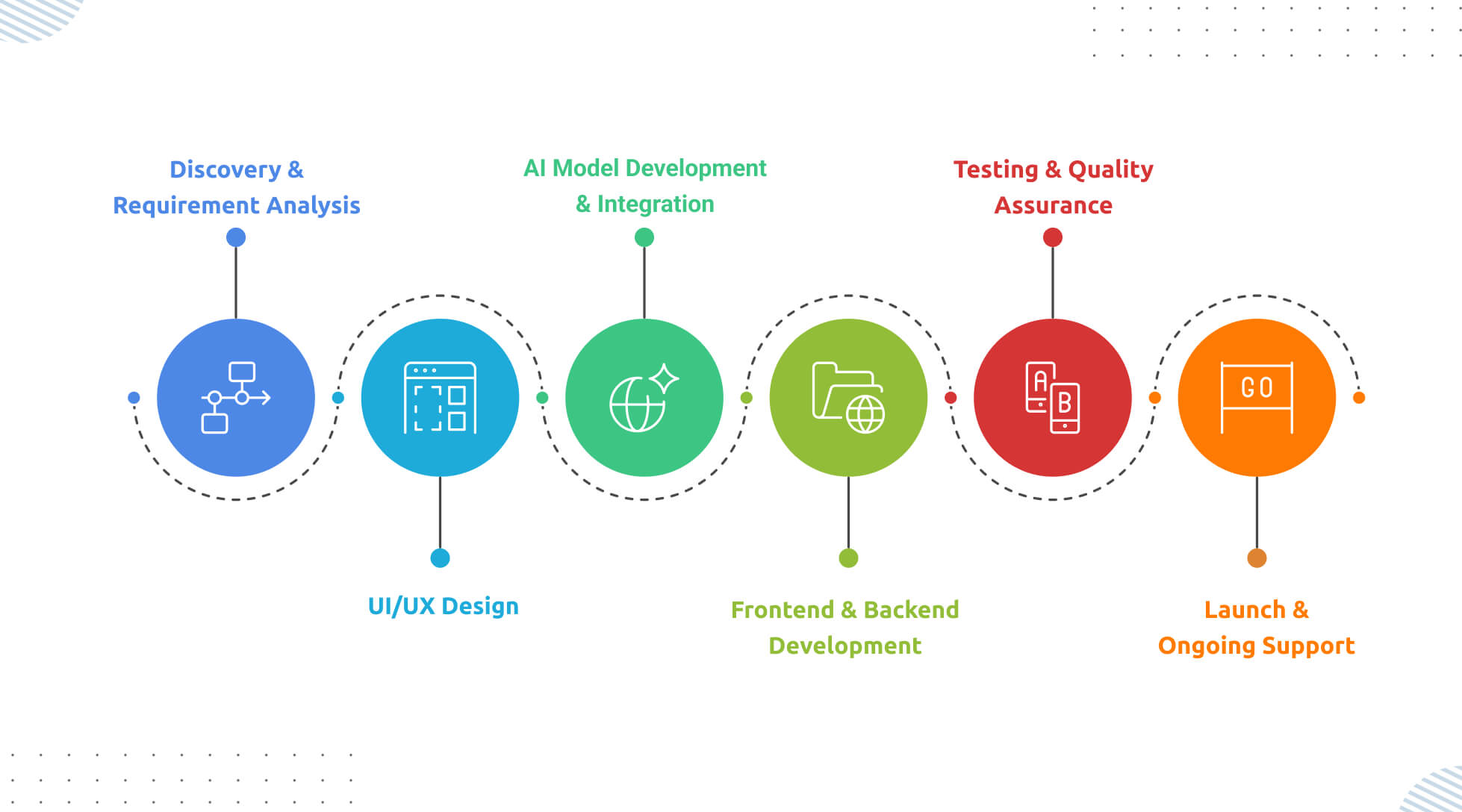
The Development Process of Building a Custom Real-Estate App

Building an AI-powered real estate platform is more than just coding; it’s about creating a seamless, scalable, and smart solution tailored to your business goals. Here's a step-by-step breakdown of what to expect during the development journey:

Development Process of Building a Custom Real-Estate App

1. Discovery and requirement analysis

Every great product is built with clarity. In this phase, your development partner should work closely with your team to understand your business models, user goals, and unique needs.

  • Define key objectives
  • Identify user personas and workflows
  • Analyze competitors and market benchmarks

2. UI/UX design

Once the blueprint is clear, focus on crafting engaging and mobile-friendly interfaces that users will love.

  • Wireframes and interactive prototypes
  • Visual branding aligned with your business identity
  • Navigation flow designed for effortless user journeys

A well-designed UI reduces bounce rates and increases conversions, especially in real estate platforms.

3. AI model development and integration

Align the power of AI-driven systems with your solutions. Depending on your goals

  • Select or build machine learning models
  • Prepare and clean your real estate data
  • Train, test, fine-tune the AI with optimal results
  • Integrate it seamlessly into your workflows

4. Frontend and backend development

This is the core engineering phase, where your platform begins to take shape, reflecting your vision.

  • Backend: Build a scalable architecture and connect APIs
  • Frontend: Develop the web or mobile interface
  • AI Integration: Embed models for real-time results
  • Security, database, and user access management

5. Testing & quality assurance

Before launching, every feature must be rigorously tested to ensure reliability and performance across devices.

  • Functionality and performance testing
  • AI accuracy validation
  • Cross-platform and cross-browser checks
  • Bug fixing and optimization

6. Launch & ongoing support

With everything ready, it’s time to go live and showcase your solution in the market. It includes:

  • Platform deployment and monitoring
  • Performance tuning and AI re-training
  • Regular feature upgrades and maintenance
  • User feedback integration

Cost To Build An AI-Powered Real Estate Platform

The cost can vary widely depending on your requirements:

Project Type Estimated Cost
Basic AI add-ons for the existing platform $10,000 - $30,000
Full-scale AI real estate CRM or platform $50,000 - $2,00,000
Advanced AI apps with predictive features & data analytics $50,000 - $3,00,000+

Factors Affecting the Cost of Building a Real Estate Platform

The cost of developing an AI-driven real estate platform can vary significantly based on several key factors:

1. Project scope & complexity

More features are equal to more time and resources. A basic AI chatbot costs far less than a full-scale, predictive analytics platform.

2. AI capabilities

Custom-trained machine learning models, NLP engines, and predictive algorithms require advanced data handling and development, which can impact cost.

3. Data volume and quality

The accuracy of AI relies heavily on the quality and quantity of data. Cleaning, training, and managing large real estate datasets may increase initial development time and cost.

4. Design and user experience (UX)

A well-designed platform that prioritizes UX often involves additional investment in wireframes, prototypes, and iterative feedback sessions, but it pays off in user retention.

5. Tech stack and integrations

Costs can vary depending on whether you use open-source tools, licensed APIs, or custom-built integrations (e.g., with MLS, payment gateways, or CRM systems).

6. Development team expertise

Hiring a specialized AI development team with real estate domain knowledge may come at a premium, but it reduces risk and accelerates delivery.

7. Maintenance and scaling needs

Post-launch costs such as AI model retraining, cloud hosting, platform upgrades, and new feature development can influence your long-term budget.

Ready to Transform Your Real Estate Business with AI?

Whether you're an agency, startup, or property tech company, AI can elevate how you find leads, close deals, and grow your business. But to get it right, you need the right technology partner.

Let’s talk. At Trigma, we specialize in building AI-powered custom solutions that deliver results. From discovery to deployment, we ensure your software is fast, future-ready, and fully aligned with your goals

How Do Agentic AI Frameworks Differ from Traditional AI Systems

We have all reached an era where AI is quite a familiar thing for us. AI has redefined the culture of every work and emerged as a most demanded innovation in the world of technology. From customer support chatbots to recommendations, AI has been a support tool for everyone. AI systems analyze our data, generate outputs, and follow predefined rules, making the systems more effective.

With all this, AI lacks one thing: it waits for a command and follows predefined instructions. However, Agentic AI frameworks are changing that. They take initiative, solve problems, and act independently. Instead of waiting for the commands, it proactively works towards goals, makes strategic decisions, and adapts to new information on its own. They are the next step in AI evolution, bringing us closer to truly autonomous machines that can operate even in complex environments.

Let’s discuss how Agentic AI is different from traditional AI and why it’s a game changer and a shift in the future of technology.

What exactly are Traditional AI systems?

Traditional AI systems are rule-based or learning-based models that operate within predefined parameters. They analyze the available data, make predictions, automate tasks, and make decisions based on the research. Traditional AI has powered automation across industries and marks a significant leap forward in the future of technology.

Characteristics of Traditional AI

AI-powered personalized treatment plans analyze patient data, such as medical history, genetics, and lifestyle factors, to create highly customized care strategies. This targeted approach enhances treatment accuracy, ensuring better patient outcomes by adapting healthcare solutions to each patient's specific needs and conditions.

1. Reactive, not proactive

Traditional AI waits for a command and follows instructions rather than taking the initiative and making decisions independently.

2. Predefined model

It functions according to the programmed rules or trained models to generate responses.

3. Limited adaptability

As AI is a trained model, its actions are predefined, and it doesn’t actively adjust its goals or rethink strategies without human intervention.

4. Single task focused

Traditional AI is made to perform one-time tasks, it struggles with multi-step reasoning or planning.

Types of Traditional AI

Traditional AI holds a deeper significance as it marks the beginning of AI innovations.

1. Rule-based AI

This system operates on the if-then logic that is usually used in chatbots and expert systems. It gives you answers accordingly as per they trained.

2. Machine learning models

This includes learning and concluding the fed data. They are usually used in recommendation engines or fraud detection.

3. Deep learning systems

They are advanced neural networks that recognize patterns and respond to user queries. Siri and Alexa are the most commonly used NLP models.

What are Agentic Frameworks?

Agentic Frameworks are AI systems that are designed to operate independently without any human intervention. It includes setting goals, making decisions, and adapting to new information without the need for human input. It can plan and take independent actions to achieve objectives.

Key Features of Agentic AI

1. Proactive decision making

It works towards goals independently rather than waiting for instructions.

2. Autonomous problem solving

Agentic AI is excellent in identifying challenges and finds solutions without human intervention.

3. Adaptive learning

It doesn’t work on fed information, although it continuously learns from interactions, updates its knowledge, and refines its approach.

4. Multi-step reasoning

It usually breaks down complex tasks into steps, prioritizes actions, and identifies mistakes on its own.

Working of Agentic Models

It works with the involvement of multiple technologies that include:

1. Reinforcement learning (RL)

It includes AI to learn by trial and error and refining strategies over time.

2. Large language models (LLMs)

Agentic AI understands and processes a vast amount of data, enabling the use of its intelligent reasoning.

Examples of Agentic AI

Auto GPT & Baby AGI: AI agents that break down and execute tasks with minimal human input.

AI Research Assistants: They can generate hypotheses, analyze findings, and suggest new research directions.

AI That Thinks, Learns & Adapts

At Trigma, we don’t just follow trends—we create them. Our Agentic AI solutions help you enhance efficiency or even revolutionize your industry with AI that thinks and adapts.

How Can Agentic AI Perform Tasks Without Human Intervention?

You might be wondering how AI can set goals independently and perform tasks without human intervention. Let’s break it down:

Agentic AI operates autonomously, but it still requires an initial purpose or high-level directive but it doesn’t need step-by-step instruction. It observes and analyzes data from its environment to make decisions. Agentic AI doesn’t watch in a human-like way, but it monitors, inputs, patterns, and trends to determine what actions to take.

Example: A self-driving car isn’t watching you, but it continuously scans roads, detects obstacles, and decides on a route based on its observations in real time.

Sources of Data for Agentic AI

Agenetic AI doesn’t watch people in a creepy way, but it does observe patterns, analyze data, and make decisions based on its inputs—just like any intelligent system designed to operate autonomously.

1. User interactions

AI-powered assistants like ChatGPT learn from conversations and adjust responses based on user needs.

2. Sensors

Automated robots scan their surroundings using sensors, GPS, and real-time input.

3. Digital history

AI-driven analytics tools track user behaviour like website visits, recent search queries and more.

4. External data sources

AI agents scan the internet, APIs, and database to gather relevant updates and insights.

Shaping the Future of Intelligence

AI is making advancements, and agentic AI is one of the immersive innovations that is changing the landscape of the present tech world. AI is more than just a tool, it’s intelligence that can make decisions, solve problems, and drive innovation.

As one of the top agentic AI companies, Trigma is part of this transformation and helping businesses integrate world-class AI solutions that deliver real, measurable results. With a team of experienced developers and AI experts, our agentic AI services help you leverage AI and build solutions that matter.

Being a leading agentic AI company, we deliver solutions across all industries as per the user’s unique needs. If you’re thinking of getting a competitive advantage in your business, partner with us and take the next step in AI innovation.

AI-Powered Healthcare App Development for Smarter Patient Care

Step into the future of healthcare with AI-powered apps that are transforming the way medical services are delivered. Imagine accessing personalized care 24/7, receiving real-time health monitoring, and getting quicker diagnoses— all from the palm of your hand. AI-driven digital healthcare apps are bridging the gap between patients and providers, making healthcare more accessible, efficient, and tailored to individual needs. Whether it’s virtual consultations or predictive health analytics, AI is enhancing patient experiences, boosting healthcare efficiency, and revolutionizing the medical landscape.

In this blog, we’ll explore the key benefits and standout features of AI-powered digital healthcare apps and how integrating AI-driven automation, like virtual assistants and predictive analytics, can transform patient care.

Benefits of AI in Digital Healthcare Apps

The usage of AI for patient-centered healthcare solutions is transforming the medical field by making it more personalized and innovative. The following points highlight the benefits of using AI in healthcare apps:

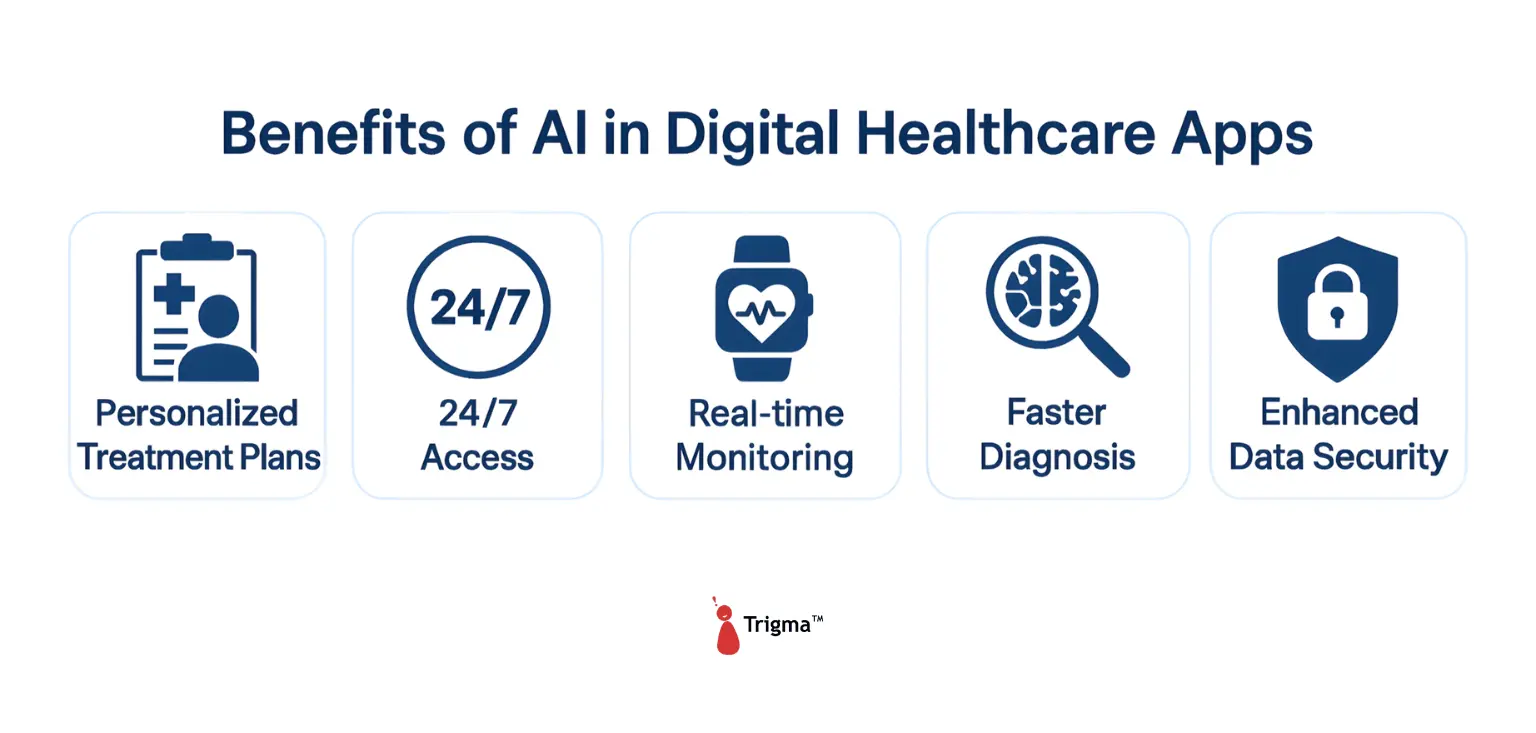
Infographic showing the benefits of AI in digital healthcare apps including personalized treatment plans, 24/7 access, real-time monitoring, faster diagnosis, and enhanced data security.

Personalized Treatment Plans

AI-powered personalized treatment plans analyze patient data, such as medical history, genetics, and lifestyle factors, to create highly customized care strategies. This targeted approach enhances treatment accuracy, ensuring better patient outcomes by adapting healthcare solutions to each patient's specific needs and conditions.

24/7 Access

AI-powered healthcare apps offer 24/7 access to medical services, enabling users to consult healthcare professionals, receive guidance, and monitor their health anytime, anywhere, ensuring continuous care without geographical barriers.

Real-time Monitoring

AI-powered wearables and mobile apps enable continuous monitoring of patient vital signs and health metrics. Real-time data tracking helps detect abnormalities and provides instant feedback for timely interventions.

According to a GoodFirms survey on AI in healthcare, 49% of respondents believe AI can help reduce errors in healthcare delivery, particularly through real-time data tracking and predictive alerts, making monitoring more accurate and proactive than ever.

Faster Diagnosis

AI algorithms accelerate diagnosis by analyzing medical images, test results, and patient data with high accuracy. This enables quicker detection of conditions, reduces diagnosis time and allows healthcare providers to implement faster treatments, ultimately improving patient outcomes.

Enhanced Data Security

AI-based systems can improve data security by identifying potential threats and vulnerabilities, detecting fraudulent activity, and ensuring that patient data is protected through advanced encryption and security protocols.

Exclusive Features Of An AI-Powered Digital Healthcare App

If you’re planning to develop an AI-powered healthcare app, here are some standout features to include for a user-centric experience:

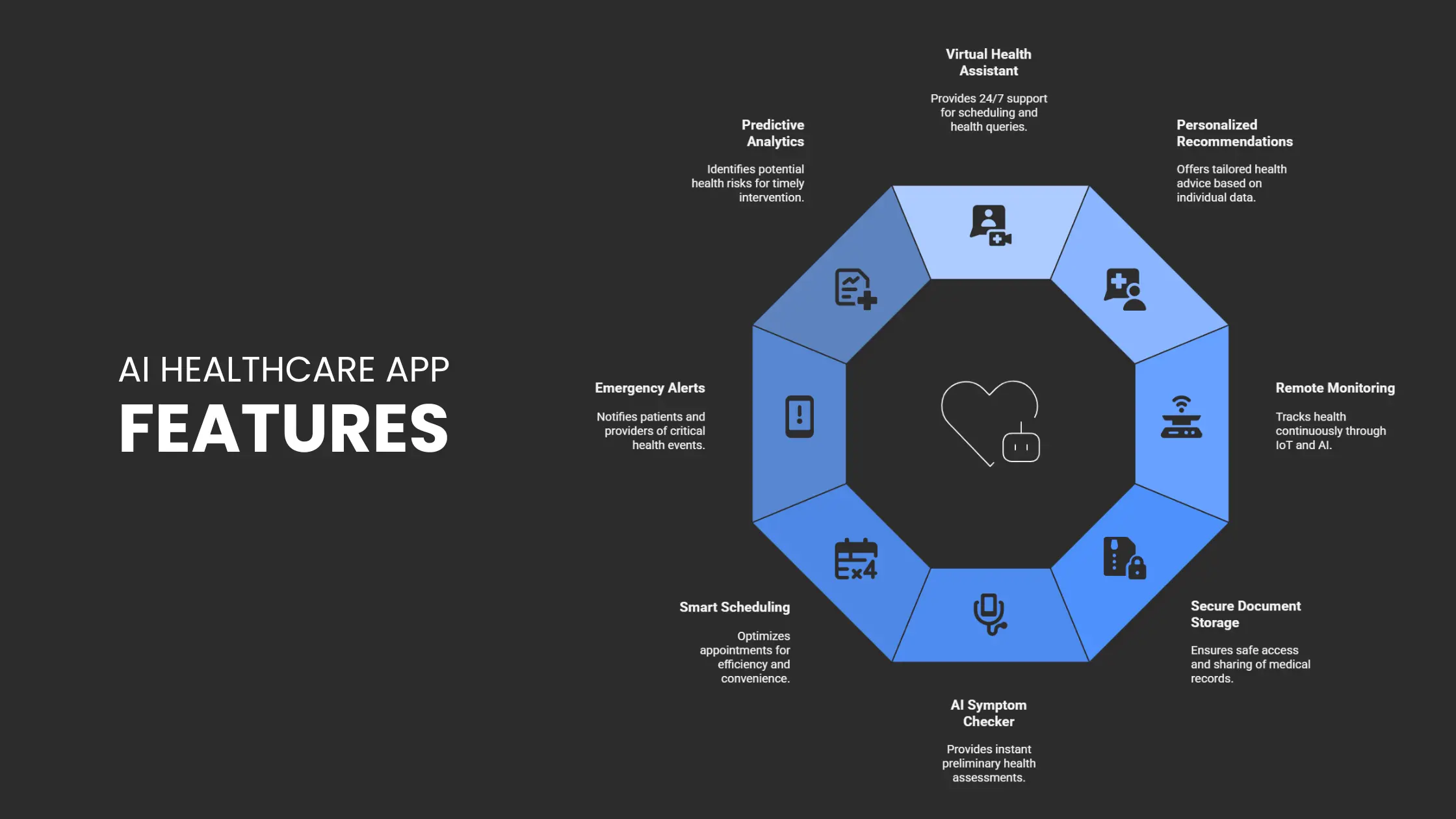
AI Healthcare App Features

1. Virtual Health Assistant

AI-powered virtual assistants help patients with scheduling, medication reminders, and answering health-related queries, available 24/7 for seamless interaction.

2. Personalized Health Recommendations

AI algorithms analyze patient data to provide tailored health recommendations, such as lifestyle changes, exercise routines, and diet plans, ensuring optimal care for each individual.

3. Remote Patient Monitoring

Remote Patient Monitoring (RPM) revolutionizes healthcare by enabling continuous health tracking through IoT devices and AI-driven analytics, fostering proactive care and improving outcomes for both patients and providers.

4. Secure Document Storage & Sharing

This feature allows patients to securely store and access their medical documents, prescriptions, and test results with advanced encryption. Ensures seamless, secure sharing with healthcare providers while maintaining privacy and compliance.

5. AI Symptom Checker

The feature will allow users to input symptoms and receive instant preliminary assessments. It provides insights into possible conditions and helps determine whether further consultation with a healthcare provider is needed.

6. Smart Appointment Scheduling

The AI-integrated feature helps with intelligent scheduling, optimizing appointment slots based on urgency, patient availability, and healthcare provider schedules, reducing wait times, and ensuring smooth operations.

7. Emergency Alerts and Notifications

Through this feature the app can detect critical health events (e.g., cardiac arrest, seizures) and instantly notify both patients and healthcare providers, ensuring immediate intervention and reducing the risk of severe health complications.

8. Predictive Health Analytics

AI-driven predictive analytics help identify potential health risks early by analyzing patient data, enabling timely intervention and preventive care for improved outcomes.

Cost of AI-Powered Healthcare App Development

The cost to build an AI-powered healthcare app depends on several key factors such as app features, design complexity, development platform, and team location. Other aspects like data integration, security compliance, and scalability can also impact the overall budget. Below is an estimated breakdown of AI-based digital healthcare app development costs to help you plan your investment effectively.

App TypeEstimated Cost (USD)Description
Basic App20,000 – 40,000Includes essential healthcare features like user registration, appointment booking, and basic AI functionalities.
Moderate App40,000 – 70,000Offers interactive features such as real-time monitoring, AI symptom checker, and secure data sharing.
Advanced App70,000 – 100,000+Includes complex integrations like predictive analytics, virtual assistants, IoT device support, and custom dashboards.

Note: Factors such as custom design, third-party integrations, and ongoing maintenance or updates can influence the overall development cost.

Trigma- Your Trusted Healthcare App Development Partner

Planning to build an AI-powered healthcare app? Trigma is your trusted partner, offering end-to-end healthcare app development services. As the global AI in healthcare market is projected to grow from USD 26.69 billion in 2024 to USD 613.81 billion by 2034, we deliver secure, personalized, and efficient solutions to enhance patient care and improve outcomes.

Lead the Healthcare Revolution with AI

Let’s create an AI-powered app with Trigma to enhance patient care, streamline processes, and empower providers to transform the future of medicine.

How Trigma Helps Set Up Your GCC

In today’s digital landscape, businesses are continuously looking for smarter, more efficient ways to scale operations, drive innovation, and stay competitive. One such strategic move is setting up a Global Capability Centre (GCC).

Whether you’re a startup looking to expand globally or a Fortune 500 company trying to optimize your operations, establishing a GCC can be a changer. But setting one up, especially in a different country, can be a complex, resource-intensive process without the right guidance.

That’s when looking for a trustworthy partner like Trigma can be a wise decision.

With deep expertise, strong local presence, and an end-to-end execution model, Trigma helps international brands to set up their GCCs in India with speed, efficiency, and confidence.

Let’s discuss what exactly this journey looks like and how Trigma makes it easier and hassle-free.

What is GCC?

A Global Capability Centre (GCC) is an offshore unit that performs strategic functions for the parent company, typically in areas like IT, software development, data analytics, customer support, R&D, finance, and HR.

Unlike traditional outsourcing, GCCs are fully owned and operated by the parent company, which allows for greater control, alignment, and integration with global business goals.

India currently hosts over 1,600 GCCs for top global enterprises — from Google and Microsoft to Walmart and JPMorgan Chase, with its deep talent pool, cost-efficiency, and tech infrastructure.

Why Set Up a GCC in India?

Below are the listed reasons why setting up a GCC can be a strategic move.

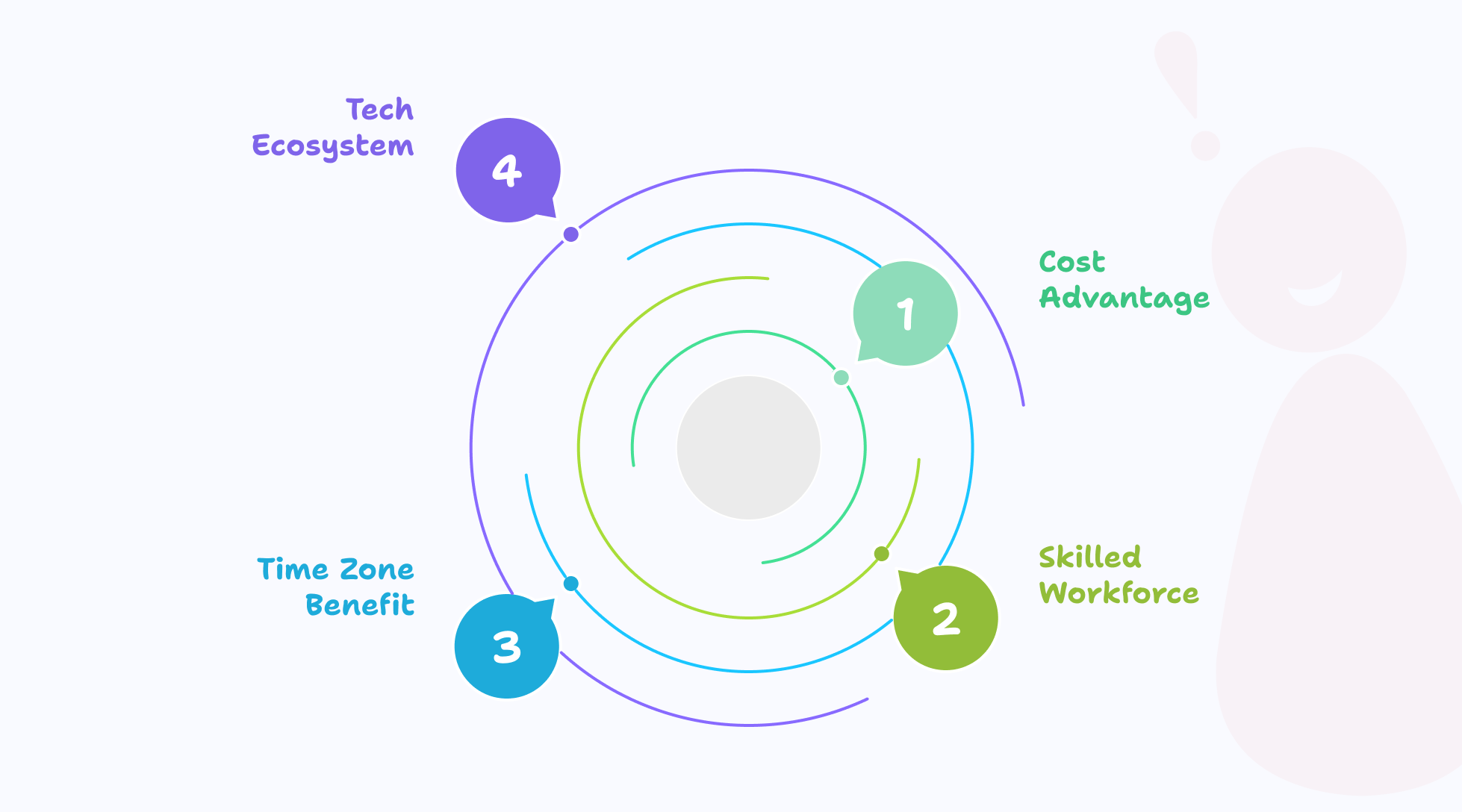
Set Up a GCC in India

1. Cost advantage

You can get access to high talent at a lower rate than in Western markets. This enables cost savings without compromising on quality.

2. Skilled workforce

India produces a million graduates every year. The talent here is not only tech-savvy, but also English proficient, making collaboration easier.

3. Time zone benefit

India’s time zone benefits global operations, enabling round-the-clock productivity.

4. Tech ecosystem

India has a robust digital infrastructure and a rapidly growing innovation ecosystem, with global MNCs already tapping into it.

How Trigma You Set Up a GCC - Step by Step

Here is the detailed process of how Trigma makes it easier to set up a GCC in India.

Strategic consultation and planning

1. Strategic consultation and planning

Setting up a GCC is not a one-size-fits-all. We begin by understanding your business needs, goals, and timelines.

  1. What functions are you looking to offshore?
  2. What kind of talent do you need?

Trigma provides strategic input and helps you decide the most suitable operating model. We then develop a customised GCC roadmap tailored to your business goals.

Location identification & infrastructure setup

2. Location identification & infrastructure setup

Choosing the right city in India matters. Some functions may benefit from being in Bangalore (tech hub), others in Gurgaon (enterprise), or Hyderabad (R&D). We help you Select the right city based on your industry, cost structure, and talent needs.

  1. Secure suitable office space - flexible, scalable, and ready to move in.
  2. Ensure access to high-speed internet, cloud server, and power backup.

We also manage vendor negotiations, lease agreements, and tech infrastructure setup, so you don’t have to worry about operational friction.

Regulatory compliance and legal support

3. Regulatory compliance and legal support

Setting up in a new country means navigating its legal and compliance landscape. Trigma ensures that your GCC

  1. Is registered under the right business structure (LLP, Pvt Ltd, etc).
  2. Is compliant with local laws, including tax, labour, data privacy and IP protection.
  3. Receives guidance on the government incentives for foreign companies.
Talent acquisition & team building

4. Talent acquisition & team building

With over 15 years of experience in IT services and consulting, we’ve built a strong talent network in India. We help you

  1. Hire top-tier talent across roles — developers, analysts, QA engineers, project managers, etc.
  2. Conduct interviews, assessments, and onboarding.
  3. Implement customised training and learning, and development programs to match your standards.

Whether you want a team of 10 or 100, we’ll help you quickly and cost-effectively.

HR, payroll, and admin operations

5. HR, payroll, and admin operations

Running an offshore is much more than just hiring. We take care of:

  1. Monthly payroll, tax filings, and statutory deductions.
  2. Employee benefits, insurance, and retention strategies.
  3. HR policies, attendance systems, and performance appraisals.
Technology & security enablement

6. Technology & security enablement

We ensure your GCC is equipped with the right tools and technologies to integrate seamlessly with your global operations.

  1. Setting up secure VPNs, cloud access, and collaboration platforms.
  2. Ensure data privacy and access control systems.
  3. Implementing cybersecurity best practices and ISO level standards.
  4. Your intellectual property remains secure, and your works like just an extension of your HQ.
Ongoing support and scale

7. Ongoing support & scale

Trigma stays onboard as your trusted growth partner. We offer

  1. Continuous monitoring and optimization.
  2. Support in expanding to new cities or units.

Our goal is not just to help you set up, but to help you succeed.

Why Partner with Trigma?

Here’s what makes Trigma a preferred GCC partner:

1. Proven expertise

15+ years in IT and digital services. Trusted by clients across the US and UK.

2. Local Presence

Headquartered in India with a branch in the U.S., we understand both worlds — culturally and operationally.

3. End-to-End Execution

From strategy to staffing to scaling — everything under one roof.

4. Agility

We set up your GCC in record time, without compromising quality.

Final Thoughts

As businesses expand globally, owning a piece of the innovation engine becomes essential. A well-structured GCC isn’t just a cost center — it becomes a value creator for your organization.

With Trigma by your side, you don’t just set up a GCC in India — you build a future-ready extension of your business that drives growth, innovation, and agility. If you’re planning to set up a GCC or are exploring what it could mean for your business, Trigma support is here.

Reach out to us today, and take your first step toward global success.

Build your GCC in India with confidence

Trigma helps you set up a future-ready capability centre with ease, from hiring to operations.