+91-98558-85133
 +1(702)760-3099

Building a business in a highly competitive world can be challenging. Agility, innovation, and speed are seen as strong pillars and often separate successful ventures from the rest. In this race, Artificial Intelligence (AI) has emerged not as a support tool, but as a strategic growth engine. From automating repetitive tasks to uncovering customer insights and driving product innovation, AI for startup growth has become a necessity.
Whether you’re building a SaaS product, launching a consumer tech brand, or scaling a D2C venture, understanding how startups use AI can unlock massive efficiency, scale, and profitability. In this blog, we’ll break down the ways AI can drive business growth and how early-stage startups can implement AI effectively.
Turn Your Startup Vision into an AI-Driven Success Story
Why AI Matters For Startups in 2025?
Surrounded by a data-driven economy, startups are already sitting on a goldmine. From user behaviour to marketing analytics, every touchpoint holds a valuable insight. AI is the key that unlocks these insights and turns them into action.
With the advancement of Generative AI, Agentic AI, AI/ML-powered automation, and predictive analytics, AI is no longer for large enterprises. It’s accessible, scalable, and customized for startups.
Business growth with AI is accelerating across industries, as companies that are opting for intelligent solutions are seeing significant cost savings on repetitive manual tasks, faster go-to-market speed, and enhanced customer experience and personalization.
Key Areas Where Startups Can Use AI
Let’s break down how startups can practically use AI across various business functions:
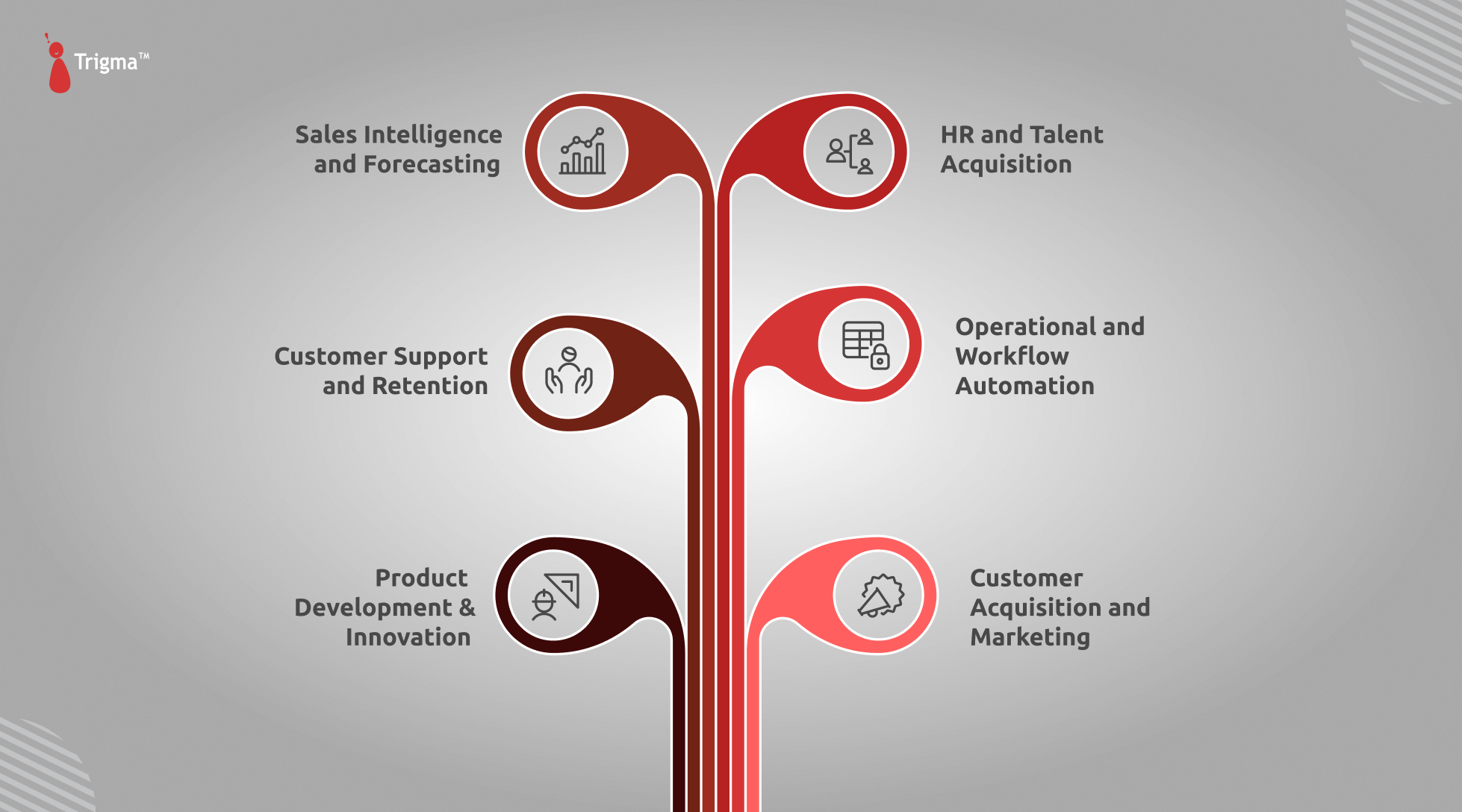
1. Product development & innovation
AI can help businesses and startups in understanding market trends, customer pain points, and user feedback at scale, incorporating smarter product decisions.
Real use-cases
- AI-driven product recommendation engines
- Feature prioritization based on user sentiment analysis
- Testing UI/UX variations with AI-generated design ideas
Example
A fintech startup uses AI to analyze support tickets and user feedback to detect bugs or prioritize product features, leading to faster iterations and higher user satisfaction.
2. Customer acquisition and marketing
Marketing budgets are tight in early-stage startups. AI for startups shines by optimising customer acquisition through data. This data is proven to be a secret sauce for many businesses if used and targeted correctly.
Real use-cases
- AI-powered ad campaign optimization (Google Ads, Meta Ads)
- Predictive lead scoring and targeting
- Personalization of content, emails, and landing pages
- Conversational AI (Chatbots and voice assistants)
Example
An e-commerce startup integrates AI to auto-generate personalized product emails and social media content, resulting in higher engagement and reduced CAC.
3. Customer support and retention
Delivering consistent, high-quality customer support is a challenge when you’re small. AI helps scale this and build trust with your user.
Real use-cases
- AI chatbots for 24/7 instant support
- Sentiment analysis to proactively address customer dissatisfaction
- Automated follow-ups or ticket classification
Example
A SaaS startup implements a multilingual AI chatbot and reduces workload by 60%, allowing the human team to focus on complex queries.
4. Operational and workflow automation
AI helps reduce the manual burden of routine operations, giving back time for strategy and execution.
Real use-cases
- Automated invoice generation and accounting via OCR
- Smart inventory and supply chain management
- AI-generated reports, dashboards, and documentation
Example
A logistics startup uses AI to optimize delivery routes based on traffic data and reduce fuel costs.
5. Sales intelligence and forecasting
AI can sharpen your sales efforts by analyzing behavior, identifying conversion patterns, and even forecasting future sales.
Real use-cases
- Lead prioritization using predictive analytics
- Real-time CRM insights
- Sales pipeline forecasting using historical data
Example
A B2B SaaS startup integrates AI into its CRM to automatically recommend the next-best action for each deal, boosting closure rates.
6. HR and talent acquisition
Recruiting and retaining top talent is a bottleneck for most startups. AI streamlines hiring, employee engagement, and retention.
Real use-cases
- Resume parsing and intelligent candidate screening
- AI-assisted performance analytics
- Predictive modeling
Example
An early-stage startup uses AI to scan 10,000+ resumes and shortlists the top 100 candidates in minutes, saving weeks of effort.
Roadmap For Startups to Get Started With AI
If you’re wondering how to get started, you don’t need a big data science team or a massive budget. Start small, scale fast.
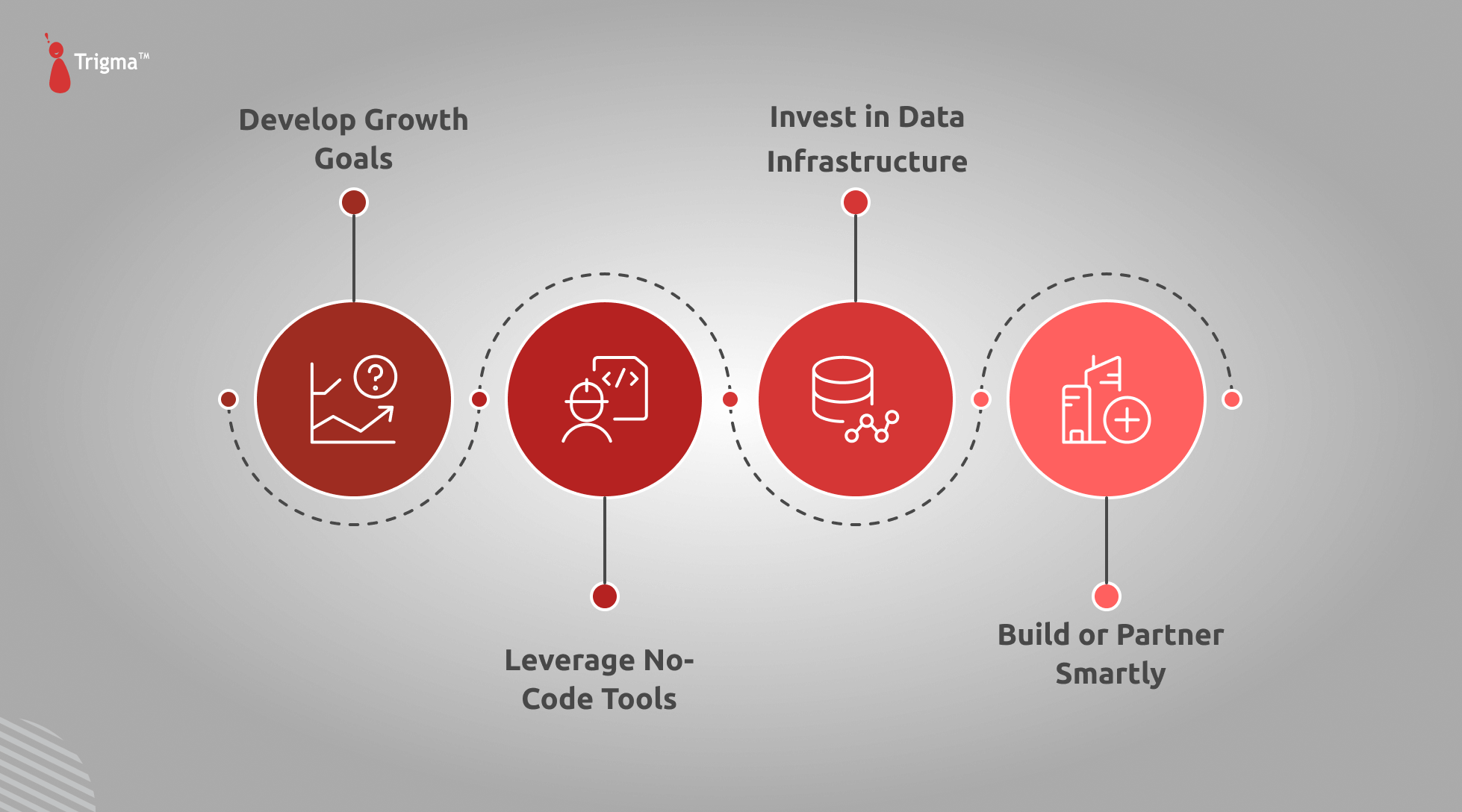
1. Develop your growth goals
Identify your business bottlenecks. Is it lead generation? Customer churn? Product feedback? Map out which areas AI can solve efficiently.
2. Leverage no-code tools
Leveraging these platforms enables rapid prototyping, cost-efficiency, and faster time-to-market for AI-driven solutions.
3. Invest in data infrastructure
AI usually works on data. Ensure you’re tracking relevant user data, behavior, and analytics.
4. Build or partner smartly
If you’re not ready to step into the market alone, partner with the right tech partners who specialize in AI for startup growth. You can also go for a white-labeled solution for faster deployment.
Also read - How Can Generative AI Benefit Your Business?
The Future of AI in Startups
The role of AI in startups is just getting started. As technologies like agentic AI, autonomous workflows, and multi-modal AI models evolve, the future will empower startups to run leaner, faster, and more intelligently than ever before.
Expect startups to move beyond using AI just for automation or analytics. The next wave will involve AI acting as co-founders, making strategic decisions, managing operations, and even building products end-to-end. With tools becoming more intuitive and open-source models more accessible, even bootstrapped teams will compete with industry giants, fueled by AI.
Moreover, with responsible AI development gaining momentum, ethical AI adoption will become a key differentiator. Startups that focus on transparency, fairness, and data privacy will build more trust and long-term value.
In short, AI won't just support startup growth; it will define how startups are built, launched, and scaled in the future.
Final Thoughts
AI is no longer a futuristic concept, it’s a practical, scalable growth partner for startups ready to move fast and make smarter decisions. When it is properly integrated, AI doesn’t just optimize your operations, it transforms how you innovate, compete and scale. Whether you’re bootstrapping your first MVP, or preparing to scale globally, now is the prime time to make AI a core part of your strategy.
At Trigma, we specialize in helping startups harness the full potential of AI, from idea to execution. Whether you’re building your first MVP, refining your product, or scaling to new markets, we bring our technical expertise and help to get your business succeed.
Partner with Trigma to turn your startup vision into an AI-driven success story.
From building intelligent solutions to driving automation, personalization, and growth, we help startups move from idea to impact, faster.