
 +91-98558-85133
 +1(702)760-3099


Key Takeaways:
- RCM software development companies help healthcare teams improve eligibility checks, authorization preparation, claims processing, denial management, and payment workflows.
- Choose a partner with healthcare expertise, relevant project experience, strong security practices, and EHR, clearinghouse, and payer integration capabilities.
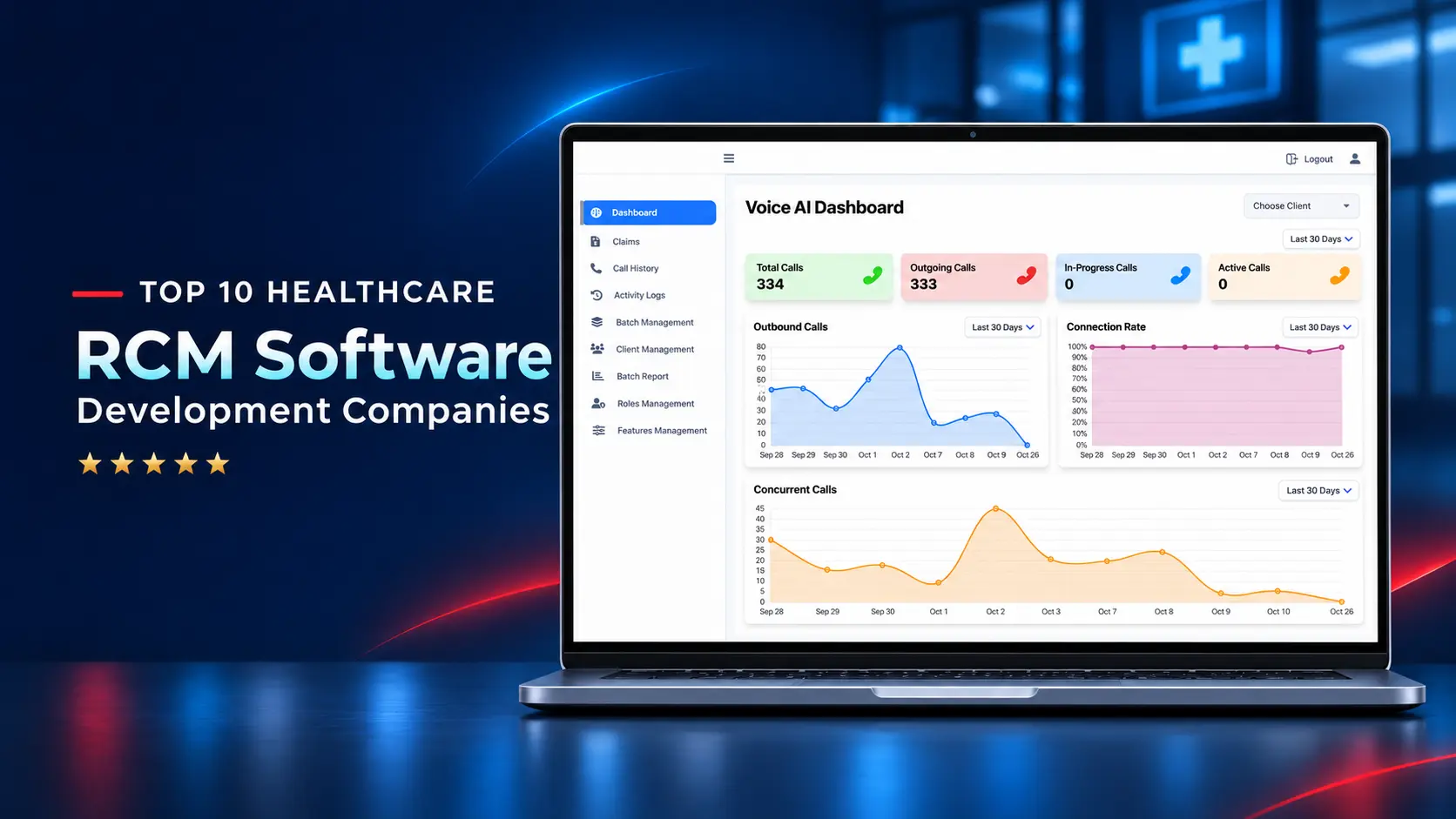
- Trigma’s AI-powered RCM solution connects case preparation, billing handoffs, and insurance follow-up, with case preparation up to 10 times faster.
- AI voice agents can automate routine payer calls and capture claim updates, denial reasons, and next actions while specialists retain clinical and coding decisions.
- Start with the workflow causing the most delays, and evaluate results through denial rates, accounts-receivable days, accuracy, and staff time saved.
The 2024 CAQH Index identifies $2.6 billion in potential savings from electronic claim submission across the medical and dental industries, including $2.5 billion in medical transactions. It also estimates that electronic submission can save medical providers 7 minutes per transaction. Those figures show why better-connected billing workflows deserve attention.
A claim can be submitted on time and still sit unpaid because eligibility information is incomplete, an authorization is missing, or the payer response never reaches the billing team. When those gaps repeat across thousands of encounters, improving the software becomes an operational priority.
The right RCM software development company helps healthcare organizations keep claims moving, manage denials, and track payments across the revenue cycle. Here are 10 companies to consider when building or improving your RCM software.
01WHAT TO LOOK FOR
How to Choose a Developer for Your Revenue Cycle
Healthcare RCM software development requires an understanding of how clinical documentation, payer rules, financial transactions, and staff workflows connect. Evaluate prospective teams against these six criteria.
01
RCM Workflow Expertise
Ask the team to explain how it handles eligibility, authorization, coding inputs, claims, denials, and payments. A workflow-specific specialist can be a strong choice when you have a clearly defined problem.
02
EHR and Payer Integration Capabilities
Look for relevant EHR, practice management, clearinghouse, and payer connections. Ask which interfaces are available in your environment and who will manage production access, data mapping, and onboarding.
03
Security and Traceability
Review access controls, encryption, audit records, and data handling before sharing patient information. Ask how the team will document and validate the controls required for your deployment.
04
Evidence From Comparable Projects
Request a relevant case study, a reference, or a walkthrough of delivered software. Separate a proposed feature from a capability already operating in a comparable setting.
05
Automation With Review Controls
Understand which actions run automatically and which require staff approval. Denial appeals, coding suggestions, and uncertain payer responses need clear escalation paths.
06
Automation With Review Controls
Clarify responsibility for payer-rule changes, interface failures, monitoring, and enhancements. Compare the ongoing engineering cost as well as the initial build.
02COMPARE YOUR OPTIONS
Top RCM Software Development Companies: Quick Comparison
Use this overview to identify relevant specializations before reviewing the individual profiles.
| Company | Founded | Team Size | Key RCM Specialization | Client Rating |
|---|---|---|---|---|
| 01Trigma | 2008 | 50–249 | AI-powered RCM automation for authorization preparation, billing handoffs, and payer follow-up | 5.0 |
| 02Peerbits | 2011 | 50–249 | Custom RCM platforms and workflow modules | 4.8 |
| 03DreamSoft4u | 2003 | 50–249 | Medical billing, remittance and EHR integration | 4.5 |
| 04Taction Software LLC | 2013 | 50–249 | X12 EDI and healthcare billing integration | 4.6 |
| 05Fortunesoft IT Innovations | 2009 | 50–249 | RCM platforms and legacy modernization | 5.0 |
| 06Webority Technologies | 2012 | 50–249 | Registration through billing and analytics | NA |
| 07OSP Labs | 2009 | 50–249 | Custom claims, denials and revenue reporting | NA |
| 08MindK | 2009 | 50–249 | Agentic benefits verification and RCM automation | 4.9 |
| 09Tateeda | 2013 | 50–249 | Medical billing and payment system engineering | 4.9 |
| 10Zymr | 2012 | 50–249 | AI-enabled RCM and multi-EHR modernization | 4.5 |
03THE SHORTLIST
10 Development Teams to Consider for Your RCM Project
COMPANY 01 / 10
1. Trigma
FOUNDED
2008
TEAM SIZE
50–249
CLIENT RATING
5.0
Trigma brings extensive healthcare experience to RCM automation through its AI-powered RCM solution. The solution supports healthcare providers and RCM companies with pre-authorization, case preparation, billing handoffs, and insurance A/R follow-up.
AI voice agents navigate payer IVRs, communicate with insurance representatives, and capture claim statuses, denial details, and next actions. This is one example of how AI agents are being applied to complex business workflows across industries, as discussed in our overview of companies building AI agent solutions.
Trigma’s AI-powered RCM solution makes case preparation 10 times faster by assembling clinical records, patient information, and treatment details for professional review. To assess its delivery record through client feedback and project experience, explore Trigma’s client reviews.
Expertise:
- Eligibility, benefits, and pre-authorization readiness checks.
- Clinical records and patient data assembly for case preparation.
- Documentation gap detection for billing review and submission.
- AI voice agents for payer IVRs and insurance follow-up.
- Claim status, denial reasons, and payment update capture.
- Individual and batch calling across insurance A/R worklists.
- Account routing, payer references, transcripts, and reporting.
Why Choose Trigma:
- Connected support from authorization preparation to claim follow-up.
- Case preparation 10 times faster, with specialist review before submission.
- Rated 5.0 and 4.9 across 260+ combined reviews on independent and reputable platforms
- 750+ projects delivered across 20+ industries since 2008
- Healthcare workflow knowledge, with clinical and coding decisions kept with professionals.
BUILD WITH TRIGMA
Bring Your RCM Workflows Together With AI-Powered Automation
Prepare authorization cases, organize billing documentation, and automate routine insurance follow-up with Trigma’s AI-powered RCM solution. Give your RCM specialists more time to focus on denials, appeals, and complex accounts.
- 1000+ projects delivered
- 20+ industries
COMPANY 02 / 10
2. Peerbits
FOUNDED
2011
TEAM SIZE
50–249
CLIENT RATING
4.8
Peerbits offers dedicated RCM software development services covering new platforms, legacy modernization, and healthcare SaaS products. Its development services connect patient access with claims, denials, payment posting, and executive reporting.
Its AI capabilities help staff prioritize work and prepare responses, with human review for consequential decisions. It is worth considering when the project requires several connected modules or a proprietary product roadmap.
Expertise:
- Eligibility verification and prior authorization workflows.
- Claim validation, denial queues, appeals, and payment posting.
- EHR connectivity using FHIR, HL7, and X12 EDI interfaces.
- Custom medical billing and multi-tenant RCM SaaS platforms.
COMPANY 03 / 10
3. DreamSoft4u
FOUNDED
2003
TEAM SIZE
50–249
CLIENT RATING
4.5
DreamSoft4u brings healthcare software and interoperability services to medical billing projects. Its billing solutions cover claim management, clearinghouse workflows, patient payments, and reconciliation through its MBSOFT offering.
DreamSoft4u also builds custom RCM modules and connects them with EHR systems. Teams can work with the company on a new billing application, adapt an existing product, or connect billing tools with the systems they already use.
Expertise
- Medical billing software development and claim workflow automation.
- Electronic remittance and payment reconciliation.
- Patient payment gateway integration.
- Healthcare data exchange and EHR connectivity.
COMPANY 04 / 10
4. Taction Software LLC
FOUNDED
2013
TEAM SIZE
50–249
CLIENT RATING
4.6
Taction Software LLC connects clinical applications with billing and payer systems. Its developers use Mirth Connect, HL7, and X12 EDI to move eligibility, claims, and remittance data between applications.
For organizations dealing with duplicate data entry or disconnected billing tools, Taction can help automate the exchange of financial and clinical information. Discuss your transaction types and clearinghouse connections when planning the integration.
Expertise
- X12 270/271 eligibility transactions and 837 claims generation.
- 835 electronic remittance advice and payment auto-posting.
- Charge capture interfaces from clinical systems.
- Denial resubmission workflows and healthcare integration.
COMPANY 05 / 10
5. Fortunesoft IT Innovations
FOUNDED
2009
TEAM SIZE
50–249
CLIENT RATING
5.0
Fortunesoft IT Innovations builds custom revenue cycle systems for care providers, billing companies, and enterprise healthcare organizations. Its offering covers platform development as well as optimization of existing financial workflows.
Its stated focus on legacy modernization is relevant for teams whose billing platform needs substantial changes. For billing service businesses, its services also include managing workflows and reporting across multiple clients.
Expertise
- Custom RCM platform design and development.
- Coding, charge capture, and billing automation.
- Claims tracking, denial handling, and resubmission.
- Patient payment tools and legacy system modernization.
COMPANY 06 / 10
6. Webority Technologies
FOUNDED
2012
TEAM SIZE
50–249
CLIENT RATING
NA
Webority Technologies builds RCM software around an organization’s registration, billing, and payment processes. It works with hospitals, clinics, diagnostic labs, and companies handling billing for multiple clients.
The lab-specific scope is useful for buyers whose requirements include high test volumes and charge capture from laboratory systems. Its broader approach connects financial workflows with existing healthcare applications and reporting.
Expertise:
- Patient registration, eligibility, and charge capture.
- Claims submission, denial management, and payment posting.
- EHR, hospital information, and laboratory system integration.
- Patient billing, accounts-receivable views, and analytics.
COMPANY 07 / 10
7. OSP Labs
FOUNDED
2009
TEAM SIZE
50–249
CLIENT RATING
NA
OSP Labs offers custom revenue cycle software designed around payer rules, specialties, user roles, and EHR or practice management environments. Its service scope spans the patient-to-payment lifecycle, including revenue reporting.
OSP can add AI-powered claims validation and denial automation to its core RCM software. Teams can begin with billing workflows, integrations, and reporting, then add AI where it addresses a clear operational need.
Expertise:
- Eligibility checks and prior authorization readiness.
- Claim preparation, denial work queues, and payment posting.
- Patient balances, reconciliation, and revenue dashboards.
- Integration with EHRs, clearinghouses, and payment systems.
COMPANY 08 / 10
8. MindK
FOUNDED
2009
TEAM SIZE
50–249
CLIENT RATING
4.9
MindK combines custom RCM development with agentic automation for tasks such as benefits verification and payer interaction. It offers both complete applications and an automation layer that works with existing systems.
Its GoodBilling platform connects patient intake, eligibility checks, benefits verification for complex plans, EMR integration, and claim creation from signed clinical notes. That example is relevant for teams trying to improve the handoff from patient access to billing.
Expertise:
- Eligibility and verification-of-benefits automation.
- Payer portal and voice workflows.
- Claim creation and EHR or clearinghouse integration.
- Custom workflow applications and RCM automation middleware.
COMPANY 09 / 10
9. Tateeda
FOUNDED
2013
TEAM SIZE
50–249
CLIENT RATING
4.9
Tateeda provides custom medical billing and claim-processing software development alongside staff augmentation. Its services include patient payment systems, claims administration, and integration with healthcare applications.
The engagement options are relevant for buyers deciding between a managed delivery team and engineers who join an existing product organization. Confirm which billing interfaces and payment providers are included in the proposed scope.
Expertise:
- Custom billing portals and claim-processing applications.
- Payment workflows and financial system integration.
- EDI 837 and 835 transactions and HL7 FHIR connectivity.
- Architecture, engineering, QA, and team augmentation.
COMPANY 10 / 10
10. Zymr
FOUNDED
2012
TEAM SIZE
50–249
CLIENT RATING
4.5
Zymr built an AI-enabled RCM platform that unified billing workflows across seven EHR systems. The scope included eligibility verification, claims scrubbing, denial prediction, payer interactions, and financial analytics.
Zymr reports a 96% clean-claims rate and a reduction in days sales outstanding from 52 to 38 for that engagement. The example makes it worth evaluating for complex modernization programs; ask how the reported measures were defined and validated.
Expertise:
- Consolidation of revenue workflows across multiple EHRs.
- AI-assisted claims review and denial prediction.
- Payer portal orchestration and eligibility checks.
- Claims visibility, payer reporting, and revenue analytics.
04HOW TRIGMA HELPS
Connecting Authorization Preparation and Insurance Follow Up With Trigma
Prepare Authorization Cases and Billing Documentation
Trigma's AI-powered RCM solution helps verify eligibility and benefits, organize clinical attachments and medical necessity documentation, and track authorization status. It consolidates patient demographics, insurance information, clinical records, and treatment details, then flags missing information for billing review. Qualified professionals retain responsibility for clinical decisions, coding judgment, and final review before submission.
Automate Routine Payer Calls Across Insurance A/R
AI voice agents navigate IVRs and communicate with payer representatives to check pending, denied, and reprocessed claims. The AI-powered RCM solution captures denial explanations, documentation requests, payment updates, and available adjustment codes. Individual and parallel batch calling help teams manage high-volume worklists without manually placing every call.
Give Specialists Clear Account Actions
Transcripts, call history, payer reference numbers, and follow-up dates keep insurance A/R activity documented. Trigma’s AI-powered RCM solution records unresolved issues and routes accounts for correction, appeal, or further follow-up. Client-specific accounts, worklists, reporting, and user access help RCM providers organize activity across multiple healthcare clients.
05BEFORE YOU HIRE
Five Questions for Your RCM Development Shortlist
YOUR PARTNER INTERVIEW CHECKLIST
5 questions to bring to your next call
01
Can you show a comparable RCM implementation?
Ask what was actually delivered, which workflows remain manual, and whether a client reference or product walkthrough is available.
02
How will you connect to our existing systems?
Request an interface plan covering EHRs, clearinghouses, payers, data ownership, and error recovery. Confirm the external approvals needed before production access.
03
What happens when automation cannot complete a task?
Ask how uncertain results reach staff, what context is preserved, and how duplicate claims or repeated financial actions are prevented.
04
How will we measure the result?
Agree on baseline measures and definitions. Depending on scope, track denial rates, days in accounts receivable, payment posting accuracy, or manual effort per task.
05
Who owns and maintains the software after launch?
Clarify source-code ownership, third-party licenses, documentation, support commitments, and the cost of future payer or interface changes.
06YOUR QUESTIONS, ANSWERED
FAQs
Should we build a complete RCM platform or automate one workflow
Start with one workflow when your existing platform works well but a task such as eligibility verification or payer follow-up creates delays. A complete platform makes more sense when fragmented systems, limited customization, or product ownership requirements affect the entire revenue cycle.
What does an RCM software development company do
An RCM software development company designs, builds, integrates, and maintains software for healthcare revenue operations. Engagements can cover patient access, claims processing, denial workflows, payment posting, analytics, or a focused module connected to an existing platform.
How is RCM software different from medical billing software
Medical billing software generally focuses on charges, claims, invoicing, and payments. RCM covers a broader journey, including eligibility, authorization, documentation handoffs, denials, and collections. Product boundaries vary, so compare actual modules and workflows.
How much does custom RCM software development cost
There is no single reliable price for every project. Module scope, integrations, data migration, claim volume, automation, and security requirements all affect the budget. Ask for a discovery-based estimate that separates development, third-party fees, infrastructure, and ongoing support.
How does Trigma connect case preparation with insurance follow-up?
Trigma’s AI-powered RCM solution organizes clinical records, patient demographics, insurance information, and treatment details into a structured case file, flagging missing information for billing review. After submission, the solution captures payer responses, claim and authorization statuses, denial explanations, payment updates, and reference numbers. RCM specialists use this information to determine the next account action.
07THE TAKEAWAY
Turning Revenue Cycle Challenges Into Better Workflows
Choosing among RCM software development companies starts with identifying what slows your revenue cycle. Whether it is incomplete eligibility checks, delayed payer follow-up, recurring denials, or disconnected billing systems, look for a partner with relevant healthcare experience and the ability to work with your existing technology.
Trigma’s AI-powered RCM solution brings authorization preparation, case management, billing handoffs, and payer follow-up into a connected RCM workflow. With faster case assembly, documented insurance calls, and clear next actions, healthcare providers and RCM companies can reduce repetitive administrative work while keeping clinical review, coding decisions, appeals, and complex accounts with qualified professionals.


