+91-98558-85133
 +1(702)760-3099

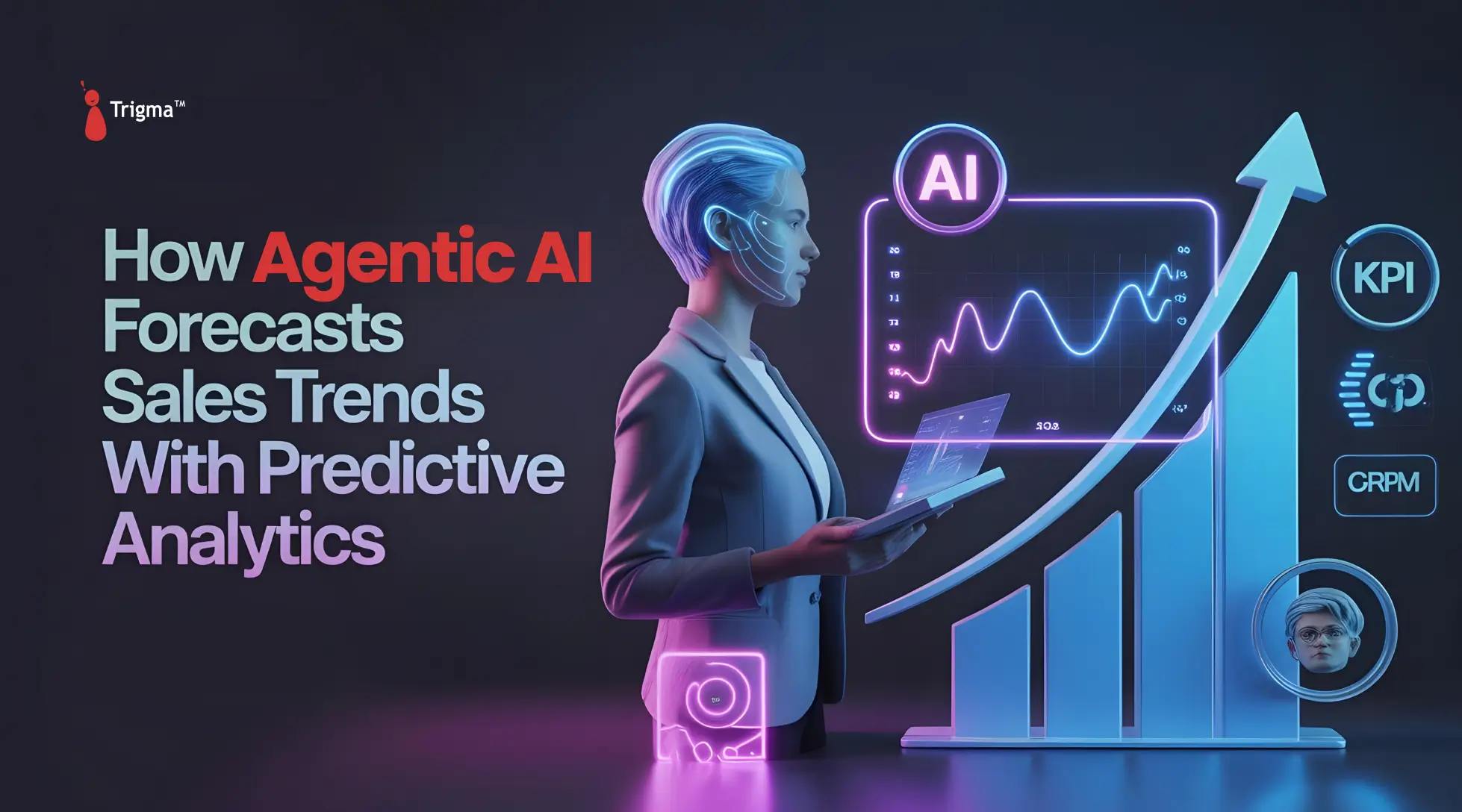
Sales forecasting has always been a cornerstone of enterprise strategy, underpinning revenue planning, resource allocation, and supply chain optimization. However, in today’s hyper-volatile market, legacy forecasting approaches, static spreadsheets, and quarterly roll-ups are increasingly inadequate. These methods failed to capture the complexity of fragmented data ecosystems, unexpected demand signals, and exogenous market shocks such as supply chain disruptions, macroeconomic volatility, and computer interventions. This results in a persistent gap between the forecasted projections and real-world outcomes, resulting in misaligned inventory and revenue leakage.
Agentic AI introduces a paradigm shift in predictive analytics. Agentic architectures deploy autonomous, goal-oriented agents capable of adapting data ingestion, multivariate modeling, and simulation in a closed-loop framework. These AI agents for analytics continuously sense, reason, and act across dynamic environments by integrating real-time data streams and autonomously triggering corrective actions.
This blog delves deeper into the value of agentic AI in sales and how traditional sales approaches are incapable of generating effective ROI. It also discusses the technical components of agentic forecasting along with its impact on business. Let’s get started.
Why Traditional Sales Forecasting Falls Short
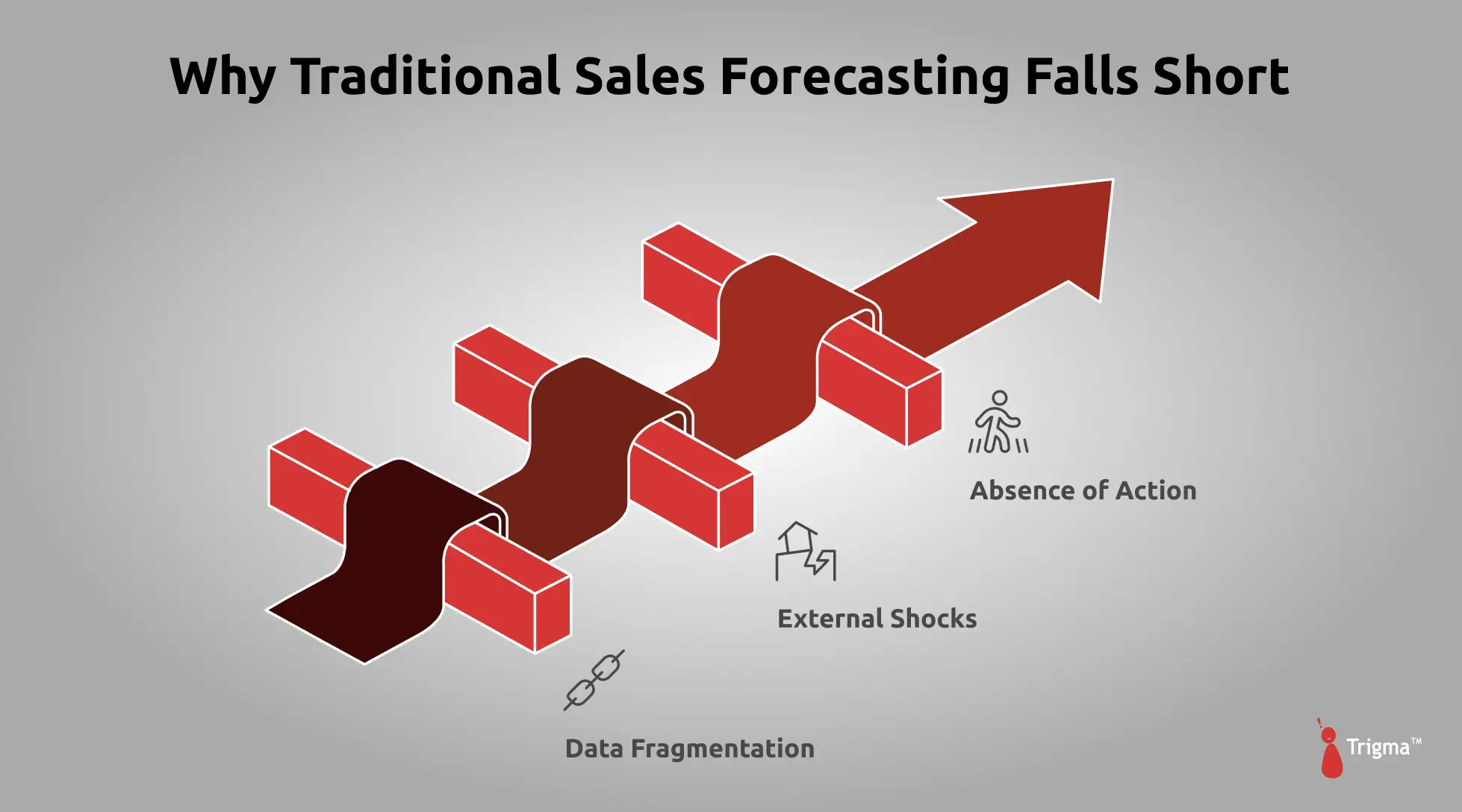
1. Data fragmentation and latency
In modern enterprises, sales signals are distributed across multiple systems: the point of sale terminals, CRM platforms, ecommerce sites, and digital advertising channels. Traditional forecasting relies on batch ETL (Extract, Transform, Load) pipelines that aggregate this data into a central warehouse, and by the time the forecast is generated, the underlying data may already be outdated. This latency means that organizations are relying on yesterday’s reality rather than today’s. This lacks real-time data synchronization, resulting in delayed responses and lost opportunities.
2. External shocks
Demand patterns are rarely stable. They are non-stationary and change over time. Seasonal shifts, promotional campaigns, or events alter buying behavior that is completely unpredictable. Worse external shocks from macroeconomic events, raw materials shortages, or even extreme weather can break forecasting models altogether. As a result, forecasts tend to over-smooth volatility, leading to businesses overstocking in declining markets or understocking in surging ones.
3. Not defined action
When forecasts are accurate, they are often delivered as static reports or dashboards on spreadsheets that planners must interpret. Therefore, the real gap arises because forecasts are not directly aligned with operational execution systems, like inventory management, ERP, or sales outreach tools. This creates a heavy dependency on human analysts, and the lag between insight and action deepens. Traditional systems fail to close this loop, which is why businesses often complain that their forecasts are “interesting but not actionable.”
Close the gap between insight and action, discover how agentic AI integrates forecasts directly into your ERP and CRM systems.
What Makes Agentic AI Different
Agentic AI is built on autonomous, goal-driven agents that collaborate to achieve defined business objectives. Instead of a single monolithic forecast, agentic systems orchestrate multiple data analytics AI agents:
- Data agents clean and prepare real-time data streams.
- Modeling agents run ensembles of statistical and machine learning models.
- Simulation agents conduct what-if analyses.
- Planner agents convert forecasts into executable strategies.
This agent mesh approach transforms forecasting into a continuous, closed-loop cycle, ie, ingest, predict, simulate, act, and learn.
Core Technical Components of Agentic AI Forecasting
Agentic AI for sales forecasting is not a single model, but a multi-agent architecture where specialized components collaborate in a closed-loop system. Each agent handles a critical function: data ingestion, modeling, simulation, planning, execution, and governance. Together, they transform static forecasts into adaptive, self-learning ecosystems.
1. Data fabric and ingestion agents
In modern enterprises, relevant signals originate from multiple domains, transactional sales, CRM pipelines, promotions, digital footprints, logistics, and even external indicators such as macroeconomic indices or weather data.
- Real-time ingestion pipelines
Tools like Kafka or Change Data Capture (CDC) ensure that data flows continuously instead of relying on outdated batch uploads. - Feature stores
Platforms such as Feast or Hopsworks store engineered features (promotion flags, price indices, channel mix) in a time-aware manner, ensuring that models always train and predict on the correct historical context. - Data agents
Autonomous agents validate schemas, impute missing values with statistical methods, and tag data quality metrics.
This ensures that the forecasting system operates on fresh, accurate, and standardized data streams.
2. Modeling agents
Agentic AI doesn’t rely on a single algorithm but deploys modeling agents that orchestrate ensembles of diverse approaches:
- Classical time series models (ARIMA, SARIMAX, Prophet) for seasonality and trend detection.
- Machine learning models (LightGBM, Random Forest) for handling tabular features like promotions, discounts, or sales rep activity.
- Deep learning architectures to capture complex multivariate time series dependencies across product categories, regions, and customer segments.
The modelling agents dynamically select and weight models using meta learners, ensuring continuous adaptation as demand patterns evolve.
3. Simulation & scenario agents
Forecasts alone are not enough; enterprises need to know what if. Simulation agents stress-test forecasts under multiple hypothetical conditions:
- Monte Carlo simulations to generate probabilistic demand and distributions.
- Counterfactual scenarios (“what if we raise the price by 5%, what if a shipment delay hits region B”)
- Elasticity testing that models customer response to promotional levers.
These simulations allow planners to move from static point forecasts to decision-ready distributions, quantifying upside, downside, and risk exposure.
4. Orchestration agents
Planner agents are the decision-making brains of the system. They
- Translate forecast outputs into action recommendations
- Respect operational constraints such as supply chain lead times, budget ceilings, and service level agreements.
- Prioritize actions expected by ROI, balancing accuracy with the cost of intervention.
Instead of leaving forecasts as “informational dashboards,” planner agents bridge the gap to execution.
5. Execution and feedback loops
A key differentiator of agentic AI is its ability to close the loop between prediction and action. Execution agents integrate directly with enterprise systems:
- ERP/SCM integration to trigger procurement and replenishment orders.
- CRM/ Marketing automation to initiate targeted outreach based on forecasted demand shifts.
- Dynamic pricing engines that adjust promotions in real time.
Crucially, every executed action is logged, and its outcomes (e.g., actual sales uplift, stockouts prevented) are fed back into the models. This self-learning loop continuously reduces error over time.
6. Monitoring and governance agents
Forecasting at enterprise scale demands trust and compliance. Governance agents ensure the system remains reliable and accountable.
- Model drift detection Alerts when performance degrades due to shifting patterns.
- Explainability SHAP or LIME-based attribution to show why forecasts changed
- Fairness and compliance Ensuring recommendations don’t violate regulations or ethical guidelines (e.g., discriminatory pricing).
- Audit trails Every decision and model change is logged for transparency.
This governance layer prevents agentic systems from becoming “black boxes” and ensures stakeholders can validate outcomes.
Business Impact: ROI & Accuracy Gains
Agentic AI transforms sales forecasting from a passive reporting exercise into a strategic profit lever. Beyond improving statistical accuracy, its value lies in measurable business impact across revenue, cost, and operational efficiency.
1. Forecast accuracy improvement
- Traditional statistical models typically deliver 60-70% forecast accuracy depending on the industry.
- Enterprises deploying AI-driven predictive analytics report 20-30% improvement in forecast accuracy.
- This leads to fewer missed sales opportunities, reduces reliance on safety stock, and better capital efficiency.
2. Inventory optimization
A Gartner survey indicates that companies overstock inventory by 10–20% on average due to inaccurate forecasts.
- By integrating forecasting with ERP/SCM systems, execution agents automatically trigger replenishments based on real demand signals.
- This leads to 15–25% lower inventory holding costs while still maintaining service levels.
- This results in reduced warehousing costs, minimized write-offs, and improved working capital utilization.
3. Revenue uplift and sales enablement
- AI-powered forecasting identifies micro-trends such as sudden regional demand shifts or promotional responsiveness.
- In this context, an AI sales assistant functions as a data analytics AI agent embedded into CRM systems, surfacing customer-level predictions and suggesting next-best actions for sales reps.
- By aligning sales activity with predictive insights, organizations see 5–10% uplift in conversion rates and faster pipeline velocity.
AI Sales Assistants: The Human AI Interface
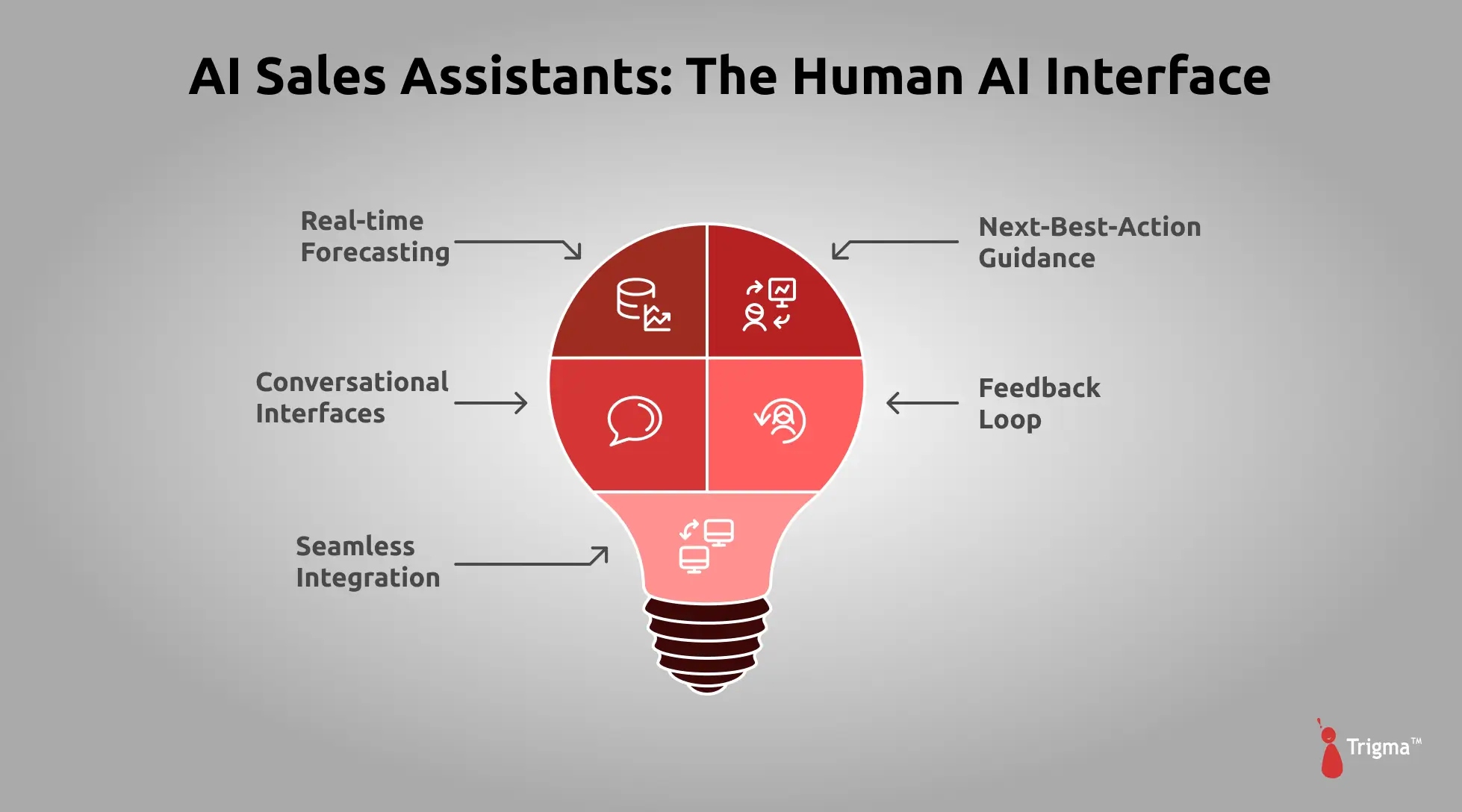
One of the most tangible and business-facing applications of agentic forecasting is the AI sales assistant. While much of predictive analytics and agentic AI operates behind the scenes, optimizing data pipelines, scenario simulations, and ERP integrations, the AI sales assistant becomes the human-AI interface, where predictive intelligence directly augments sales teams.
These assistants function as specialized data analytics AI agents embedded with CRM platforms, digital communication tools, or even voice-enabled interfaces. Their role extends far beyond simple task automation:
- Real-time Forecasting at the Edge
AI sales assistants surface micro-forecasts directly at the rep level, predicting which accounts are most likely to convert, which SKUs are trending in specific geographies, and what timing is optimal for outreach. - Next-Best-Action Guidance
By leveraging the outputs of agentic forecasting models, these assistants recommend context-specific actions: offering a targeted discount, upselling a complementary product, or reallocating time from a low-probability lead to a high-probability one. - Conversational Interfaces
Modern assistants can integrate natural language interfaces, allowing sales professionals to query them as they would a colleague, “What’s the expected Q4 demand for Product Line A in the Midwest?” and receive data-backed answers instantly. - Feedback Loop from Human Judgment
Unlike rigid dashboards, AI sales assistants are interactive. They allow reps to input ground-level intelligence (e.g., “client mentioned budget freeze”), which feeds back into the forecasting system, improving its accuracy and adaptability. - Seamless Integration
By syncing across CRM (Salesforce, HubSpot), ERP, and marketing automation systems, the AI sales assistant ensures that sales strategies are not siloed but aligned with enterprise-wide forecasting outputs.
The result is a symbiotic human-AI interface where predictive analytics becomes not just an enterprise-level planning tool but a day-to-day tactical advantage. For sales leaders, this bridges the final mile, transforming statistical insights into actionable behaviors that drive revenue.
Conclusion
Sales forecasting has evolved from static spreadsheets and quarterly projections into a dynamic, intelligence-driven discipline. Traditional methods, limited by data latency, rigid statistical assumptions, and an execution gap, can no longer keep pace with today’s volatile, non-stationary markets.
Agentic AI closes this gap by combining autonomous data analytics AI agents, advanced predictive modeling, scenario simulation, and real-time orchestration into a self-learning ecosystem. The result is not just greater forecast accuracy, but an adaptive forecasting engine that continuously aligns predictions with execution, optimizing inventory, improving promotional ROI, and enabling revenue growth.
At the frontline, AI sales assistants extend these capabilities directly to sales professionals, creating a human-AI interface where predictive insights become day-to-day tactical advantages. By embedding intelligence into workflows, enterprises unlock a new standard of agility, precision, and profitability.
As competitive landscapes grow more complex and market signals become more fragmented, businesses that embrace agentic forecasting today will not only achieve superior accuracy but also secure a decisive strategic edge in tomorrow’s markets.
Ready to Transform Your Sales Forecasting?
Leverage the power of Agentic AI and intelligent sales assistants to achieve unmatched accuracy, optimize inventory, and drive measurable ROI.