+91-98558-85133
 +1(702)760-3099

60-Second Summary
- Building a healthcare app in 2026 requires more than innovation and demands strict HIPAA compliance to protect patient data and avoid legal risks.
- HIPAA governs how protected health information is collected, stored, shared, and secured, making compliance mandatory for apps handling medical or billing data.
- HIPAA-compliant apps build patient trust, prevent costly fines, and enable secure services like telemedicine, patient portals, and AI-powered healthcare solutions.
- Key compliance practices include secure cloud infrastructure, data separation, end-to-end encryption, audit logs, access controls, and regular security assessments.
- Partnering with experienced HIPAA-compliant app developers helps healthcare businesses build secure, scalable, and future-ready digital health platforms.
Why do some healthcare apps scale confidently while others get stalled by compliance risks and legal red flags?
In 2026, building a healthcare app isn't just about AI innovation or speed to market; it's about protecting patient data in a world of rising breaches and regulations. HIPAA compliance has become a make-or-break factor for digital health success.
In this complete guide, you'll learn what HIPAA compliance really means, why it matters for modern healthcare apps, and how to build AI-powered solutions that are secure, compliant, and future-ready.
What is HIPAA Compliance and Why Does It Matter to Healthcare Apps?
HIPAA stands for the Health Insurance Portability and Accountability Act (1996), which ensures that healthcare providers protect patients' medical information and provide better quality care to them.
It's a strict US law focused on the privacy of patients' data regarding how it's used, shared, secured, and handled.
When developing any healthcare application or platform, you need to ensure that your app complies with HIPAA, meaning billing details, medical records, and insurance-related data should be safeguarded.
Types of Health Data and Regulatory Requirements
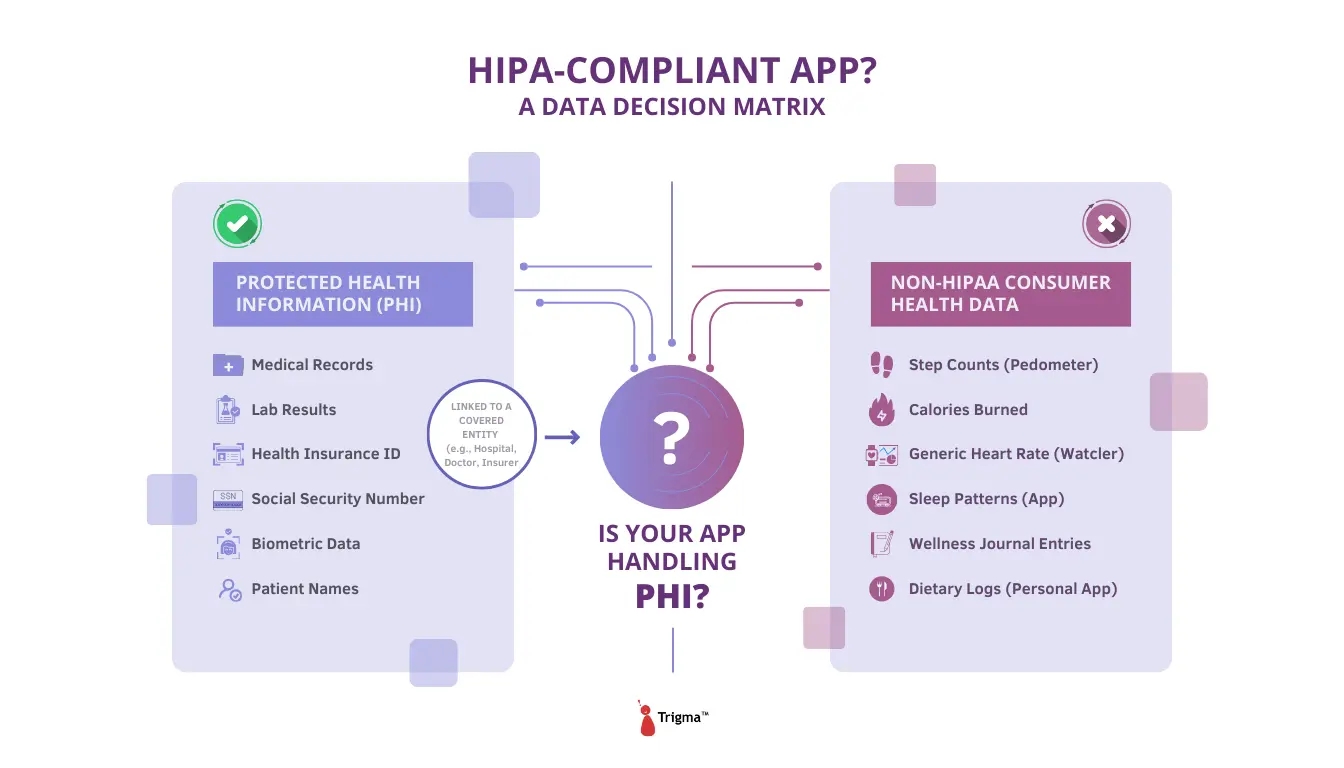
But whether your healthcare app should meet the HIPAA compliance requirements and Privacy rules boils down to one thing : What type of data your app interacts with.
Protected Health Information (PHI)
PHI or ePHI includes anything that helps identify the patient's identity, such as name, email address, birth date, medical conditions, test results, health-related information, and other identifiers.
This means that for delivering healthcare app development services, you should be HIPAA compliant as per the PHI standard.
Consumer Health Information
Consumer-related health information isn't shared with healthcare providers, medical professionals, and insurance companies. This data remains intact within the consumer app ecosystem and is used extensively in consumer-focused digital products such as:
- Wearables and fitness trackers
- Wellness and fitness apps
- Activity tracking apps
Apps such as FitBit and other wellness tracking applications collect the patient's data, such as number of calories burned, heart rate readings, and number of steps.
In this case, HIPAA compliance is not mandatory.
Want to build a HIPAA compliant app for your healthcare business?
What Are the Benefits of Creating HIPAA-Compliant Healthcare Software?
Complying with HIPAA requirements for healthcare application development not only prevents costly fines for healthcare providers but also reassures stakeholders such as customers, ensuring that their data is safe.
For Patients
Here are a few benefits of HIPAA-compliant software:
Protecting Patient’s Privacy
When building an AI powered healthcare application, you need to ensure that patient privacy and their medical information are not compromised.
Healthcare organizations that are HIPAA compliant mean information will only be accessed by authorized stakeholders involved in care, billing, or operations.
From the patient's perspective, if an app follows all the benchmarks of HIPAA rules, then they're more likely to engage with your healthcare app, leading to better reviews and increasing the trust factor between medical staff and patients.
Healthcare Parties Can't Share the Information
As per HIPAA's strict limits, prescription vendors are allowed to access the patient's data but are not authorized to send it forward.
Notifying the Patients About Data Breaches
If a data breach occurs, healthcare entities should inform patients about such breaches, allowing them to know what medical information was exposed.
One breach can expose millions of PHI records. Numbers show that in 2024, there were 725 incidents. Even though there were fewer cases compared to 2023, the dramatic increase in breaches between 2018-2021 was largely due to ransomware and hacking incidents.
The app developers you partner with should implement strict security measures such as end-to-end encryption in healthcare apps and run audit trails to see who accessed data, when, and how it was accessed. They should run self-audits annually for safeguarding PHI.
This means before a breach occurs, your HIPAA-compliant healthcare app provider will track unusual patterns and can manage patient data with ease.
For Hospitals
If your healthcare organization doesn't comply with HIPAA regulations for app development, this can result in significant fines, and sometimes the fines are so steep that they can reach around $1 million.
A popular example is a Massachusetts hospital that was hit with a huge penalty of $218,000 for putting the data of 500 patients at risk. Because they ignored HIPAA security regulations, they were penalized.
How to Create an AI-Powered HIPAA-Compliant Healthcare App?
The process of developing a HIPAA-compliant app involves not just creating the app but requires doing due diligence to protect the security and privacy of protected health information.
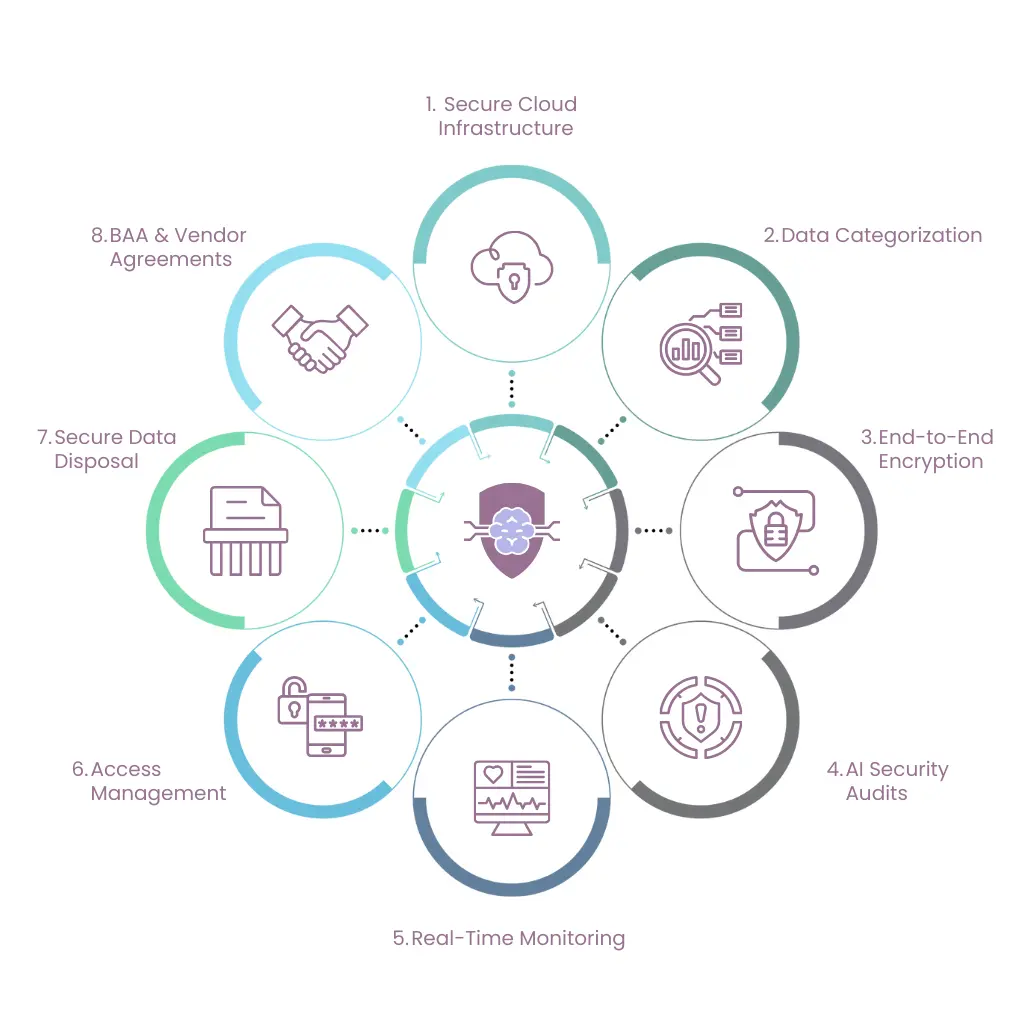
1. Select the HIPAA-Compliant Backend Infrastructure
Choose backend infrastructure that is HIPAA compliant. Leading cloud providers such as AWS, Microsoft Azure, and Google Cloud have a secure infrastructure for handling patient health information.
But choosing HIPAA services doesn't guarantee the security of a patient's data; you need to manage these services correctly.
2. Categorize the Sensitive Data from Non-Sensitive Data
When creating a mobile application, the healthcare app development company should keep sensitive health information separate from non-sensitive data like settings and user analytics.
Once the PHI is secured in different storage locations, the chances of accessing that sensitive data accidentally can be reduced.
3. Implement End-to-End Encryption in Healthcare Data
Your sensitive healthcare information should be end-to-end encrypted when stored and when transmitted.
Once data is encrypted, no unauthorized party can access or misuse a patient's medical data.
For that, there are two standard encryption methods that can be used in developing AI-powered healthcare solutions:
-
- AES-256 for data at rest
- TLS/SSL for data in transit
- Conduct Security Checks
At Trigma, our healthcare developers run quick security audit checks using their manual and automated testing tools to review the code, scan for weaknesses, and spot threats before they become a concern.
Thus, regular risk assessments ensure that your AI-powered healthcare app will remain secure and comply with HIPAA requirements.
4. Set Up System Logs
Real-time logging and monitoring is important to record user activities and events.
HIPAA security guidelines require healthcare providers to keep an eye on user activity and monitor logs and activities to prevent patients' information from being accessed or breached.
5. Manage Access Carefully
Access to PHI should be given only to authorized individuals. If unusual behavior tries to log in, then automated alerts will be generated. For that, setting up user roles is important, and regularly checking who has access to patients' health data is essential.
6. Dispose of Data Safely
When you don't need healthcare-protected information, then it can be disposed of securely. If PHI is not destroyed securely, then it could lead to HIPAA violations and financial losses.
7. Create a Business Associate Agreement With a Third Party Vendor
Make sure that third-party vendors (like cloud storage providers and AI developers) sign the business associate agreement. It's an ongoing guarantee that they will use the patient's health-related information for authorized use only.
This agreement specifies how the vendor will use the data, covers obligations for the vendor to report data breaches, and includes terms for secure destruction of PHI.
Tech Stack for Building HIPAA-Compliant Healthcare Applications
When creating secure AI solutions for healthcare organizations, choosing the right tech stack is important.
From selecting the front-end frameworks to backend servers, make sure that every layer is responsible for creating secure, compliant, and high-performing HIPAA-compliant solutions.
| Category | Tech Stack/Tools Used | Reason (Why is it important for HIPAA compliance?) |
|---|---|---|
| Frontend | React, Angular, and Vue.js | A secure frontend framework is good for creating intuitive design and protecting patients' data. |
| Backend | Node.js, Django | Choosing a secure backend infrastructure is important for storing PHI data, enabling role-based access control, and protecting the data from unauthorized access. |
| Mobile Development | React Native, Flutter, Swift, Kotlin | Secure mobile SDKs and native development frameworks protect patient health data and ensuring that data stored on the device or in transit is end-to-end encrypted. |
| Cloud Hosting | AWS, Google Cloud Healthcare API, Microsoft Azure | HIPAA-compliant hosting providers sign the business associate agreement to ensure that your data is encrypted both in transit and when stored. |
| AI/ML Frameworks | TensorFlow, PyTorch | Differential privacy and federated learning are used to train the model so they won't expose the exact patient details. |
| Databases | PostgreSQL, MongoDB | A compliant database ensures that your patient information isn't leaked, altered, or deleted. |
| DevOps and Security Tools | Kubernetes, Datadog | Security and monitoring tools are useful for automated compliance checks and detecting suspicious activity. |
| UI/UX Design | HIPAA-aware UI patterns, patient portals | Just as a secure healthcare application requires a robust backend, it also needs good UI/UX design, as this influences user behavior. |
Why Partner with Trigma for HIPAA-Compliant App Development?
As a renowned healthcare app development company, we've delivered 50+ AI solutions in the past, from telemedicine platforms to AI-based EHR solutions and on-demand HIPAA-compliant healthcare apps.
The healthcare solutions we develop today aren't just secure; rather they align with the HIPAA security standards such as strong encryption and access controls.
Recently, we served a client named "Doctome" by creating a healthcare solution in Algeria. The mobile application allows patients to check the doctor's availability and book a specific slot.
The healthcare platform we developed not only had good UI/UX design; we ensured that Doctome met all the legal requirements, such as complying with the local data protection laws.
For that, we conducted expert-led compliance audits to ensure that the telemedicine platform aligns with Algerian healthcare laws.
Result: Patients can access healthcare services remotely. No more long waiting time!
Create a Similar App like Doctome
FAQs
What is the cost of developing a HIPAA-compliant AI application for healthcare?
The cost of creating an AI powered healthcare platform ranges between $30,000 to $300,000 and more. It's just a rough estimate, as the cost varies depending on features and how well it can be integrated with EHR/EMR systems.
Are all healthcare apps required to comply with HIPAA security rules?
No, not all healthcare apps are required to become HIPAA compliant. But if you're creating a healthcare application that stores or transmits protected health information, then HIPAA compliance is mandatory.
However, for developing fitness apps or wellness platforms that do not handle PHI, HIPAA compliance is not required.
What are the key features required for HIPAA-compliant AI healthcare applications?
For creating HIPAA-compliant healthcare applications, here are the must-have features to be included:
- Data encryption
- Access control
- Audit control
- Secure login and multi-factor authentication
How to make your healthcare application HIPAA compliant?
Here is the checklist to make your application HIPAA compliant:
- Have a clear understanding of your business idea and know who your target audience is. Make sure to think about how your app will generate revenue in the long run.
- Choose a trusted healthcare app development company that has a proven track record in delivering secure HIPAA-compliant mobile apps.
- Launch your idea as an MVP
- Publish your app on the app store