+91-98558-85133
 +1(702)760-3099

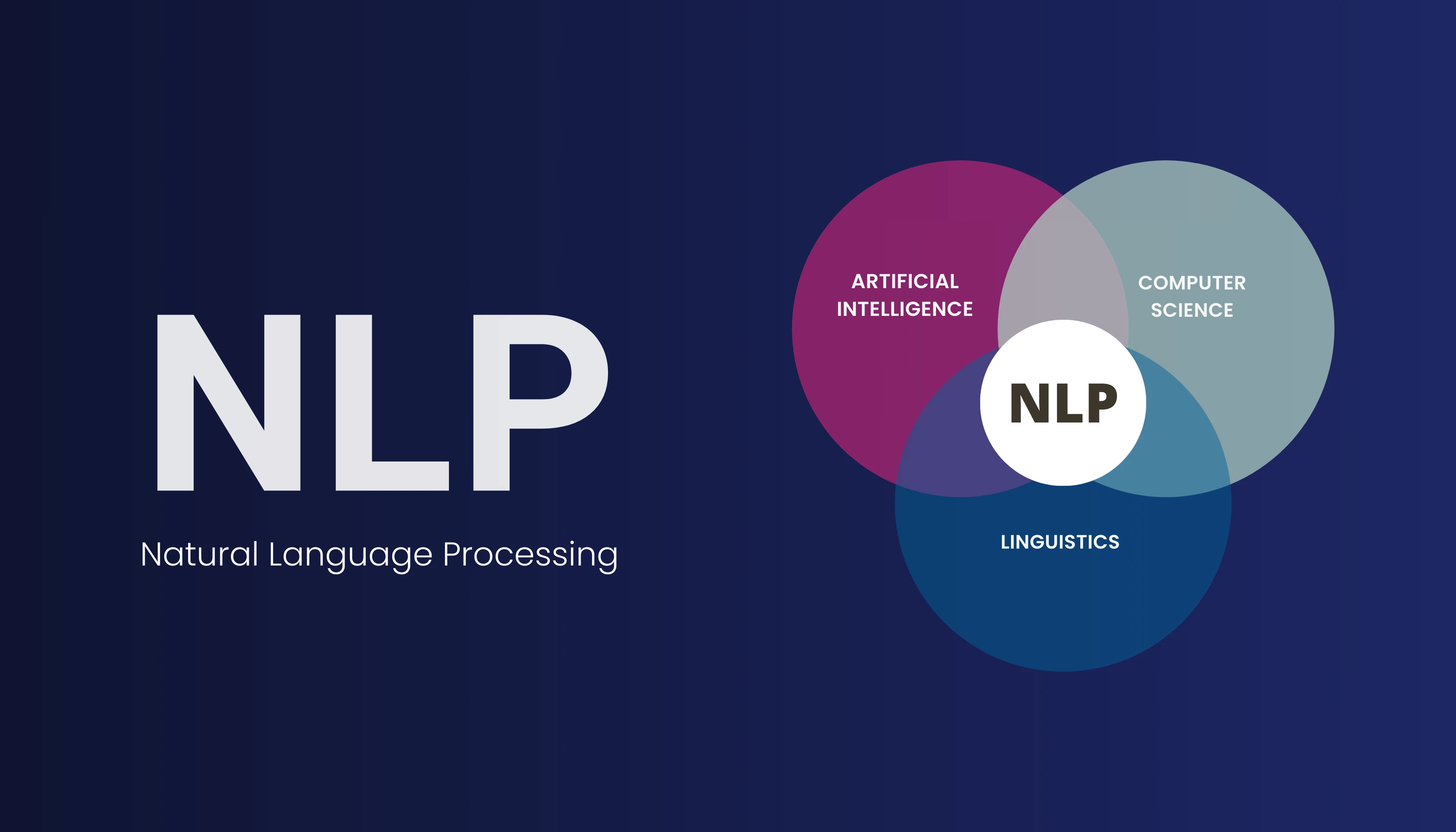
Have you ever wondered why AI systems can read emails, understand customer chats, analyze contracts, or respond naturally in conversations? The major difference lies in how LLMs models effectively understand human language. Every single time you enter a question, dictate a message, or ask AI to summarize something, NLP technologies kick in.
NLP enables machines to read, interpret, and respond to language that humans use it everyday. What was once considered an experimental AI capability is now the core technology behind AI automation, smarter decision-making, and enterprise-scale digital transformation.
For today’s business and technology leaders, understanding NLP is no longer just a technical topic; it’s a strategic one. Knowing how NLP works, which techniques matter, and how modern NLP systems are built helps organizations unlock value from unstructured data like emails, documents, and voice interactions.
Let’s explore more of Natural Language Processing in detail in a more practical way.
What is Natural Language Processing (NLP)?
Natural Language Processing (NLP) is a subfield of artificial intelligence that enables machines to read, interpret, generate, and respond to human language in a meaningful and contextual manner.
Unlike traditional rule-based systems, NLP systems learns patterns, semantics, intent, and relationships within language, allowing AI to move beyond keyword matching towards true language and understanding.
At enterprise levels, NLP forms the backbone of AI-powered customer support, intelligent document processing, conversational AI and voice agents, knowledge discovery and search, compliance monitoring, and AI automation. In simple words, NLP helps turn complex and unstructured data into smart & actionable intelligence.
Working of NLP (Natural Language Processing)
At the core, NLP enables machines to understand, analyze, and generate human language in a way that is helpful for business applications. Rather than treating language as plain text, NLP systems break it down, interpret its meaning, and convert it into actionable insights. Here’s how NLP typically works:
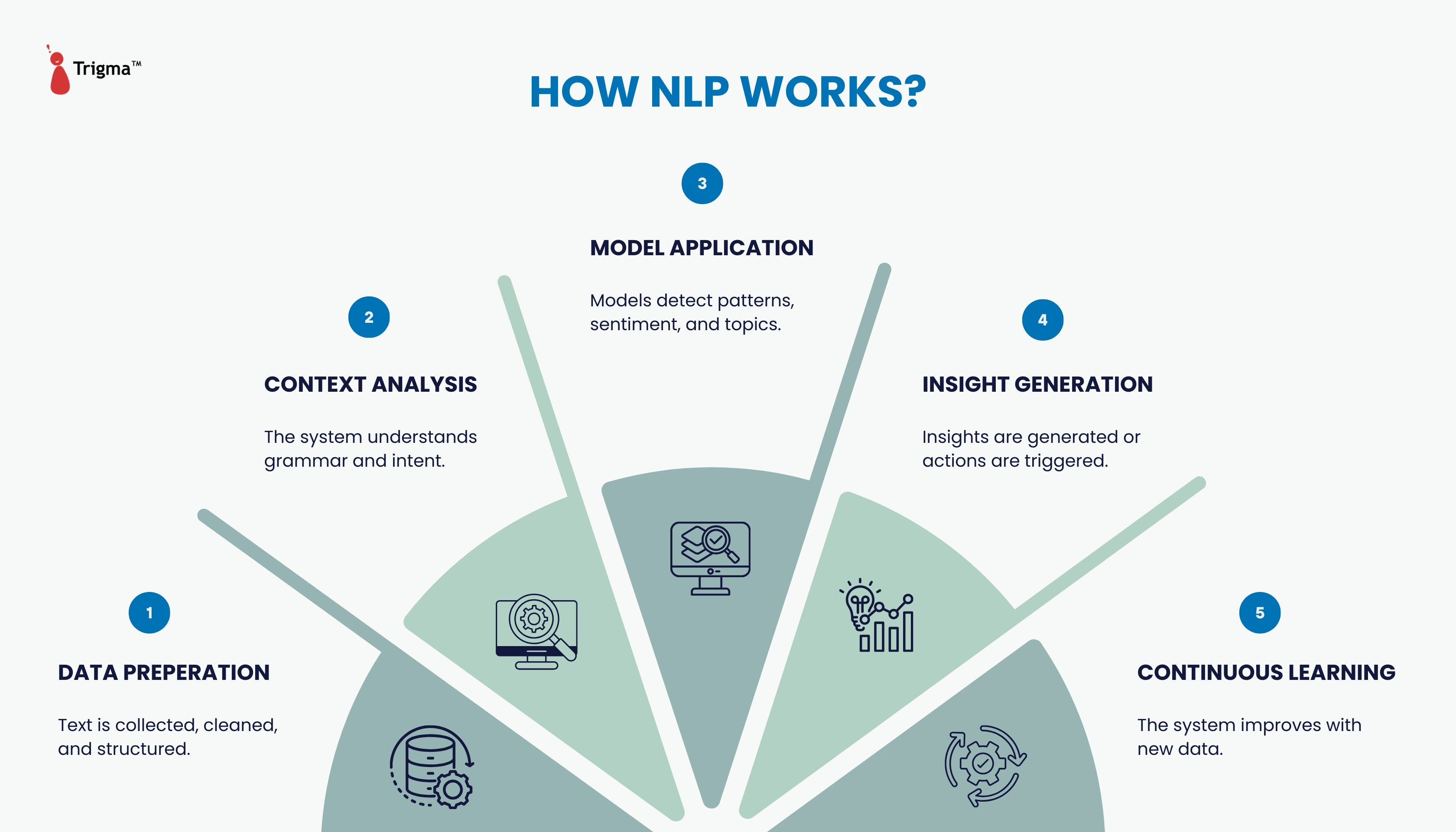
1. Data input and language preparation
The first step typically includes collecting raw data from various sources such as emails, chat conversations, documents, video transcripts, or websites. This data is then cleaned to make it structured. It involves breaking text into words and phrases (tokenization), converting words to their base form (lemmatization), and removing unnecessary words while keeping meaning intact. This ensures the data is ready for deeper analysis.
2. Understanding structure and meaning
In this step, NLP models analyze how words are structured and how they relate to each other. This helps the system understand sentence structure and grammar, context, and intent behind the text. This is the stage where NLP moves beyond keyword matching and begins to understand language contextually.
3. Apply NLP models and techniques
Modern NLP systems use advanced natural language processing models, powered by machine learning and deep learning, to identify patterns, sentiments, topics, and intent. These models are trained on large datasets and fine-tuned for specific business domains.
In enterprise setups, smaller task-focused micro models in natural language processing are often used to handle specific functions such as intent detection, document classification, or sentiment analysis more efficiently.
5.Continuous learning and improvement
NLP systems continuously improve by learning from new data, feedback, and changing language patterns. This allows them to adapt to evolving customer behavior, industry terms, and business needs over time.
Key NLP Techniques Used in Systems
Modern NLP systems rely on a well defined techniques that allow machines to understand language, extract action, and take action. Below are the most commonly used NLP techniques used in real-world systems:
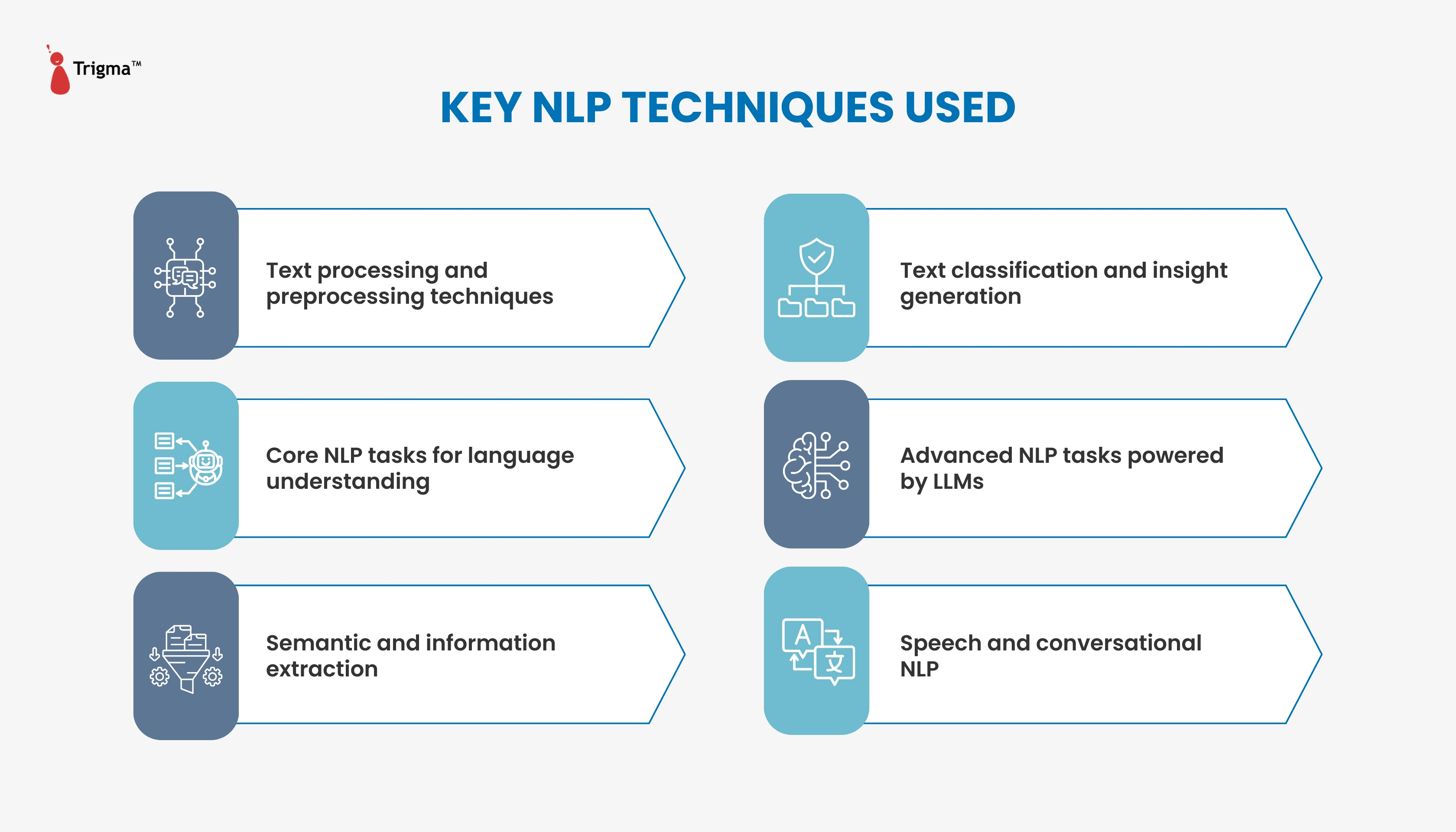
1. Text processing and preprocessing techniques
Before performing any analysis, raw language data must be cleaned and prepared. Preprocessing ensures that text is consistent, structured, and suitable for further processing.
Key techniques include:
Tokenization Splitting text into smaller units such as words, phrases, or sentences. This is the first step in any NLP pipeline.
Stemming and Lemmatization Reducing words to their base or root form. It will help models treat related words consistently.
Text normalization Standardize text by handling punctuation, special characters, capitalization, spelling variations, and formatting inconsistencies.
2. Core NLP tasks for language understanding
NLP tasks focus on understanding the structure, meaning, and intent behind the text. These tasks are often combined to power real-world NLP systems.
Common tasks include:
| Part of speech tagging | Identifying the grammatical role of each word, such as noun, verb, or adjective. |
| Syntactic parsing | Analyzing sentence structure to understand how words form phrases and sentences. |
| Sentiment analysis | Determining the emotional tone of text is widely helpful in customer feedback and brand analysis. |
3. Semantic and information extraction
To move beyond surface-level understanding, NLP systems apply semantic analysis techniques.
These include:
| Word sense disambiguation | Identify the correct meaning of the word based on context. |
| Entity and relation extraction | Extracting entities and identifying relationships between them is especially useful in documents like contracts, reports, and research papers. |
4. Text classification and insight generation
These tasks help NLP systems organize and interpret large volumes of text.
Key techniques include:
| Text classification | Categorized text into predefined groups such as support tickets, document types, or user intent. |
| Topic modeling | Identifying recurring themes or topics across large datasets without manual labeling. |
| Spam detection | Identifying suspicious or unwanted content automatically. |
5. Advanced NLP tasks powered by LLMs
With the rise of LLMs, NLP systems can now handle more complex and human-like tasks.
Advanced NLP tasks include:
| Machine translation | Translating accurately from one language to another. |
| Text summarization | Generating concise summaries from long documents, reports, or conversations. |
| Question answering | Extracting and often rephrasing information to answer specific questions based on a given text. |
| Natural language generation | Generate context-aware text for chatbots, reports, or automated responses. |
These tasks often require large datasets, advanced models, and domain-specific fine-tuning for specific industries.
6. Speech and conversational NLP
NLP also plays a key role in voice-driven systems. This involves speech-to-text for converting spoken language into text, text-to-speech for generating voice responses, and dialogue systems such as chatbots or virtual assistants that enable personalized and interactive conversations.
Types of NLP Systems
Below are the main types of NLP systems that are used in businesses today:
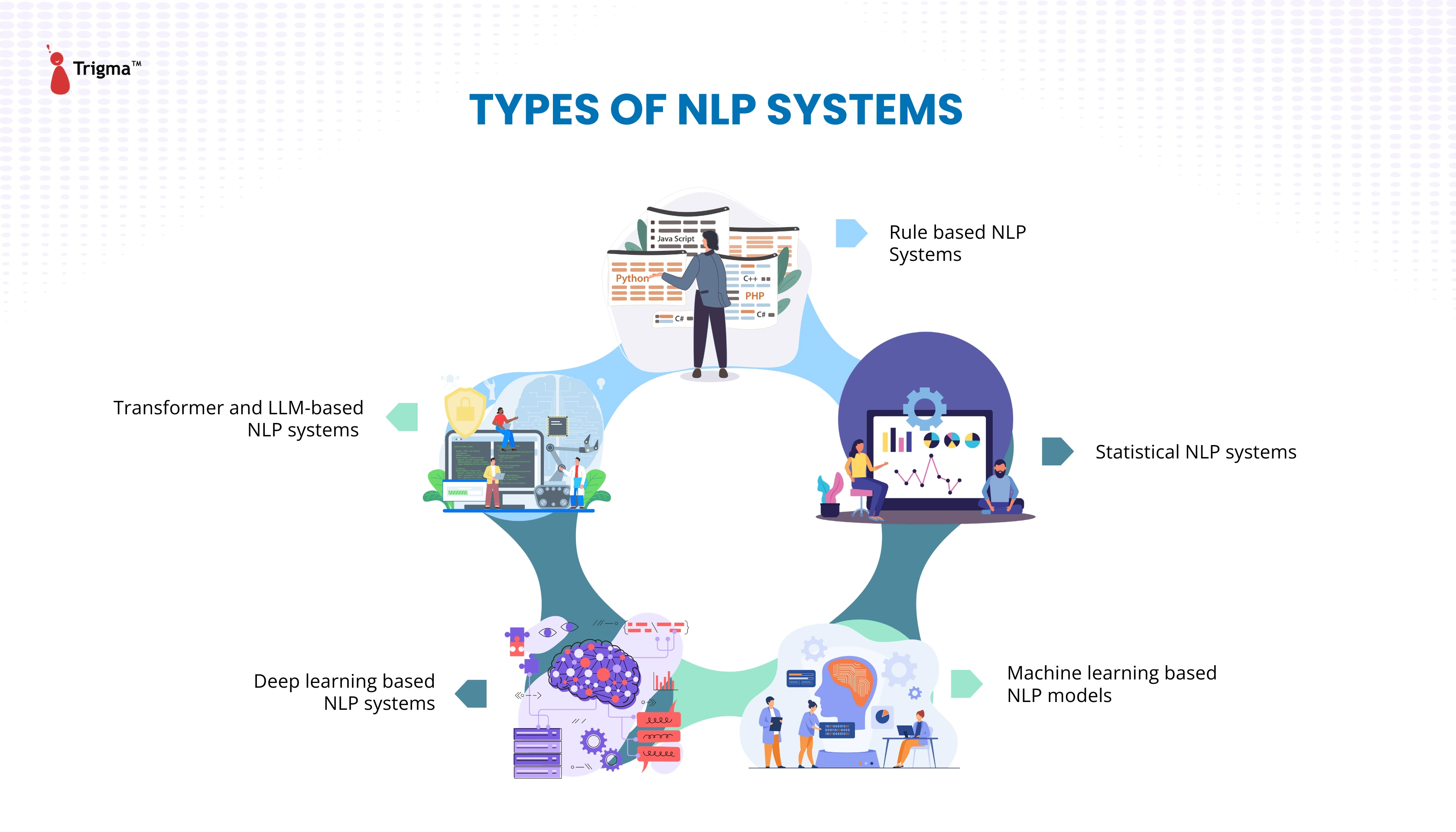
1. Rule-based NLP systems
Rule-based NLP systems rely on predefined linguistic rules created by humans. These systems follow strict instructions for processing language, such as grammar rules or keyword patterns. It was typically best suited for basic text matching, simple chatbots, and keyword-based search systems.
2. Statistical NLP systems
These systems use mathematical and probability-based models trained on language data. Instead of relying on fixed rules, they identify patterns based on word frequency and usage. This is commonly used for spam detection, basic sentiment analysis, and early text classification systems.
3. Machine learning based NLP models
These systems employ both supervised and unsupervised machine learning techniques to enhance language understanding. It improves accuracy over time and handles language variations in a better way.
4. Deep learning based NLP systems
Deep learning based NLP systems use neural networks to understand language context, meaning, and relationships between words. It involves strong contextual understanding and high accuracy for complex tasks. It is typically used for chatbots, voice assistants, and sentiment analysis.
5. Transformer and LLM-based NLP systems
The most advanced category of NLP systems. These systems are built using a transformer architecture and large language models (LLMs) that understand language at a deep contextual level. It is usually used in conversational AI, intelligent assistants, content generation, question answering, and enterprise knowledge systems.
Ready to build scalable NLP systems for your enterprise?
Micro Models in Natural Language Processing
Micro models are small, specialized NLP models trained to perform specific language tasks, such as intent detection, contract clause detection, or sentiment scoring, rather than handling everything in a large model.
Many enterprises nowadays are adopting NLP micro models as they help in faster training and deployment, lower computational cost, better domain accuracy, and easier governance & compliance. Micro models align perfectly with enterprise AI architectures, where flexibility and precision matter more than intelligence.
The Future of NLP
The future of NLP lies in its ability to move beyond understanding text to driving intelligent action. NLP will increasingly serve as the interface between humans and enterprise systems, enabling seamless AI automation, faster decision making, and more natural interactions across business operations.
As organizations adopt large language models alongside task-specific micro models in natural language processing, NLP systems will become more accurate, scalable, and governed. Industry-specific NLP solutions, deeper contextual understanding, and responsible AI practices will define how language intelligence is deployed at scale.
In the years ahead, NLP will no longer be a standalone capability; it will be a strategic foundation for enterprise AI, shaping how businesses communicate, operate, and compete.