+91-98558-85133
 +1(702)760-3099

60-Second Summary
- The world's most successful companies like Tesla, Amazon, Apple didn't build everything internally. They partnered with external vendors to move faster and smarter.
- Building an in-house AI team gives you full control, IP ownership, and data security but realistically costs $180K+ per engineer and takes 6–12 months before delivering measurable value.
- Outsourcing plugs you into a team that already has frameworks, deployment pipelines, and niche expertise in areas like NLP and computer vision; your MVP can be live in weeks.
- Cost-wise, outsourcing shifts you from paying per headcount to paying per project, which is significantly more manageable for startups and early-stage builds.
- The real trade-off isn't quality; it's control vs. speed. Strong communication, clear NDAs, and a dedicated project manager close that gap quickly.
Outsourcing is bad and you might think that we should rather build an AI team internally. But that is only half the story.
The most successful companies in the world, such as Amazon, Apple, Tesla, and Alibaba, have not achieved their status through internal efforts alone. Tesla, for example, is not just selling cars; it is selling software solutions like the Tesla Version 7.0 software.
This has been made possible not just through their internal software development teams, but also through the third-party vendors (external teams) they have partnered with to support their IT and AI initiatives.
Just like Tesla, if you want to launch your AI product but lack the budget, technical expertise, or existing infrastructure, then outsourcing may be the solution for you.
Read this blog to learn how in-house AI development differs from hiring a dedicated AI development team.
What is an In-house Team?
Building an in-house AI team involves hiring, training, and managing AI experts who work directly within your organization. These include chief product officer, data scientists, data engineers, MLOps engineers, AI product manager etc.
While this gives you full control, it requires a significant investment of time and budget, along with ongoing management oversight.
You will also need a long-term hiring plan and substantial funding. When it comes to integrating AI into existing systems, the process can become complex, especially if your infrastructure or requirements are evolving.
What Benefits Does Building an In-house AI Team Offer?
Here are a few advantages your business will gain by building an AI team in-house:
1. Maximum Control and IP Ownership
You get complete control over the development process from planning to deployment including decisions about priorities, methodologies, and timelines.
Because you own the project, you can make quick decisions and ensure that your AI solutions align with specific use cases. The intellectual property you create and the models you train remain entirely yours.
2. Deep Domain Knowledge
An in-house AI development team can integrate with your company's culture and processes, making collaboration easier. They become familiar with your industry, its nuances, and its challenges before building an AI solution.
3. No Security Breaches
Building an in-house AI team means keeping your sensitive data safe within the organization, as your team controls where data is stored, who can access it, and how it is used.
They will comply with existing security policies and compliance standards such as HIPAA and GDPR, which reduces the risk of data exposure. When no third party or vendor is involved, confidential data is better safeguarded.
Disadvantages of Building an In-house AI Development Team
Despite its advantages, the in-house approach may not always be the best option. Here are several drawbacks:
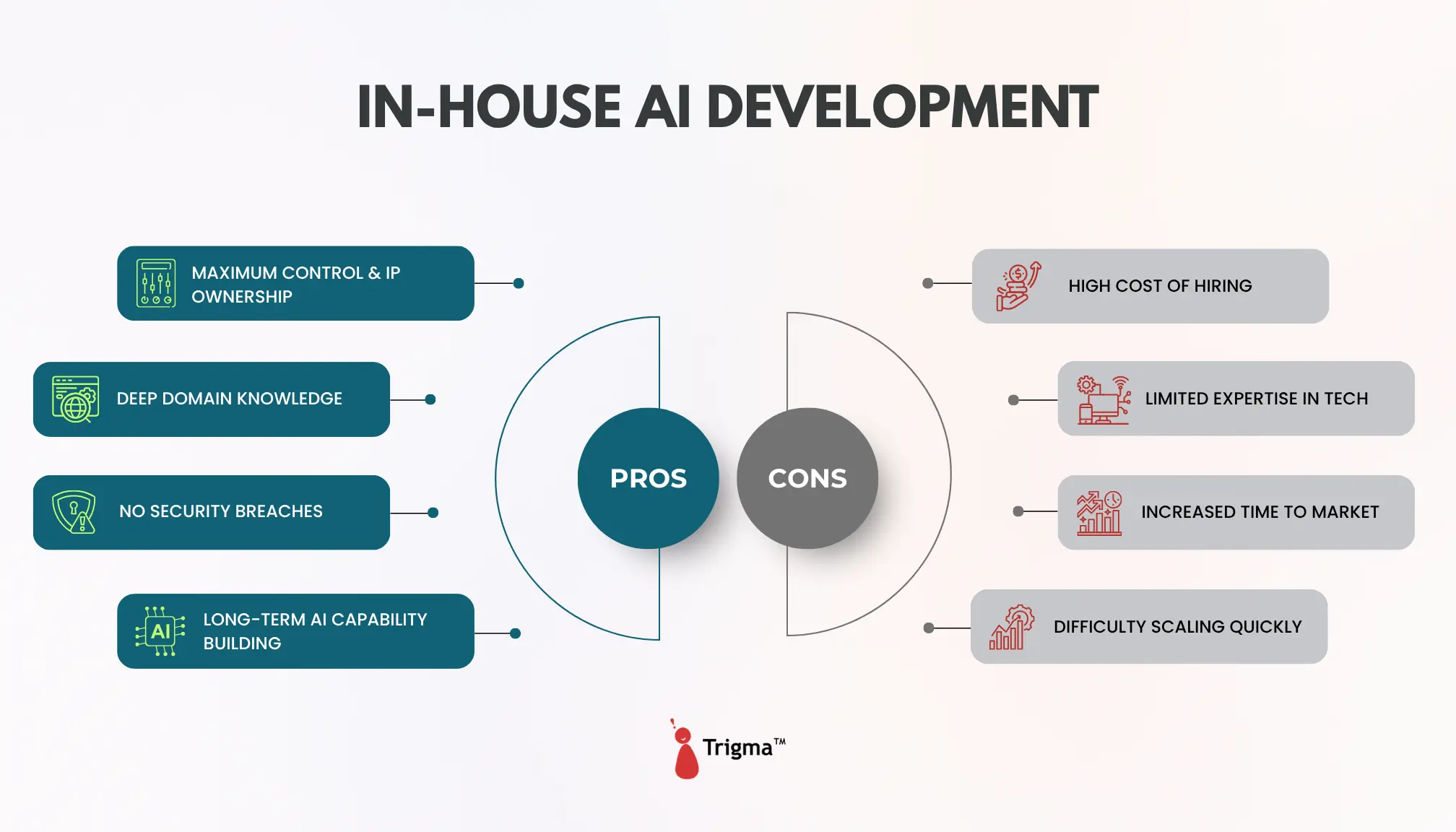
1. High Cost of Hiring
When teams say "we will build in-house," they often do not factor in the real costs associated with developing generative AI applications and agentic AI systems. Before shipping anything to production, you need to hire experienced AI engineers, data scientists, and developers.
For instance, hiring an AI agent developer in the US demands a salary of $180,000 to $250,000 per year. On top of that, there are additional expenses such as retirement benefits, retention bonuses, and insurance.
2. Limited Expertise in Tech
Finding talented professionals with niche AI expertise is increasingly challenging, and even when you find top-tier talent, retaining them becomes a significant concern.
One study states that 85% of companies have postponed their AI projects due to the AI talent shortage.
Since artificial intelligence is a broad field, building an AI solution requires expertise across areas such as natural language processing and machine learning.
Even among tech companies that have found AI developers at competitive rates, nearly 44% are still willing to increase salaries for AI/ML roles.
If you cannot find a skilled team, the most feasible option is to partner with an offshore development agency.
3. Increased Time to Market
Building an in-house AI team can take several weeks to a few months just to assemble. Hiring specialists, onboarding them, and setting up infrastructure and data pipelines adds further delays.
While your team is coming together, competitors may already be running AI copilots with real users.
First-time AI initiatives often involve trial and error, figuring out use cases, data governance, MLOps, and security practices and it may take another 6 to 12 months to see measurable value.
What is Outsourced AI Development?
Outsourcing AI development involves partnering with an external agency. It is like bringing on a team of AI experts who arrive with ready-to-deploy frameworks, established methodologies, and hands-on experience.
If you want to bring your MVP to market faster to secure early funding, outsourcing is often the most effective option. The ability to scale the team up or down also gives you greater flexibility.
What Benefits Does Outsourcing AI Development Provide?
Here are few benefits of hiring an external vendor that’s highly scalable as per your project requirements and gives you access to wide range of AI specialists across different industries:
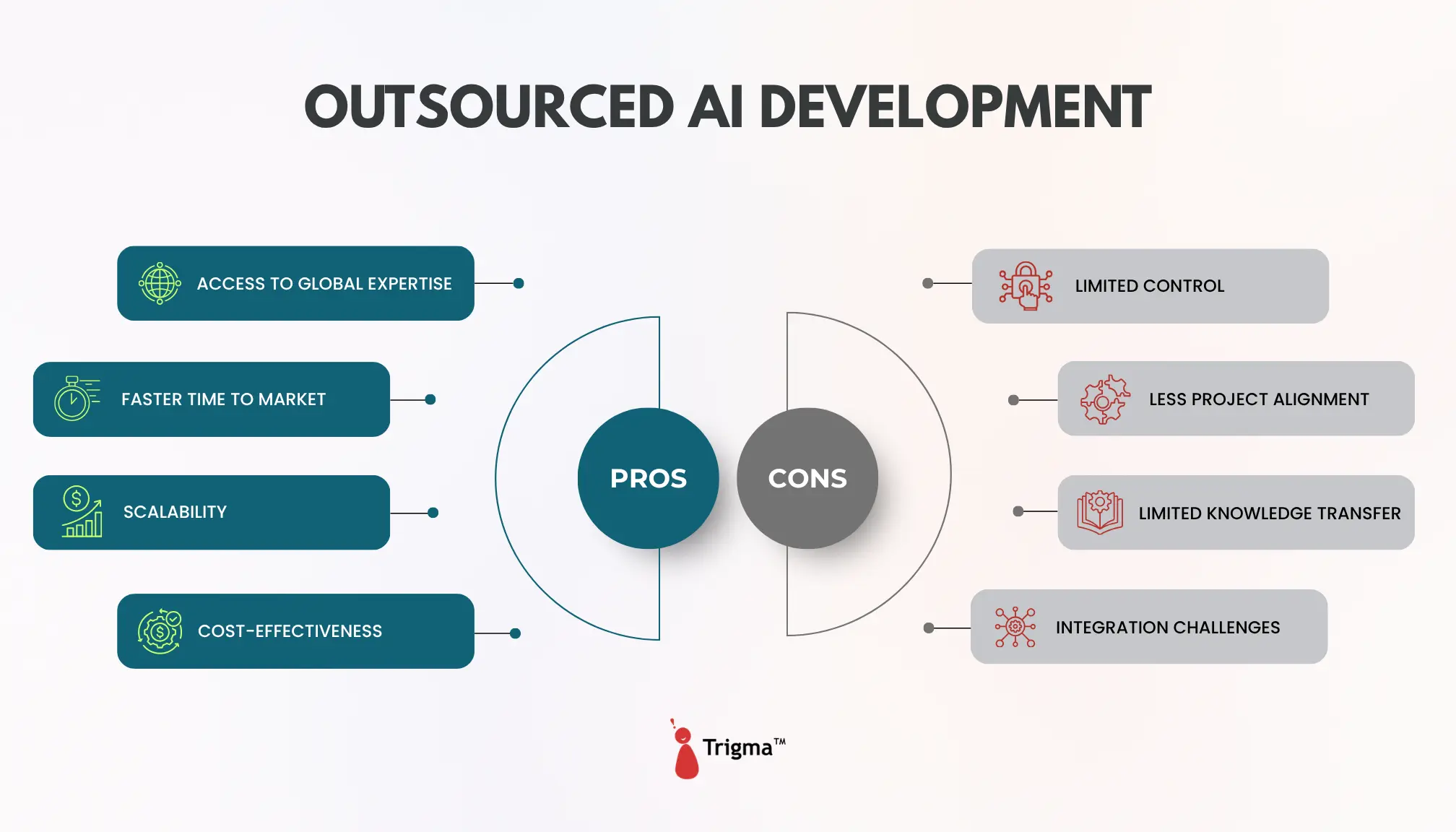
1. Access to Global Expertise
Outsourcing AI projects gives you access to a global pool of specialized AI developers who build AI solutions every day.
You gain hands-on expertise across niche skill sets such as computer vision, natural language processing, and robotics skills that are often difficult to source locally. Working with top minds in the field can move your project from prototype to production.
2. Faster Time to Market
An outsourced AI development company can get your project started within a few weeks, as they already have templates, methodologies, and frameworks for training and model deployment.
They know how to productionize prompts and secure models with guardrails, allowing you to test your AI prototype with real users quickly, not next year.
3. Scalability
Scaling an in-house team is possible but comes at a higher cost per hire, making it better suited for companies with long-term, stable AI roadmaps rather than fast-moving projects.
Outsourcing gives you the flexibility to scale your team up or down based on project requirements; a process that would otherwise take months if hired in-house.
4. Cost-Effectiveness
With outsourcing, you pay per project rather than per headcount, which is more affordable than maintaining full-time employees.
You avoid ongoing salary costs, infrastructure investments, and the complexity of hiring and offboarding. This model is especially well-suited for short-term or MVP-stage projects.
Disadvantages of Outsourcing AI Development
Despite having few advantages, here are the few downsides that outsourcing AI development which are as given below:
1. Limited Control
When developing AI models in-house, you have complete control over the day-to-day process, from strategy to execution. Working with an outsourced team can create communication challenges due to time zone differences, language barriers, and cultural differences.
2. Less Project Alignment
Although external teams are technically skilled, they may lack a deep understanding of your target market, internal workflows, and product development methodology. This can result in AI models that users are less likely to resonate with.
How Building an In-house AI Team Differs from Outsourcing AI Developers for Startups?
| Basis of Comparison | In-house AI team | Outsourcing AI development |
|---|---|---|
| Control | More control over the development process, with full IP ownership. | Less direct control, but having a project manager and clear communication keeps things aligned. |
| Speed of Deployment | Teams can start building and deploying in weeks. No more endless recruitment cycles. | Slower deployment cycles because of long hiring processes. |
| Talent Access | Finding expert AI engineers with domain expertise in NLP, computer vision, and generative AI is difficult. | Provides immediate access to top-notch AI developers and LLM engineers. |
| Data and security | No data or security breaches, because you own the infrastructure. No vendor reliance. | Requires strong data protection policies and NDAs, especially if the AI project involves sensitive data. |
| Scalability | When the project demands more people, you incur additional costs per headcount. | Faster, because scaling the team up or down is easier based on your project needs. |
| Cost | Higher upfront costs due to greater investment in cloud services, infrastructure, and people. | Potentially lower cost, because you pay per project rather than per headcount. |
Not sure where to start with AI?
Let Trigma's experts build the right AI strategy for your business.
How Can Trigma Become Your Outsourced AI Development Partner in 2026?
We make AI development simple regardless of the stage your business is at. We never follow a one-size-fits-all approach. Whether you need help launching an AI-powered MVP or building long-term IP, we tailor the right product development strategy to your use case.
Here’s how:
- Take your product idea to the ground through ready to go AI development partners.
- We follow an R&D approach where we check the exact feasibility of the solution as per your industry whether it is implementable or not. If not, we suggest an alternative approach to solve the problem.
- Your security and data protection are our priority. The AI models and systems we build remain under your full control including the models, codebase, and database.
FAQs
How do I know whether building an in-house AI team or outsourcing is the right option?
If you want to launch AI MVP quickly and have a limited budget, outsourcing is the most practical option. However, if AI is a core part of your long-term product strategy, building your own in-house team may be the better investment.
Can outsourcing AI development be risky?
Yes, outsourcing can become risky when the vendor lacks domain expertise, uses outdated technology stacks, or has no security policies in place.
Can I build an in-house team while also outsourcing AI development?
Yes. A small in-house team can focus on core strategic decisions, while an outsourced agency handles execution and product development.