performance icon
Top IT Services Company 2025 Top Software Developers 2025 Top Generative AI Company 2025 G2 High Performer Winter 2025 G2 Leader Winter 2025 AI Deployment Company 2024 Top Software Development Company in USA for 2024 Top ReactJs Company in USA for 2024
trigma-logo

How to Set Up Your Business with Agentic AI Solutions

Hold on before you dive headfirst into AI integration; speed alone won’t guarantee success. In today’s global AI race, organizations are rushing to embed technologies into their operations at breakneck speed. The fear of falling behind competitors often drives businesses to adopt AI quickly, hoping it will solve complex challenges overnight.

However, the truth is, AI is powerful, not magic. While the rise of GPT models and agentic frameworks has propelled AI into mainstream conversations, achieving meaningful results demands more than just adoption; it requires vision, expertise, and strategic alignment with business goals.

This is where agentic AI solutions for businesses enter the spotlight. Designed to move beyond imagination, they empower enterprises to deploy autonomous AI agents for automation than plan, act, and adapt, transforming how businesses operate across industries.

In this blog, we’ll explore how businesses can move from strategy to deployment of autonomous agents, unlocking both efficiency and competitive advantage.

Why Businesses Can’t Say No To Agentic AI?

Most organizations use some form of AI, such as recommendation engines, predictive analytics, or chatbots. Yet these systems are inherently reactive. They deliver value only when prompted and may fall short in handling dynamic and real-world scenarios. The major problems with traditional AI adoption are:

  • Operational drag: Human oversight is still required for repetitive and low-value tasks.
  • Limited adaptability: Static models can’t adjust quickly when the business environment shifts.
  • Scalability bottlenecks: Automation works in silos and struggles across complex workflows.

But Agentic AI gives you a better advantage.

  • Goal-driven intelligence: Agents focus on achieving business outcomes, not just answering queries.
  • Reasoning and learning: They continuously enforce using reinforcement learning and LLM-based reasoning.
  • Collaborative autonomy: Multiple agents can coordinate tasks across departments.

Don’t just automate your tasks, elevate them with Agentic AI solutions that think, adapt, and act.

Key Steps in Building Your Business With Agentic AI

Key Steps in Building Your Business With Agentic AI

1. Align AI with business objectives

Agentic AI integration isn’t about adopting technology for the sake of innovation. It’s about aligning autonomy with real business objectives.

Ask the required questions:

  1. Where are the most pressing workflow bottlenecks?
  2. Which processes drain employees' valuable time?
  3. Can autonomous agents directly reduce costs or accelerate outcomes?

Examples:

  • Finance: Agents reconcile accounts, detect anomalies, and generate compliance-ready reports.
  • Human resources: AI handles recruitment end-to-end, from candidate screening to interview scheduling.
  • Customer support: Queries are resolved autonomously, with intelligent escalation when required.

2. Map workflows for agent deployment

Every process does not require autonomy. Businesses must evaluate workflows against some filters:

  1. Is the task routine repeatable and predictable?
  2. Does the task involve high-volume handling?
  3. Can agents make reasoned, context-driven choices?
  4. Can they seamlessly connect with CRMs, ERPs, or SaaS ecosystems?

Example: In supply chain operations, agents can autonomously predict demand, optimize procurement, and coordinate logistics partners, reducing delays and improving efficiency.

3. Design a robust agentic AI strategy

Agentic AI requires more than deploying tools. Businesses must build a strategy that ensures effective AI functioning. Here’s how a strategy should look:

  • Data readiness: Ensure structured and unstructured datasets are clean, secure, and accessible. Enable real-time pipelines to feed sales, customers, and operations data into agents.
  • Agent frameworks: Decide between building custom frameworks and adopting a platform like LangChain or enterprise-ready orchestration tools. Define role-specific agents, such as sales agents, compliance agents, and HR agents.
  • Governance and security: Establish ethical guidelines, compliance standards, and accountability protocols. Implement audit trails and risk controls to prevent overreach.

4. Pilot, validate, and scale

The smartest businesses don’t attempt a massive rollout from day one. Instead, they follow a pilot first model:

  • Pilot: Start small with one or two critical workflows.
  • Validate: Measure outcomes against KPIs like error reduction, cost savings, and turnaround time.
  • Scale: Expand agentic deployments across departments.

This strategic adoption ensures minimal disruption while maximizing ROI.

How Agentic AI is Transforming Industries

Agentic AI for businesses is no longer just a futuristic concept; they are actively reshaping industries by enabling autonomous AI agents for workflow automation. From improving operational efficiency to enhancing customer experience, the impact spans multiple sectors:

1. E-commerce and retail

  • Autonomous inventory management: Agents predict demand, optimize stock levels, and automatically reorder products.
  • Dynamic pricing: AI agents adjust prices in real time based on market trends, competitor pricing, and consumer behavior.
  • Personalized consumer engagement: Autonomous agents interact with customers through chatbots and recommendation systems, driving loyalty and conversations.

2. Fintech

  • Fraud detection: AI agents continuously monitor transactions, flag suspicious activity, and reduce false positives.
  • Automated compliance: Agents ensure regulatory adherence, generate reports, and reduce manual audits.
  • Smart investment recommendations: Autonomous systems analyze market trends and optimize portfolio decisions.

3. Healthcare

  • Patient management: AI agents handle follow-ups, schedule appointments, and send reminders.
  • Diagnostic support: Agents assist clinicians by analyzing large datasets and suggesting probable diagnoses.
  • Operational efficiency: Hospitals optimize staffing, manage supply chains, and reduce administrative overhead.

4. Sales & revenue operations

  • Lead qualification and nurturing: Autonomous AI agents analyze incoming leads, prioritize them based on intent, and engage prospects with personalized follow-ups.
  • Sales forecasting: Agents track historical data, market trends, and pipeline activity to generate accurate revenue predictions.
  • Workflow automation: Routine sales tasks, like meeting scheduling, proposal generation, and CRM updates, are handled autonomously, freeing sales teams to focus on closing deals.
  • Customer insights: AI agents provide actionable recommendations by analyzing buying patterns, helping sales teams tailor their strategies.

5. Manufacturing & supply chain

  • Predictive maintenance: Agents monitor machinery and schedule interventions before breakdowns occur.
  • Logistics optimization: Autonomous agents coordinate suppliers, shipments, and inventory for smooth operations.
  • Quality control: AI detects anomalies in production lines, reducing defects and operational costs.

Challenges Your Business Must Be Prepared For

Despite its transformative power, its adoption comes with challenges:

  • Integration hurdles: Legacy IT systems may resist seamless connections.
  • Change management: Employee resistance is common; necessary training is essential.
  • Governance risks: Without oversight, autonomy can lead to compliance issues.
  • Over autonomy: AI must be guided with guardrails to avoid misaligned decisions.

Don’t Wait for the Future, Build It

By 2030, AI-driven enterprises will outperform competitors by 25% in efficiency and innovation. Start your journey with Trigma now.

Final Thoughts

The global AI race is accelerating, but speed without strategy leads to wasted investments and underwhelming results. Businesses must leverage the power of AI technologies, and their true potential lies in agentic AI solutions; systems that think, act, and adapt autonomously.

By deploying autonomous AI agents for workflow automation, organizations can move beyond efficiency gains and unlock transformative business outcomes with greater agility, smarter decision-making, and scalable growth.

The path would be even easier if organizations don’t rush for AI adoption, but rather design it strategically. Define objectives, map high-impact workflows, establish governance, and scale with precision. Businesses that do so will not only keep pace but set the standard for their industries.

The right time to adopt is now, while others are waiting; your organization has the opportunity to take the lead.

Trigma helps businesses, whether startups, mid-sized, or enterprises, to unlock the full potential of Agentic AI. From strategy design to deployment of agentic AI agents, we enable you to adopt Agentic AI with confidence and speed.

Explore Trigma’s Agentic AI solutions and give a forward leap to your business.

How AI Agents Improve Patient Follow-Ups and Care Continuity

Healthcare is entering a new era, one defined by intelligence, speed, and personalization. At the core of this shift are AI agents, reshaping how care is delivered and managed.

The McKinsey report estimates that these intelligent assistants could unlock $360 billion in annual savings in the US alone, simply by streamlining operations and improving clinical outcomes. But more than numbers, the real impact is human; less time lost to administrative burdens, faster diagnostics, and more precise and personalized care.
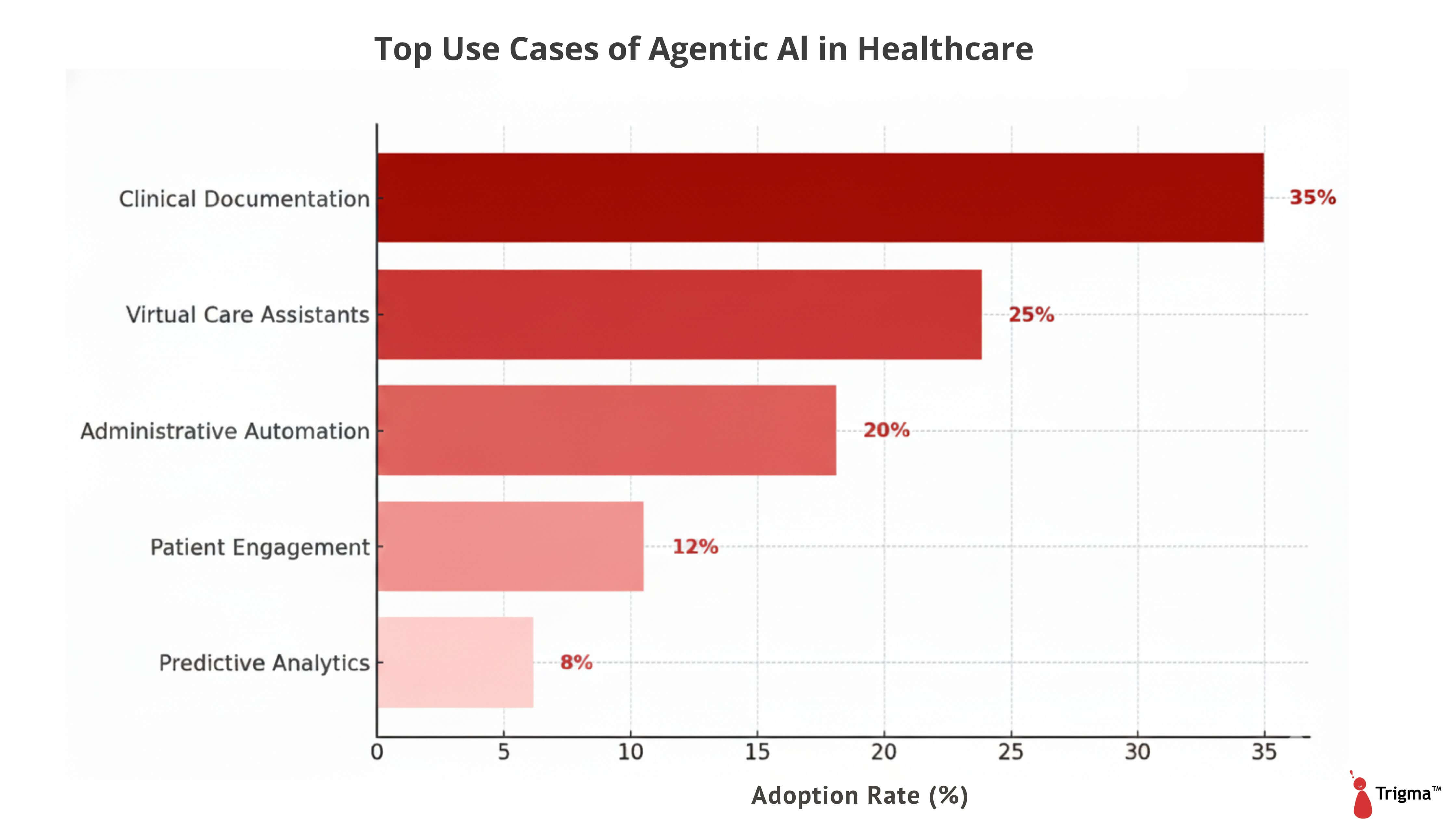
top use cases of agentic ai in healthcare

As patient volumes surge, regulations tighten, and data grow more complex, traditional healthcare models are straining under pressure. AI agents step in as coordinated digital partners, bridging the gaps and empowering hospitals and pharma companies to achieve more with greater efficiency and better outcomes.

In this blog, we’ll dive into the critical ways AI agents are transforming healthcare today and what it means for the future of care delivery.

The Traditional Challenge of Patient Follow-ups

Earlier, healthcare systems struggled with consistent follow-ups due to:

  • Fragmented communication channels between patients and doctors.
  • Resource-intensive manual outreach that limits scalability.
  • Delayed interventions are caused by poor visibility into patient recovery.
  • Non-compliance risks, where patients skip appointments, miss medication schedules, or fail to follow care plans.

These gaps not only impact patient outcomes but also drive up costs through avoidable readmissions, emergency room visits, and poor chronic disease management.

Agentic AI: Redefining Post Care Management

AI agents powered by NLP, predictive analytics, and context-aware automation are bridging these systemic gaps. Unlike static chatbots, AI agents operate as proactive digital care coordinators, offering continuous, intelligent, and adaptive support.
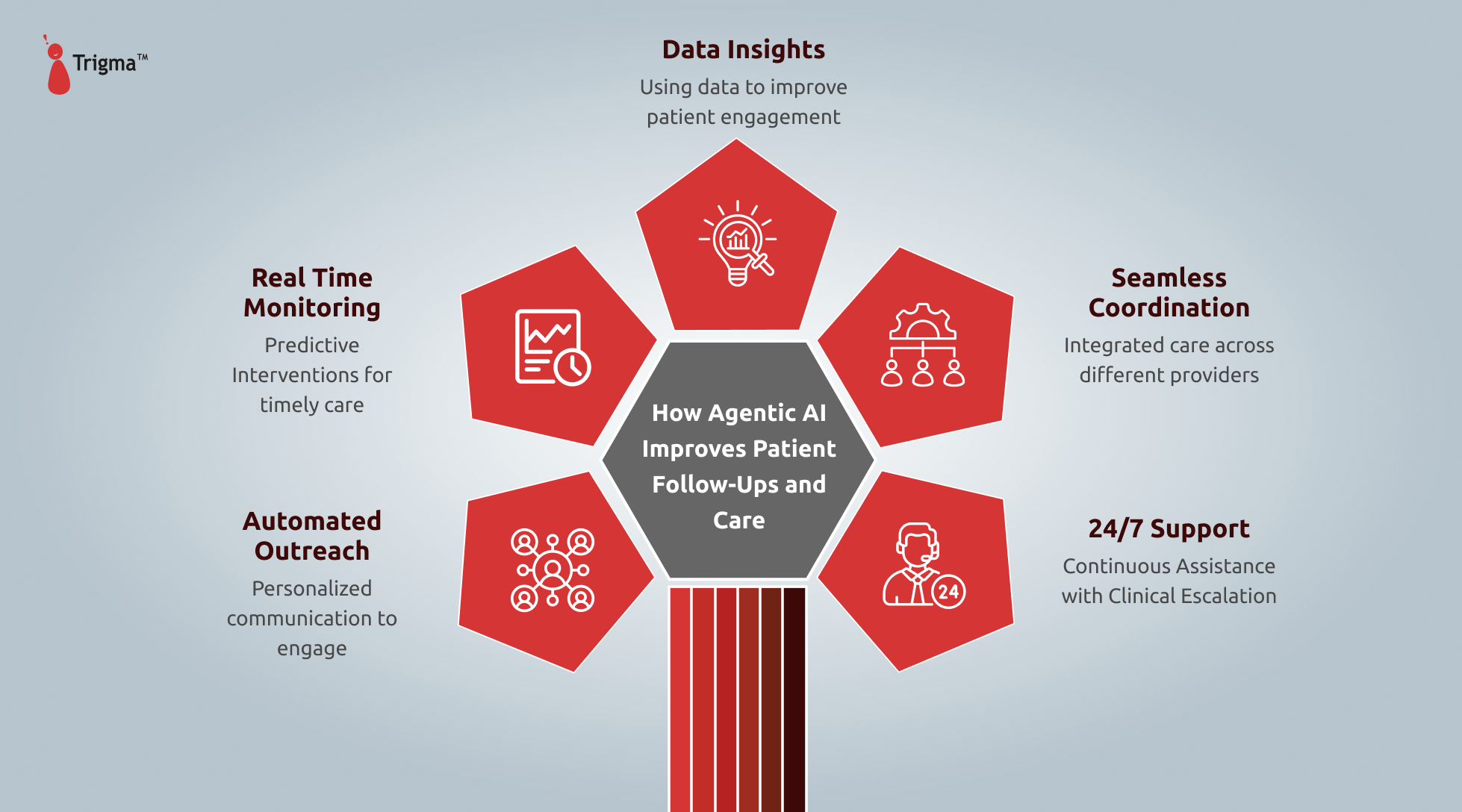
Redefining Post Care Management

Here’s how they enhance patient follow-ups and continuity of care:

1. Automated and personalized outreach

AI agents dynamically schedule and manage post-discharge follow-ups, appointment reminders, and medication adherence alerts. Leveraging patient data, they tailor interactions based on individual needs—whether it’s reminding a diabetic patient about glucose monitoring or prompting a cardiac patient to schedule a follow-up consultation.

2. 24/7 patient support with clinical escalation

Through natural language understanding (NLU), AI agents can answer routine patient queries at scale, ensuring symptom checks, addressing side effects, or clarifying care plans while intelligently escalating complex cases to clinicians. This ensures continuous availability without overburdening healthcare staff.

3. Real-time monitoring and predictive interventions

Connected to IoMT (Internet of Medical Things) devices, AI agents monitor vital parameters such as blood pressure, heart rate, or oxygen levels. They apply predictive models to flag potential risks early, triggering timely intervention and preventing complications.

4. Seamless coordination

AI agents integrate with EHR systems, payer portals, and clinical workflows, ensuring that all stakeholders, from primary care physicians to specialists, stay aligned on patient progress. This reduces fragmentation and supports true healthcare management.

5. Data-driven patient engagement insights

By analyzing engagement patterns, AI agents provide care teams with actionable intelligence on adherence, sentiment, and recovery trajectories. These insights help providers pivot strategies for at-risk patients, improving both population health management and patient retention.

Revolutionize Healthcare with Agentic AI

Over 60% of providers will rely on autonomous AI agents by 2026. See how TellDoc AI can transform patient care.

Real World AI Agents In Healthcare

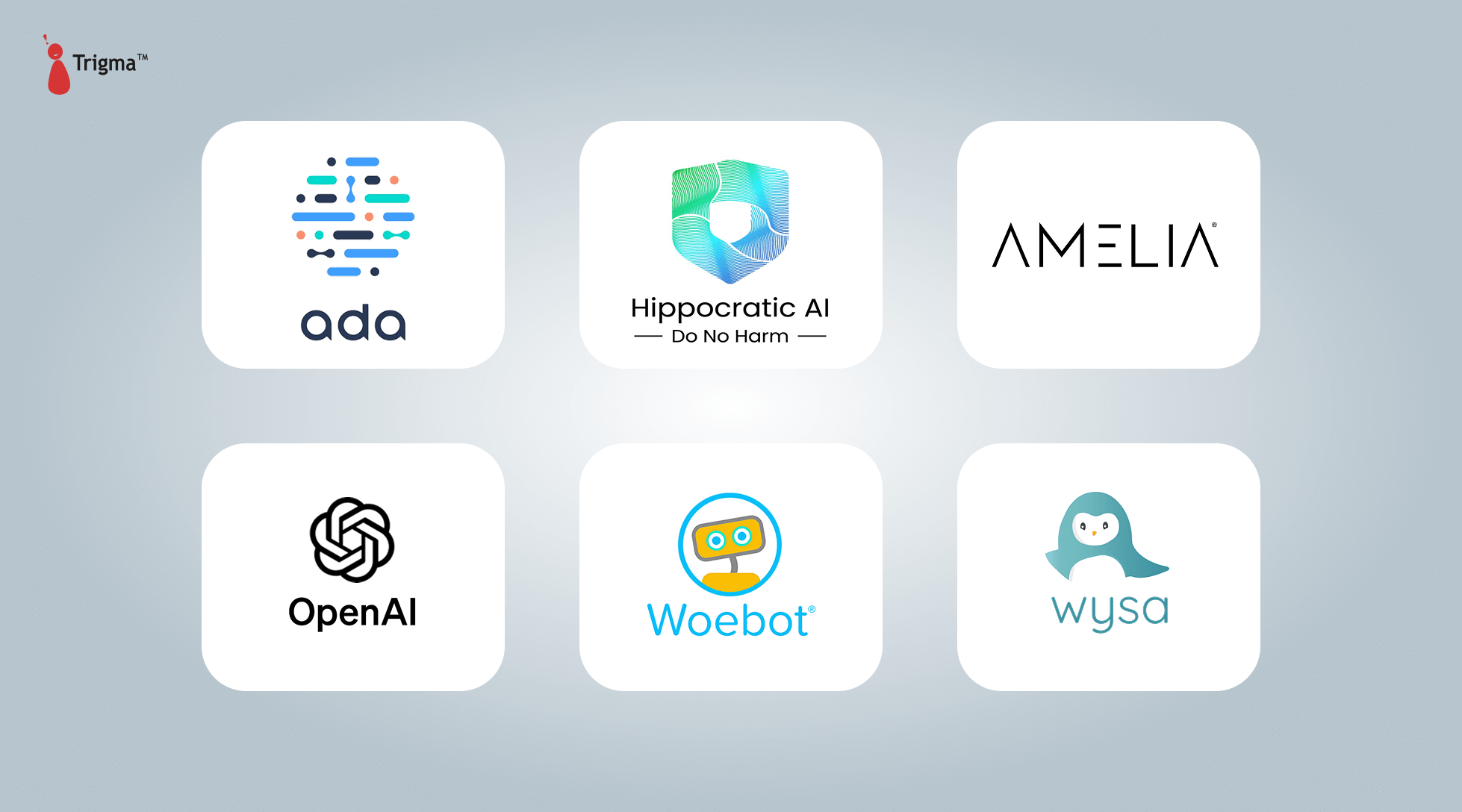
Several companies are already leveraging AI agents to strengthen patient follow-ups and care continuity:
Real World AI Agents In Healthcare

1. Ada Health

Ada Health provides an AI-powered symptom checker that adapts to user responses and ensures the patient receives accurate guidance on when to seek medical care.

2. Hippocratic AI

Hippocratic AI is a safe, trustworthy approach to AI agents in healthcare. It enables AI agents that support follow-ups, patient triage, chronic disease management, and care navigation while prioritizing safety, empathy, and regulatory compliance.

3. Amelia AI Agents

An advanced AI agent platform that delivers conversational and cognitive automation in healthcare. Amelia’s virtual agents handle patient interactions, appointment scheduling, claim processing, and post-care follow-ups, providing human-like engagement.

4. Open AI Health

Open AI Health specializes in leveraging natural language processing (NLP) to transform clinical notes, patient notes, and unstructured health data into actionable insights. Its AI agents help support physicians in follow-ups, decision-making, and care coordination by ensuring critical information is not lost in documentation.

5. Woebot

A conversational AI mental health agent that engages users through chatbot interactions. Woebot provides cognitive behavioral guidance, mood tracking, and timely follow-ups, helping users manage stress, anxiety, and depression with accessible and personalized support.

6. Wysa

An AI-driven mental health coach that offers emotionally intelligent conversations and evidence-based interactions. Wysa’s AI agents support daily check-ins, self-care exercises, and personalized guidance, complementing professional therapy and promoting mental well-being.

The Future Landscape in Patient Care and Follow-ups

As healthcare shifts towards value-based care models, AI agents are set to become indispensable. With advancements in Generative AI, multimodal learning, and interoperability standards, these agents will soon handle complex scenarios—such as interpreting imaging data, delivering multilingual support, and dynamically adjusting care pathways.

The ultimate vision is a continuous, 360° care ecosystem where patients receive round-the-clock support, providers gain real-time insights, and healthcare organizations reduce costs while improving outcomes.

Final Thoughts

AI agents are no longer a futuristic concept; they are actively transforming healthcare today. From patient-facing agents like Babylon Health, Woebot, and Wysa to operational platforms like Olive AI and Amelia, these systems streamline follow-ups, improve care continuity, and enhance patient engagement.

By integrating predictive analytics, natural language processing, and real-time monitoring, AI agents ensure that healthcare providers can deliver timely, personalized, and compliant care. The adoption of AI agents represents a strategic advantage for healthcare organizations aiming to reduce administrative burden, improve clinical outcomes, and elevate patient satisfaction. As technology continues to advance, AI agents will play an increasingly central role in creating efficient, patient-centric care ecosystems.

If your organization is looking to leverage AI agents for smarter patient follow-ups and continuous care, investing in these solutions now is a step toward future-ready healthcare delivery.

Don’t get left behind

Upgrade your patient care with Trigma’s Agentic AI services
AI Agents vs. Agentic AI: Choosing the Right Technology for Your Organization

Have you ever noticed how Spotify recommends the perfect playlist for you and Netflix seems to know exactly what you want to binge-watch next? These everyday experiences showcase the power of AI agents; systems that are designed to understand preferences and deliver outcomes.

But as AI evolves, this raises a bigger debate over AI agents and agentic AI. While agents handle specific, well-defined tasks, Agentic AI goes further, adapting, planning, and making autonomous decisions that feel almost human-like.

In today’s world, it’s really hard to imagine not having instant, personalized solutions at our fingertips. From entertainment to healthcare to business operations, AI has transformed complexity into convenience, making technology feel effortless.

In this blog, let’s head towards this discussion and learn how Agentic AI and AI Agent differ. It will be an effective decision to choose what's right for your business and how it can be effective.

What are AI Agents?

An AI agent is a system built to handle specific tasks to achieve a predefined goal. They are like the digital workers designed to carry out specific tasks within set boundaries. Many agents use LLMs at the core, but they stay focused on short tasks instead of pursuing large goals.

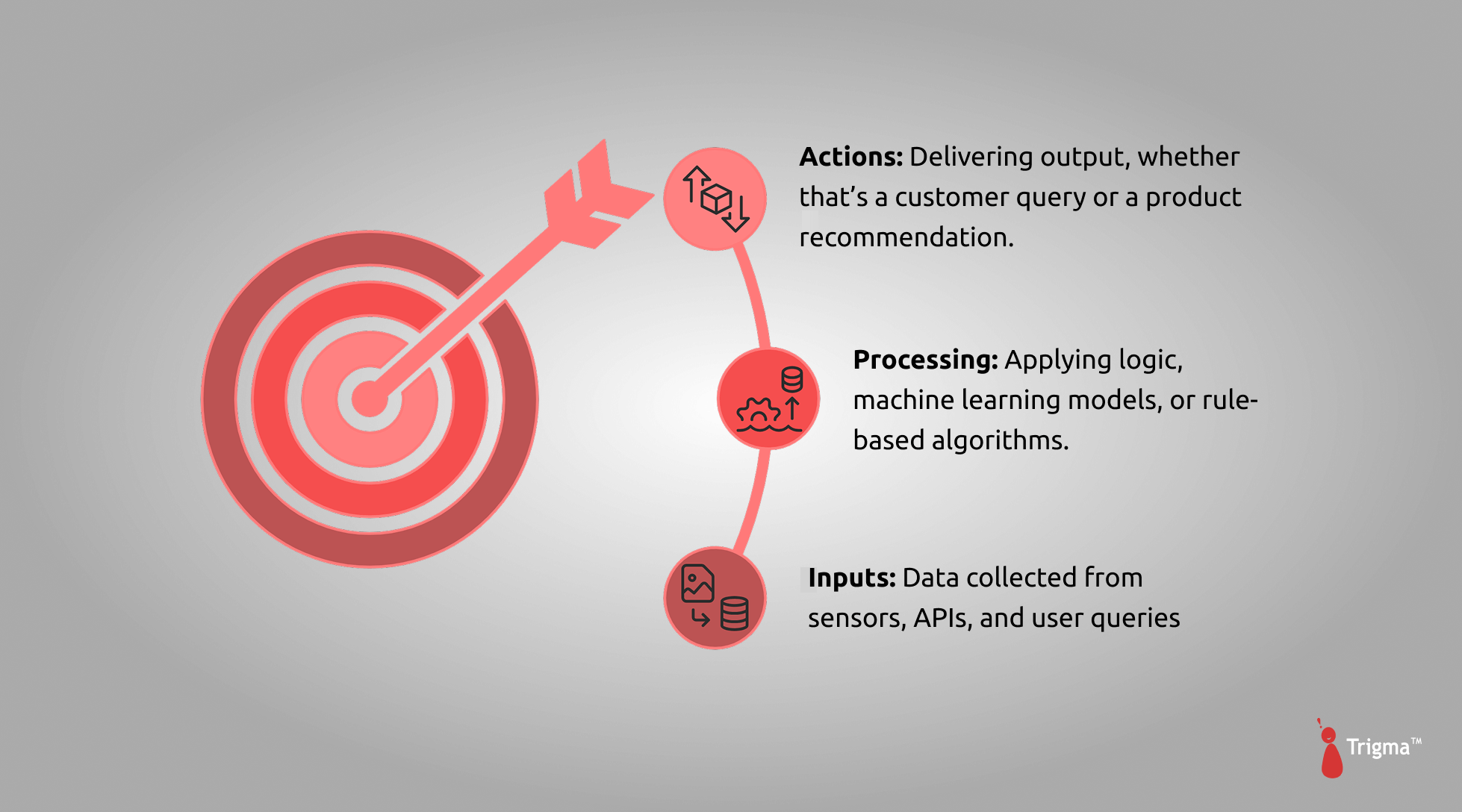
Often called task-driven assistants, they operate based on:

  • Inputs: Data collected from sensors, APIs, and user queries.
  • Processing: Applying logic, machine learning models, or rule-based algorithms.
  • Actions: Delivering output, whether that’s a customer query or a product recommendation.

Examples:

  • Chatbot in customer service: Trained on FAQs, these agents can resolve queries like “ What’s my account balance? Or How to Log in to the portal?”
  • Recommendation engines: Amazon’s “Customer also bought” feature is an agent working behind the scenes.
  • Robotic process automation (RPA) bots: Automating repetitive back-office tasks like invoice processing.

AI agents are powerful but typically narrow in scope. They are designed for specific outcomes and often require human oversight when tasks move beyond their training data.

What is Agentic AI?

Agentic AI is a next-level transformation in the AI world. It’s not just about executing predefined tasks; it’s about creating autonomous, goal-driven systems that can adapt, plan, and execute smartly and effectively. Unlike simple AI agents, Agentic AI systems demonstrate higher cognitive capabilities:

What are AI Agents
  1. Autonomy: Operates with minimal human intervention, adjusting strategies based on real-time feedback.
  2. Goal-oriented planning: Break down complex objectives into smaller sub-goals and execute them subsequently.
  3. Adaptability: Learn from interactions and continuously improve decision-making.
  4. Collaboration: Works with humans or other AI systems to complete end-to-end workflows.

Examples of Agentic AI

  • Healthcare diagnosis: An agentic AI can not only analyze X-rays but also cross-reference patient history, suggest next diagnostic steps, and recommend treatment pathways.
  • Financial trading systems: Instead of following fixed rules, Agentic AI adapts to market volatility, rebalances the portfolio, and explains its decisions.
  • Supply chain optimization: Monitor disruptions, reroute shipments, and negotiate with suppliers dynamically.

In short, where an AI agent “executes tasks,” Agentic AI “orchestrates outcomes.”

Stay Ahead of the Curve

By 2030, 70% of enterprises will rely on autonomous AI agents. Don’t get left behind and start building your Agentic AI strategy today.

Difference Between AI Agents and Agentic AI

Feature AI Agents Agentic AI
Scope Narrow, task-specific Broad, goal-oriented
Autonomy Limited, often needs human intervention High operates independently
Learning capability Mostly pre-trained or rule-based Adaptive, learns continuously
Decision making Follows predefined logic Dynamic reasoning and planning
Use case Chatbots, recommendation engines Healthcare, logistics, automation, decision-making

Which One Does Your Organization Need?

Choosing between AI agents and Agentic AI depends upon your business goals, budget, and organization’s level of adoption.

When to use AI Agents

  • Need quick automation wins with minimal complexity
  • Use cases are well-defined and repetitive
  • Low-cost, low-risk AI implementation due to budget constraints

When to use Agentic AI

  • If you’re managing complex, multi-step workflows that need adaptive intelligence.
  • If you want systems that collaborate with humans instead of simply replacing manual tasks.
  • If your organization requires scalable AI solutions that improve over time and handle uncertainty.

The Unique Roles

  • An AI agent is like a waiter who follows instructions, takes orders, serves dishes, and processes payments.
  • Agentic AI is like a restaurant manager that anticipates demand, assigning staff, ordering supplies, handling emergencies, and even suggesting a menu revamp.

Both are important, but their roles differ drastically.

Final Thoughts

AI agents and Agentic AI aren’t competitors; they’re different stages in the evolution of intelligent systems. AI agents are effective when it comes to handling specific, structured, and repetitive tasks, while agentic AI represents a leap towards autonomous, adaptive, and goal-oriented intelligence that can transform entire workflows.

For organisations, the major question is not which one is better, but which one aligns with your current business needs. If your priority is quick automation for customer queries, data processing, or workflow efficiency, AI agents are the right fit. But if you’re looking to scale intelligently, adapt to uncertainty, and enable systems that learn and evolve, Agentic AI is where the future lies.

In essence, the journey begins with agents, but it matures with agentic intelligence. Forward-thinking organizations that invest in both will be best positioned to thrive in the AI-first era.

At Trigma, we design and deploy cutting-edge AI solutions, from task-focused AI agents to enterprise-grade agentic AI systems. Whether you’re starting small or ready for large-scale transformation, our team helps you harness AI to achieve measurable business outcomes.

Let’s explore how AI can work for your organization.

How Agentic AI Forecasts Sales Trends with Predictive Analytics

Sales forecasting has always been a cornerstone of enterprise strategy, underpinning revenue planning, resource allocation, and supply chain optimization. However, in today’s hyper-volatile market, legacy forecasting approaches, static spreadsheets, and quarterly roll-ups are increasingly inadequate. These methods failed to capture the complexity of fragmented data ecosystems, unexpected demand signals, and exogenous market shocks such as supply chain disruptions, macroeconomic volatility, and computer interventions. This results in a persistent gap between the forecasted projections and real-world outcomes, resulting in misaligned inventory and revenue leakage.

Agentic AI introduces a paradigm shift in predictive analytics. Agentic architectures deploy autonomous, goal-oriented agents capable of adapting data ingestion, multivariate modeling, and simulation in a closed-loop framework. These AI agents for analytics continuously sense, reason, and act across dynamic environments by integrating real-time data streams and autonomously triggering corrective actions.

This blog delves deeper into the value of agentic AI in sales and how traditional sales approaches are incapable of generating effective ROI. It also discusses the technical components of agentic forecasting along with its impact on business. Let’s get started.

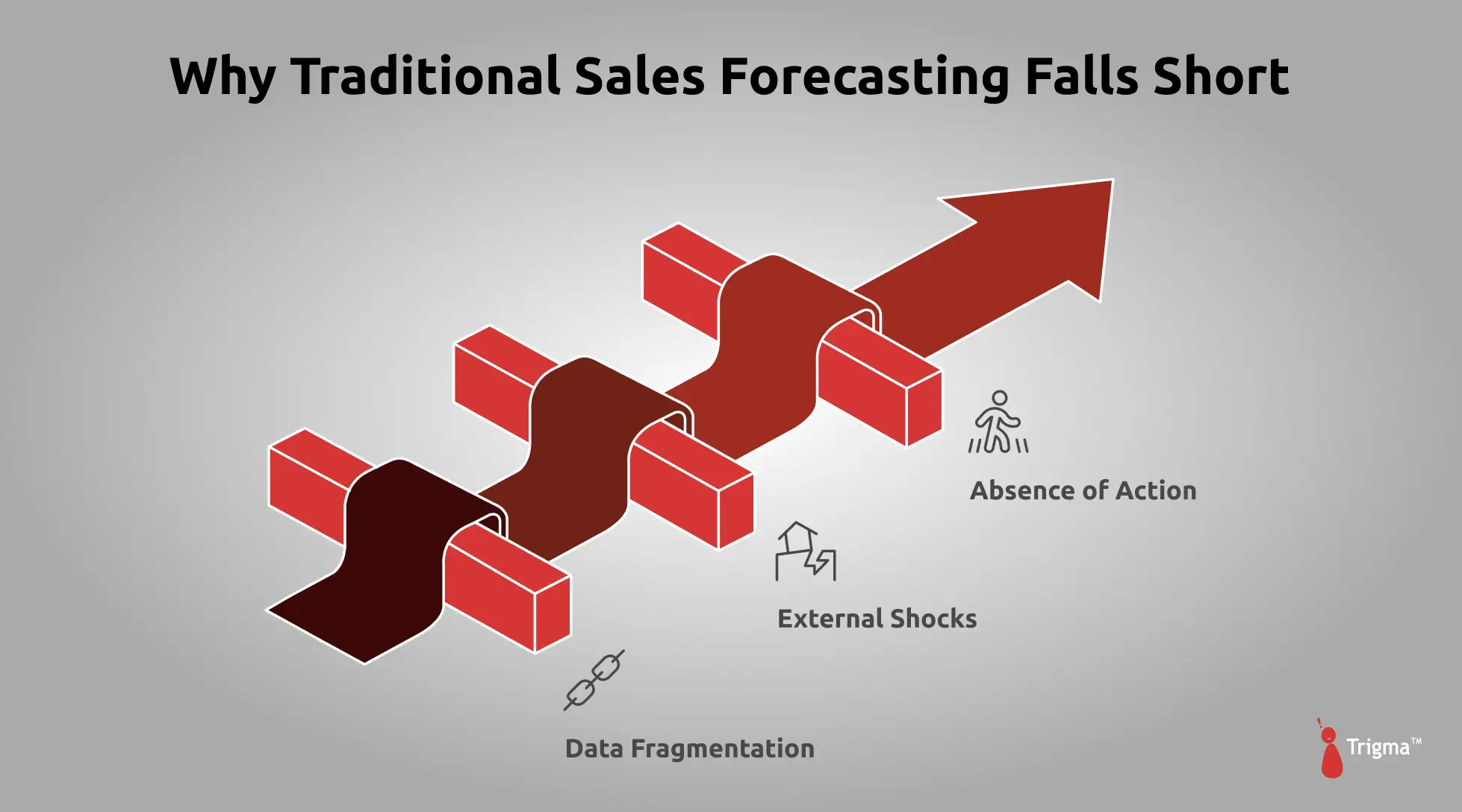
Why Traditional Sales Forecasting Falls Short

Why Traditional Sales Forecasting Falls Short

1. Data fragmentation and latency

In modern enterprises, sales signals are distributed across multiple systems: the point of sale terminals, CRM platforms, ecommerce sites, and digital advertising channels. Traditional forecasting relies on batch ETL (Extract, Transform, Load) pipelines that aggregate this data into a central warehouse, and by the time the forecast is generated, the underlying data may already be outdated. This latency means that organizations are relying on yesterday’s reality rather than today’s. This lacks real-time data synchronization, resulting in delayed responses and lost opportunities.

2. External shocks

Demand patterns are rarely stable. They are non-stationary and change over time. Seasonal shifts, promotional campaigns, or events alter buying behavior that is completely unpredictable. Worse external shocks from macroeconomic events, raw materials shortages, or even extreme weather can break forecasting models altogether. As a result, forecasts tend to over-smooth volatility, leading to businesses overstocking in declining markets or understocking in surging ones.

3. Not defined action

When forecasts are accurate, they are often delivered as static reports or dashboards on spreadsheets that planners must interpret. Therefore, the real gap arises because forecasts are not directly aligned with operational execution systems, like inventory management, ERP, or sales outreach tools. This creates a heavy dependency on human analysts, and the lag between insight and action deepens. Traditional systems fail to close this loop, which is why businesses often complain that their forecasts are “interesting but not actionable.”

Close the gap between insight and action, discover how agentic AI integrates forecasts directly into your ERP and CRM systems.

What Makes Agentic AI Different

Agentic AI is built on autonomous, goal-driven agents that collaborate to achieve defined business objectives. Instead of a single monolithic forecast, agentic systems orchestrate multiple data analytics AI agents:

  • Data agents clean and prepare real-time data streams.
  • Modeling agents run ensembles of statistical and machine learning models.
  • Simulation agents conduct what-if analyses.
  • Planner agents convert forecasts into executable strategies.

This agent mesh approach transforms forecasting into a continuous, closed-loop cycle, ie, ingest, predict, simulate, act, and learn.

Core Technical Components of Agentic AI Forecasting

Agentic AI for sales forecasting is not a single model, but a multi-agent architecture where specialized components collaborate in a closed-loop system. Each agent handles a critical function: data ingestion, modeling, simulation, planning, execution, and governance. Together, they transform static forecasts into adaptive, self-learning ecosystems.

1. Data fabric and ingestion agents

In modern enterprises, relevant signals originate from multiple domains, transactional sales, CRM pipelines, promotions, digital footprints, logistics, and even external indicators such as macroeconomic indices or weather data.

  • Real-time ingestion pipelines
    Tools like Kafka or Change Data Capture (CDC) ensure that data flows continuously instead of relying on outdated batch uploads.
  • Feature stores
    Platforms such as Feast or Hopsworks store engineered features (promotion flags, price indices, channel mix) in a time-aware manner, ensuring that models always train and predict on the correct historical context.
  • Data agents
    Autonomous agents validate schemas, impute missing values with statistical methods, and tag data quality metrics.

This ensures that the forecasting system operates on fresh, accurate, and standardized data streams.

2. Modeling agents

Agentic AI doesn’t rely on a single algorithm but deploys modeling agents that orchestrate ensembles of diverse approaches:

  • Classical time series models (ARIMA, SARIMAX, Prophet) for seasonality and trend detection.
  • Machine learning models (LightGBM, Random Forest) for handling tabular features like promotions, discounts, or sales rep activity.
  • Deep learning architectures to capture complex multivariate time series dependencies across product categories, regions, and customer segments.

The modelling agents dynamically select and weight models using meta learners, ensuring continuous adaptation as demand patterns evolve.

3. Simulation & scenario agents

Forecasts alone are not enough; enterprises need to know what if. Simulation agents stress-test forecasts under multiple hypothetical conditions:

  • Monte Carlo simulations to generate probabilistic demand and distributions.
  • Counterfactual scenarios (“what if we raise the price by 5%, what if a shipment delay hits region B”)
  • Elasticity testing that models customer response to promotional levers.

These simulations allow planners to move from static point forecasts to decision-ready distributions, quantifying upside, downside, and risk exposure.

4. Orchestration agents

Planner agents are the decision-making brains of the system. They

  • Translate forecast outputs into action recommendations
  • Respect operational constraints such as supply chain lead times, budget ceilings, and service level agreements.
  • Prioritize actions expected by ROI, balancing accuracy with the cost of intervention.

Instead of leaving forecasts as “informational dashboards,” planner agents bridge the gap to execution.

5. Execution and feedback loops

A key differentiator of agentic AI is its ability to close the loop between prediction and action. Execution agents integrate directly with enterprise systems:

  • ERP/SCM integration to trigger procurement and replenishment orders.
  • CRM/ Marketing automation to initiate targeted outreach based on forecasted demand shifts.
  • Dynamic pricing engines that adjust promotions in real time.

Crucially, every executed action is logged, and its outcomes (e.g., actual sales uplift, stockouts prevented) are fed back into the models. This self-learning loop continuously reduces error over time.

6. Monitoring and governance agents

Forecasting at enterprise scale demands trust and compliance. Governance agents ensure the system remains reliable and accountable.

  • Model drift detection Alerts when performance degrades due to shifting patterns.
  • Explainability SHAP or LIME-based attribution to show why forecasts changed
  • Fairness and compliance Ensuring recommendations don’t violate regulations or ethical guidelines (e.g., discriminatory pricing).
  • Audit trails Every decision and model change is logged for transparency.

This governance layer prevents agentic systems from becoming “black boxes” and ensures stakeholders can validate outcomes.

Business Impact: ROI & Accuracy Gains

Agentic AI transforms sales forecasting from a passive reporting exercise into a strategic profit lever. Beyond improving statistical accuracy, its value lies in measurable business impact across revenue, cost, and operational efficiency.

1. Forecast accuracy improvement

  • Traditional statistical models typically deliver 60-70% forecast accuracy depending on the industry.
  • Enterprises deploying AI-driven predictive analytics report 20-30% improvement in forecast accuracy.
  • This leads to fewer missed sales opportunities, reduces reliance on safety stock, and better capital efficiency.

2. Inventory optimization

A Gartner survey indicates that companies overstock inventory by 10–20% on average due to inaccurate forecasts.

  • By integrating forecasting with ERP/SCM systems, execution agents automatically trigger replenishments based on real demand signals.
  • This leads to 15–25% lower inventory holding costs while still maintaining service levels.
  • This results in reduced warehousing costs, minimized write-offs, and improved working capital utilization.

3. Revenue uplift and sales enablement

  • AI-powered forecasting identifies micro-trends such as sudden regional demand shifts or promotional responsiveness.
  • In this context, an AI sales assistant functions as a data analytics AI agent embedded into CRM systems, surfacing customer-level predictions and suggesting next-best actions for sales reps.
  • By aligning sales activity with predictive insights, organizations see 5–10% uplift in conversion rates and faster pipeline velocity.

AI Sales Assistants: The Human AI Interface

AI Sales Assistants The Human AI Interface

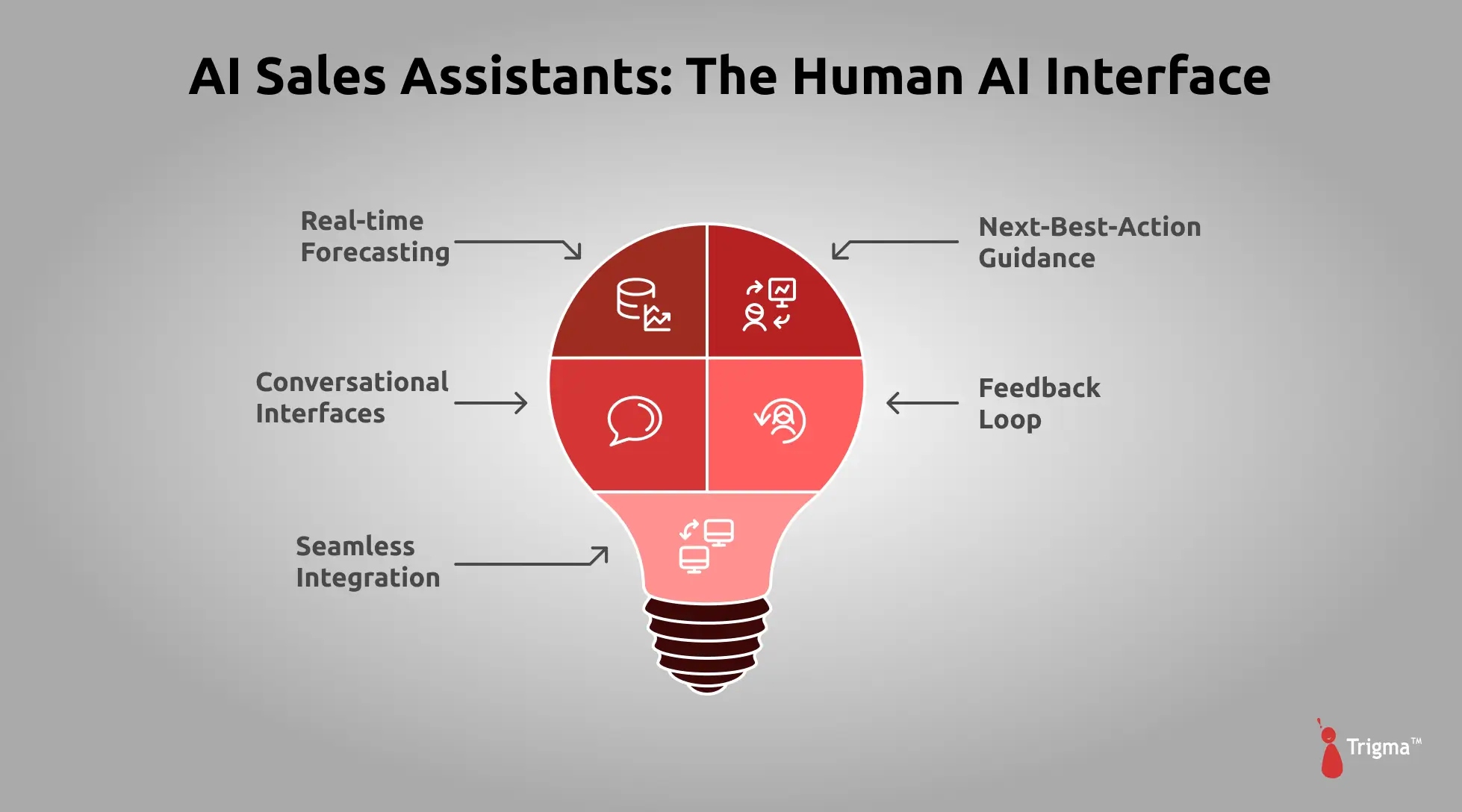
One of the most tangible and business-facing applications of agentic forecasting is the AI sales assistant. While much of predictive analytics and agentic AI operates behind the scenes, optimizing data pipelines, scenario simulations, and ERP integrations, the AI sales assistant becomes the human-AI interface, where predictive intelligence directly augments sales teams.

These assistants function as specialized data analytics AI agents embedded with CRM platforms, digital communication tools, or even voice-enabled interfaces. Their role extends far beyond simple task automation:

  • Real-time Forecasting at the Edge
    AI sales assistants surface micro-forecasts directly at the rep level, predicting which accounts are most likely to convert, which SKUs are trending in specific geographies, and what timing is optimal for outreach.
  • Next-Best-Action Guidance
    By leveraging the outputs of agentic forecasting models, these assistants recommend context-specific actions: offering a targeted discount, upselling a complementary product, or reallocating time from a low-probability lead to a high-probability one.
  • Conversational Interfaces
    Modern assistants can integrate natural language interfaces, allowing sales professionals to query them as they would a colleague, “What’s the expected Q4 demand for Product Line A in the Midwest?” and receive data-backed answers instantly.
  • Feedback Loop from Human Judgment
    Unlike rigid dashboards, AI sales assistants are interactive. They allow reps to input ground-level intelligence (e.g., “client mentioned budget freeze”), which feeds back into the forecasting system, improving its accuracy and adaptability.
  • Seamless Integration
    By syncing across CRM (Salesforce, HubSpot), ERP, and marketing automation systems, the AI sales assistant ensures that sales strategies are not siloed but aligned with enterprise-wide forecasting outputs.
    The result is a symbiotic human-AI interface where predictive analytics becomes not just an enterprise-level planning tool but a day-to-day tactical advantage. For sales leaders, this bridges the final mile, transforming statistical insights into actionable behaviors that drive revenue.

Conclusion

Sales forecasting has evolved from static spreadsheets and quarterly projections into a dynamic, intelligence-driven discipline. Traditional methods, limited by data latency, rigid statistical assumptions, and an execution gap, can no longer keep pace with today’s volatile, non-stationary markets.

Agentic AI closes this gap by combining autonomous data analytics AI agents, advanced predictive modeling, scenario simulation, and real-time orchestration into a self-learning ecosystem. The result is not just greater forecast accuracy, but an adaptive forecasting engine that continuously aligns predictions with execution, optimizing inventory, improving promotional ROI, and enabling revenue growth.

At the frontline, AI sales assistants extend these capabilities directly to sales professionals, creating a human-AI interface where predictive insights become day-to-day tactical advantages. By embedding intelligence into workflows, enterprises unlock a new standard of agility, precision, and profitability.

As competitive landscapes grow more complex and market signals become more fragmented, businesses that embrace agentic forecasting today will not only achieve superior accuracy but also secure a decisive strategic edge in tomorrow’s markets.

Ready to Transform Your Sales Forecasting?

Leverage the power of Agentic AI and intelligent sales assistants to achieve unmatched accuracy, optimize inventory, and drive measurable ROI.

7 Ways AI Is Making Virtual Reality Smarter and More Immersive

Virtual reality (VR) has evolved significantly from being a futuristic concept in sci-fi movies to a technology that people actually use in their daily lives. In previous times, VR has mostly been seen in research labs or niche gaming setups, bulky headsets, limited graphics, and experiences that felt more experimental than practical.

Today, VR has evolved into a powerful tool across various industries, including healthcare, education, fitness, architecture, and even therapy. Headsets are lighter, visuals are faster, and experiences feel far more natural. But the real game-changer behind this evolution is Artificial Intelligence (AI).

AI is making VR smarter, faster, and more immersive, turning digital environments into living, responsive worlds. Instead of static stimulations, VR powered by AI adapts to the user to predict their movements and creates experiences that feel deeply personal.

Let’s explore in this blog seven powerful ways AI is shaping the future of VR and why it matters to businesses and industries alike.

Powerful Ways AI is Upgrading VR

Impactful Ways AI is Upgrading VR

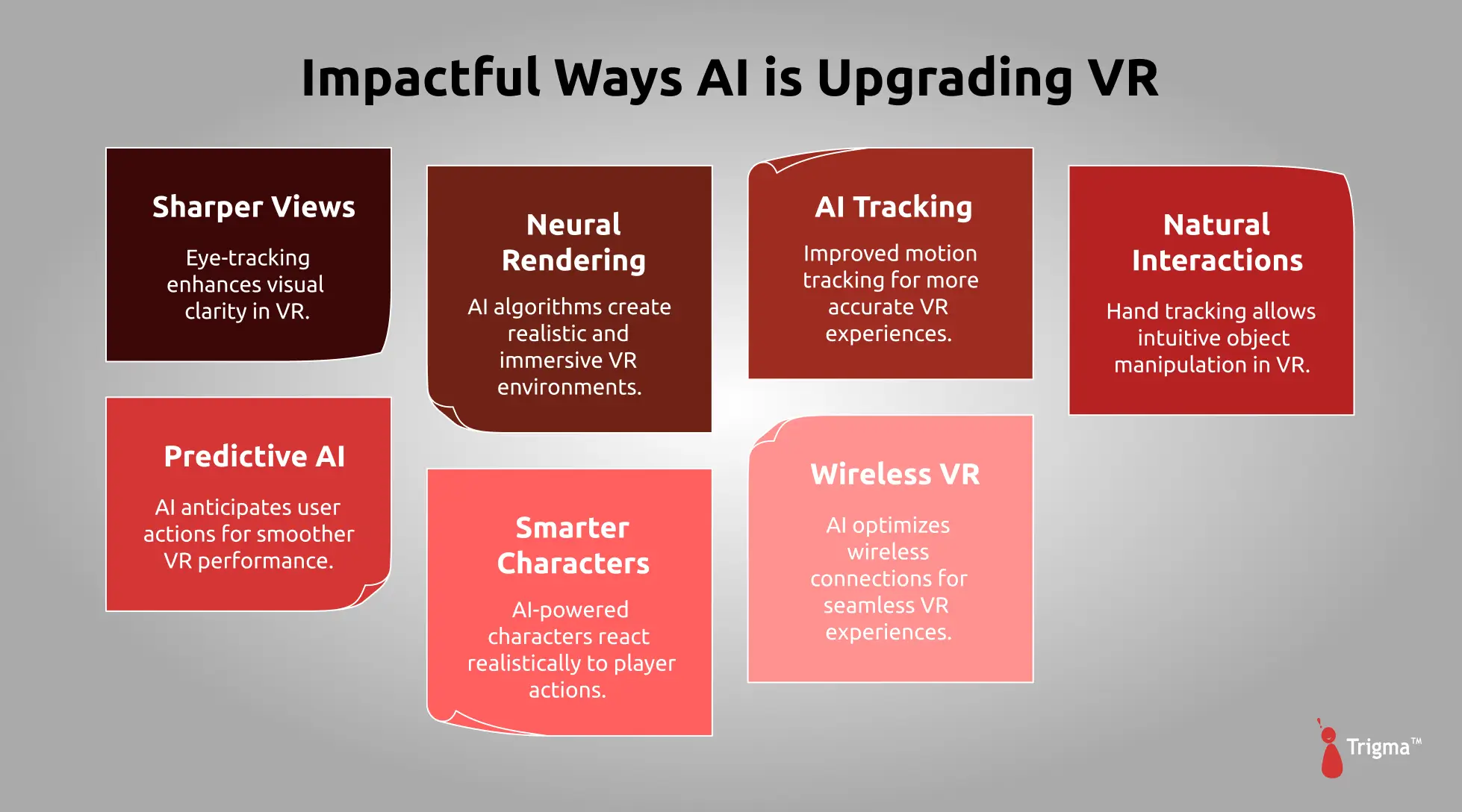
1. Sharper views with eye-tracking

When you look at something in real life, your eyes naturally focus on the center of what you’re seeing, while the edges stay slightly blurred. VR headsets are now using AI-powered eye-tracking to recreate this natural vision pattern. This technique, called foveated rendering, sharpens only the area you’re looking at while reducing detail in your peripheral vision.

This is powerful because it gives you the best of both worlds; crystal clear visuals, where you need them, and lighter processing where you don’t. This means there is smoother performance, higher frame rates, and even longer battery life for wireless headsets. For users, this translates into more lifelike visuals and comfort, and for businesses, it makes VR applications scalable without requiring expensive, high-powered software.

2. Neural rendering

One of the most exciting breakthroughs in VR is the ability to turn real places into digital environments without spending months on manual 3D modelling. This was made possible with AI techniques like neural rendering and neural radiance fields. With just a few photos or video clips, AI can learn the details of the real-world scene and recreate it in 3D. This results in a photorealistic virtual space that feels almost like stepping into the actual location.

For businesses, this technology means faster content creation, reduced costs, and more authentic environments that people actually connect with. For individuals, it means VR that feels less like a game and more like a window into reality.

3. AI tracking

In the early days of VR, external sensors needed to be placed around your room to track your head and hand movements. It worked, but it was complicated, expensive, and limited in where you could actually use VR. With AI-powered inside-out tracking, headsets can track your movement using built-in cameras and smart algorithms. This means the system understands where you are in the room, how you move, and even estimates your body posture, all without extra equipment.

For users, this creates a freedom of movement that feels natural. You can walk, turn, or reach out, and your avatar mirrors you instantly. For businesses, it makes VR more practical in offices, classrooms, or gyms since you don’t need a specially prepared setup.

4. Natural interactions with your hands

One of the biggest shifts in VR is moving beyond controllers. While joysticks and buttons work, they don’t always feel natural, especially for new users. That’s where AI-powered hand and gesture tracking comes in. Using advanced computer vision, VR headsets can now recognize the exact position of your hands and fingers. This allows you to point, swipe, pinch, grab, or draw in mid-air, just like you would in the real world.

For individuals, this makes VR more intuitive and immersive, with no learning curve, just natural movement. For businesses, it opens up new opportunities in training, healthcare, and education, where realistic interaction is essential. With AI translating subtle gestures into precise actions, VR starts to feel less like using technology and more like simply using your own body.

5. Predictive AI

If you’ve ever felt dizzy or uncomfortable in VR, it’s usually because of lag, the tiny delay between your real movement and what you see inside the headset. Even a fraction of a second can break the illusion and cause motion sickness. AI helps solve this problem with predictive tracking. By learning how people move, AI can anticipate where your head or hands will be a split second before you actually get there. The system then adjusts the visuals in advance, keeping everything perfectly in sync.

For individuals, this means longer, more comfortable VR sessions without nausea. For businesses, it ensures smoother experiences in training, presentations, and customer-facing demos, where comfort is non-negotiable. In short, AI makes VR feel natural, fluid, and effortless, so the technology disappears, and you’re fully immersed in the experience.

6. Smarter characters

In older VR experiences, virtual characters (NPCs) are limited. You could ask them something, but they’d always give the same pre-programmed response. This often made interactions feel robotic and predictable. With generative AI, that’s changing fast. Now, VR characters can see, listen, and respond naturally, just like real people. They can hold conversations, adapt to your actions, and even change their behavior based on how you interact with them.

For individuals, this means more immersive storytelling and gameplay, where every experience feels unique. For businesses, it’s a powerful tool for training and simulations, like practicing customer service with an AI client who reacts differently each time, or learning leadership skills by managing a virtual team.

7. Wireless VR

One of the biggest hurdles for VR has always been the need for powerful hardware. High-quality VR experiences used to require a gaming PC or console, connected with thick cables that limited movement. That’s quickly changing with AI-enhanced streaming. AI can now optimize how VR content is delivered over Wi-Fi or the cloud. It uses smart techniques like foveated streaming, sharpening only the part of the image you’re looking at, while adjusting quality in real time to match your network speed.

For individuals, this means you can enjoy smooth, high-quality VR experiences without being tied down by wires or expensive equipment. For businesses, it makes VR more scalable and accessible, allowing teams, clients, or students to join immersive experiences from almost anywhere.

Why This Matters

Whether you’re a business leader, a healthcare professional, an educator, or simply a VR enthusiast, AI is unlocking a level of immersion that was once impossible. Training feels more realistic, healthcare therapies more engaging, games more interactive, and virtual meetings more human.

VR is no longer just about “being inside a game.” It’s about living inside smarter, adaptive environments that can teach, train, entertain, and connect us in ways we never imagined.

The future of VR is not just about headsets, it’s about how AI makes these experiences smarter, smoother, and more meaningful.

At Trigma, we’re not just building VR applications; we’re shaping the future of immersive technology. As a leading AI and technology solutions company, Trigma combines deep expertise in Artificial Intelligence, Virtual & Augmented Reality, and custom software development to deliver experiences that go beyond expectations.

With a proven track record, innovative mindset, and a client-first approach, Trigma is your trusted partner to bring visionary VR ideas to life, powered by AI.

Ready to Explore AI-Powered VR?

If you’re ready to explore how AI-driven VR can transform your business or project, let’s talk. Book a free consultation today and start building your next immersive experience.

Let’s build the future together.