+91-98558-85133
 +1(702)760-3099

60-Second Summary
- Traditional debugging tools fail with AI agents because failures aren't code errors : they're reasoning drift, wrong tool choices, and hallucinations that spread silently before anyone notices.
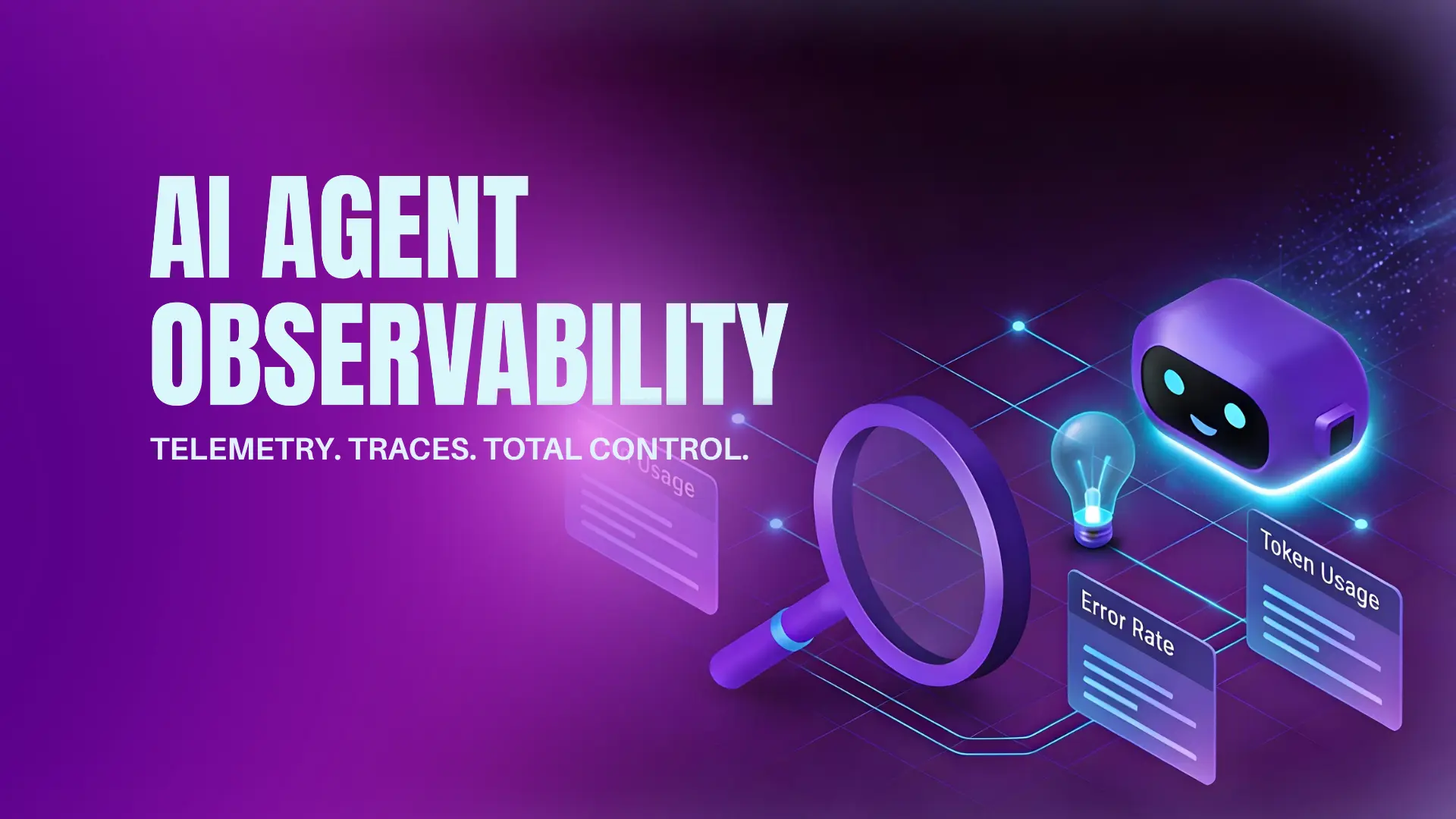
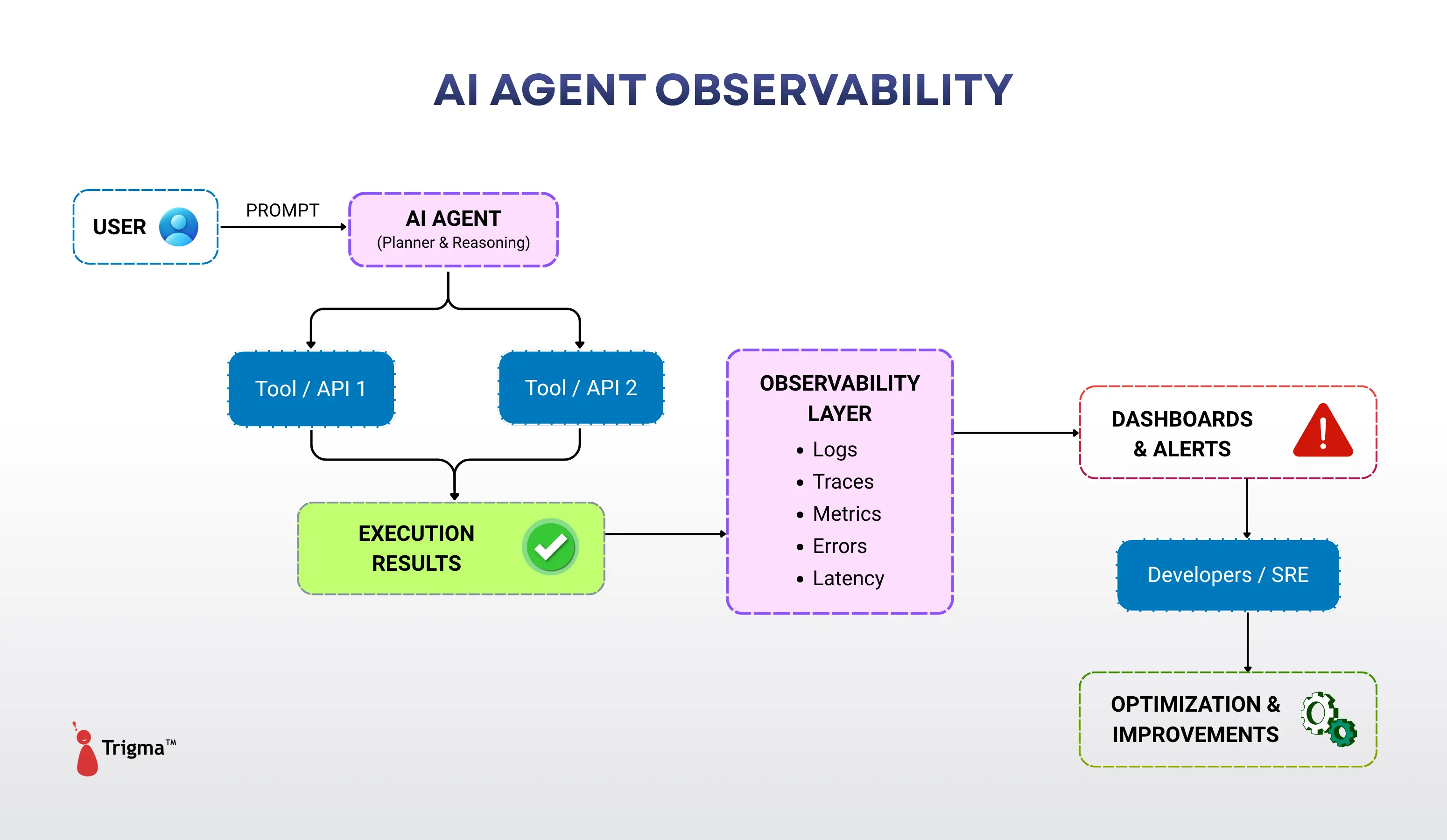
- Observability tracks the full agent journey such as prompts, decisions, tool usage, and traces so teams can debug faster, enforce compliance, and optimize performance in real time.
- Key benefits include catching errors early, improving output accuracy, enabling real-time intervention, and giving non-technical teams a shared view of agent behavior.
- Implementing it right means collecting telemetry from both the system and the agent, visualizing data through dashboards, and building for cross-team collaboration not just developers.
- Trigma goes beyond monitoring what agents do. It measures what they're worth, comparing human vs. AI efficiency, tracking ROI, and managing governance from setup to scale.
Just like traditional systems, AI agents don't fail in obvious ways. Instead, they drift, response quality declines, hallucinations emerge, and decisions may be technically correct but contextually flawed.
But why did the agent do that? Observability answers this by providing traceability across inputs, decisions, and outcomes, along with insights into tool usage and influencing factors such as prompt design or data sources.
Through observability, teams can monitor behavior and risk in real time, so you can move AI agents from experimental deployments to reliable, enterprise-ready systems.
In this blog, we'll cover what AI agent observability means, why AI agents need it, and how you can quickly implement it.
What is AI Agent Observability?
Once you build AI agents, the next big challenge is observability. Think of it this way: when traditional software fails, you already know what to do such as check the error logs, look at the trace, and find the line of code that failed.
But AI agents have changed everything. When an agent takes 200 steps in just 2 minutes and makes a mistake, a different type of error has occurred; one not related to a line of code that failed.
The agent failed because of its reasoning. The teams building and shipping AI agents aren't the ones with the best evaluation frameworks; they're the ones who review production traces the way surgeons review post-op reports.
AI agent observability focuses on how agents behave within their agentic workflows. It involves looking at things like:
By adopting such responsible AI practices, agent performance improves.
Why AI Agent Observability Is a Must-Have in 2026?
AI agents need observability because they don't behave the way traditional software does. Traditional software follows fixed rules, is predictable, and can be governed through code, traces, and logs.
Think of it this way: if you ask an AI the same question twice, it may throw back different answers each time. If you give it the same task, it may take a different approach altogether.
Even when an AI agent makes a mistake, you may not notice it until the issue has already spread or caused problems.
To detect what AI agents are doing, traditional observability tools may not suffice; you need AI agent observability to monitor, debug, and optimize agent behavior in real time.
1. Non-Deterministic Behavior Requires Continuous Visibility
AI agents don't behave the same way every time. Even for the same input, they may think through different steps, choose different tools, and select alternative paths to act.
This means they're probabilistic not like rule-based systems and their variability can't be removed.
So teams need observability to determine whether those differences are harmless or harmful.
Small changes can cause big differences, like slightly different wording in a request, unclear or ambiguous instructions, or differences in the memory or data the agent retrieves.
Even when settings are tightly controlled, large language models can drift in behavior or interpret the same prompt differently.
2. Debugging and Troubleshooting AI Agents is Harder
Traditional debugging doesn't work well for AI agents because they don't follow simple, fixed steps. They operate through multi-step processes that include planning, using tools, retrieving memory, and making conditional decisions.
When something goes wrong, it doesn't appear as a clear error. Instead, the failure shows up as:
- Incorrect reasoning
- Unfinished tasks
- Wrong tool choices
Because of this, observability is required to perform root cause analysis, and teams need to reconstruct the agent's entire decision-making process.
Traces show the exact step where the agent went off track such as a tool failure or misinterpreted instruction. Logs tell you what was happening internally before the failure such as faulty assumptions, stale context, or inappropriate tool parameters.
Without monitoring and observability, teams can neither diagnose why a task went wrong nor replicate the conditions to verify fixes.
3. Reliability, Safety, and Compliance Need Traceability
AI agents often handle sensitive data, interact with external systems, and make important decisions. Because they act independently, you need a way to track and verify everything they do.
You need observability to see whether agents followed approved policies, respected access restrictions, and avoided prohibited actions.
Security monitoring helps detect risks such as unauthorized use of tools, signs of data exposure, and attempts to manipulate the agent's instructions.
4. Continuous Improvement and Operational Optimization
AI agents change over time as models are updated, data changes, user behavior evolves, and new tools are added. Because of this, their performance, cost efficiency, and output quality can either improve or worsen depending on how they're operating.
Observability is essential because improving and optimizing these agents depends on real-time feedback. This telemetry shows:
- Performance metrics, which indicate where reasoning steps or tool usage are slowing down the system.
- Token usage and cost data, which reveal inefficiencies such as too many retries or overly large inputs that increase cost.
Observability also helps identify where an agent isn't following the intended workflow, allowing teams to refine prompts, redesign workflows, and update how tools are used.
What Are The Benefits of Having AI Agent Observability?
AI agent observability helps engineers better see, control, and trust how AI agents are working. Once observability is set up, it not only helps teams catch problems early; it also helps them get more value from their AI agents.
1. Improve Performance At Scale
When teams clearly understand how AI agents work, they can find slowdowns, detect failed tool usage, and spot inefficient workflows.
Observability reveals patterns you can't see from just the final output. This helps teams improve prompts, use tools better, and align agents with real business needs.
2. Strengthen Data Quality and Accuracy
AI agents depend on internal data to make decisions, and even small issues lead to inconsistencies.
Observability helps teams catch when the agent pulls information from the wrong source, when a prompt is misunderstood, or when the agent generates inaccurate responses.
3. Enable Real-Time Intervention
Dashboards and alerts let teams quickly step in when something goes wrong before it causes bigger problems. This level of responsiveness is important for tasks such as customer support, fraud detection, and production monitoring.
4. Support Sustainable Scaling
As more teams start using AI agents, observability ensures these systems don't turn into black boxes.
It gives everyone like admins, analysts, and operators a shared view of how agents behave, which reduces confusion, makes collaboration easier, and ensures agents fit well into real workflows.
How To Implement AI Agent Observability?
Building observability for AI agents isn't just about collecting data; it's about collecting the right data in a useful way.
The goal is to capture what matters, connect it so it makes sense, and present it in a way that people can easily act on.
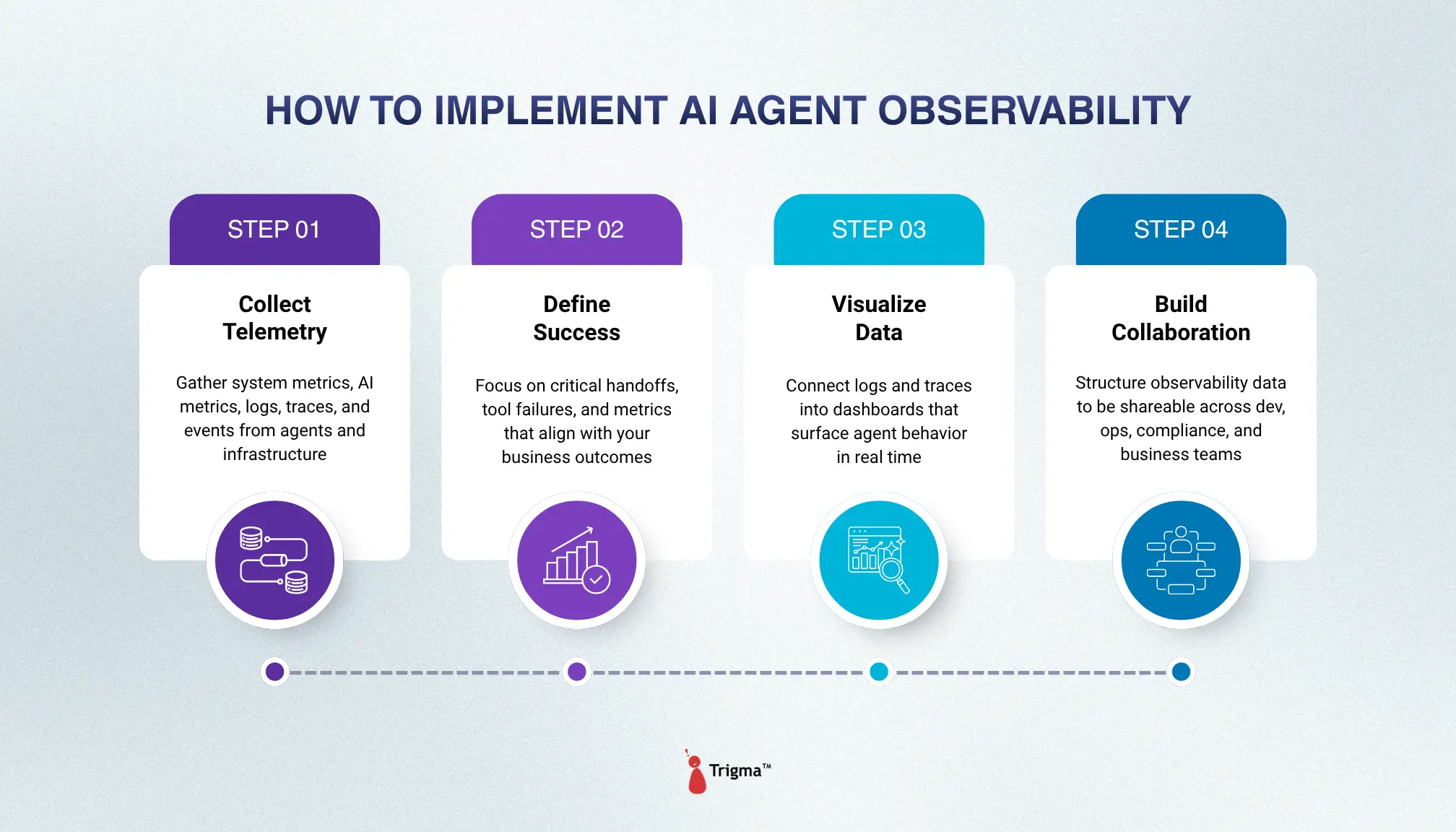
1. Start By Collecting Telemetry From the Right Places
To monitor AI agents properly, observability relies on two data sources: the system running the agent (servers, APIs, and tools) and the agent itself (prompts, decisions, and tool usage).
You need access to both to understand what's happening end to end.
This step includes:
- System metrics such as CPU, memory, and network usage
- AI metrics such as token usage, response time, and prompt quality
- Events such as failed API calls, tool errors, and human handoffs
- Logs such as interactions, inputs, tool actions, and decision steps
- Traces such as the full path from input to final output
The result?
Many teams now use AI model monitoring for measuring accuracy and performance across deployments.
2. Define What Success Looks Like
Not every action needs to be traced. Focus on the moments that matter most such as critical handoffs, tool failures, and delayed responses.
The result?
Make sure these metrics align with the outcomes that matter to your team, such as reducing escalations, improving task completion, or shortening response time.
3. Visualize Data In Context
Raw data like logs and traces aren't helpful on their own. Observability becomes valuable when these data points are connected and surfaced in relevant ways usually through dashboards that highlight important behavior and results in real time.
Visualization tools also help non-technical users understand what the AI agent is doing and decide when to take action.
4. Build For Collaboration
Observability shouldn't be just for developers. Teams across support, operations, compliance, and data also need to understand how AI agents behave.
Structure your observability data to be shareable, clean, easy to understand, and aligned with your business impact.
How Trigma Helps You Implement Observability For AI Agents?
While most observability tools show you what the agent is doing, Trigma's technical expertise goes further quantifying what the agent is actually delivering, in value, not just activity.
It tracks and compares human vs. agent efficiency, and supports your entire journey from initial setup and system design through dashboards, testing, training, and ongoing management. While most providers focus on just one part, Trigma handles everything in one place.
Recently, we helped an enterprise build an AI workforce and governance platform.
Many enterprises are adopting AI tools and agents but lack clarity and control over how these systems operate with no visibility into what an AI agent is doing and no governance framework to prevent issues such as hallucinations or policy violations.
Implementing the governance platform for that enterprise meant:
- Tracking AI actions, decisions, and workflows
- Comparing human vs. AI work
- Evaluating AI model performance using metrics such as trust score and GSTI
- Comparing the ROI of human vs. AI work in terms of cost and output
Your AI Agents Are Running. But Are They Performing?
Trigma goes beyond basic monitoring — measuring trust scores, comparing human vs. AI output, and building the governance framework your enterprise needs to scale AI with confidence.