+91-98558-85133
 +1(702)760-3099

60-Second Summary
- Single-agent systems run on one model with one goal ; simpler to build, debug, and cost-effective for small to medium businesses with straightforward workflows.
- Multi-agent systems deploy specialized agents working in parallel, making them ideal for complex, large-scale enterprise operations that demand speed and accuracy.
- Single agents work best for focused tasks like chatbots or targeted automation, but fall short when scalability and parallel processing are required.
- Multi-agent systems offer key advantages including scalability, parallel decision-making, fault tolerance, and reduced hallucinations through cross-agent verification.
- However, studies show multi-agent systems fail 60–80% of the time due to specification issues, inter-agent misalignment, and coordination breakdowns.
- The right choice depends on your workflow like sequential tasks favor single agents, while parallelizable tasks with independent subtasks favor multi-agent architectures.
Choosing between a single-agent and multi-agent AI system could be one of the most consequential decisions for your operations. Get it wrong, and you're either over-engineering a simple problem or under-powering a complex one.
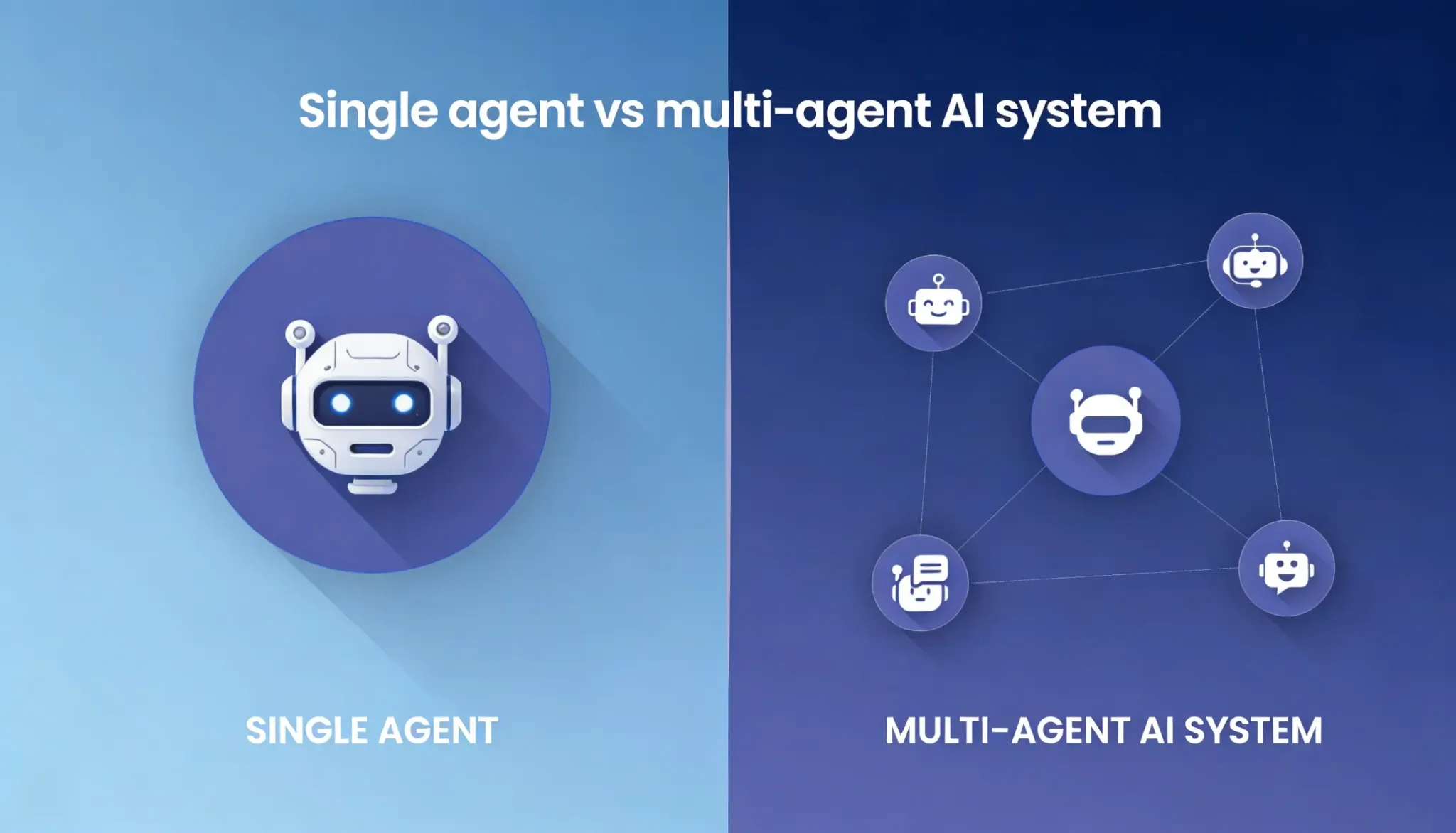
Single-agent systems prioritize simplicity — one model, one goal, easy to build and debug. Multi-agent systems distribute intelligence, with specialized agents working in parallel to handle complexity at scale.
The right choice comes down to understanding what each system offers, where each falls short, and what your business actually demands.
What are Single AI Agents?
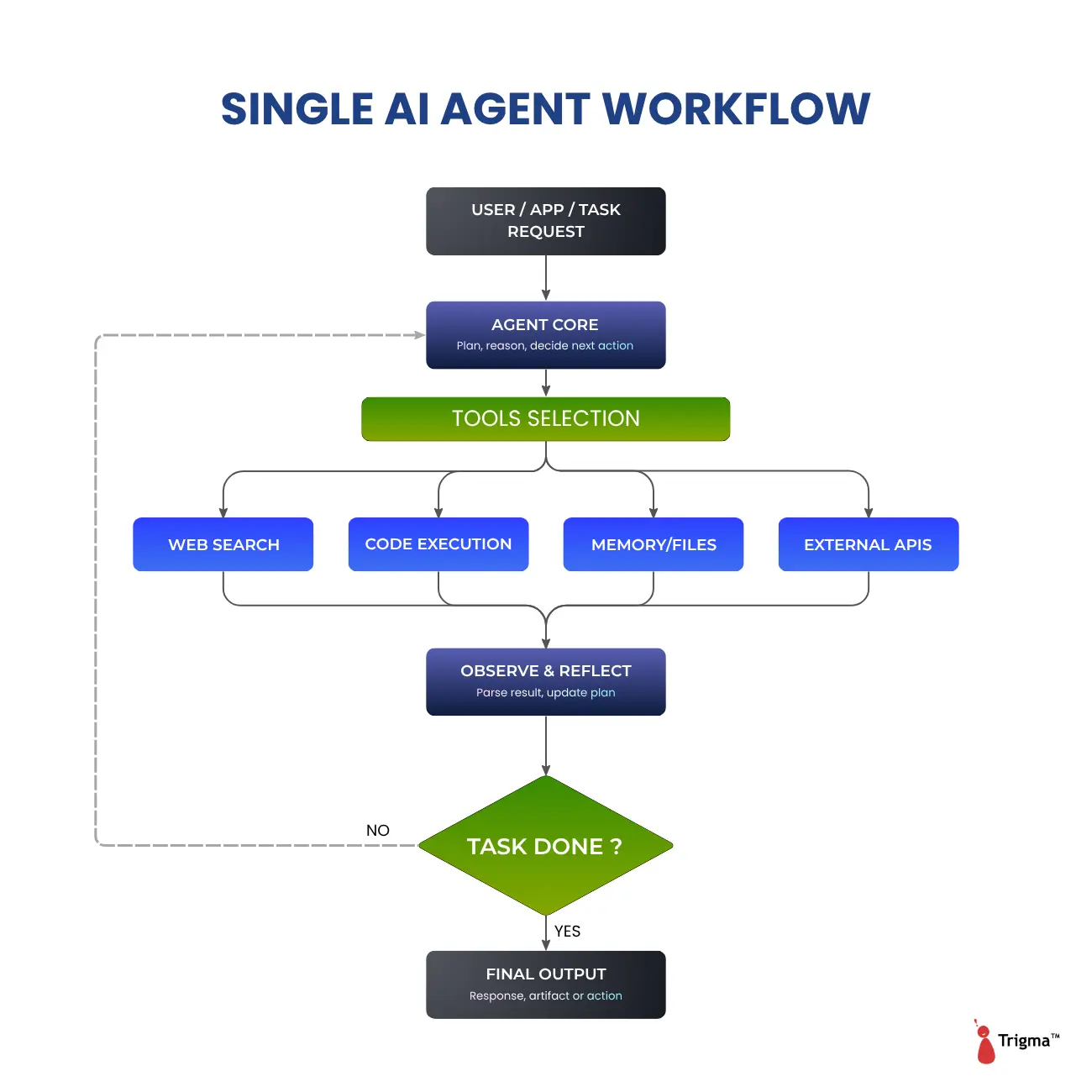
A single AI agent is essentially one AI assistant handling everything like research, analysis, visualizations, and writing with no handoffs, no coordination, just one system to manage.
For rapid prototyping or targeted workflows, a single AI agent can deliver high-quality results without the overhead of a multi-agent setup.
The agent connects to memory for context retention and tools for performing tasks.
This setup works great for straightforward applications where one agent manages all user interactions, such as simple chatbots or focused assistants.
Benefits of Single AI Agents over Multi-Agent Systems
In single agent architecture, one agent handles the entire workflow. Think of it as one highly capable generalist, and investing in such architecture offers several benefits:
- Only one agent is responsible for decision-making, which makes the process faster. Consider it like a sole proprietorship where the owner makes all decisions independently.
- Development cycles are shorter, making it suitable for fast automation of specific workflows.
- Developing single agents requires fewer resources than multi-agent ecosystems, making it cost-effective for small to medium businesses.
- It simplifies the overall system architecture by reducing the need for many specialized agents for different functions.
What are the Limitations of a Single AI Agent for Enterprise?
Here are a few downsides of building single AI agents for your business:
- Single agent AI has limited scope, as it cannot handle complex problems requiring parallel processing of tasks.
- There's no multi-agent coordination, since every agent works independently. This means it cannot divide the work, unlike multi-agent AI, or share decisions with other agents.
- As business needs grow, single AI agents are not scalable enough to handle large business processes and can become overloaded.
- There's no cross-checking of decisions in single agent systems, as there's no built-in peer review.
What is a Multi-Agent AI System?
A multi-agent system lets you build a team of specialists.
Instead of one generalist, you have focused roles; agents that excel at handling different data sources, one agent specializes in code generation, another handles data retrieval, and a third specializes in synthesis and planning.
Each agent goes deeper in its own domain, which helps maintain quality across the board.
Unlike single agents, multiple agents use a central orchestration layer that manages and directs the activities of individual agents.

Real World Example of Multi Agent Systems
Consider a medical equipment management system where every agent performs a unique function.
- The inventory agent monitors stock levels and flags items falling below the threshold.
- The maintenance agent checks when equipment was last serviced and tracks the next due date.
- A user support agent handles frequently asked questions from users.
Each agent in this case acts like a microservice, communicating with the others.
Together, they function like a collaborative team, with every agent specializing in its own work with greater autonomy.
What are the Benefits of Multi-Agent AI Systems Over Single AI Agents?
Multi-agent AI works on a divide-and-conquer principle, assigning specific roles to agents that a single-agent setup cannot provide.
Here are a few advantages your enterprise can gain through multi-agent workflows:
1. Scalability
Instead of one agent doing everything, tasks are distributed to specialist agents who are experts in a specific domain. Multi-agent architectures are well-suited for industries like logistics, where demand changes continuously.
You can add agents to handle increasing user requests during peak hours and scale them down when not needed.
2. Parallel Decision-Making
In traditional automation, tasks happen sequentially, but in multi-agent ecosystems, work is split across multiple AI agents.
This means different tasks can be handled at the same time, such as creating promotional content, running advertising campaigns, studying market trends, tracking campaign performance, and generating reports.
The result?
Everything gets done faster because it happens in parallel.
3. Robustness and Fault Tolerance
Multi-agent systems remain operational even if one agent fails, as it won't bring down the entire system.
For example, in autonomous vehicle coordination, if a car's sensor agent fails, other agents can share data to keep navigation safe. Redundancy can also be built in, where multiple agents monitor and cross-check each other's progress.
Similarly in cybersecurity, agents can monitor different network layers, so an attack on one layer doesn't affect the others. Developers can recover from failures by restarting agents or redistributing their tasks.
Note:
Multi-agent systems well-suited for critical applications like disaster response, where systems must handle unpredictable situations.
4. Reduced Hallucinations
Combining multiple agents can help reduce hallucinations and bias. Here’s how -
- Agents can question each other to clarify and refine answers.
- One agent's output can be verified by others.
- Multiple agents can compare answers and agree on the best one.
- Agents can access up-to-date information, reducing errors from outdated knowledge.
Note:
While multi-agent systems don't automatically eliminate hallucinations, they add checks, collaboration, and real-time data access to deliver more reliable results across the entire workflow.
What are the Disadvantages of Using Multi-Agent Systems for Enterprises?
Though multi-agent systems are gaining popularity with frameworks like CrewAI and AutoGen getting traction. Studies show that multi-agent systems fail 60–80% of the time, and they don't fail silently.
They repeat steps, forget context, ignore each other's messages, or verify things incorrectly. Sometimes, they don't even know when to stop.
- 42% of failures stem from specification issues, meaning agents might hardcode answers, repeat steps endlessly, or never recognize that they've completed a job.
- 37% are caused by inter-agent misalignment, where agents ignore each other's inputs, misinterpret their roles, or take actions that don't match their reasoning.
- Verification failures are another major problem. Sometimes there are no checks at all; other times, checks are surface-level like a customer's issue is marked resolved without verifying whether the customer’s problem was actually fixed or not.
- Coordination problems arise when agents get in each other's way if they're not well-coordinated.
- Endless loops occur when AI agents keep interacting without making real progress. Instead of completing tasks, they repeat the same questions and arguments. This typically happens when there's no clear stopping condition, instructions are vague, or agents start losing earlier context due to memory limits.
What’s the Difference Between Single AI Agents and Multi-Agent Systems?
Here's how single agent AI differs from multi-agent AI in terms of collaboration, scalability, and efficiency.
| Basis of Comparison | Single Agent AI | Multi-Agent AI |
| 1. Definition | Consists of one autonomous agent working in an environment | Consists of multiple agents interacting with each other |
| 2. Interaction | No inter-agent communication required | Agents collaborate with each other to solve problems faster |
| 3. Decision-Making | Centralized | Distributed (multiple agents coordinate decisions) |
| 4. Scalability | Performance slows as tasks grow more complex; cannot handle increasing workloads | Scalable, as each agent handles a specific part of the task |
| 5. Task Distribution and Specialization | Single agent handles all tasks independently, which can overburden the system | Parallel processing allows tasks to be assigned to specialized agents |
|
6. Resource Usage |
Lower computational resources required, as processing happens in one model | Requires more computational power, as work is distributed across multiple agents |
| 7. Adaptability and Learning | Works well in predictable settings but struggles when new variables or tasks arise | Can learn from the environment and adapt strategies accordingly. e.g., financial systems that monitor conditions and adjust pricing decisions |
Build Smarter Single and Multi-Agent AI Systems With Trigma
Whether you want to build single AI agents or a multi-agent architecture, we can help you choose the right approach.
It depends on your goals such as multi-agent systems are generally better suited for parallelizable tasks with independent subtasks, while single agents work better when tasks must be completed sequentially.
Both approaches have their own merits, but it all comes down to your use case.
Ready to build your own agentic system?
Whether you need a focused single agent or a full multi-agent system, Trigma's AI engineers help you design, build, and deploy the right architecture for your business goals.
FAQs
Why are agents viewed as more advanced than traditional AI chatbots?
AI agents are considered more advanced than traditional chatbots because they can operate independently with little or no human input.
While chatbots mainly respond to prompts and depend on user instructions, AI agents can make decisions, adapt to different situations, and take actions to achieve goals on their own.
In short, chatbots react, but AI agents can think, adapt, and act independently.
Can you give some real-world examples of single AI agents?
Examples of single agents include OpenAI's Operator, which can control computers on behalf of users, and Anthropic's Claude, which can interact with systems by moving cursors and entering data.
Are there any challenges in AI agent development?
Key challenges persist across agentic AI systems. Reliability remains a concern, as models can still produce incorrect or misleading outputs. Most are designed for single-pass responses, limiting their ability to explore, iterate, or self-correct.
Creativity is another gap; responses can lack the nuance and originality that complex business decisions demand. Finally, reasoning capabilities, while improving, can still falter on questions that require deeper logical thinking.