+91-98558-85133
 +1(702)760-3099

AI agents are no longer just assistants; they're making decisions, triggering workflows, and acting on behalf of businesses in real time.
But with that autonomy comes a real risk. Agents can hallucinate, misread context, and take actions that go beyond their intended boundaries.
And unlike a human employee who instinctively knows when to pause and ask, an autonomous system doesn't unless you design it to.
That's exactly where human oversight comes in. Not as a workaround for AI's shortcomings, but as a deliberate architectural choice that ensures every high-stakes decision gets a second set of eyes before it's executed.
In this blog, we break down what "human-in-the-loop" really means inside multi-agent AI systems, why it's becoming a MUST HAVE for enterprises, and how it's fundamentally different from "human-on-the-loop" monitoring.
What is Human-In-The-Loop in Multi-Agent AI Systems?
Human-in-the-loop is the most popular architecture in multi-agent systems because it combines human approval with agentic automation. For non-critical tasks, AI agents can run tools repeatedly and adjust actions on their own and this works fine.
But business-critical tasks need much higher reliability to avoid harmful outcomes.
Even though agents can change their actions and correct themselves while reasoning, there are still risks in performing operations such as modifying databases or accessing sensitive information.
Because of these risks, the human-in-the-loop pattern was created, where humans review or approve important decisions before a group of AI agents takes any action.
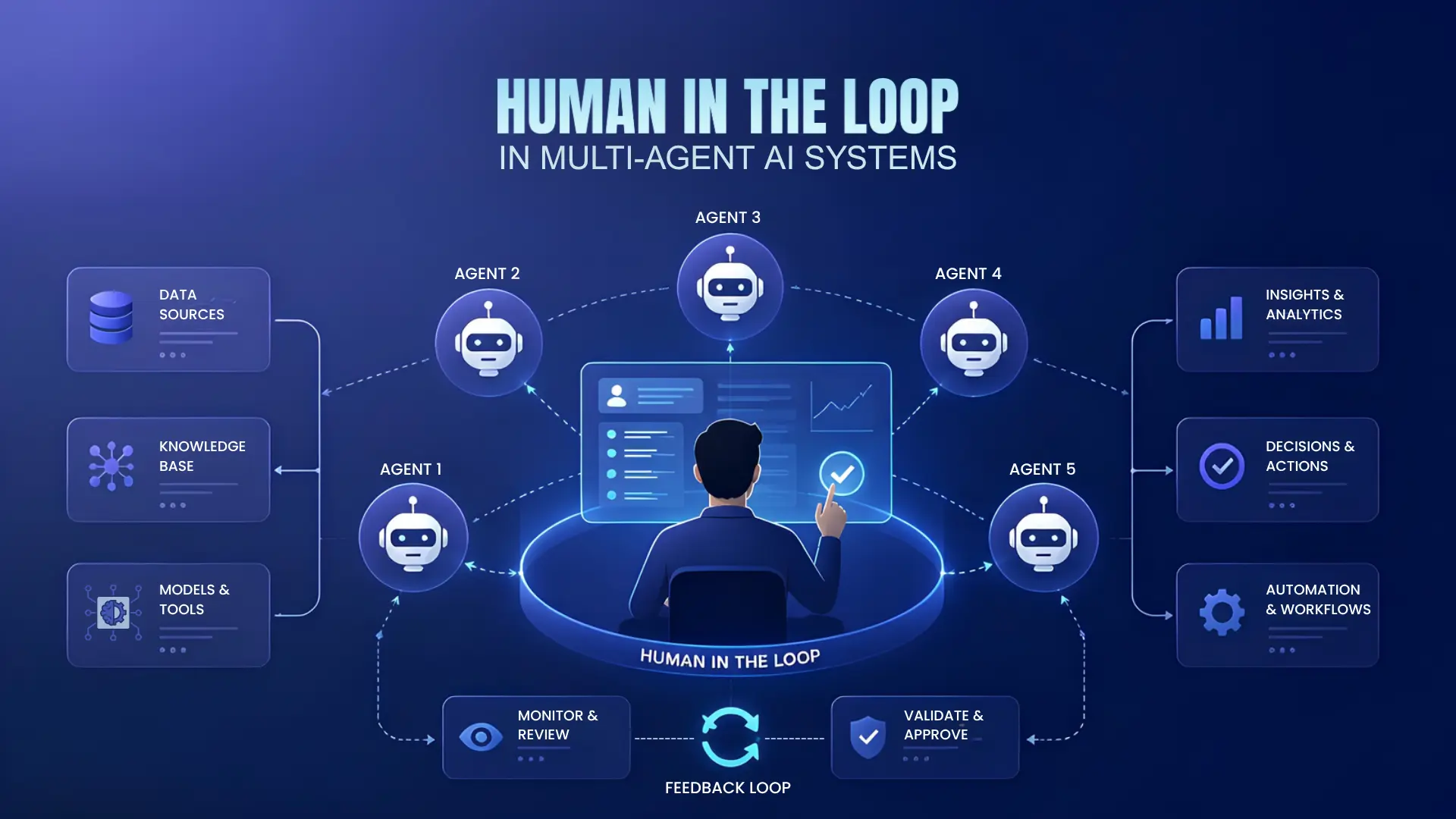
Human-in-the-Loop Multi-Agent AI Workflow
Why Deploy Human Oversight in Multi-Agent Systems?
Even though AI agents are very capable, they are not perfect. They can misunderstand context, miss meaning, or make decisions that have unexpected consequences. That's why human-in-the-loop approvals are required in multi-agent system architecture.
When humans are involved in the AI lifecycle, it means:
- They review and verify the outputs
- They provide oversight in sensitive or high-risk situations
- They improve the performance of a group of AI agents over time through continuous feedback loops
Note: Humans are not just people who approve things at the end of a workflow. They are involved in important parts of the system, such as:
- Objectives — Defining what the system should do
- Constraints and permissions — Setting rules for what agents are allowed to do
- Evaluation criteria — Deciding how success is measured
- Escalation paths — Defining when problems should be escalated to humans
- Accountability — Making sure accountability is clearly established
How Human-In-The-Loop Differs from Human-On-The-Loop Controls?
Devlin Lillies, Chief Consulting Officer at Improving, states that right now, AI agents are powerful assistants, but they are not standalone executives yet. The key is always keeping a human in the loop to guide, correct, and amplify.
But does that mean applying the human oversight model everywhere? Most agent demos treat human oversight like a feature you add later and that's a big mistake.
Hence, understanding the difference between human-in-the-loop and human-on-the-loop operating models is critically important.
| Basis of Comparison | Human-In-The-Loop | Human-On-The-Loop |
|---|---|---|
| System behavior | The system pauses before taking an action. | The system runs automatically, but if something goes wrong, humans can intervene, override the decision, or stop the system completely. |
| Human role | Humans review and approve actions before they happen. | Humans monitor and step in if needed. |
| Decision control | Humans make the final decision before the action proceeds. | AI makes decisions, but humans can override them. |
| When used | For high-risk or irreversible actions. | For low-risk and reversible tasks. |
| Examples | Fund transfers, data deletion. | Draft reports, queries. |
How Human-In-The-Loop Works in Multi-Agent AI Systems?
Humans participate in the loop in several ways. Here's a quick breakdown:
1. Data Labelling & Output Review
Human experts label data, solve complex edge cases, and review AI-generated outputs using structured review tools.
2. Contextual Escalation
Instead of reviewing every AI decision, systems route only low-confidence outputs to human reviewers keeping the process fast and efficient.
3. Multi-Step Evaluation
Agents go through a 3-stage review process:
- Automated scoring
- AI self-reflection
- Human review
4. Workflow Monitoring
When AI agents access developer tools, humans design and monitor the workflows to prevent unintended outcomes.
5. Model Fine-Tuning via RLHF
Humans improve AI over time by ranking, rewriting, or giving feedback on responses especially in fields like legal services, healthcare, and customer support.
Real-World Example:
Coding An AI agent drafts a complete plan or writes code for a new feature → A human reviewer checks and approves it before execution.
When To Choose Human-In-The-Loop vs. Human-On-The-Loop for Multi-Agent AI Systems?
To decide when humans should be involved, each action should be evaluated using two factors: risk and reversibility
- Risk refers to how serious the consequence is, evaluated on a scale from low to high.
- Reversibility means whether the action can be undone if something goes wrong.
For low-risk and reversible tasks, such as drafting reports or running queries, the human-on-the-loop framework is used. Agents operate independently while humans monitor only if there is an anomaly.
For high-risk and reversible actions, such as budget proposals or configuration changes, human-in-the-loop with fast approval cycles is preferred. AI suggests actions, but humans validate them before execution.
For high-risk and irreversible actions, such as fund transfers, data deletion, or signing contracts, strict human-in-the-loop with enhanced safeguards is necessary.
These situations require stronger controls such as multi-party approvals, audit trails, and guardrails.
| Risk Level | Reversibility | Oversight Model | Examples |
|---|---|---|---|
| Low Risk | Reversible | Human-on-the-loop | Draft reports, queries |
| High Risk | Reversible | Human-in-the-loop | Budget proposals, configuration changes |
| High Risk | Irreversible | Strict human-in-the-loop | Fund transfers, data deletion |
Key Human-In-The-Loop Patterns in Multi-Agent Workflows
While agents can handle many tasks automatically, there are certain situations where human involvement is necessary:
1. Data Labelling & Output Review
Human experts label data, solve complex edge cases, and review AI-generated outputs using structured review tools.
Example: A claims processing agent reviews the submitted documents and estimates the settlement amount.
Before finalizing payment, an approval agent sends the case to a human for validation of costing and claim settlement.
2. Rejection Handling
When a user says no, the agent asks for feedback to understand what went wrong.
Example: If a report generated by an agent is rejected, the agent asks what needs to be changed.
3. Logic Modification
If the AI agent is stuck or cannot solve a problem, it asks a human for help instead of failing silently.
Example: A customer support AI tries to resolve a billing issue but cannot find the right policy. Instead of guessing, it asks a human agent: "I can't resolve this issue; can you guide me on the correct rule?"
4. Output Editing
Before delivering the final output, the agent requests a review.
Example: Before publishing content, the agent asks the marketing team to review it for tone, accuracy, and completeness.
Challenges That the Human-In-The-Loop Framework Creates in Multi-Agentic Workflows
While agents can handle many tasks automatically, there are certain situations where human involvement is necessary:
1. Increased Latency and Cost
While agents can handle many tasks automatically, there are certain situations where human involvement is necessary:
2. Bottlenecks in High-Volume Systems
In high-throughput environments, human review can become a bottleneck. If there are too many tasks and too few reviewers, the system can slow down and create a backlog.
3. Human Bias and Inconsistency
It can be difficult to decide which outputs actually need human review and which do not.
4. Complex Escalation Systems
Designing smart frameworks to detect risks and route tasks to humans is challenging but necessary.
5. Quality Assurance Challenges
Maintaining consistent review quality across teams, shifts, and time zones requires regular audits.
6. Need for Domain Expertise
In fields like medicine, finance, or healthcare, reviewers must be trained experts, which raises the bar for recruiting, training, and managing human resources.
How Trigma Can Help You Develop Multi-Agent AI Systems?
Whether you want to build a single-agent or multi-agent system, we help you choose the right setup based on your use case. In multi-agent architecture, we focus on deploying multiple AI agents, each handling different subtasks.
Since different agents work simultaneously and are interdependent, the failure of one agent won't disrupt the entire workflow especially under the supervision of human reviewers, where every AI agent operates with pause-and-check nodes.
Having developed multi-agent systems across diverse verticals such as healthcare, fintech, and logistics, we know how to build AI agents that deliver real ROI.