+91-98558-85133
 +1(702)760-3099

Quick Summary
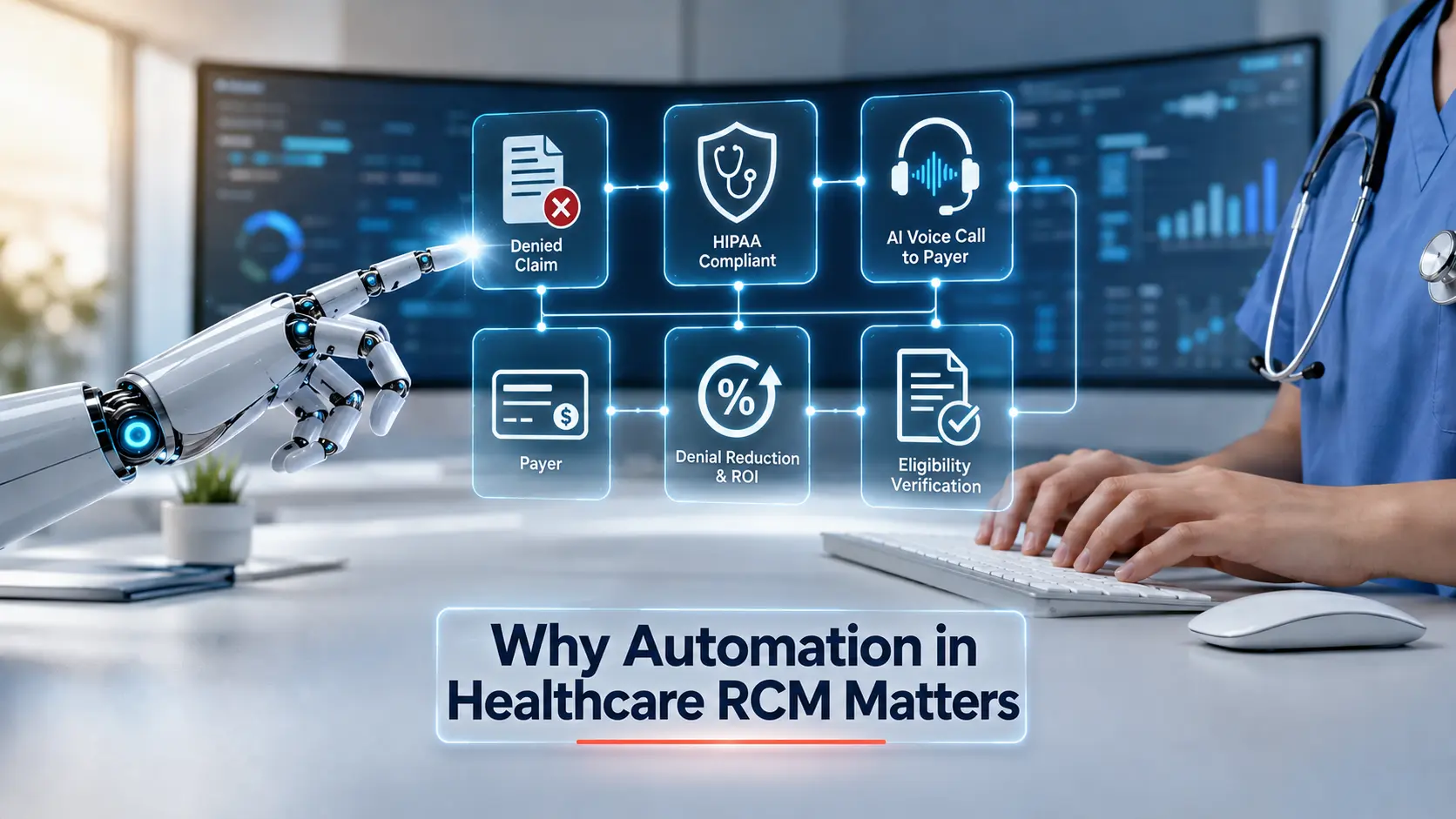
- Manual payer follow-up, not claim submission, is where healthcare RCM still loses the most time and money: around half of providers still review claims manually, and CAQH's 2025 Index still puts $21 billion in industry-wide savings on the table.
- Rigid, script-based robo-dialers fail against payer IVR systems; only AI voice agents with real-time intent detection navigate them reliably.
- Four use cases deliver the fastest ROI: autonomous claims follow-up calls, pre-submission claim scrubbing, automated eligibility verification, and dynamic denial triage.
- 83% of organizations saw claim denials drop by at least 10% within six months of deploying AI-driven automation (Black Book Research), but only 15% of organizations report positive ROI overall (HFMA/FinThrive), a gap driven by shallow integration versus deep, purpose-built builds.
- The core strategic decision is build vs. buy: off-the-shelf plug-ins carry vendor volatility, rising fees, and weak EHR integration; custom-built systems become owned, appreciating infrastructure instead of a rented liability.
Somewhere in your organization right now, a billing specialist is sitting on hold.
They are not just waiting a minute or two. A manual claim status call with an insurance payer runs 25 minutes on average. According to the landmark industry benchmarks tracked in the 2025 DataSpring CAQH Index Report, this operational friction burns up critical enterprise hours. Even though basic electronic tools have expanded across the industry, U.S. healthcare still leaves a massive $21 billion savings opportunity on the table simply because backend exception handling is still performed by hand.
This is not a staffing problem. It is an architecture problem. It is the primary reason why revenue cycle management (RCM) has become one of the most critical technology decisions a health system or medical billing group will face. Front-end claim submission is largely a solved milestone. What happens after a claim leaves your ecosystem is where the real revenue and the real operational risk still lives.
This guide breaks down why this back-end gap persists, where advanced automation actually moves the needle, what the latest evidence says about real-world ROI, and how to navigate the ultimate boardroom dilemma: should you build custom infrastructure or buy a pre-packaged plugin?
THE FRICTION POINT
Why Traditional Revenue Cycles Still Stall at the Phone Line
Clearinghouses validate formatting. Code scrubbers catch errors before a claim ever leaves the building. Clean claim rates at intake are, for the most part, an optimized metric.
Back-end follow-up is a completely different story. The moment a claim enters payer adjudication, standard digital workflows drop off. What follows is manual, analog, and slow.
The numbers back this up from multiple operational angles. Beyond the twenty five minute manual phone inquiry drain, prior authorization adds its own layer of heavy friction. Clinicians and administrative staff spend an average of thirteen hours per week processing tedious prior authorization requests, according to comprehensive American Medical Association (AMA) Survey Data.
The opportunity cost here is massive. Every hour a billing specialist spends trapped in a payer's telephone queue is an hour they cannot spend resolving high-tier revenue exceptions or fighting complex denials. When an organization only automates the front end, it leaves its operating margins highly vulnerable to back-end billing attrition.
PAYER DEFLECTION
Why Basic Robo-Dialers Fail
Commercial insurance payers do not design their interactive voice response (IVR) phone systems for provider efficiency. They use deep menu nesting and frequent structural updates specifically designed to deflect automated high-volume callers.
While electronic claim status transaction adoption rose to eighty one percent in the latest DataSpring powered by CAQH benchmarks, roughly one in five transactions still routes through manual, human-staffed channels. This remaining nineteen percent volume is precisely where rigid, script-based legacy automation breaks down.
A basic robo-dialer built on a static decision tree fails the instant a payer alters its telephone menu or changes its security verification prompts. This is where rigid workflows hit a structural wall. Cognitive automation solves this by shifting from rigid code to dynamic reasoning:
- Dynamic Intent Detection: Interpreting spoken phrases and changing touch-tone prompts in real time.
- Adaptive Conversation State: Gracefully recovering and recalculating routing paths when a payer call tree fluctuates.
- Natural Language Responses: Interacting fluently with live insurance representatives without triggering restrictive bot-detection filters.
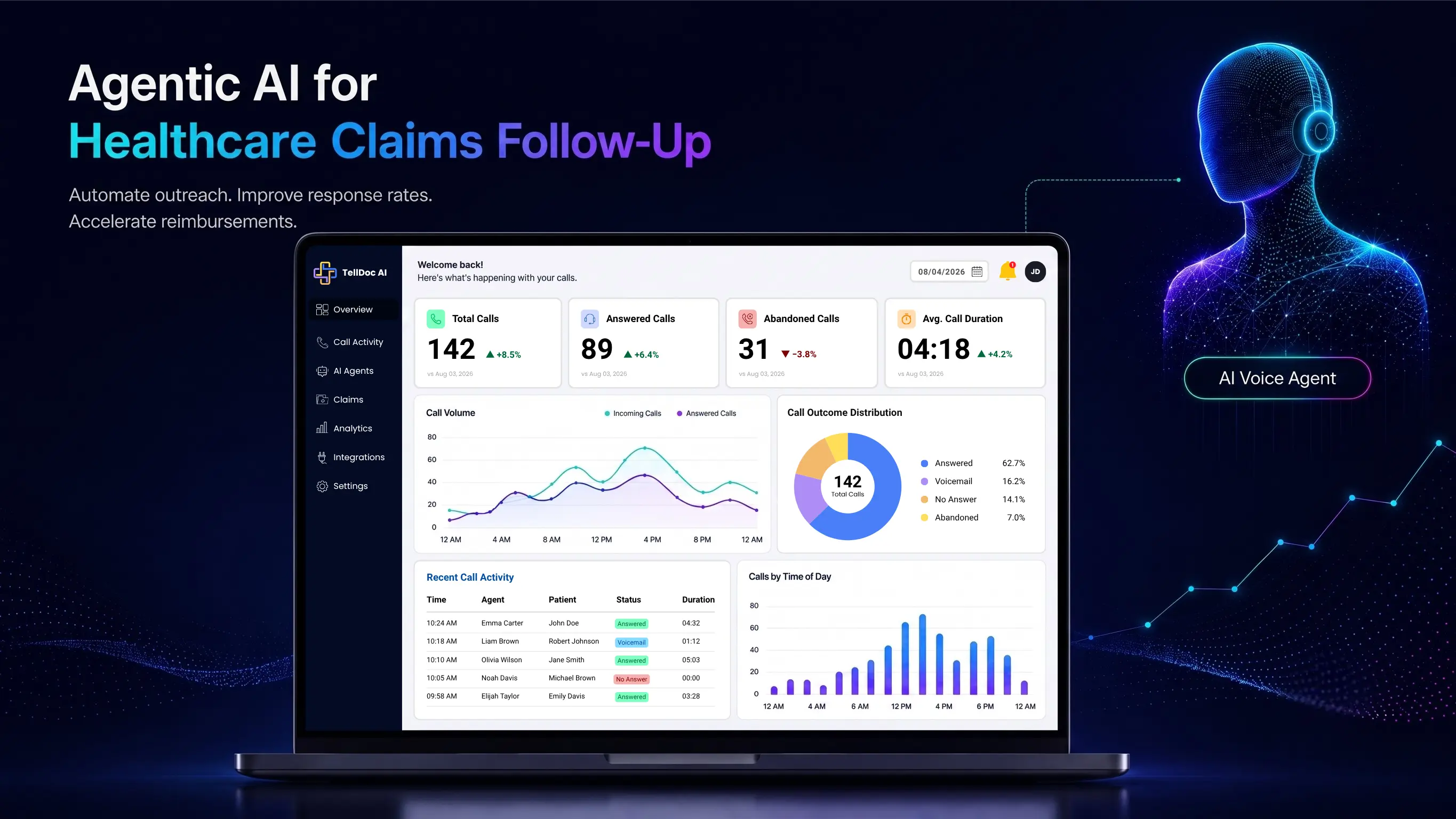
A custom AI Voice Agent does not simply memorize a static call tree. It actively interprets it.
This is already running in production. A US-based RCM company deployed exactly this architecture and cut follow-up call labor costs by 40-60% while handling 10x the call volume with the same team.
CORE USE CASES
Where Custom Automation Replaces Manual Friction
Four core operational areas deliver the highest, most immediate financial return when transitioned to intelligent, custom-built execution loops:
Autonomous Claims Follow-Up Calls:
Custom AI agents place outbound calls to payers, navigate hold times, converse natively, extract structured denial reasons, and seamlessly scale to handle inbound payer or patient queries.
Pre-Submission Claim Scrubbing:
Advanced engines scan clinical documentation to cross-reference historical denial patterns for specific payer and procedure combinations before submission.
Automated Eligibility Verification:
Instantly pulls real-time insurance eligibility data at patient intake natively inside the EHR, eliminating independent portal log-ins.
Dynamic Denial Triage:
Automatically prioritizes rejections by cash-flow impact and recovery probability, auto-routing simple fixes while escalating complex exceptions to human teams.
THE TECH STACK
The Engine Powering Intelligent RCM Platforms
True automated orchestration requires a coordinated, multi-layered architecture where each tier solves a distinct operational problem:
Natural Language Processing (NLP) and GenAI
Transforms unstructured clinical notes or call logs into clean, structured data.
Conversational AI and Low-Latency Voice Engines
Powers fluent, human-like voice recognition that lets an agent hold a live phone conversation without sounding robotic.
Robotic Process Automation (RPA)
Handles deterministic login, form population, and repetitive data entry macros.
Secure FHIR and HL7 API Gateways
Bridges automation natively with legacy EHR databases and clearinghouses without manual data entry.
The critical component is the RPA-to-AI handoff. RPA manages the highly repetitive data movements, while AI handles the ambiguous, judgment-based conversation loops. This dual-engine approach ensures the system adapts under stress rather than crashing outright.
MEASURABLE IMPACT
The Business Value of Custom RCM Automation
A risk-averse financial executive deserves a transparent look at the industry metrics, bypassing vague market hype. Recent market data reveals that automation rewards deep system integration over shallow fixes.
Mature AI-driven denial deployments realize a thirty to forty percent reduction in overall denial rates once moved past initial pilot phases, according to industry benchmarks compiled by Black Book Research.
Conversely, a landmark survey conducted by the Healthcare Financial Management Association (HFMA) and FinThrive revealed a crucial warning sign: while sixty three percent of healthcare organizations have adopted AI in their revenue cycles, only fifteen percent currently report a clear, positive ROI.
The takeaway here is stark. Bolted-on, third-party software widgets consistently underperform due to severe baseline workflow and IT infrastructure constraints. Deeply integrated, purpose-built architectures are where significant enterprise returns materialize.
Where Does Your Organization Fall on This Gap?
Benchmark your denial rates and follow-up times against a purpose-built system.
THE PROCUREMENT DILEMMA
Navigating the RCM Build vs. Buy Decision
Once the operational benefits are proven, the conversation shifts from a technical evaluation to a definitive procurement strategy: do you build custom IP, or rent a pre-packaged plug-in?
Off-the-shelf RCM tools promise fast deployment, but they introduce compounding structural liabilities that can paralyze long-term operations:
Vendor Volatility and Sudden Shutdowns
Small software point-solutions are frequently acquired or shut down entirely, abruptly stalling your revenue cycle mid-flight.
Eroding ROI Models
Rigid per-seat or per-call subscription pricing scales directly with your claim volume, actively punishing your growth.
Shallow Integrations
Rented tools are built for the market average, failing to accommodate your unique payer mix or proprietary workflows.
This dependency creates massive technical debt, leaving your organization unable to modify, audit, or scale its own vital financial pipelines.
THE PROCUREMENT MATRIX
Why Custom Builds Outperform Rented Tools
Evaluating the choice across four fundamental operational pillars reveals why owning your infrastructure minimizes systemic risk:
Payer Navigation
Rented plugins break frequently when payer IVR or menu structures shift. Custom-engineered architecture uses dynamic intent detection to adapt to call changes in real time.
Data Pipelines
Rented tools require manual copy-pasting or fragile data bridging between apps. Custom builds are natively bound to update core EHR and clearinghouse logs instantly.
HIPAA Compliance
Rented systems rely on third-party security frameworks outside your direct control. Custom-engineered setups offer a Zero-Trust architecture with absolute ownership over ePHI scrubbing and logs.
Corporate Valuation
Rented plugins are a continuous operational expense that disappears if the vendor closes. Custom builds create a proprietary, long-term corporate asset that appreciates with scale.
How Trigma Helps Healthcare and RCM Organizations Implement This
Trigma works as a technology and development partner for healthcare organizations and RCM companies integrating agentic AI into claims operations. That can mean building a new voice agent from the ground up, integrating one into an existing EHR or practice management system, or extending an existing automation stack with agentic capabilities for denials, eligibility checks, or credentialing.
If your team is evaluating where to start, claim status follow-up is typically the highest-leverage first deployment. High call volume, well-defined structure, and a clear cost baseline to measure results against.
From there, the same architecture extends naturally into denials, prior auth, and credentialing.
FAQs
How does this actually reduce claim denials, not just flag them?
Pre-submission scrubbing catches payer-specific issues before a claim goes out, and dynamic denial triage routes what still gets rejected by cash-flow impact and recovery odds, so the highest-value fixes happen first.
Is a custom-built AI voice/RCM system HIPAA-compliant?
Yes, when it's built on a Zero-Trust model: encrypted call recordings, automated ePHI scrubbing from transcripts and logs, and a signed BAA backed by SOC 2 Type II attestation. The difference from a rented plug-in is that you own and can audit that compliance posture directly, rather than trusting a vendor's.
Does this replace our billing team, or just shift what they spend time on?
No. It removes the hold-time and repetitive-call work, not the judgment calls. Staff shift from making status calls to working the complex denials and high-tier exceptions, the work that actually protects margin.
What's the actual difference between RPA and AI here, and why do we need both?
RPA is the deterministic layer: portal logins, form population, data entry. AI Voice/NLP is the judgment layer: holding a live conversation, adapting to what a payer says. Neither one alone is sufficient, the RPA-to-AI handoff is what lets the system degrade gracefully instead of breaking outright.
How does this get through a payer's IVR system when our current tools get stuck?
Script-based robo-dialers fail the moment a payer restructures its phone menu, because they're following a fixed decision tree. An AI voice agent uses dynamic intent detection to interpret the menu as it happens, adapting in real time instead of breaking.
We're not a large health system. Does a custom build still make sense?
If anything, smaller RCM companies have more exposure to the risks of renting, not less. Vendor volatility, rising per-seat pricing, and shallow EHR integration all hit harder when you don't have the volume to negotiate favorable terms with a plug-in vendor.
What's a realistic timeline for ROI?
It varies by scope, but the gap between organizations that see partial gains and those that see full ROI almost always comes down to integration depth. A narrow, bolted-on tool underperforms; a system built around your specific payer mix and EHR is what gets you there.