+91-98558-85133
 +1(702)760-3099

Healthcare systems in the United States lose 25% of their total budget to administrative workflows and clinician burnout is at an all-time high. The bottleneck isn't talent or intent. It's coordination.
Multi-agent AI systems are changing that equation. Unlike a single AI tool that handles one function in isolation, these systems deploy networks of specialized agents working in concert like managing documentation, triage, and compliance simultaneously, without human orchestration at every step.
This post breaks down what multi-agent AI in healthcare actually means, where it creates measurable impact, and why CXOs are moving from pilots to enterprise deployment.
What is a Multi Agent AI System In Healthcare?
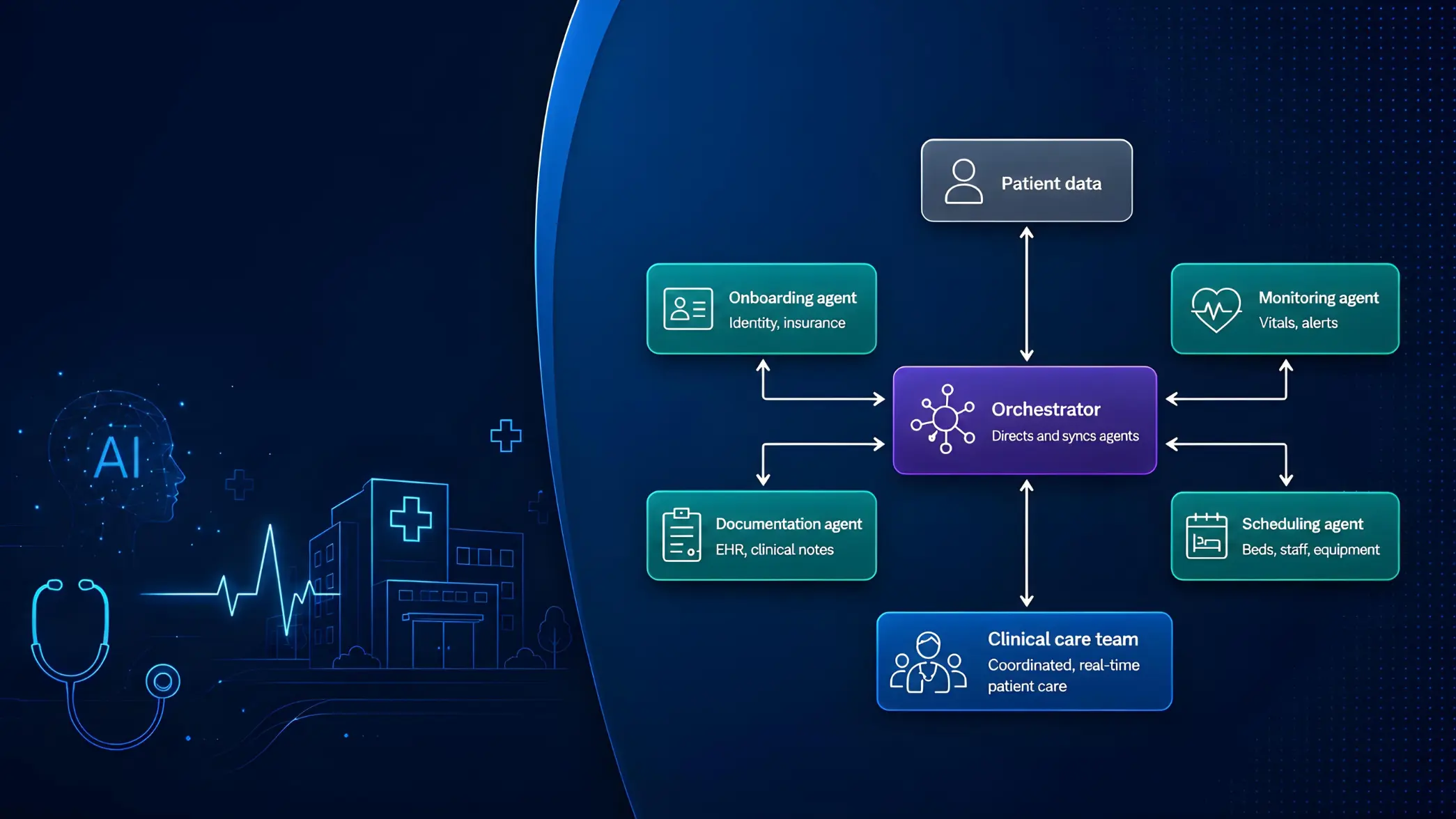
A multi agent AI system is a collection of AI agents that work together or even compete to reach a common goal. Each agent has its own job, tools and objectives but they coordinate sharing data, dividing work and making collective decisions.
This approach makes it easy to handle problems that are too big or complex for a single AI agent model.
Similarly in healthcare, not everyone works in isolation and so does the multi agent AI system. Once an agent can pull the healthcare data, another agent schedules care and a third agent checks compliance. And they shared insights instead of working alone.
Together they provide a detailed report to doctors highlighting a likelihood of particular disease along with recommendations for testing and potential treatment.
What Are The Benefits of Implementing Multi Agent Systems In HealthCare?
Implementing multi agent AI offers several benefits to healthcare organizations which are as given below:
1. Improving patient care
A multi agent system in healthcare uses a group of AI agents that acts like a healthcare team, where each agent has a different job such as collecting patient information, analyzing health data or tracking treatment progress.
These agents share information with each other in real time helping doctors and nurses get a complete view of patients. This results in faster decisions, fewer mistakes and better coordination between the healthcare staff.
2. Better Decision Making
Multi Agent AI systems improve clinical and operational decisions by combining the expertise of multiple specialized agents. Here, one agent may analyze medical imaging, another evaluates patient history and a third checks clinical guidelines.
These agents provide a holistic view of the patient rather than relying on a single source.
3. Improves Operational Efficiency
Through the automation of repetitive administrative tasks such as data entry, claim processing, report generation and patient record management, multi agent systems take off such manual workload letting doctors and medical staff focus on enhancing patient care.
Then, resource allocation is another area where multi-agent architectures can help. They can assign staff, equipment and facilities based on real time needs. In a large hospital, this might mean adjusting staffing levels depending on how many patients arrive.
Like if patients suddenly arrive in the emergency department, the system can quickly assign more doctors and nurses there. While if fewer patients are there, it can reduce staff as no one is sitting idle.
4. Better Communication and Coordination Between Different Departments
In hospitals, different departments struggle to share information quickly. But multi agent AI systems help to fix this by allowing healthcare providers to easily access the information they need.
For example, if Sarah visits a heart specialist, her primary doctor can immediately view any test results or updates to her treatment plan. This ensures that all her doctors stay informed and can work together to provide better care.
This means multi agent systems improve healthcare by removing communication barriers and making sure the right information reaches the right care providers at the right time.
Use Cases of Multi Agent AI Systems In HealthCare
Let’s discuss few use cases of Multi Agent AI in healthcare which are as given below:
1. Streamlines Patient Onboarding
Often, the traditional onboarding processes look more complex and time consuming involving several identity checks, insurance validation and collecting medical history all often done separately.
A multi agent AI system breaks onboarding processes into specialized intelligent agents which works like this way:
- Identity agent - verifies ID using OCR and diagnostics
- Insurance agent - checks policy coverage, eligibility, co-pay
- Data extraction agent - processes intake forms (NLP)
- Medical history agent - summarizes past EHR records
In the healthcare sector, multi Agent AI is a gamer changer where a patient uploads documents or fills digital form, an identity agent verifies authenticity, insurance agent validates coverage in real time, medical history agent fetches and summarizes records.
All outputs are structured into a single structured patient’s profile where tasks run in parallel, errors are caught early and leads to reduction in onboarding time.
2. Smarter Scheduling and Resource Allocation
In a hospital environment, every appointment depends on inter connected factors such as doctor’s availability, room capacity, medical equipment, staff workload and urgency of patient’s condition.
Traditional scheduling systems often fail because they treat these elements in isolation, which leads to inefficiencies such as long waiting times, underutilized equipment and subtle bottlenecks in departments.
The multi agent AI architecture works the different way like when a patient requests an appointment, the system doesn’t assign the next available slot. But here’s how agents work together:
- The patient agent communicates the urgency and preferences
- Document agent proposes feasible time windows
- Resource agent checks whether the required equipments are available at those times
For example, if a piece of equipment becomes unavailable due to maintenance, the resource agent immediately updates the system and other agents would update accordingly.
3. Real time Patient Summarization
In a labour and delivery unit, patient data comes from multiple streams such as updating vital signs, fetal monitoring signals, clinician notes and clinician signals.
The best part? Handling all these different data types can be difficult because each stream has a different structure, speed and clinical meaning.
That’s where multi agent AI architecture solves this by assigning different agents to handle different types of datasets. Like one agent processes vital signals and detects trends such as abnormal heart rate or blood pressure changes.
A second agent analyzing clinician notes and extracting meaningful insights using natural language processing. This means all these agents work independently by continuously sharing their outputs with a central orchestrator.
Through distributed intelligence, multiple AI agents are helping healthcare professionals based on the roles they’ve been assigned to.
So, if anything goes wrong (such as abnormal fetal heart rate), then the relevant agent detects it immediately and updates the summary.
4. Multi Agent AI for Protocol Aware Clinical Question Answering
Hospital protocols especially for emergencies are stored as long and static PDF documents that are difficult to navigate during time sensitive situations.
In scenarios where clinicians do not have time to read entire documents and need quick and precise answers. That’s where multi agent AI architecture solves this by breaking down the system into specialized agents that handle different tasks collaboratively.
One agent is responsible for document ingestion and preprocessing where it reads entire PDFs on one go and converts them into smaller sections.
While another agent organizes this information into a searchable knowledge base, making it easier to retrieve specific content.
A query understanding agent processes the clinician’s question, interprets intent and identifies key medical terms or conditions such as hypertension.
A filtering agent removes unnecessary information so that only the most important content is visible. Then a summarization agent summarizes everything into concise summaries.
This means when a clinician asks the question, the multi agent AI architecture will check the details, verify the source, remove unwanted info and provide actionable recommendations along with citations that the nurse can apply quickly.
5. Real Time Documentation Support
Real time documentation support in healthcare is one of the biggest challenges that clinicians are facing.
Traditionally, doctors and clinicians spend huge amounts of time manually documenting patient records such as writing notes, updating electronic health records, and ensuring compliance with medical standards.
But a multi agent AI system improves this by automating documentation in real time while the patient interaction is still happening.
In multi agent AI architecture, one agent would listen to patient conversations, transcribe conversations and another agent converts key medical information into clinical notes and EHR format.
6. Hyperpersonalized Healthcare
Hyper personalized healthcare using multi agent AI means different AI agents work together to provide personalized care for each individual patient based on their medical history, genetics, lifestyle and behavior.
One agent may track patterns such as blood sugar changes, while other converts these insights into personalized diet or treatment recommendations.
While additional agents may support by suggesting meals, ordering groceries, or adapting care plans to daily habits and preferences.
Overall, such intelligent healthcare systems enable proactive, preventive and highly personalized care while simplifying patient communication and healthcare operations.
How Trigma Can Help You In Developing Multi Agent AI Systems?
As a multi Agent AI development company, we help startups and enterprises by not just building intelligent tools, but by creating intelligent ecosystems with guardrails, audit trails and human oversight.
From creating custom multi Agent ecosystems to integrating it with your existing business systems, we will help you make your business workflows more smarter where agents are collaborating with each other and keep workflows running smoothly.
Want our help in creating multi Agent AI architecture?
Ready to Put Multi-Agent AI to Work in Your Organization?
Trigma's agentic AI engineers design and build multi-agent systems tailored to your existing workflows, from prototype to full enterprise deployment.