+91-98558-85133
 +1(702)760-3099


60-Second Summary
- Agentic AI Helps Move RCM Tasks Forward: It can retrieve records, review payer responses, choose an approved next step, and check the result. Its actions stay within defined permissions.
- Applications Span the Revenue Cycle: Agents can support eligibility checks, prior authorization, claim preparation, denial management, underpayment reviews, and patient billing questions.
- The Opportunity Is to Reduce Repeated Work: Connecting records and tasks can help staff spend less time searching for information. Clear account statuses and next steps can also make unresolved work easier to manage.
- Denial Patterns Can Improve Earlier Checks: Agents can identify recurring documentation gaps and suggest changes. Staff should validate those findings before updating billing rules or workflows.
- Human Judgment Remains Essential: Conflicting records, ambiguous coding, clinical statements, and disputed charges need appropriate review. Agents should pause when evidence is missing or an action exceeds their authority.
- Start With One Measurable Workflow: Choose a recurring task with reliable data and a verifiable outcome. Compare handling time, rework, resolution quality, and total cost before expanding.
A payer requests a missing report. The billing team finds it, checks the requirement, prepares a response, and updates the account. The work is straightforward, but it can still take several handoffs to complete.
Across a busy revenue cycle, these small tasks accumulate. Staff spend time finding information and moving it between systems while unresolved accounts wait.
Agentic AI can help coordinate that work. An agent can gather the right records, identify an allowed next step, and check whether it succeeded. For healthcare finance leaders and RCM providers, the opportunity is to move routine cases forward while keeping people responsible for exceptions and consequential decisions.
Here is how that approach can work across a U.S. healthcare revenue cycle and how to decide where it belongs in yours.
What Is Agentic AI in Healthcare RCM?
Agentic AI uses information, connected tools, and feedback to move revenue cycle tasks forward.
Revenue cycle management, or RCM, covers the work involved in collecting payment for care. It begins with registration and coverage checks and continues through claim resolution and patient balances.
An AI agent can select its next action based on what it finds. If a payer requests a supporting report, the agent can check the request, locate the report in an approved system, and prepare a response. If the report is missing or patient details conflict, it can flag the issue for staff.
Traditional automation follows predefined steps, such as flagging an empty field. Agentic AI can coordinate several steps when the path depends on new information.
These tools can work together. An agent can retrieve supporting documents, a generative model can draft an appeal, and a rules engine can hold submission until an authorized reviewer approves it.
Why RCM Teams Are Looking Beyond Routine Automation
Disconnected administrative tasks leave staff with repeated work and unresolved accounts.
The 2025 CAQH Index, released in February 2026, identified $21 billion in potential savings from automating manual and partially manual administrative transactions across U.S. healthcare. That opportunity spans administrative automation broadly, including approaches beyond agentic AI.
The burden is also clear at the practice level. An AMA survey of 1,000 physicians conducted in late 2024 found that physicians and their staff spent an average of 13 hours per physician each week handling prior authorizations.
Submitting information electronically does not resolve every exception. Someone still needs to interpret a response, find missing evidence, and determine who should act. Those gaps are where a carefully scoped agent can help.
How Agentic AI Changes a Typical RCM Workflow
An agent can connect the steps between identifying a problem and resolving it.
Consider the missing-report example from the introduction. The comparison below shows an illustrative workflow, rather than a measured customer result.
|
Approach |
How the Missing Report Request Is Handled |
|---|---|
|
Manual Process |
A specialist reads the request, locates the report, prepares a response, and updates the account. |
|
Traditional Automation |
A rule creates a task when the request arrives. Staff investigate and complete the response. |
|
Agentic Workflow |
An agent matches the request to the claim, locates the report, and prepares a response for approval. After submission, it checks the acknowledgement. |
The improvement comes from connecting the work between systems. The report must already exist, the patient and claim must match, and the submission must be verified. If those conditions fail, the agent should route the case to a person.
Where Agentic AI Can Help Across the Revenue Cycle
Agents can support both payment collection and the work that prevents billing problems.
The right scope depends on data access, payer requirements, and your team's approval policies. These applications show where to look for useful opportunities.
Eligibility and Registration
Agents can surface coverage discrepancies before they create downstream billing work.
An agent can retrieve eligibility details and compare them with registration records. If member information conflicts, it can create a correction task and attach the relevant evidence. This gives the registration team a clear issue to resolve before the encounter.
Eligibility confirmation does not guarantee payment. Unclear benefits and coverage limitations still need an appropriate review before staff discuss financial expectations with patients.
Prior Authorization
Agents can gather existing records and keep authorization requests moving.
An agent can check approved payer requirements, identify missing documents, and prepare an authorization request. It can then track the response and route requests for more information to the responsible team.
Approvals, denials, and requests for additional information must remain separate statuses. A request that needs another document should never appear as approved. Clinical statements and medical necessity should remain subject to qualified review.
Claim Preparation and Denial Prevention
Agents can help teams catch recurring problems before another claim is submitted.
An agent can compare claim information with approved edits and supporting records. It can flag an authorization mismatch or identify a documentation gap for a billing specialist to review.
Denied claims can also inform earlier checks. Suppose a team repeatedly finds the same missing attachment for a payer and service. An agent can group those cases and suggest an intake check. The workflow owner validates the pattern before changing the rule.
This feedback connects denial management with prevention. It should use reviewed evidence and current policies. The agent should not change billing rules or clinical codes simply because a past claim was paid.
Denial Management and Payer Follow-Up
Agents can organize evidence and prepare the next action for unpaid claims.
An agent can gather claim history, interpret the payer's stated reason, and prepare a correction task or appeal packet. Queue priorities can account for filing deadlines, recovery prospects, and the effort required to resolve each case.
Appeal submissions need the approvals set by the organization. The agent should preserve the evidence behind its recommendation and distinguish a submitted response from a resolved denial.
For more detail on payer interactions, read Trigma's guide to agentic AI in healthcare claims processing.
Underpayment Detection
Agents can help investigate payments that fall below the expected reimbursement.
A paid claim may still be underpaid. Even when a payer approves a claim, the amount received can fall below the payment expected under the contract.
An agent can retrieve the remittance, claim details, and applicable contract terms. A validated payment engine calculates the expected amount. The agent can then assemble the discrepancy for review by the reimbursement team.
The calculation needs the correct plan, effective dates, and payment provisions. Contract ambiguity and legitimate adjustments must be resolved before anyone labels a difference as recoverable revenue.
Example — Reviewing a Potential Underpayment
A payer pays a claim, but the amount is below the expected reimbursement. An AI agent gathers the claim, remittance, and applicable contract details. A reimbursement specialist reviews the difference and confirms whether further action is needed.
Patient Billing Support
Agents can prepare account explanations and route balance questions to the right staff.
An agent can summarize approved account information and identify whether a question concerns a pending payer response, a posted payment, or a patient balance. This can reduce the research needed before a representative answers the patient.
Disputed charges and financial assistance decisions need staff review. An unresolved insurance issue should not automatically become a patient bill or collection action.
What Agentic AI Can Improve for RCM Teams
The clearest benefits are less repeat handling and earlier action on unresolved work.
Each benefit should be tied to a workflow your team can observe. A faster draft is useful only if it reduces total effort or helps reach a valid outcome.
|
Potential Benefit |
What Produces It |
What to Measure |
|---|---|---|
|
Less repeat work |
Records and payer responses travel with the task. |
Staff touches and rework per resolved case. |
|
Faster Exception Handling |
The next owner receives the evidence needed to act. |
Time from an exception arriving to a verified resolution. |
|
Better Queue Visibility |
Accounts show their current status and next action. |
Cases without an owner or overdue next step. |
|
More Capacity for Complex Cases |
Routine investigation requires less staff time. |
Handling time, workload, and review effort. |
|
Stronger Revenue Recovery |
Teams investigate valid denials and payment discrepancies. |
Additional collections after recovery costs. |
Include integration, model usage, supervision, and rework when calculating cost. Time released becomes a financial benefit when the team can use that capacity productively or reduce actual expense. Keep additional revenue separate from payments that simply arrive sooner.
Where Human Review Remains Essential
People should own decisions that affect coding, disputed balances, and clinical evidence.
Define these responsibilities before the agent receives permission to change records. Billing specialists can review corrections and appeals. Coding staff should resolve ambiguous codes and modifiers. Clinicians validate clinical statements. Finance leaders set approval policies for write-offs and other account adjustments.
A named workflow owner should maintain payer rules, review exceptions, and approve changes to the process. IT and security teams control access and system connections. Every unresolved account still needs a responsible person or team.
Patient data protection also depends on the full workflow. HHS cloud computing guidance calls for risk analysis and appropriate business associate agreements when applicable providers handle electronic protected health information. Compliance requires more than choosing a model or signing a vendor contract.
- Limit the agent to the records and actions required for its task.
- Record the evidence, system actions, approvals, and results in protected audit logs.
- Use current payer policies and retain the version behind each recommendation.
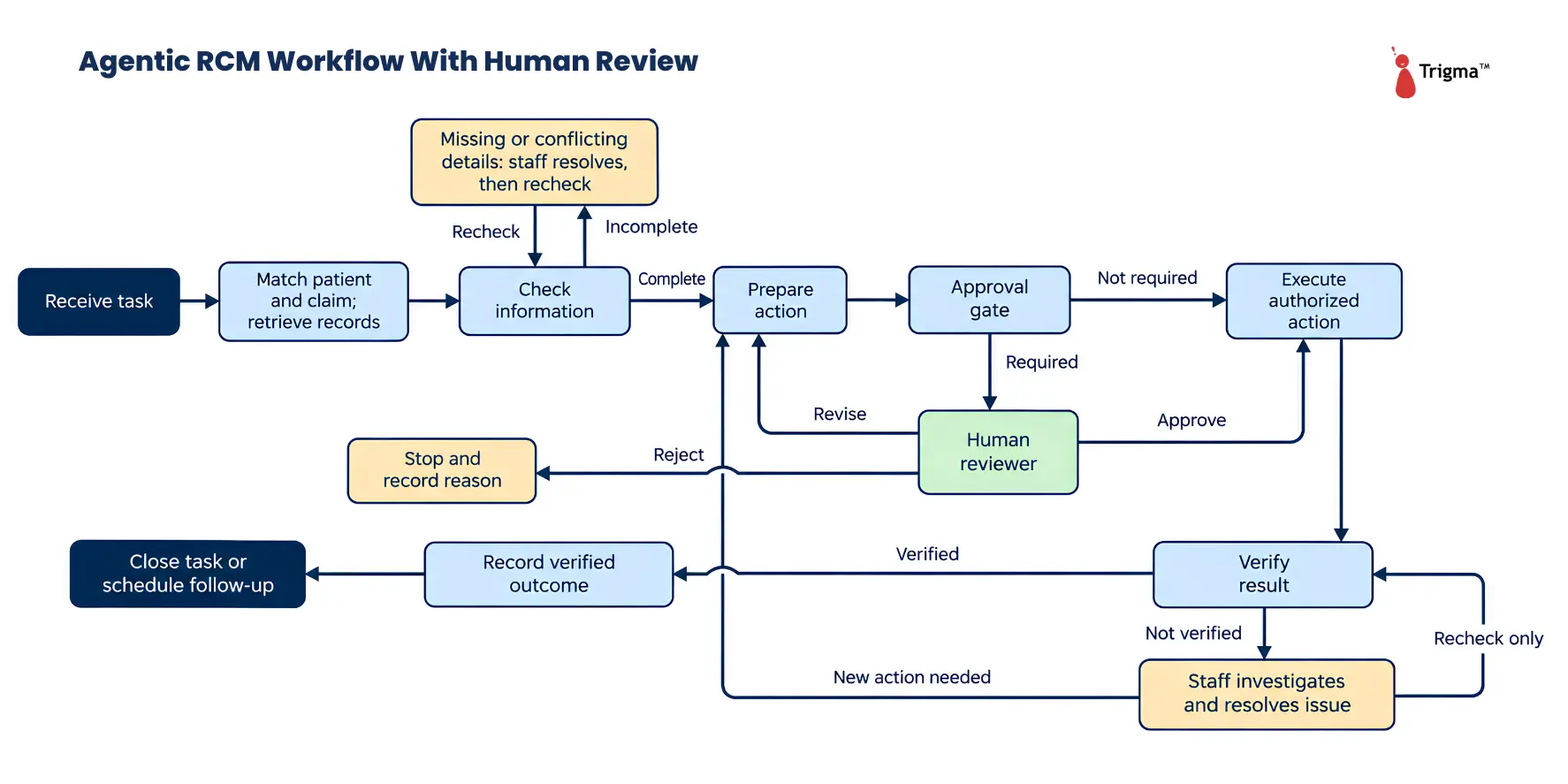
- Stop and escalate when patient details conflict, evidence is missing, or an action cannot be verified.
How Human Review Fits Into an Agentic RCM Workflow
The agent handles approved tasks and pauses when a case needs human judgment.
How to Choose Your First Agentic RCM Workflow
Start with a recurring task whose inputs and outcomes are easy to verify.
A narrow missing-document queue may be a better starting point than broad denial management. It offers a clearer task boundary. Before selecting a pilot, check the following:
| Criterion | Question |
|---|---|
| Volume | Does the task recur often enough to justify development and support? |
| Data Access | Can the agent reach reliable records through approved connections? |
| Exception Frequency | Are common cases consistent, or does each one require expert judgment? |
| Financial Impact | Does the workflow consume staff time or delay collectible payment? |
| Verification | Can your team confirm the result and trace the actions taken? |
Once a workflow fits, introduce it in stages:
- Establish a Baseline: Measure handling time, cost, errors, and current resolution rates.
- Test on Historical Cases: Include missing records, conflicting information, and unsuccessful actions.
- Run in Shadow Mode: Compare recommendations with staff decisions without changing live accounts.
- Allow Limited Actions: Retain defined approvals and review mistakes before expanding permissions.
- Evaluate Comparable Cases: Account for payer mix, claim age, and changes in staffing or volume.
Expand when the workflow produces reliable results and acceptable total costs. More actions per hour do not establish success if the team must spend longer correcting them.
How Trigma Can Help You Build Agentic RCM Workflows
Trigma can support custom agents, system integration, and human approval workflows.
Trigma's agentic AI development services include tool integration, workflow orchestration, and controls for human review. For RCM teams, a useful starting point is one queue with a clear operational problem and a measurable result.
Define the records the agent needs, the systems it must use, and the decisions your team must approve. Then test the workflow against real operating conditions before extending it across the revenue cycle.
Discuss your RCM workflow with Trigma to explore a focused implementation.
FAQs
What happens if a payer portal is unavailable?
Set limited retries and a visible outage status. Route urgent cases to staff. When access returns, check the payer's record before retrying an interrupted submission to avoid sending it twice.
What should an RCM AI vendor contract cover?
Clarify retention periods, model training restrictions, subcontractors, and incident notification. Include charges for usage, maintenance, and support. Define how account records and work history will be returned and deleted when the agreement ends.
Can one agent support several medical specialties?
Documentation patterns and payer requirements differ. An imaging workflow may need evidence that does not apply to therapy services. Use specialty-specific test cases before extending an existing agent to a new service line.
How can you avoid becoming dependent on one AI model?
Maintain approved policies and tool definitions outside provider-specific prompts where practical. Require exportable work history. Before switching models, rerun the same test cases and confirm that the existing approval settings still work as intended.
When should an RCM AI agent involve a human reviewer?
Examples include conflicting patient records, ambiguous coding, disputed charges, or an appeal that requires clinical judgment. The agent should pause and give the reviewer the relevant evidence, the reason for escalation, and the decision needed.
Does human oversight mean reviewing every action an RCM agent takes?
Routine record retrieval can run within approved permissions. Actions such as changing a disputed billing code or submitting an appeal may require approval before proceeding. This human-in-the-loop approach lets teams focus review on decisions that need their judgment.