+91-98558-85133
 +1(702)760-3099

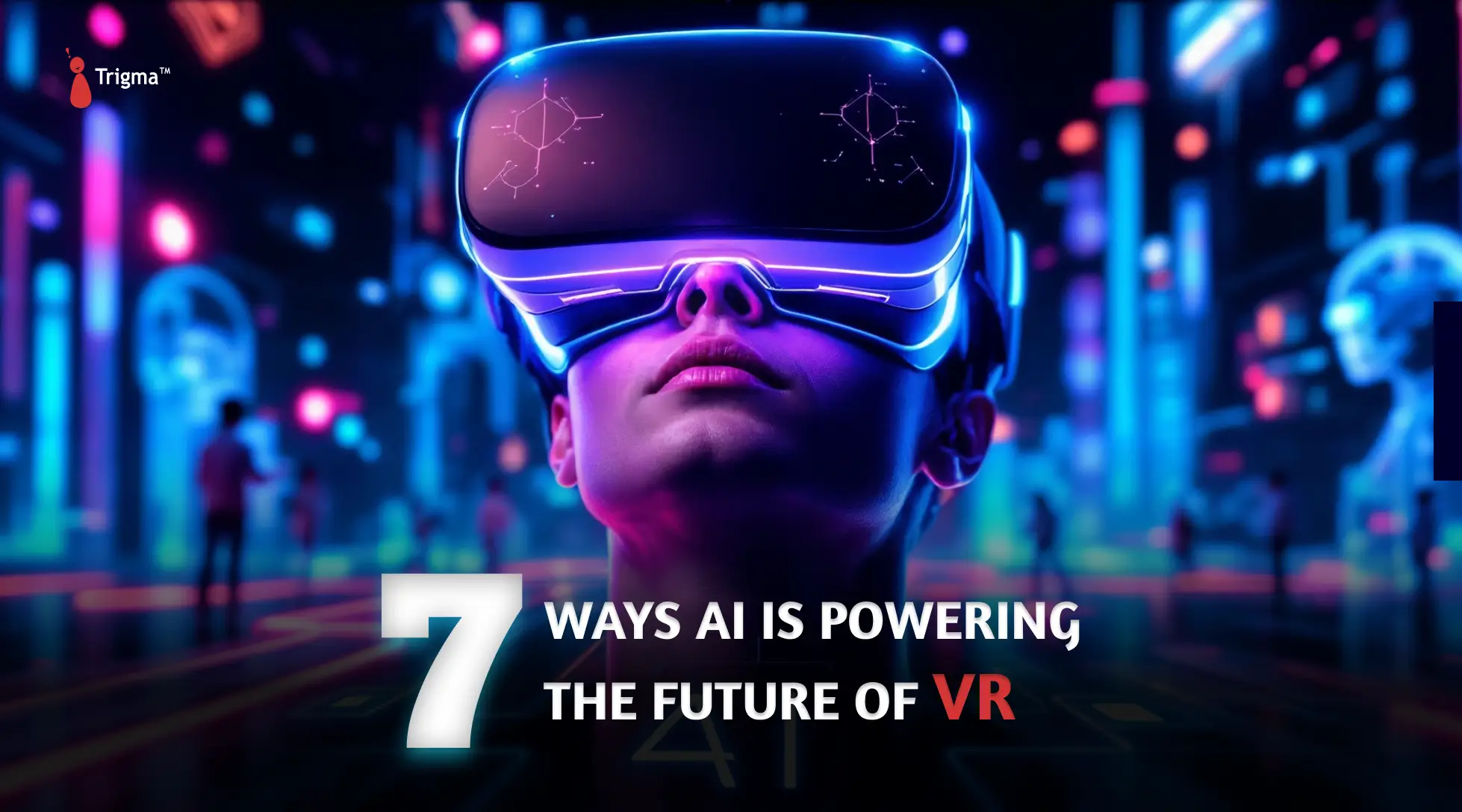
Virtual reality (VR) has evolved significantly from being a futuristic concept in sci-fi movies to a technology that people actually use in their daily lives. In previous times, VR has mostly been seen in research labs or niche gaming setups, bulky headsets, limited graphics, and experiences that felt more experimental than practical.
Today, VR has evolved into a powerful tool across various industries, including healthcare, education, fitness, architecture, and even therapy. Headsets are lighter, visuals are faster, and experiences feel far more natural. But the real game-changer behind this evolution is Artificial Intelligence (AI).
AI is making VR smarter, faster, and more immersive, turning digital environments into living, responsive worlds. Instead of static stimulations, VR powered by AI adapts to the user to predict their movements and creates experiences that feel deeply personal.
Let’s explore in this blog seven powerful ways AI is shaping the future of VR and why it matters to businesses and industries alike.
Powerful Ways AI is Upgrading VR
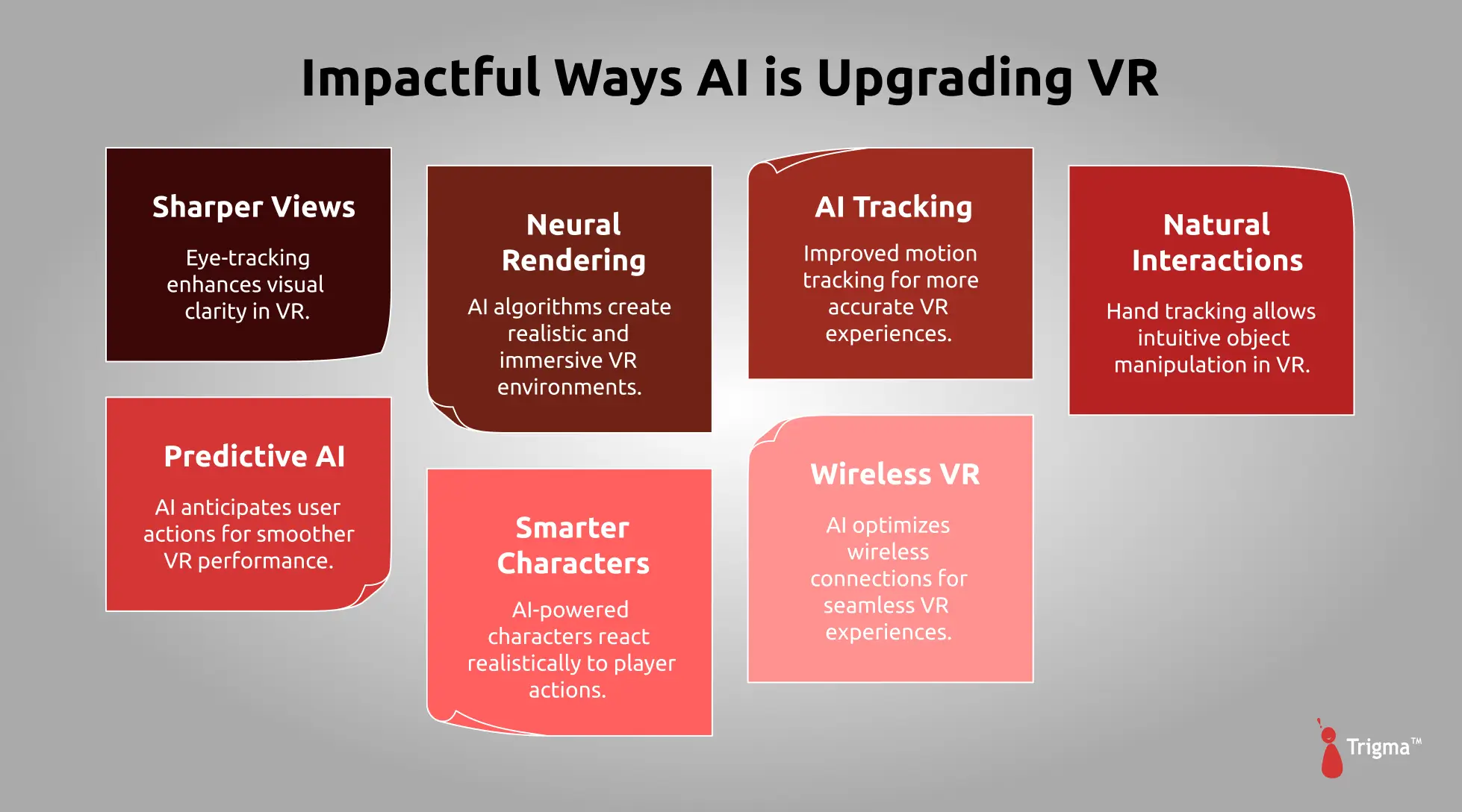
1. Sharper views with eye-tracking
When you look at something in real life, your eyes naturally focus on the center of what you’re seeing, while the edges stay slightly blurred. VR headsets are now using AI-powered eye-tracking to recreate this natural vision pattern. This technique, called foveated rendering, sharpens only the area you’re looking at while reducing detail in your peripheral vision.
This is powerful because it gives you the best of both worlds; crystal clear visuals, where you need them, and lighter processing where you don’t. This means there is smoother performance, higher frame rates, and even longer battery life for wireless headsets. For users, this translates into more lifelike visuals and comfort, and for businesses, it makes VR applications scalable without requiring expensive, high-powered software.
2. Neural rendering
One of the most exciting breakthroughs in VR is the ability to turn real places into digital environments without spending months on manual 3D modelling. This was made possible with AI techniques like neural rendering and neural radiance fields. With just a few photos or video clips, AI can learn the details of the real-world scene and recreate it in 3D. This results in a photorealistic virtual space that feels almost like stepping into the actual location.
For businesses, this technology means faster content creation, reduced costs, and more authentic environments that people actually connect with. For individuals, it means VR that feels less like a game and more like a window into reality.
3. AI tracking
In the early days of VR, external sensors needed to be placed around your room to track your head and hand movements. It worked, but it was complicated, expensive, and limited in where you could actually use VR. With AI-powered inside-out tracking, headsets can track your movement using built-in cameras and smart algorithms. This means the system understands where you are in the room, how you move, and even estimates your body posture, all without extra equipment.
For users, this creates a freedom of movement that feels natural. You can walk, turn, or reach out, and your avatar mirrors you instantly. For businesses, it makes VR more practical in offices, classrooms, or gyms since you don’t need a specially prepared setup.
4. Natural interactions with your hands
One of the biggest shifts in VR is moving beyond controllers. While joysticks and buttons work, they don’t always feel natural, especially for new users. That’s where AI-powered hand and gesture tracking comes in. Using advanced computer vision, VR headsets can now recognize the exact position of your hands and fingers. This allows you to point, swipe, pinch, grab, or draw in mid-air, just like you would in the real world.
For individuals, this makes VR more intuitive and immersive, with no learning curve, just natural movement. For businesses, it opens up new opportunities in training, healthcare, and education, where realistic interaction is essential. With AI translating subtle gestures into precise actions, VR starts to feel less like using technology and more like simply using your own body.
5. Predictive AI
If you’ve ever felt dizzy or uncomfortable in VR, it’s usually because of lag, the tiny delay between your real movement and what you see inside the headset. Even a fraction of a second can break the illusion and cause motion sickness. AI helps solve this problem with predictive tracking. By learning how people move, AI can anticipate where your head or hands will be a split second before you actually get there. The system then adjusts the visuals in advance, keeping everything perfectly in sync.
For individuals, this means longer, more comfortable VR sessions without nausea. For businesses, it ensures smoother experiences in training, presentations, and customer-facing demos, where comfort is non-negotiable. In short, AI makes VR feel natural, fluid, and effortless, so the technology disappears, and you’re fully immersed in the experience.
6. Smarter characters
In older VR experiences, virtual characters (NPCs) are limited. You could ask them something, but they’d always give the same pre-programmed response. This often made interactions feel robotic and predictable. With generative AI, that’s changing fast. Now, VR characters can see, listen, and respond naturally, just like real people. They can hold conversations, adapt to your actions, and even change their behavior based on how you interact with them.
For individuals, this means more immersive storytelling and gameplay, where every experience feels unique. For businesses, it’s a powerful tool for training and simulations, like practicing customer service with an AI client who reacts differently each time, or learning leadership skills by managing a virtual team.
7. Wireless VR
One of the biggest hurdles for VR has always been the need for powerful hardware. High-quality VR experiences used to require a gaming PC or console, connected with thick cables that limited movement. That’s quickly changing with AI-enhanced streaming. AI can now optimize how VR content is delivered over Wi-Fi or the cloud. It uses smart techniques like foveated streaming, sharpening only the part of the image you’re looking at, while adjusting quality in real time to match your network speed.
For individuals, this means you can enjoy smooth, high-quality VR experiences without being tied down by wires or expensive equipment. For businesses, it makes VR more scalable and accessible, allowing teams, clients, or students to join immersive experiences from almost anywhere.
Why This Matters
Whether you’re a business leader, a healthcare professional, an educator, or simply a VR enthusiast, AI is unlocking a level of immersion that was once impossible. Training feels more realistic, healthcare therapies more engaging, games more interactive, and virtual meetings more human.
VR is no longer just about “being inside a game.” It’s about living inside smarter, adaptive environments that can teach, train, entertain, and connect us in ways we never imagined.
The future of VR is not just about headsets, it’s about how AI makes these experiences smarter, smoother, and more meaningful.
At Trigma, we’re not just building VR applications; we’re shaping the future of immersive technology. As a leading AI and technology solutions company, Trigma combines deep expertise in Artificial Intelligence, Virtual & Augmented Reality, and custom software development to deliver experiences that go beyond expectations.
With a proven track record, innovative mindset, and a client-first approach, Trigma is your trusted partner to bring visionary VR ideas to life, powered by AI.
Ready to Explore AI-Powered VR?
If you’re ready to explore how AI-driven VR can transform your business or project, let’s talk. Book a free consultation today and start building your next immersive experience.
Let’s build the future together.