+91-98558-85133
 +1(702)760-3099

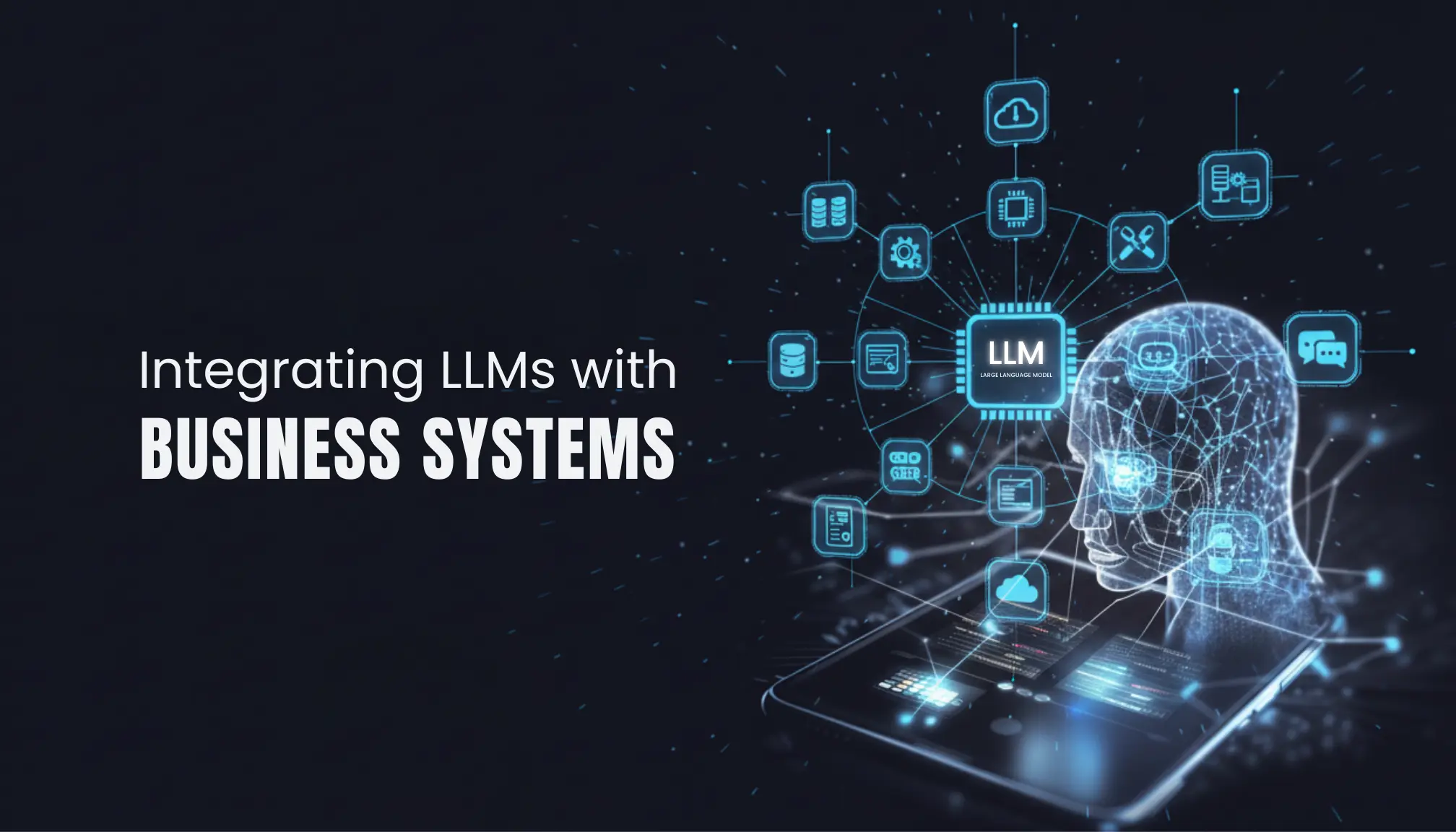
Modern digital systems are undergoing a fundamental redesign. Applications are no longer expected to generate predefined responses; rather, they provide real time response based on the user’s query intent. Large Language Models (LLMs) are becoming the core technology enabling this shift, functioning as an intelligent layer across the enterprise operations.
Organizations are integrating LLMs directly into their website, mobile applications, SaaS platforms, and business systems to improve decision-making, operational efficiency, and customer experience. 88% of the experts report that integrating LLMs into their operations has significantly improved the quality of work. So, to stay ahead in the competitive world, LLM integration is crucial.
This blog will break down how enterprises can approach LLM integration and provide a practical roadmap to navigate the significance of LLM and unlock the transformative power of your business.
What Exactly Is LLM Integration?
Imagine you have a digital companion who can understand the nuance of human language, respond to complex queries, and generate creative content tailored to your specific needs. This is the reality of LLMs, the technology that holds the power to replace semantic search, offers users a more personalized approach, and serves as a new frontier in business intelligence.
LLM integration is a process of connecting large language models such as ChatGPT, Claude, and Gemini to a business’s existing systems and workflows. Moreover, it’s about embedding probabilistic reasoning engines into deterministic software systems.
This typically connects the LLM (Large Language Model) with existing enterprise infrastructure, such as CRMs, ERP, CMS, or BI tools. The LLM integration helps organizations unlock capabilities such as context-aware automation, natural language interfaces across complex systems, and decision support. Therefore, LLM must be considered as first class component, not the add-ons to existing workflows.
Roadmap To Integrate LLM in Your Applications
Successful LLM integration is achieved through a structured and outcome-driven approach that aligns tech with business objectives. Below is the detailed process to integrate LLM in your systems.
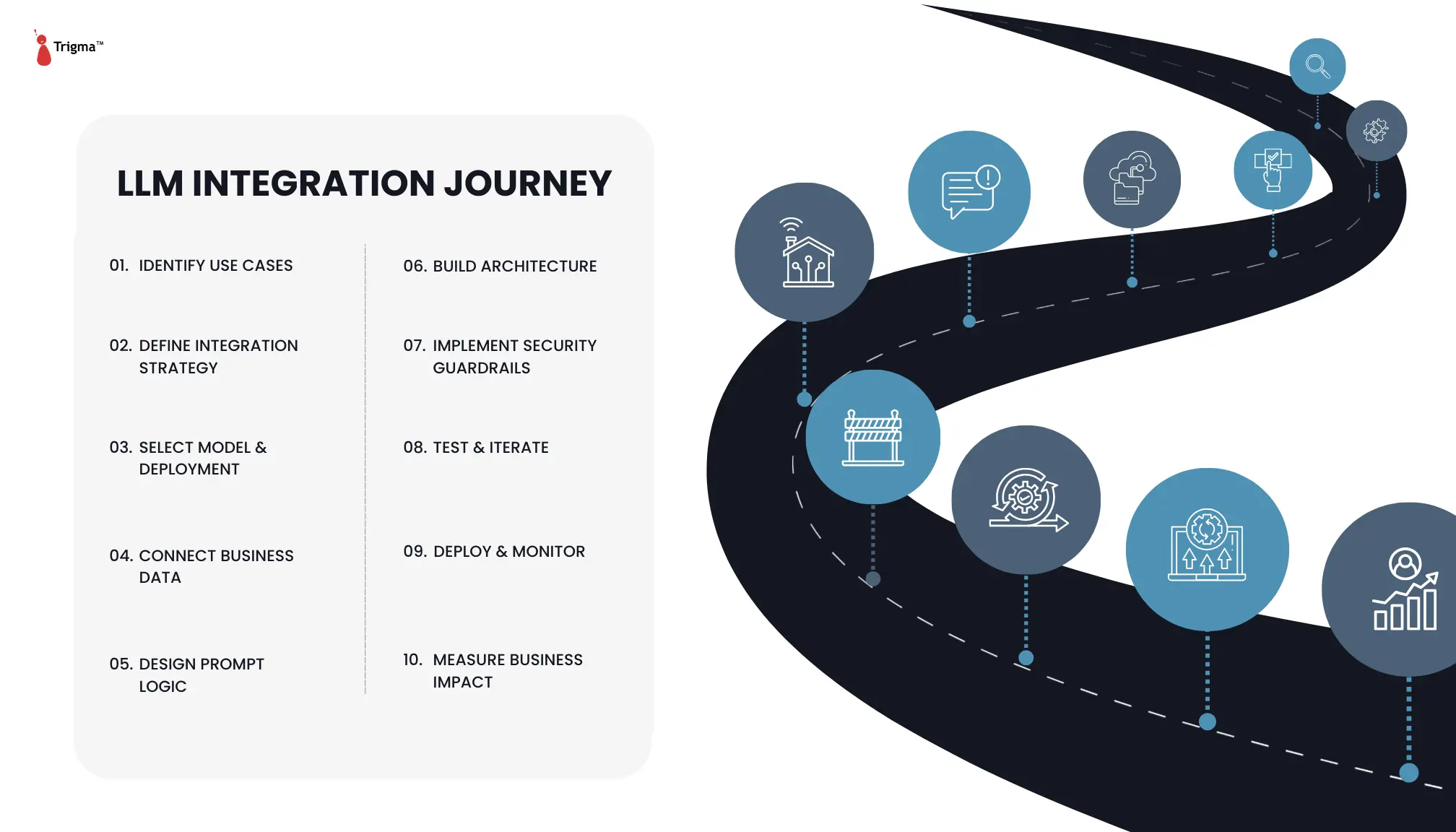
1. Identify business use cases
Every LLM integration must begin with a clear understanding of where intelligence can create real value. Rather than focus on technology solely, look for workflows that are repetitive, knowledge-intensive, or decision-heavy. Common enterprise use cases include:
- Customer support automation
- Sales assistance and lead qualification
- Internal knowledge discovery and search
- Report generation and executive summary
- Document analysis, risk assessment, and compliance checks
A clearly defined problem statement can lead to cost reduction, response accuracy, or improved customer satisfaction.
2. Define the integration approach
Once you have an idea about the use case, the next step is deciding how the LLM will interact with the system and users. This determines both UX design and system complexity. Integration mainly includes chat-based assistants for direct user interaction, automation for task execution, AI copilots embedded with existing tools, and agent-based systems that perform actions across applications.
Organizations can integrate LLMs into existing enterprise systems to enhance current capabilities, as well as into early-stage products or startups to rapidly validate ideas and accelerate time to market. In both cases, the focus should be on aligning the integration approach with the intended user journey, business outcomes, and system constraints.
3. Select LLM and deployment model
Choosing the right model and hosting strategy is a strategic decision that impacts cost, latency, and compliance. Organizations must evaluate cloud-based LLMs (OpenAI, Azure OpenAI, Anthropic) for speed and scalability, and private or on-premise LLMs for regulated environments.
This deployment strategy aligns businesses with effective risk tolerance and operational needs.
4. Prepare and connect business data
LLM delivers real value only when grounded in enterprise-specific knowledge, not generic data. The right and quality data integration ensures LLM performs to the best to their capability and offers users a personalized approach.
Integration can be done through such methods as retrieval augmented generation (RAG) using vector databases, direct querying of structured databases, and API integrations with CRMs, ERP, HR, and support systems. This sets a structured, searchable knowledge layer that ensures accuracy, relevance, and contextual grounding.
5. Design prompt and instruction logic
Prompt designs define how the LLM behaves inside the system. This step transforms a general-purpose model into a domain-aware, controlled intelligence layer. This includes system prompts defining role, tone, and boundaries, input templates for consistency, output formatting rules for downstream systems, and fallback responses for ambiguity or uncertainty.
This helps generate predictable, repeatable, and controllable AI responses suitable for business use cases.
6. Build the application architecture
Enterprise-grade architecture requires a modular and scalable architecture. It typically includes architectures such as frontend (web & mobile interfaces), backend services handling business logic and APIs, LLM orchestration layer, databases and vector stores, and external system integrations.
Frameworks such as LangChain, LlamaIndex, and Semantic Kernel are often used to accelerate development and orchestration.
7. Implement guardrails & security
Security is surely crucial when integrating LLMs into business systems. The security measures include role-based access control and permissions, data masking for sensitive information, prompt detection and prevention, and logging, monitoring, and audit trails. The effective security ensures a secure, compliant AI system for enterprise deployment.
8. Test, validate & iterate
Before launching or executing a full-scale rollout, LLM-powered systems must be rigorously tested. Validation should cover the accuracy and relevance of responses, edge cases and failure scenarios, latency, and user acceptance and trust. During early phases, human oversight is critical to ensure reliability and refinement.
9. Deployment and monitoring
Once validated and tested, the system can be deployed with continuous monitoring in place. This includes effectively checking usage patterns, performance & latency, cost, and token consumption, and error rates & user feedback. However, prompts, workflows, and data pipelines should be continuously refined based on real-world usage.
10. Measure business impact
The last and final step is measuring outcomes against the original objectives. Success metrics typically include operational efficiency gains, cost savings, user adoption & engagement, quality output & consistency, and overall ROI. This feedback loop ensures LLM integration is aligned with evolving business needs.
Use Cases of LLMs Across Industries
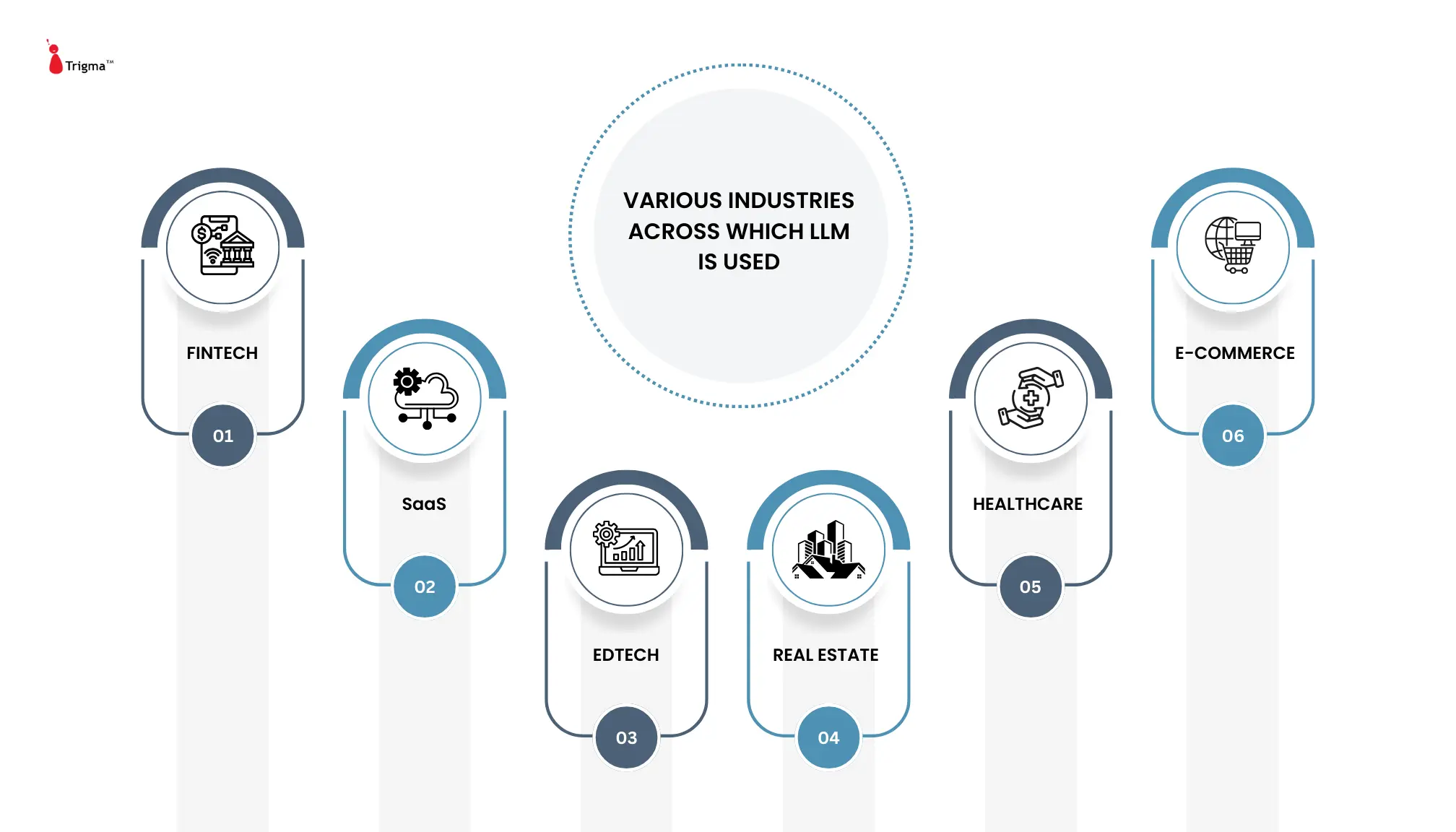
LLMs are no longer confined to generic conversational interfaces. Across industries, organizations are integrating LLMs into their business systems to augment decision-making and gain a competitive edge in the market. Below are some of the impactful use cases across various industries.
Fintech
In fintech, LLMs are being integrated to enhance transparency, compliance, and customer engagement, ensuring strict compliance with regulations. LLMs are typically integrated using retrieval augmented generation (RAG) to ensure responses are grounded in verified financial data and regulatory documentation.
Edtech
Edtech platforms are known for leveraging AI to deliver personalized, adaptive learning at scale. This is highly beneficial in the case of personalized learning paths and content recommendations. LLMs help shift education from static content delivery to dynamic, user-centric experiences.
Healthcare
Healthcare platforms integrate LLMs cautiously to improve efficiency while maintaining patient safety and compliance. LLMs are often deployed with strict guardrails, human oversight, and private model hosting to meet regulatory and ethical standards.
Real estate
LLMs are being used in real estate for effective decision-making for buyers, agents, and investors. By combining LLM reasoning with real-time market statistics and data, real estate platforms deliver more informed and efficient transactions.
SaaS
SaaS platforms are embedding LLMs as AI copilots that enhance user productivity and reduce cognitive load. LLMs in SaaS web applications act as a contextual layer that adapts to user behaviour and the system in real time.
E-commerce
In e-commerce, LLMs are integrated to enhance customer engagement and automate support. By connecting with product and customer data, LLMs enable personalized recommendations and more efficient shopping experiences.
As an LLM development company, Trigma has worked with businesses that have leveraged AI and built custom LLM models for their businesses. One such platform we built is an on-demand petcare platform where we integrate an LLM model to enhance customer support and experience.
Looking to implement RAG in your business?
Summing Up
LLM is no longer just an experimental approach; it’s a defining factor in how modern organizations build, scale and compete. As applications and business systems become more intelligence-driven, LLMs are emerging as a foundational components that shape productivity, decision making, and customer experience across the enterprise.
Ultimately, the companies that succeed in the next phase of digital transformation will not be those that experiment with AI the most, but those that embed intelligence deeply and responsibly in their core systems.