performance icon
Top IT Services Company 2025 Top Software Developers 2025 Top Generative AI Company 2025 G2 High Performer Winter 2025 G2 Leader Winter 2025 AI Deployment Company 2024 Top Software Development Company in USA for 2024 Top ReactJs Company in USA for 2024
trigma-logo

How to Integrate LLMs in Applications & Business Systems?

Modern digital systems are undergoing a fundamental redesign. Applications are no longer expected to generate predefined responses; rather, they provide real time response based on the user’s query intent. Large Language Models (LLMs) are becoming the core technology enabling this shift, functioning as an intelligent layer across the enterprise operations.

Organizations are integrating LLMs directly into their website, mobile applications, SaaS platforms, and business systems to improve decision-making, operational efficiency, and customer experience. 88% of the experts report that integrating LLMs into their operations has significantly improved the quality of work. So, to stay ahead in the competitive world, LLM integration is crucial.

This blog will break down how enterprises can approach LLM integration and provide a practical roadmap to navigate the significance of LLM and unlock the transformative power of your business.

What Exactly Is LLM Integration?

Imagine you have a digital companion who can understand the nuance of human language, respond to complex queries, and generate creative content tailored to your specific needs. This is the reality of LLMs, the technology that holds the power to replace semantic search, offers users a more personalized approach, and serves as a new frontier in business intelligence.

LLM integration is a process of connecting large language models such as ChatGPT, Claude, and Gemini to a business’s existing systems and workflows. Moreover, it’s about embedding probabilistic reasoning engines into deterministic software systems.

This typically connects the LLM (Large Language Model) with existing enterprise infrastructure, such as CRMs, ERP, CMS, or BI tools. The LLM integration helps organizations unlock capabilities such as context-aware automation, natural language interfaces across complex systems, and decision support. Therefore, LLM must be considered as first class component, not the add-ons to existing workflows. 

Roadmap To Integrate LLM in Your Applications

Successful LLM integration is achieved through a structured and outcome-driven approach that aligns tech with business objectives. Below is the detailed process to integrate LLM in your systems.
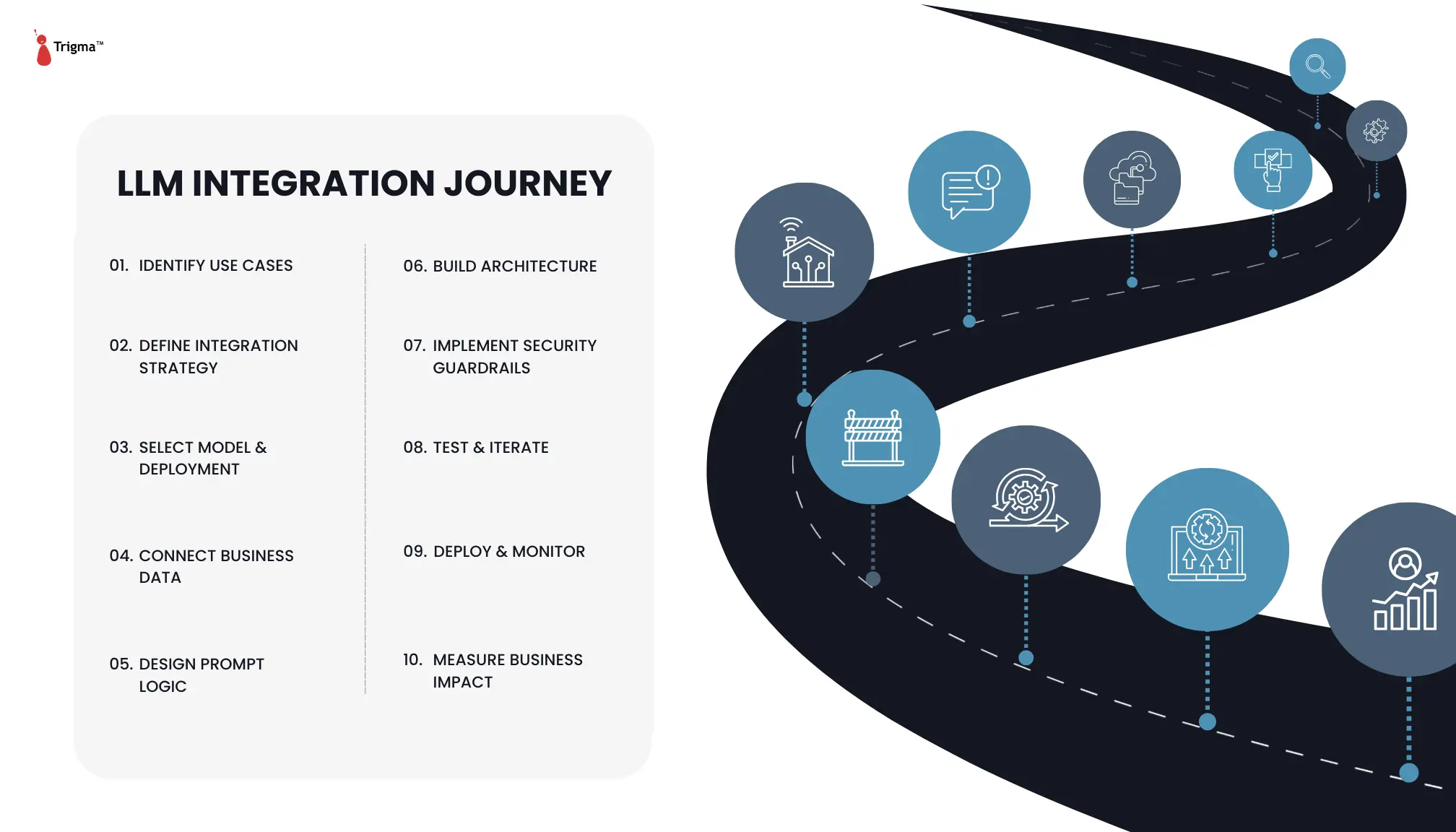
Diagram showing the LLM integration journey including identifying use cases, selecting models, connecting business data, deployment, testing, and measuring business impact.

1. Identify business use cases

Every LLM integration must begin with a clear understanding of where intelligence can create real value. Rather than focus on technology solely, look for workflows that are repetitive, knowledge-intensive, or decision-heavy. Common enterprise use cases include: 

  • Customer support automation 
  • Sales assistance and lead qualification 
  • Internal knowledge discovery and search 
  • Report generation and executive summary 
  • Document analysis, risk assessment, and compliance checks 

A clearly defined problem statement can lead to cost reduction, response accuracy, or improved customer satisfaction.

2. Define the integration approach

Once you have an idea about the use case, the next step is deciding how the LLM will interact with the system and users. This determines both UX design and system complexity. Integration mainly includes chat-based assistants for direct user interaction, automation for task execution, AI copilots embedded with existing tools, and agent-based systems that perform actions across applications.

Organizations can integrate LLMs into existing enterprise systems to enhance current capabilities, as well as into early-stage products or startups to rapidly validate ideas and accelerate time to market. In both cases, the focus should be on aligning the integration approach with the intended user journey, business outcomes, and system constraints.

3. Select LLM and deployment model

Choosing the right model and hosting strategy is a strategic decision that impacts cost, latency, and compliance. Organizations must evaluate cloud-based LLMs (OpenAI, Azure OpenAI, Anthropic) for speed and scalability, and private or on-premise LLMs for regulated environments. 

This deployment strategy aligns businesses with effective risk tolerance and operational needs.

4. Prepare and connect business data

LLM delivers real value only when grounded in enterprise-specific knowledge, not generic data. The right and quality data integration ensures LLM performs to the best to their capability and offers users a personalized approach.

Integration can be done through such methods as retrieval augmented generation (RAG) using vector databases, direct querying of structured databases, and API integrations with CRMs, ERP, HR, and support systems. This sets a structured, searchable knowledge layer that ensures accuracy, relevance, and contextual grounding.

5. Design prompt and instruction logic

Prompt designs define how the LLM behaves inside the system. This step transforms a general-purpose model into a domain-aware, controlled intelligence layer. This includes system prompts defining role, tone, and boundaries, input templates for consistency, output formatting rules for downstream systems, and fallback responses for ambiguity or uncertainty.   

This helps generate predictable, repeatable, and controllable AI responses suitable for business use cases. 

6. Build the application architecture

Enterprise-grade architecture requires a modular and scalable architecture. It typically includes architectures such as frontend (web & mobile interfaces), backend services handling business logic and APIs, LLM orchestration layer, databases and vector stores, and external system integrations. 

Frameworks such as LangChain, LlamaIndex, and Semantic Kernel are often used to accelerate development and orchestration.

7. Implement guardrails & security

Security is surely crucial when integrating LLMs into business systems. The security measures include role-based access control and permissions, data masking for sensitive information, prompt detection and prevention, and logging, monitoring, and audit trails.  The effective security ensures a secure, compliant AI system for enterprise deployment.

8. Test, validate & iterate

Before launching or executing a full-scale rollout, LLM-powered systems must be rigorously tested. Validation should cover the accuracy and relevance of responses, edge cases and failure scenarios, latency, and user acceptance and trust. During early phases, human oversight is critical to ensure reliability and refinement.

9. Deployment and monitoring

Once validated and tested, the system can be deployed with continuous monitoring in place. This includes effectively checking usage patterns, performance & latency, cost, and token consumption, and error rates & user feedback. However, prompts, workflows, and data pipelines should be continuously refined based on real-world usage.

10. Measure business impact

The last and final step is measuring outcomes against the original objectives. Success metrics typically include operational efficiency gains, cost savings, user adoption & engagement, quality output & consistency, and overall ROI. This feedback loop ensures LLM integration is aligned with evolving business needs.

Use Cases of LLMs Across Industries

LLMs are no longer confined to generic conversational interfaces. Across industries, organizations are integrating LLMs into their business systems to augment decision-making and gain a competitive edge in the market. Below are some of the impactful use cases across various industries.
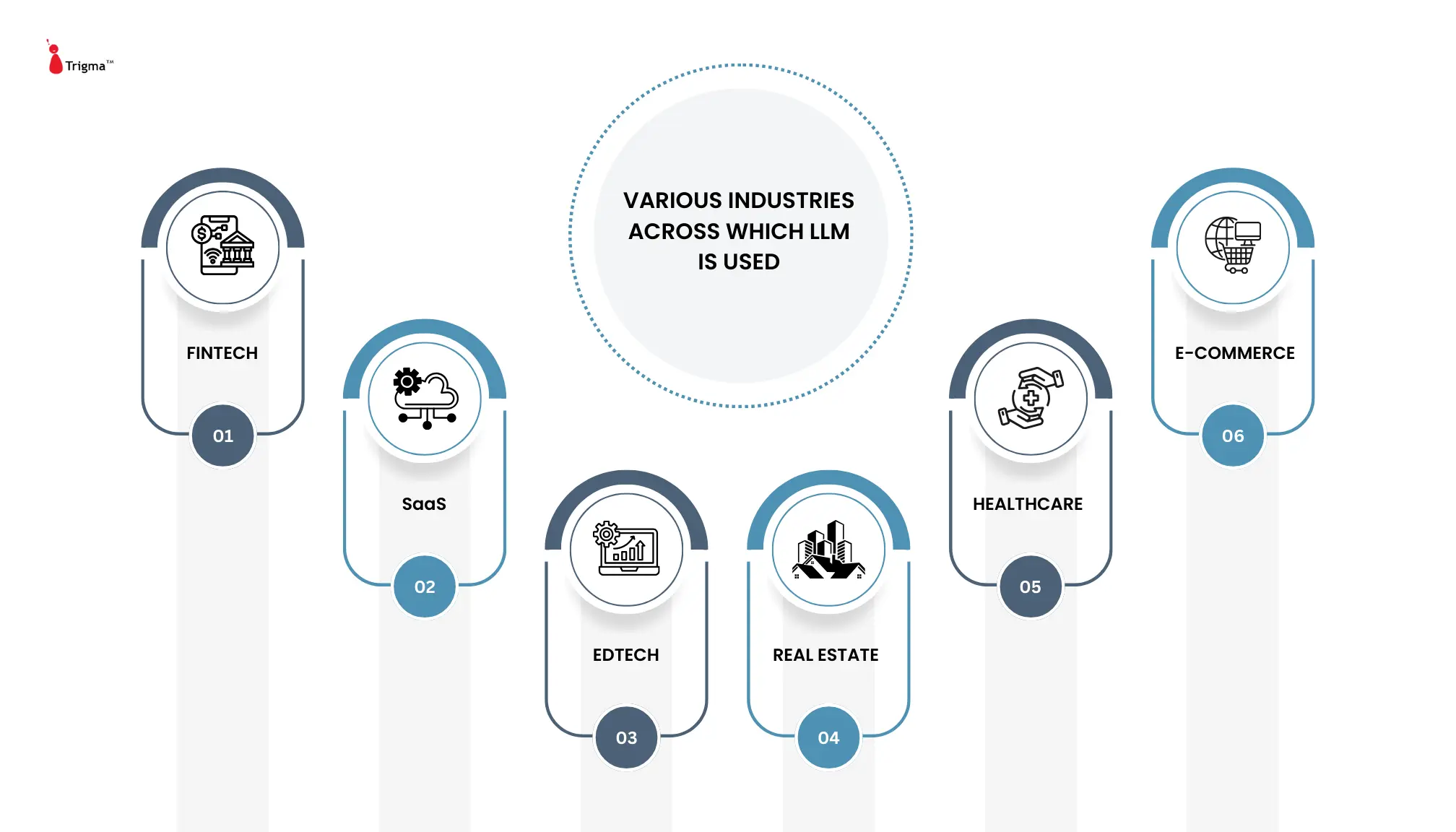
Infographic showing industries using LLM integration including fintech, SaaS, edtech, real estate, healthcare, and ecommerce for business automation and AI transformation.

Fintech

In fintech, LLMs are being integrated to enhance transparency, compliance, and customer engagement, ensuring strict compliance with regulations. LLMs are typically integrated using retrieval augmented generation (RAG) to ensure responses are grounded in verified financial data and regulatory documentation.

Edtech

Edtech platforms are known for leveraging AI to deliver personalized, adaptive learning at scale. This is highly beneficial in the case of personalized learning paths and content recommendations. LLMs help shift education from static content delivery to dynamic, user-centric experiences.

Healthcare

Healthcare platforms integrate LLMs cautiously to improve efficiency while maintaining patient safety and compliance. LLMs are often deployed with strict guardrails, human oversight, and private model hosting to meet regulatory and ethical standards.

Real estate

LLMs are being used in real estate for effective decision-making for buyers, agents, and investors. By combining LLM reasoning with real-time market statistics and data, real estate platforms deliver more informed and efficient transactions.  

SaaS

SaaS platforms are embedding LLMs as AI copilots that enhance user productivity and reduce cognitive load. LLMs in SaaS web applications act as a contextual layer that adapts to user behaviour and the system in real time. 

E-commerce

In e-commerce, LLMs are integrated to enhance customer engagement and automate support. By connecting with product and customer data, LLMs enable personalized recommendations and more efficient shopping experiences.

As an LLM development company, Trigma has worked with businesses that have leveraged AI and built custom LLM models for their businesses. One such platform we built is an on-demand petcare platform where we integrate an LLM model to enhance customer support and experience.

Looking to implement RAG in your business?

Summing Up

LLM is no longer just an experimental approach; it’s a defining factor in how modern organizations build, scale and compete. As applications and business systems become more intelligence-driven, LLMs are emerging as a foundational components that shape productivity, decision making, and customer experience across the enterprise.

Ultimately, the companies that succeed in the next phase of digital transformation will not be those that experiment with AI the most, but those that embed intelligence deeply and responsibly in their core systems.
What is Natural Language Processing (NLP)?

Have you ever wondered why AI systems can read emails, understand customer chats, analyze contracts, or respond naturally in conversations? The major difference lies in how LLMs models effectively understand human language. Every single time you enter a question, dictate a message, or ask AI to summarize something, NLP technologies kick in. 

NLP enables machines to read, interpret, and respond to language that humans use it everyday. What was once considered an experimental AI capability is now the core technology behind AI automation, smarter decision-making, and enterprise-scale digital transformation. 

For today’s business and technology leaders, understanding NLP is no longer just a technical topic; it’s a strategic one. Knowing how NLP works, which techniques matter, and how modern NLP systems are built helps organizations unlock value from unstructured data like emails, documents, and voice interactions. 

Let’s explore more of Natural Language Processing in detail in a more practical way.

What is Natural Language Processing (NLP)?

Natural Language Processing (NLP) is a subfield of artificial intelligence that enables machines to read, interpret, generate, and respond to human language in a meaningful and contextual manner. 

Unlike traditional rule-based systems, NLP systems learns patterns, semantics, intent, and relationships within language, allowing AI to move beyond keyword matching towards true language and understanding. 

At enterprise levels, NLP forms the backbone of AI-powered customer support, intelligent document processing, conversational AI and voice agents, knowledge discovery and search, compliance monitoring, and AI automation. In simple words, NLP helps turn complex and unstructured data into smart & actionable intelligence.

Working of NLP (Natural Language Processing)

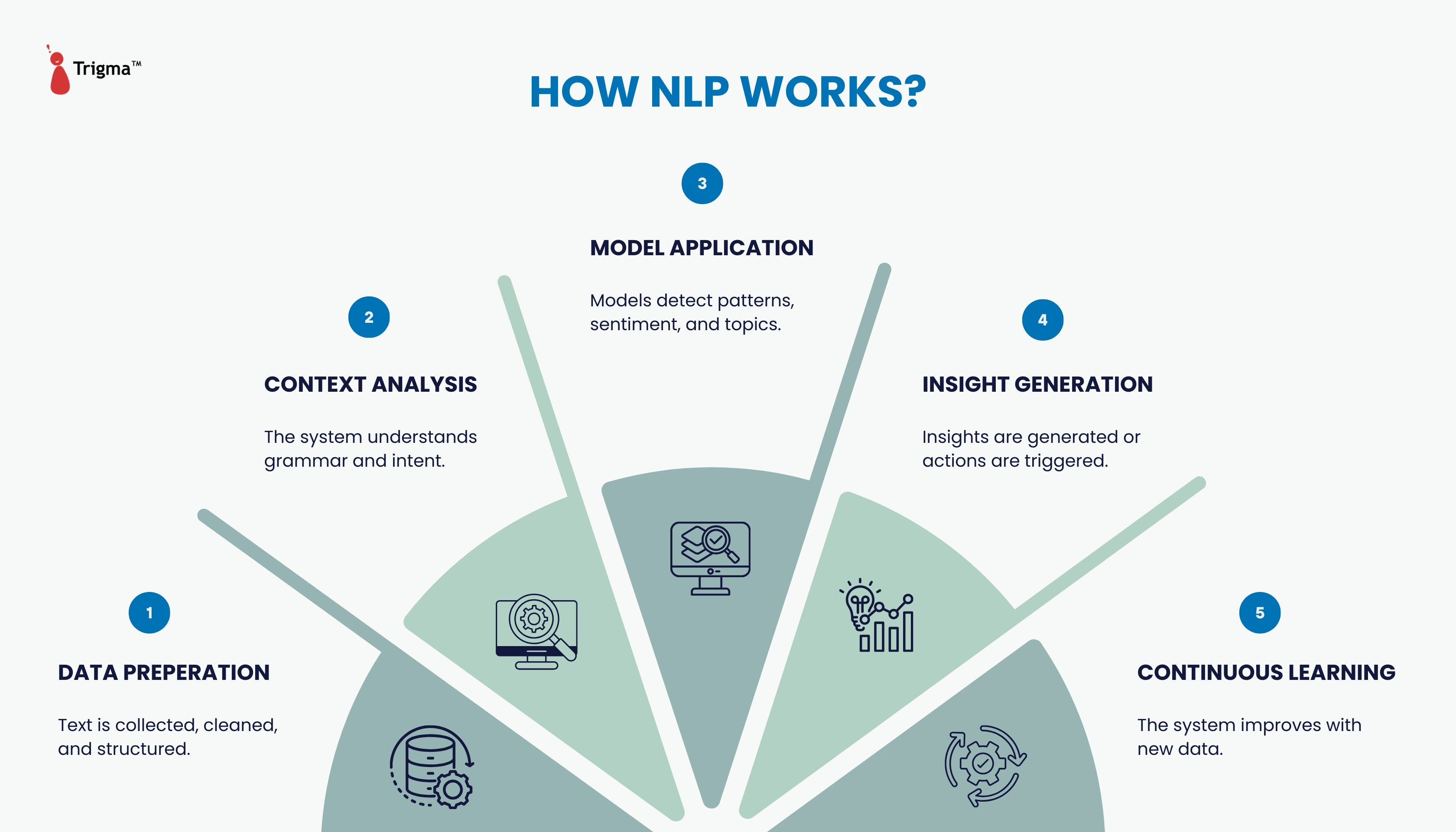
At the core, NLP enables machines to understand, analyze, and generate human language in a way that is helpful for business applications. Rather than treating language as plain text, NLP systems break it down, interpret its meaning, and convert it into actionable insights. Here’s how NLP typically works:

How NLP Works

1. Data input and language preparation

The first step typically includes collecting raw data from various sources such as emails, chat conversations, documents, video transcripts, or websites. This data is then cleaned to make it structured. It involves breaking text into words and phrases (tokenization), converting words to their base form (lemmatization), and removing unnecessary words while keeping meaning intact. This ensures the data is ready for deeper analysis. 

2. Understanding structure and meaning

In this step, NLP models analyze how words are structured and how they relate to each other. This helps the system understand sentence structure and grammar, context, and intent behind the text. This is the stage where NLP moves beyond keyword matching and begins to understand language contextually. 

3. Apply NLP models and techniques

Modern NLP systems use advanced natural language processing models, powered by machine learning and deep learning, to identify patterns, sentiments, topics, and intent. These models are trained on large datasets and fine-tuned for specific business domains. 

In enterprise setups, smaller task-focused micro models in natural language processing are often used to handle specific functions such as intent detection, document classification, or sentiment analysis more efficiently. 

5.Continuous learning and improvement

NLP systems continuously improve by learning from new data, feedback, and changing language patterns. This allows them to adapt to evolving customer behavior, industry terms, and business needs over time. 

Key NLP Techniques Used in Systems

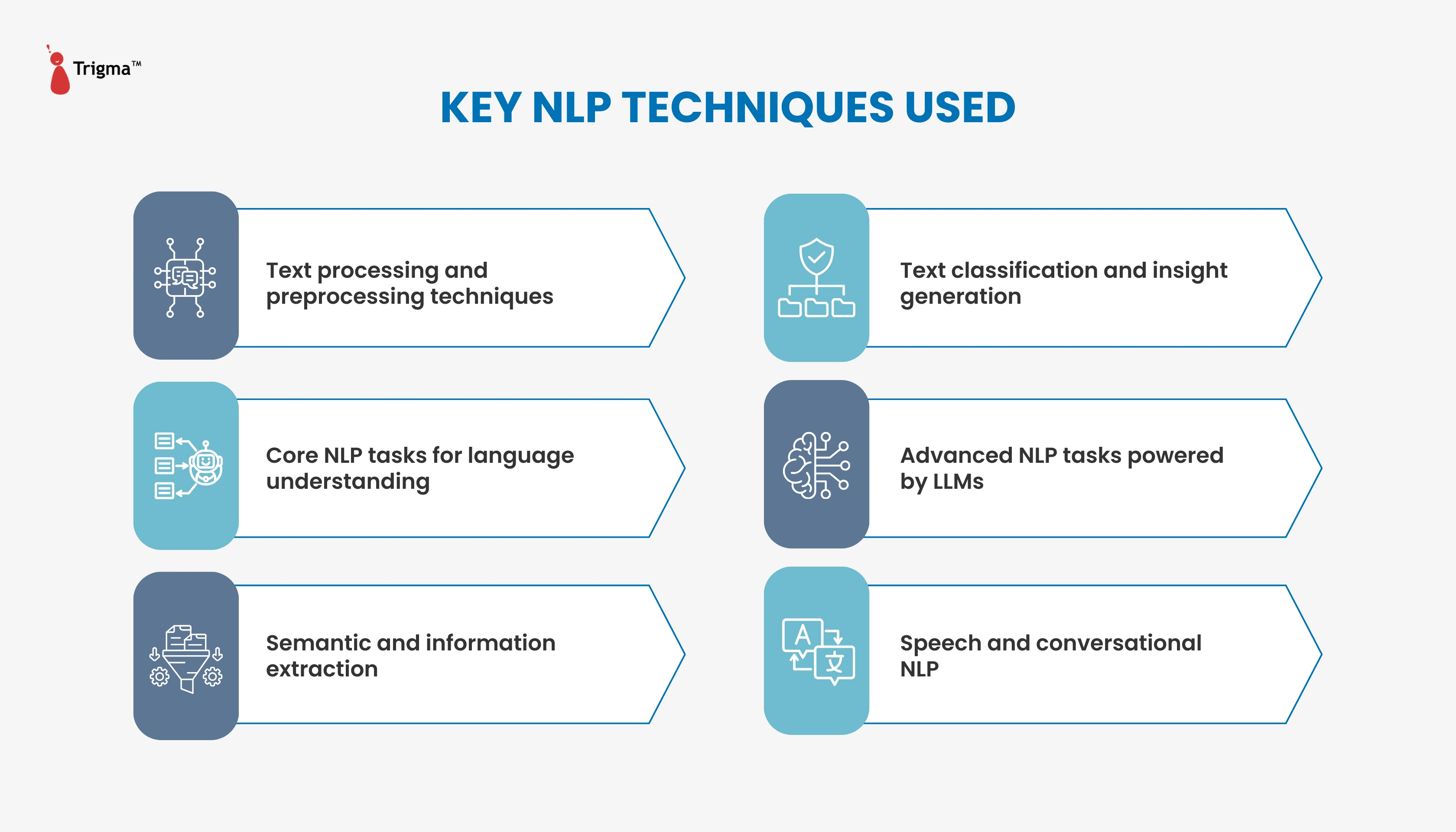
Modern NLP systems rely on a well defined techniques that allow machines to understand language, extract action, and take action. Below are the most commonly used NLP techniques used in real-world systems: 

Key NLP Techniques

1. Text processing and preprocessing techniques

Before performing any analysis, raw language data must be cleaned and prepared. Preprocessing ensures that text is consistent, structured, and suitable for further processing.

    Key techniques include:

    TokenizationSplitting text into smaller units such as words, phrases, or sentences. This is the first step in any NLP pipeline.
    Stemming and LemmatizationReducing words to their base or root form. It will help models treat related words consistently.
    Text normalizationStandardize text by handling punctuation, special characters, capitalization, spelling variations, and formatting inconsistencies.

      2. Core NLP tasks for language understanding

      NLP tasks focus on understanding the structure, meaning, and intent behind the text. These tasks are often combined to power real-world NLP systems.

        Common tasks include:

        Part of speech taggingIdentifying the grammatical role of each word, such as noun, verb, or adjective.
        Syntactic parsingAnalyzing sentence structure to understand how words form phrases and sentences.
        Sentiment analysisDetermining the emotional tone of text is widely helpful in customer feedback and brand analysis.

          3. Semantic and information extraction

          To move beyond surface-level understanding, NLP systems apply semantic analysis techniques.

            These include:

            Word sense disambiguationIdentify the correct meaning of the word based on context.
            Entity and relation extractionExtracting entities and identifying relationships between them is especially useful in documents like contracts, reports, and research papers.

              4. Text classification and insight generation

              These tasks help NLP systems organize and interpret large volumes of text.

                Key techniques include:

                Text classificationCategorized text into predefined groups such as support tickets, document types, or user intent.
                Topic modelingIdentifying recurring themes or topics across large datasets without manual labeling.
                Spam detectionIdentifying suspicious or unwanted content automatically.

                  5. Advanced NLP tasks powered by LLMs

                  With the rise of LLMs, NLP systems can now handle more complex and human-like tasks.

                  Advanced NLP tasks include: 

                  Machine translationTranslating accurately from one language to another.
                  Text summarizationGenerating concise summaries from long documents, reports, or conversations.
                  Question answeringExtracting and often rephrasing information to answer specific questions based on a given text.
                  Natural language generationGenerate context-aware text for chatbots, reports, or automated responses.

                  These tasks often require large datasets, advanced models, and domain-specific fine-tuning for specific industries. 

                  6. Speech and conversational NLP

                  NLP also plays a key role in voice-driven systems. This involves speech-to-text for converting spoken language into text, text-to-speech for generating voice responses, and dialogue systems such as chatbots or virtual assistants that enable personalized and interactive conversations. 

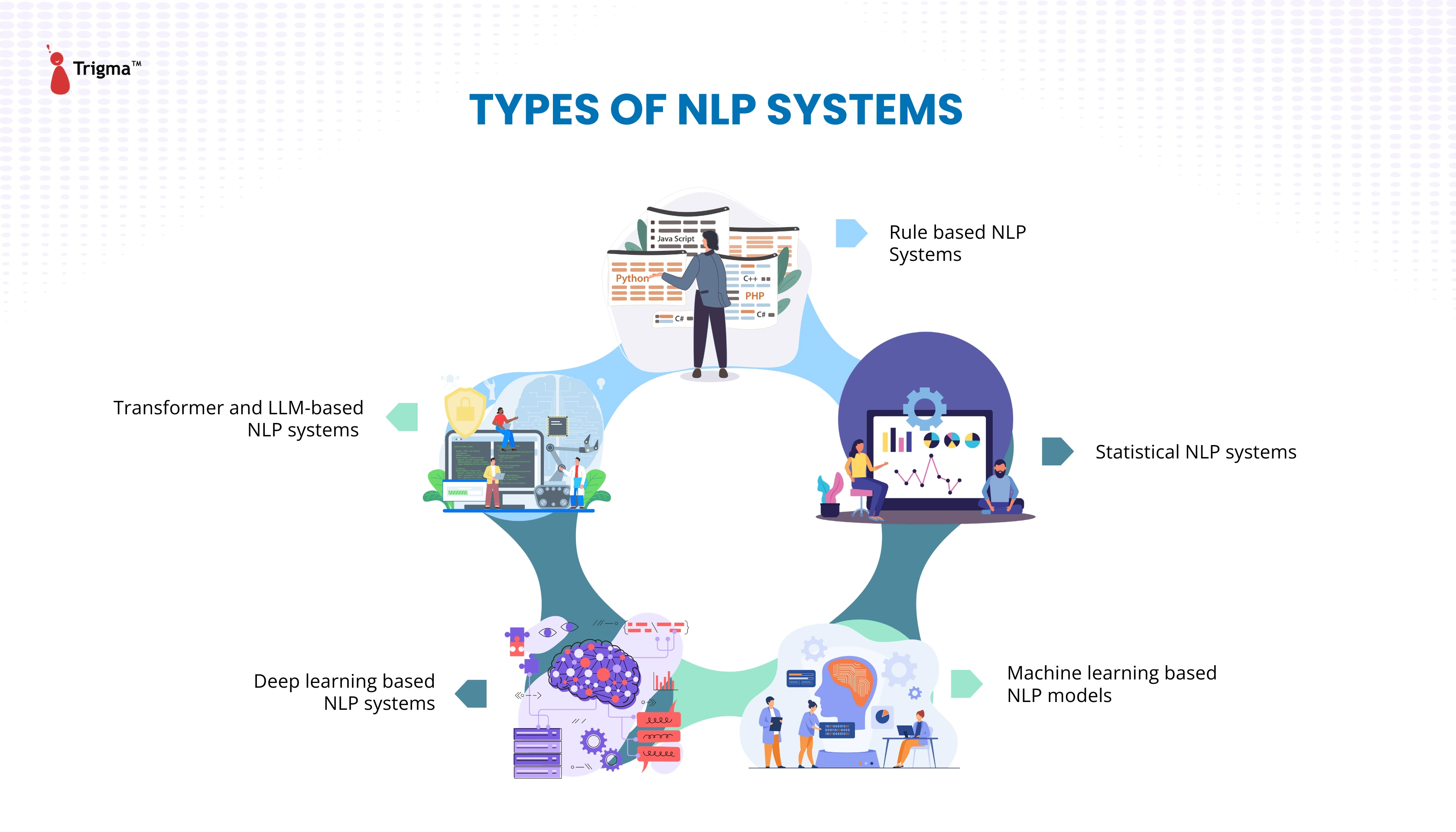
                  Types of NLP Systems

                  Below are the main types of NLP systems that are used in businesses today: 

                  Types of NLP Systems

                  1. Rule-based NLP systems

                  Rule-based NLP systems rely on predefined linguistic rules created by humans. These systems follow strict instructions for processing language, such as grammar rules or keyword patterns.  It was typically best suited for basic text matching, simple chatbots, and keyword-based search systems. 

                  2. Statistical NLP systems

                  These systems use mathematical and probability-based models trained on language data. Instead of relying on fixed rules, they identify patterns based on word frequency and usage. This is commonly used for spam detection, basic sentiment analysis, and early text classification systems.

                  3. Machine learning based NLP models

                  These systems employ both supervised and unsupervised machine learning techniques to enhance language understanding. It improves accuracy over time and handles language variations in a better way.

                  4. Deep learning based NLP systems

                  Deep learning based NLP systems use neural networks to understand language context, meaning, and relationships between words. It involves strong contextual understanding and high accuracy for complex tasks. It is typically used for chatbots, voice assistants, and sentiment analysis.

                  5. Transformer and LLM-based NLP systems

                  The most advanced category of NLP systems. These systems are built using a transformer architecture and large language models (LLMs) that understand language at a deep contextual level. It is usually used in conversational AI, intelligent assistants, content generation, question answering, and enterprise knowledge systems.

                  Ready to build scalable NLP systems for your enterprise?

                  Micro Models in Natural Language Processing

                  Micro models are small, specialized NLP models trained to perform specific language tasks, such as intent detection, contract clause detection, or sentiment scoring, rather than handling everything in a large model.

                  Many enterprises nowadays are adopting NLP micro models as they help in faster training and deployment, lower computational cost, better domain accuracy, and easier governance & compliance. Micro models align perfectly with enterprise AI architectures, where flexibility and precision matter more than intelligence.  

                  The Future of NLP

                  The future of NLP lies in its ability to move beyond understanding text to driving intelligent action. NLP will increasingly serve as the interface between humans and enterprise systems, enabling seamless AI automation, faster decision making, and more natural interactions across business operations. 

                  As organizations adopt large language models alongside task-specific micro models in natural language processing, NLP systems will become more accurate, scalable, and governed. Industry-specific NLP solutions, deeper contextual understanding, and responsible AI practices will define how language intelligence is deployed at scale. 

                  In the years ahead, NLP will no longer be a standalone capability; it will be a strategic foundation for enterprise AI, shaping how businesses communicate, operate, and compete.

                  What is Retrieval Augmented Generation (RAG)?

                  Ever wondered how these AI models can deliver confident, accurate answers when the information they need is constantly changing? 

                  As Large Language Models (LLMs) continue to advance, their ability to deliver human-like responses has grown, but reliability remains a key concern. LLMs struggle to stay current, verify facts, and adapt to specialized business knowledge. This is where Retrieval Augmented Generation (RAG) is transforming the way intelligent systems operate in real-world scenarios. 

                  Rather than relying on pre-trained knowledge, RAG enables AI to retrieve relevant & trusted information at the moment. RAG enables companies to integrate their data with LLMs, allowing for more trustworthy and relevant AI opportunities.  As companies increasingly adopt AI for decision-making support, customer interactions, and internal knowledge access, RAG is emerging as a critical foundation for building systems that businesses can trust. 

                  In this blog, we’ll explore RAG in AI,  how it works, how it is different from semantic search, and why organizations are heavily investing in RAG architectures.

                  What is RAG in AI?

                  RAG is an AI architecture that combines the strengths of traditional information retrieval systems with the capabilities of generative large language models (LLMs).  Instead of relying on predefined data like traditional language models, RAG fetches relevant documents from an internal knowledge source before generating an answer. 

                  This architecture combines two powerful capabilities 

                  1. Information retrieval from external knowledge sources 
                  2. Natural language generation using LLMs (Large Language Models) 

                  Instead of relying solely on the LLM database, RAG retrieves information from relevant external sources and adds that information to the model before generating a response.

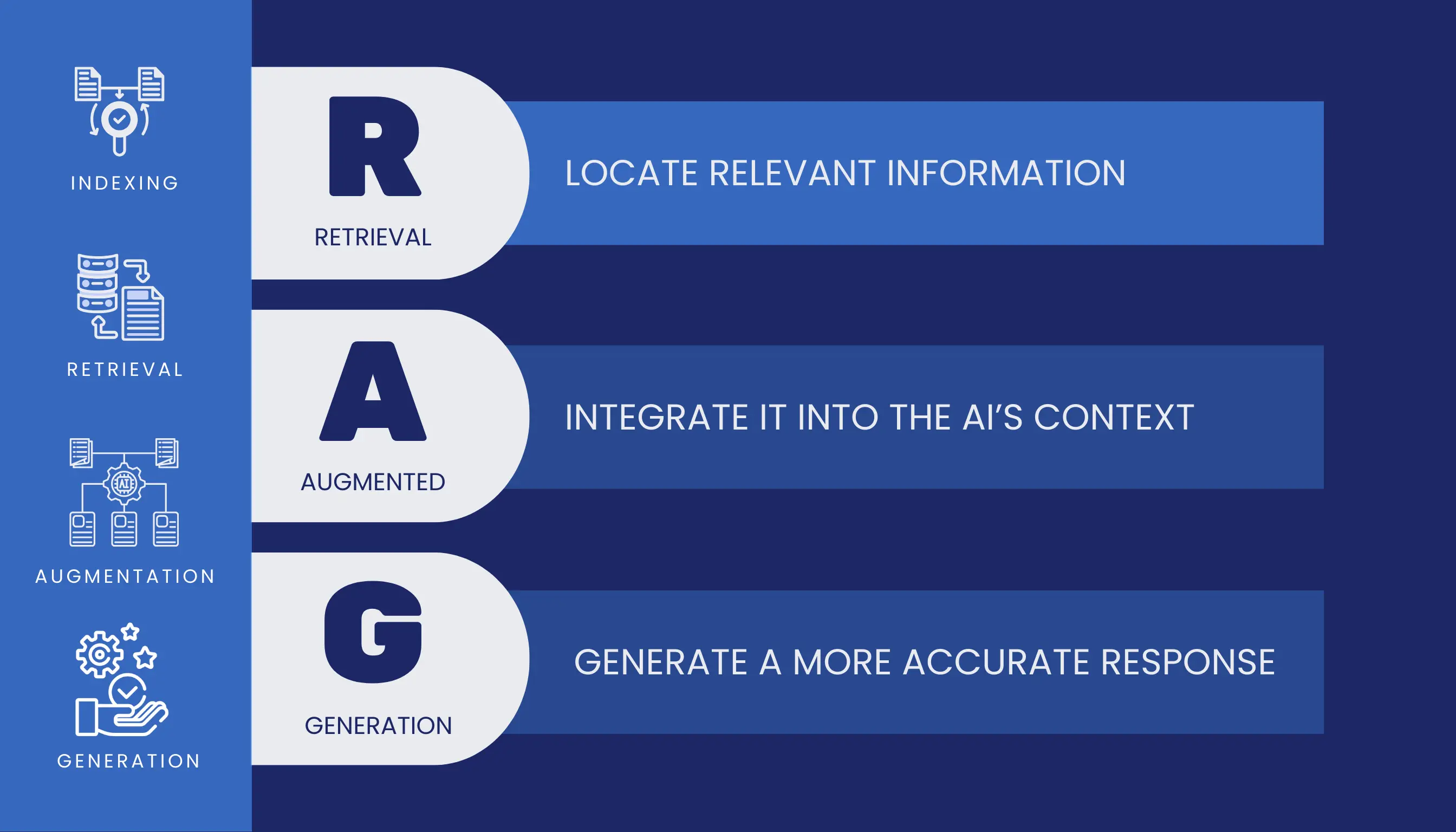
                  Visual explanation of Retrieval Augmented Generation (RAG) showing how AI retrieves relevant information, integrates it into context, and generates a more accurate response

                  RAG and Large Language Models (LLMs)

                  Large Language Models (LLMs) are designed to generate responses by learning patterns from massive volumes of training data. While this enables fluent and contextually aware language generation, LLM still operates with static knowledge, i.e., they can’t adapt to access real-time data and new updated content. 

                  In this scenario, RAG helps LLMs overcome their knowledge limits by allowing them to fetch the right information from external sources before answering. The combination of RAG and LLMs allows enterprises to move beyond generic AI outputs and toward systems that can reason over specific domain data, comply with internal policies, and adapt as information evolves. 

                  This architecture not only improves response accuracy but also reduce hallucinations that are considered to be the most common challenge in LLM deployments.  This relationship (LLM & RAG) allows organizations to deploy AI systems that are context-aware, continuously updatable, and safer and more explainable.

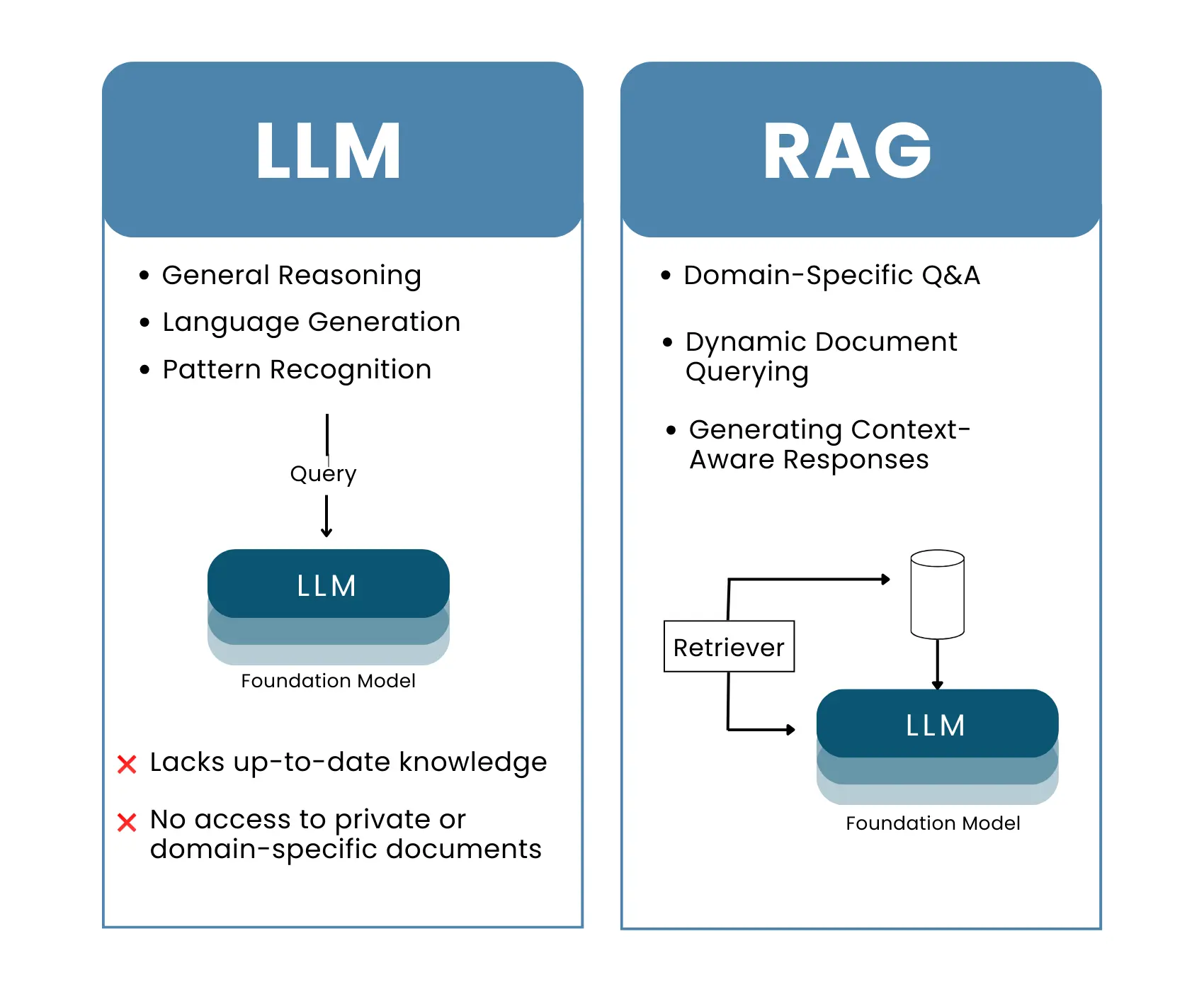
                  Side-by-side comparison showing a standalone LLM handling queries using general reasoning versus a RAG system that retrieves external documents through a retriever before generating context-aware responses.

                  To understand how this approach differs from traditional models, see a detailed comparison of LLMs vs RAG.

                  Working of RAG (Retrieval Augmentation Generation)

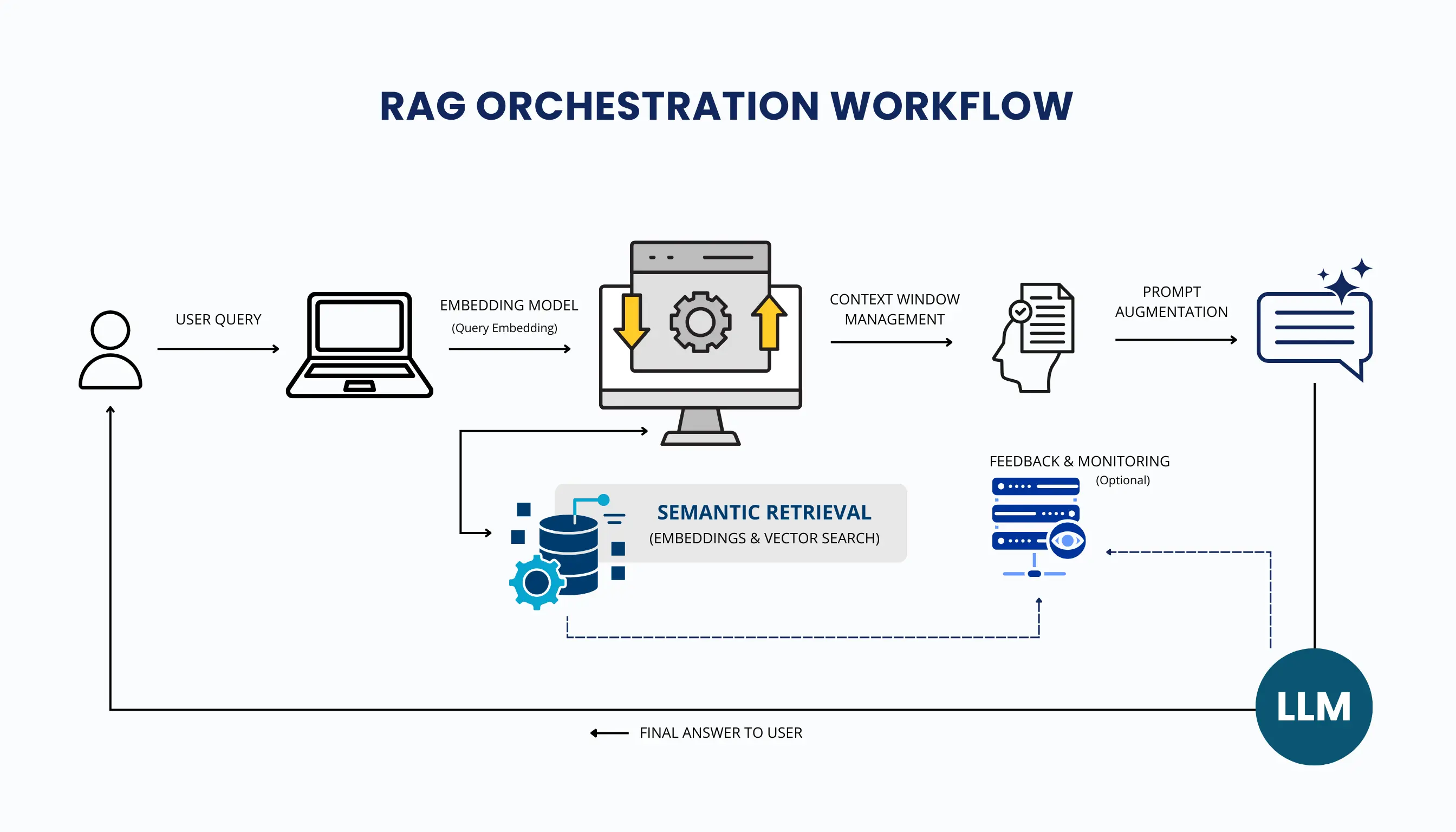
                  RAG works by combining information retrieval with text generation to produce accurate and context-aware responses. Instead of relying on LLMs, RAG allows the systems to retrieve relevant information first and then respond and generate. Here’s how it actually worked:

                  Diagram illustrating a RAG orchestration workflow where a user query is embedded, semantically retrieved from a vector database, managed within a context window, augmented into a prompt, processed by an LLM, and returned to the user, with optional feedback and monitoring for continuous system improvement.

                  1. User query

                  When a user puts a query to the LLM, the system first understands the intent behind the query.  The input is converted into a numerical representation called an embedding that captures the semantic meaning of the query.

                  2. Information retrieval

                  The embedding is then used to search a vector database containing pre-indexed documents, knowledge bases, and enterprise data. Through the search, the system identifies the most relevant pieces of data based on the query.

                  3. Context

                  The retrieved content is passed to LLM models, and this step ensures that the model has access to accurate, up-to-date information before generating a response, including forming an answer as per the user’s intent and query.

                  4. Response generation

                  Finally, the LLM generates a natural language-based answer using both the user’s query and retrieval context. The response is based on real data, research, not outdated and predefined data.

                  Type of RAG Architectures

                  Below are the common RAG architecture types.

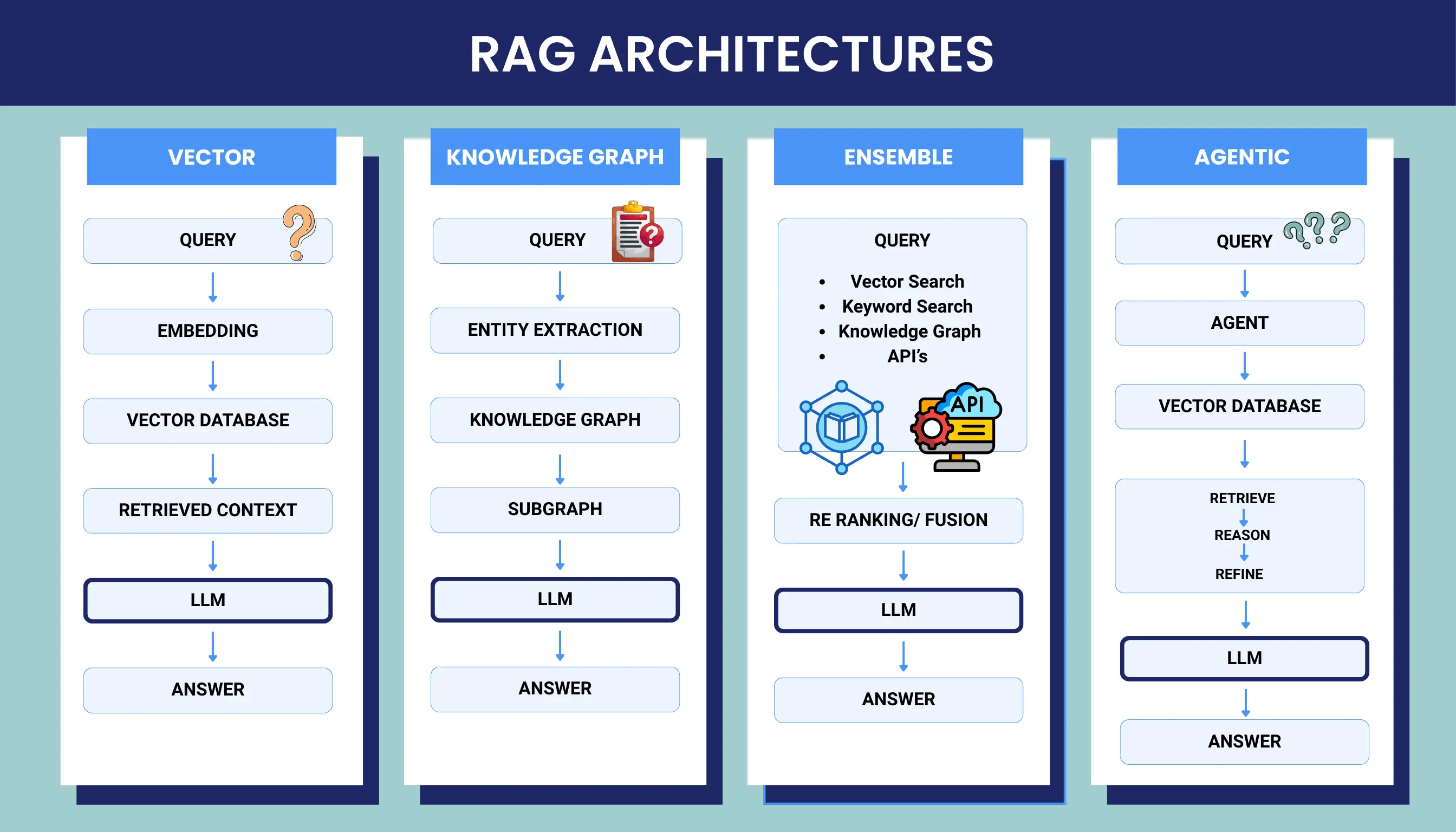
                  Diagram comparing different Retrieval Augmented Generation (RAG) architectures, including vector-based RAG, knowledge graph RAG, ensemble RAG, and agentic RAG workflows with LLMs

                  Vector-based RAG

                  Vector-based RAG works with a specialized vector database that stores information as numerical embeddings. This format allows AI systems to understand semantic meaning and retrieve the most relevant context efficiently.

                  Knowledge graph-based RAG

                  In this, the information is organized into nodes and representations. By leveraging knowledge graphs, RAG systems can identify meaningful connections between entities, enabling more structured reasoning and human-like understanding.

                  Ensemble RAG

                  Ensemble RAG runs multiple retrievers in parallel and combines their outputs. This approach improves reliability by allowing different retrieval methods to complement each other and cross-check results.

                  Agentic RAG

                  Agentic RAG introduces autonomous decision-making into the retrieval process. Instead of relying on a single retrieval step, the systems can plan, iterate, and decide what information to fetch and when. This enables deeper reasoning, better context refinement, and more reliable responses for complex queries.

                  Major Reasons Why Organizations are Heavily Investing in RAG Architectures

                  • Improved accuracy and trust by grounding AI responses in real data 
                  • Reduced hallucinations as compared to LLMs 
                  • Access to real-time information without retrieving data 
                  • Faster deployment and lower costs than fine-tuning large models 
                  • Scalable architectures that grow with enterprise data 
                  • Better explainability and compliance for regulated industries 
                  • Future-ready foundation for production-grade applications

                  RAG v/s Semantic Search

                  BasisSemantic SearchRAG
                  Primary purposeFind the most relevant document or contentRetrieves information and generate a complete information
                  OutputList of documents, lists, or passagesNatural language responses grounded in retrieved data
                  Role of LLMsOptional or limitedCore component of the system
                  Knowledge usageRetrieves existing content onlyDirectly answers complex queries
                  Hallucination riskNo hallucinationReduced hallucination due to grounded retrieval
                  Use of vector searchYesYes
                  User experience User reads and interprets resultsAI provides a ready-to-use answer

                  Semantic search helps users find information, while RAG helps users to understand information by turning retrieved data into accurate conversational responses.

                  Looking to implement RAG in your business?

                  Whether you’re exploring customer support automation, AI-driven knowledge systems, the RAG architecture can unlock measurable impact. Partner with Trigma, having experienced AI teams to design, build, and deploy RAG solutions tailored to your data and business growth.

                  What are AI Voice Agents?

                  Key Takeways

                  • AI voice agents are becoming essential enterprise infrastructure, powering customer support and other industrial operations at scale. 
                  • Modern AI voice agents are based on contextual understanding driven by NLP, LLMs, and advanced speech-to-text generation.
                  • Real-time intelligence and continuous learning allow voice agents to adapt instantly, improve over time, and deliver a human-like experience. 
                  • Deep enterprise integration enables real action, connecting voice agents with ERPs, CRMs, and core systems. 
                  • Organizations that adopt AI voice agents early will gain a competitive edge as voice AI decision making support employees.

                  Have you ever come across this question, how will businesses manage millions of customer conversations without being overwhelmed by human teams?

                  In the coming years, voice AI won’t just assist interactions; it will quietly power many aspects of enterprise operations, enabling businesses to operate smarter and stay ahead of the competition.

                  As organizations rapidly shift towards an AI-driven, voice-first experience, leaders should understand where voice agents are delivering real and measurable value and where this hype can be reached in the future.

                  In this blog, we’ll deeply understand what AI voice agents are, how they work, and why enterprises are increasingly investing in AI voice agent solutions to safeguard their business in the future.

                  Understanding AI Voice Agents

                  An AI voice agent is an intelligent, voice-enabled software that conducts AI-driven conversations with humans. It can perform various tasks, such as answering questions, providing information, and completing actions through natural and conversational interactions. 

                  Legacy AI voice assistants like Alexa and Siri were designed for narrow & scripted tasks. In contrast, the modern AI era welcomes Alexa+, a next-generation assistant designed to go beyond commands, acting as a more intelligent, context-aware personal assistant that is capable of handling a wide range of tasks.  

                  How AI Voice Agents Work?

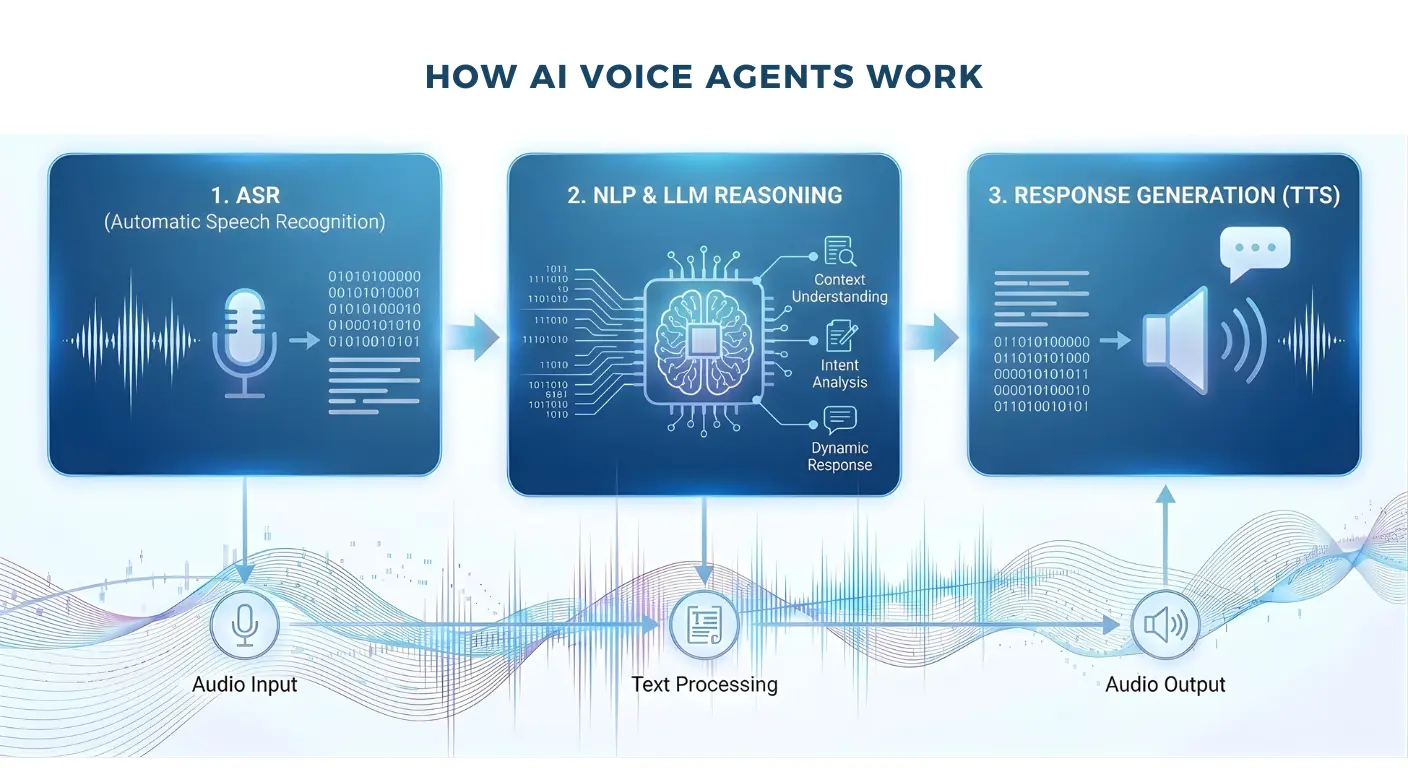
                  AI voice agents are effectively responsible for executing natural conversations. Through Natural Language Processing (NLP), Speech Generation Technologies, and LLM models, they carefully understand the context and create personalized responses. Here’s how they actually work at the core:

                  Infographic illustrating the three-step workflow of AI voice agents: Automatic Speech Recognition (ASR), NLP & LLM Reasoning, and Response Generation (TTS).

                  1. Automatic speech recognition (ASR)

                  Everything starts with the query. When a user speaks, the system captures audio input and converts it into text using automatic speech recognition (ASR) backed by advanced speech-to-text models. These models are effectively trained on diverse accents, languages, and speaking styles, ensuring accuracy in response.

                  2. NLP & LLM reasoning

                  Once the speech is converted into text, natural language processing comes in, where the text is recognized, and LLMs analyze user intent, context, conversational history, and tone of the input query. This enables the AI voice agent to reason, decide, and generate responses dynamically rather than relying on predefined scripts.

                  3. Response generation

                  The end and AI-generated response is then converted back into speech using a text-to-speech model. Speech generation systems effectively mimic natural human speech, adjust pace and emotion, and support multiple voices and languages. This is the reason why today’s AI voice agents feel more conversational rather than robotic.

                  Key Capabilities of Modern AI Voice Agents

                  A responsive and well-designed AI voice agent possesses various capabilities that enhance the overall effectiveness of the output. Below are some of the capabilities of these modern AI voice agents.

                  1. Real-time conversation

                  Considered the most effective capability, real-time conversational intelligence enables an AI agent to listen, interpret, reason, and respond instantly during live interactions. 

                  Unlike traditional systems that rely heavily on a pre-fed database, AI voice agents process user input in real time, adapt to responses in mid- conversations, and handle interruptions, follow-up questions, and clarification naturally. In a recent trial of PolyAI,  Tom Mackenzie showed a live interaction with a restaurant AI voice agent. The conversation highlights how an AI voice agent understood, not just the query, but also suggested the best solution to his concern. It completely feels like a human conversation.

                  2. Context-aware responses

                  Context awareness enables an AI voice agent to remember and understand what’s happening within and across conversations. This particularly includes retaining conversation history during a call, understanding user intent beyond keywords, and referencing past interactions and preferences. 

                  For example, an AI voice calling agent won’t ask a customer to repeat the information that has been shared in earlier conversations, they already exists in their database, and this significantly improves overall user experience and trust.

                  3. Continuous learning from interactions

                  Modern AI voice agents are designed to improve over time. Through continuous interactions and learning, they analyze conversation outcomes, identify misunderstandings, and refine intent detection, thus improving the end response accuracy.    

                  Using feedback loops, supervised training, and periodic LLM fine-tuning, the voice agents become more accurate, efficient, and aligned with business goals without requiring constant manual updates.

                  4. Enterprise system integration

                  AI voice agents are not just limited to one-time user interactions, it deeply integrated with existing enterprise systems such as CRMs, ERPs, healthcare systems, and other analytical tools. This integration allows the voice agent to take real actions and helps enterprises in their day-to-day operations.  

                  Example: Mercedes-Benz integrated an AI voice agent into their MBUX systems for natural and in-car voice interactions, allowing drivers to control features and get necessary information.

                  Use Cases of Voice Agent Across Industries

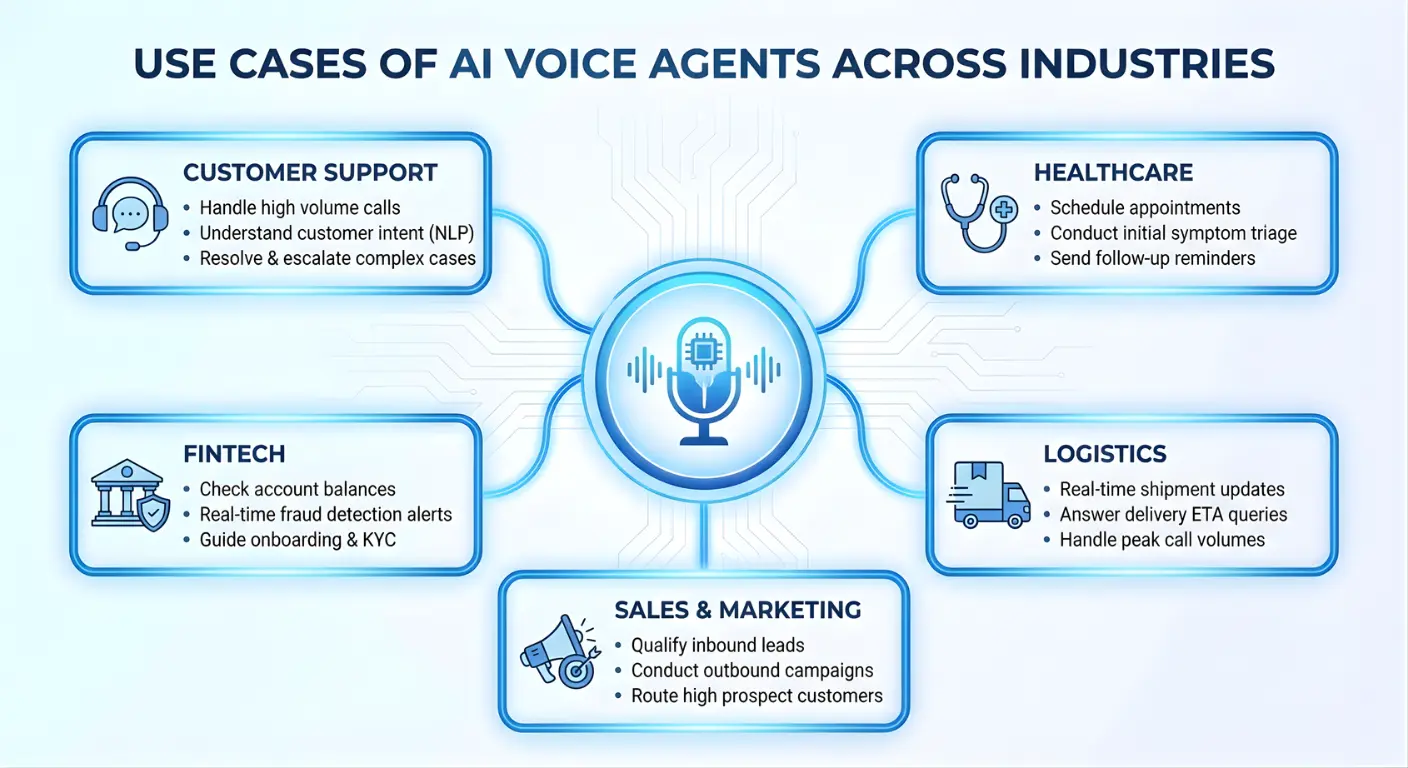
                  It would be a foolish call to say that AI voice agents are limited to experimental pilots, as they are being deployed at critical communication layers in various industries, handling high-volume and high-impact interactions through AI-driven conversations.  Here’s how different sectors are using AI voice agents in real-world scenarios.

                  Infographic illustrating the practical use cases of AI Voice Agents across five key industries: Customer Support, Healthcare, Fintech, Logistics, and Sales & Marketing.

                  Customer support

                  Customers are the one who directly interacts with AI voice agents. They are capable of handling a large number of incoming calls autonomously. They can understand customer intent using natural language processing (NLP), resolve customer issues, and escalate or transfer complex cases to human agents with full conversational context. 

                  By leveraging LLMs and real-time speech processing, AI voice agents reduce wait times, improve first call resolution, and significantly lower support costs without compromising customer experience.

                  At Trigma, we have successfully built an AI voice agent in real estate that transforms the experience of buyers through AI-driven interactions. This solution mainly focuses on inbound and outbound call thus understanding buyer intent in real time and responding to their queries.

                  Healthcare

                  Healthcare is almost surrounded by AI voice agents, as every business wants excellent care for its patients. AI voice agents help address clinician burnout and rising patient demand by automating non- clinical interactions. These usually help in scheduling and rescheduling appointments, conducting initial symptom triage, and sending follow-up reminders and post-care instructions. 

                  These voice agents use ASR and STT models to accurately capture patient responses, while NLP and LLM ensure safe, structured, and compliant conversations.

                  Fintech

                  In regulated industries like banking and finance, AI voice agents provide secure, scalable, and consistent customer interactions. They are commonly responsible for checking bank account balances, real-time fraud detection alerts, and guiding onboarding and KYC-related interactions. 

                  By integrating core banking systems and contextual understanding, AI voice calling agents deliver faster responses while maintaining guidelines and accuracy.

                  Logistics

                  Operations in logistics and supply chains are highly dependent on effective and constant communication. AI voice agents make it easier by providing real-time status shipment updates, answering delivery ETA, and delay related query.

                  With a scalable AI voice agent, logistics companies can handle massive call volumes even during peak seasons, ensuring timely and accurate communication each time.

                  Sales & Marketing

                  For sales and marketing, AI voice agents function as intelligent front-line representatives. They can effectively qualify inbound leads by asking structured questions, conduct outbound calls for campaigns & follow-ups, and route high prospect customers directly to the sales team. 

                  Powered by AI-driven conversations, these voice agents ensure consistent messaging, faster response times, and improved conversion rates, ensuring human to focus on closing rather than qualifying. 

                  Trace Sales AI, Trigma’s ready-to-deploy solution, can effectively help in executing high-end sales. With autonomous agents, this solution helps turn conversations into conversions and helps execute sales without human oversight.

                  Create an AI voice agent like Trace Sales AI to transform your business operations 

                  Why Partner with Trigma For An AI Agent Development?

                  Trigma is recognized as a leading AI agent development company on Clutch, delivering enterprise-grade solutions globally.

                  With over 250+ clients served and a strong market presence since 2008, our AI agent solutions have helped organizations streamline operations, enhance customer interactions, and scale day-to-day workflows with confidence. 

                  Trigma recognized as a Top AI Agents Company 2025 by Clutch, highlighting a 5.0-star rating based on 128 reviews as a trusted AI voice agent development partner.

                  Partnering with the right company can ensure custom LLM fine-tuning, secure data pipelines, scalable cloud architecture, regulatory and compliance readiness, and continuous model optimization. 

                  If your business wants high ROI with reliability and accuracy, this is a critical factor for effective growth. 

                  The Future of AI Voice Agents

                  As LLMs become more reasoning-capable and speech models more expressive, AI voice agents will evolve from task executors to decision support partners. We’re heading towards a future where voice agents proactively initiate conversations, AI understands emotions, and multi-modal AI voice agents act as digital employees. This transformation is unfolding faster than most organizations anticipate. Those who take the lead today will not only adapt to this shift but clearly stand out in the AI-driven future.

                  How Much Does It Cost to Develop an AI-Powered EdTech App in 2026?

                  The edtech sector has entered a new era driven by Generative AI, adaptive learning, multimodal, and agent-based tutoring systems. By 2030, the market for AI-enabled learning platforms is projected to reach USD 32.27 billion, growing at a CAGR of 31.2%, driven by demand for personalized learning, assessment automation, and the rise of smart classrooms.

                  However, building an AI-powered edtech mobile app is no longer a simple “app development exercise”; it requires an integrated strategy, planning, and integration. Whether it’s LLM engineering, machine learning pipelines, cloud interface optimization, data governance and compliance, cross-platform mobile integration, or real-time AI-driven learning experiences, AI-powered edtech platforms are trained accordingly.

                  And this makes cost estimation complex, and this blog breaks down exactly what impacts pricing and how much an edtech app costs in 2026.

                  Why AI Is The Core of Edtech: The Present Overview

                  AI has shifted from being an optional enhancement to becoming the central engine driving innovation in edtech. The massive growth in edtech reflects a systemic shift towards intelligent, personalized, and automated learning models.

                  AI now powers adaptive learning, real-time assessments, predictive analytics, AI tutoring, and multimodal content generation, capabilities that increase engagement by up to 75% and reduce dropout rates by 15%. Institutions also rely on AI for operational efficiency, including automated grading, smart proctoring, and administrative workflows, reducing manual workload.

                  As competitors rapidly integrate AI-driven features to enhance personalization and scale, the market has made one fact clear that AI is no longer a differentiator; it is the foundation of modern EdTech platforms.

                  Key Cost Drivers of An AI-Powered Edtech App

                  Building an AI-Powered edtech app involves several technical and business-oriented components that directly influence the total development cost. Here are the core factors that shape the price of an AI-driven edtech app.

                  1. AI complexity

                  The depth of AI functionality is the biggest cost driver. Basic AI models (chatbots, recommendation engines, content tagging) require minimal model training and mostly use existing APIs. However, advanced AI (adaptive learning engines, behaviour-driven personalisation, predictive analytics, automated assessment scoring, voice-based tutors) demands custom datasets, extensive training cycles, and continuous fine-tuning. The more intelligence the system needs, the higher the engineering effort and infrastructure cost.

                  2. App features & learning models

                  The integration within the app directly impacts time and cost. Standard modules, like onboarding, dashboards, quizzes, payment systems, and progress tracking, are less expensive. More sophisticated modules for AR/VR learning, real-time doubt resolution, teacher analytics dashboard, and AI-driven curriculum planning require specialized development and testing. Each additional feature increases the architecture complexity, API integrations, and design requirements.

                  3. Data requirements and model training

                  AI systems rely heavily on high-quality datasets, such as text, images, audio, student performance metrics, behavioral logs, etc. Data collection, procurement, cleaning, annotation, model training, and optimization require a huge cost. EdTech apps that need large-scale personalization or adaptive learning engines require continuous model retraining, which adds recurring costs as well.

                  4. Third-party integrations

                  Edtech apps often integrate Learning Management Systems (LMS), payment gateways, video streaming platforms, AI APIs, and plagiarism checkers. Each integration adds licensing fees and implementation time, especially when syncing data across multiple systems, and this increases the overall cost.

                  5. Platform Choice

                  Costs differ depending on the tech stack. Native apps (Swift for iOS, Kotlin for Android) ensure higher performance but require separate codebases, doubling development time. Cross-platform apps (Flutter, React Native) are more cost-efficient but may need native modules for heavy AI-based tasks. The level of performance required for AI features (particularly real-time assessments or video analytics) may dictate the platform choice.

                  Costing Based on App Complexity

                  The budget of an AI-powered mobile app varies depending on the features, AI capabilities, and scalability requirements. Here is a clear breakdown of the same:

                  AI EdTech MVP Solution

                  Estimated cost:
                  $10,000 - $50,000

                  Timeline: 3-4 months

                  Includes

                  • AI chatbot (FAQ / support level)

                  • Basic recommendation logic

                  • Push notifications

                  • Standard analytics dashboard

                  Best for

                  • MVPs
                  • Early-stage EdTech startups

                  Advanced AI EdTech Solution

                  Estimated cost:
                  $50,000 - $200,000

                  Timeline: 6-8 months

                  Includes

                  • AI-driven personalization

                  • LMS integration

                  • Multi-platform support

                  • Custom recommendation pipelines

                  Best for

                  • Scaling EdTech products
                  • Personalized learning journeys

                  Enterprise AI EdTech Platform

                  Estimated cost:
                  $200,000+

                  Timeline: 10-14 months

                  Includes

                  • Custom ML & LLM-based learning engines

                  • GPU-based model training

                  • AR/VR learning modules

                  • Advanced analytics & scalability

                  Best for

                  • Universities

                  • Enterprise EdTech platforms

                  • Government & corporate learning systems

                  The Future of Learning Beyond

                  AI isn’t just enhancing edtech; it’s actually redefining how learning happens. By 2026, the edtech industry will make remarkable growth, and that too defined by the AI-powered era.

                  1. Adaptive learning will become standard

                  Until now, adaptive learning has been limited to enterprise-level platforms. But AI now makes real-time personalization possible at scale. AI-driven systems will analyze the pace of learning, knowledge gaps, and adjust the lesson difficulty accordingly. By 2026, every edtech platform will offer personalized paths to improve user engagement.

                  2. AI-Driven curriculum

                  Traditionally curriculum has been so static. But with the edtech advancements, the modern curriculum should be designed on industry trends through AI, automatically update modules, generate lessons, quizzes instantly, and align learning material with real-job roles. This will allow edtech companies to build scalable, constantly updated learning libraries without more manual effort.

                  3. Emotion-aware learning systems

                  More than just personalization, AI is moving towards understanding how students feel while learning. Using facial expression analysis, voice sentiment detection, and engagement score tracking, AI will detect whether the learner is confused, bored, or disengaged. Emotion-aware systems can increase memory comprehension and memory retention for users through AI.

                  4. AR/VR immersive learning

                  AR/VR, with the combination of artificial intelligence, will completely transform experiential learning. It’s whether medical students practice surgeries in 3D, history students experience ancient civilizations, and language learners interact with AI-driven virtual characters. AI will dynamically adapt these environments based on learner actions, making learning deeply immersive and realistic.

                  AI will dominate edtech in 2026 because it enables learning that is faster, more intuitive, highly personalized, emotionally aware, and immersive.

                  Transform Your Edtech Vision Into a High-Performance AI App

                  At Trigma, we build highly scalable, intelligent edtech solutions powered by next-gen AI models and future-ready solutions

                  Frequently Asked Questions (FAQs)

                  How long does it take to develop an AI-based edtech app?

                  A basic MVP usually takes 8-12 weeks to build, while a moderately complex app with AI features takes 6-8 months. If you’re developing an advanced platform with personalized features, it may take up to 10-15 months, depending on the features.

                  Will integrating AI make my edtech app too expensive?

                  Modern AI APIs make advanced features affordable because you only pay for usage. You can begin with essential AI capabilities such as content recommendations, student feedback, or automated assessments, and scale gradually as your user base grows. With the right architecture, AI integration is cost-efficient.

                  Does my AI edtech app need cloud services?

                  Yes, AI workloads require cloud compute, GPU support, and scalable storage. Platforms like AWS, Azure, and Google Cloud help handle real-time AI interface, large datasets, multi-region traffic, and secure content delivery.

                  How secure is an AI-based edtech app?

                  It is extremely secure when the edtech app is built with the right standards. You must comply with FERPA, COPPA, and GDPR. AI data pipelines require encryption, secure storage, role-based access, and strict control over training data.

                  Do I need custom AI models, or can I use existing APIs?

                  An edtech app can be built with both approaches. Existing APIs (OpenAI, Google AI, Azure) ensure faster and cheaper implementation, whereas custom models require more time and cost but ensure higher accuracy and personalization.