+91-98558-85133
 +1(702)760-3099


AI agents aren't waiting in a lab somewhere for 2027. Right now, in 2026, they're closing sales, reviewing insurance claims, screening resumes, and calling insurance payers on behalf of real companies, without a human walking them through each step.
That's the real shift agentic AI represents. Older AI tools answered questions. This one finishes jobs.
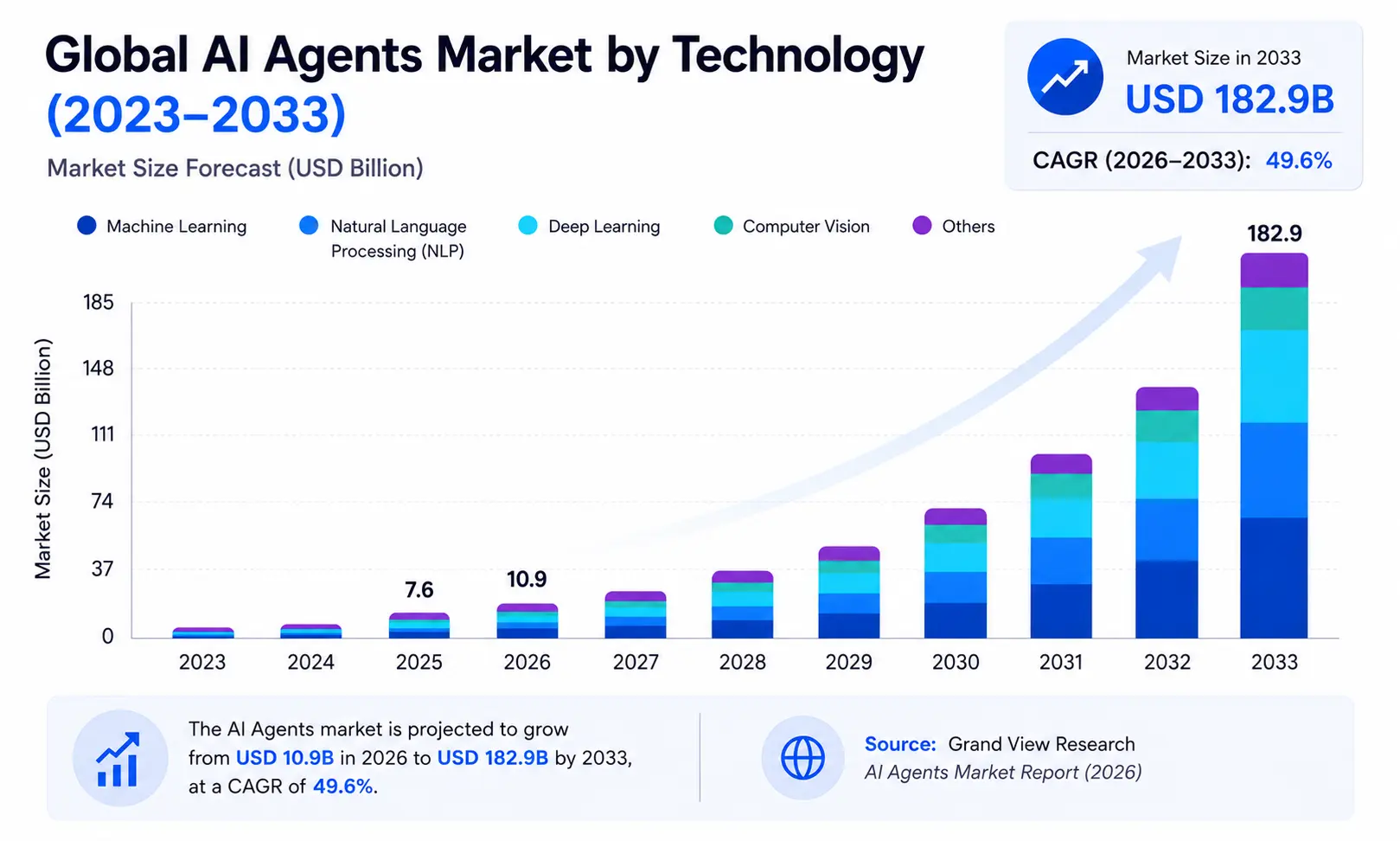
The numbers back up what's happening on the ground. The global AI agents market is projected to grow from $10.9 billion in 2026 to $182.97 billion by 2033, a 49.6% CAGR, according to Grand View Research.
And it's not just market analysts betting big. In an IBM survey of 3,500 senior executives across EMEA, 92% of leaders said they expect agentic AI to deliver measurable ROI within two years, IBM reports.
So where is agentic AI actually being put to work? Here's a walk through the use cases running in production right now, industry by industry.
Quick Summary
- Agentic AI use cases now cover most core business functions: engineering, healthcare, finance, marketing, hiring, support, and supply chain.
- The global AI agents market is projected to reach $182.97B by 2033, a 49.6% CAGR from 2026.
- 92% of EMEA business leaders expect agentic AI to deliver measurable ROI within two years.
- The strongest use cases share three traits: high volume, a repeatable structure, and a clear, measurable outcome.
- Trigma has built and deployed this exact kind of system in production for a US healthcare RCM company, detailed further below with a full case study.
Here's a short explainer on what actually separates agentic AI from a standard chatbot or automation tool.
Agentic AI Use Cases by Function
Agentic AI is helping various businesses, boosting their overall efficiency. Below are listed industries where agentic AI is helpful:
1. Software Development
Feed an agent a feature request straight from your Jira board, and it doesn't just draft a suggestion. It writes the code, runs it through CI/CD, and reports back that the build is ready for review. No one has to babysit the middle steps.
2. Healthcare
Healthcare runs on paperwork almost as much as it runs on patient care, and that's exactly where agents are earning their keep. They're confirming appointments and cutting no-show rates, transcribing clinical notes into the EHR while the visit is still happening, and flagging high-risk patients the moment lab results come in.
3. AI Voice Agents for Claims Follow-Up
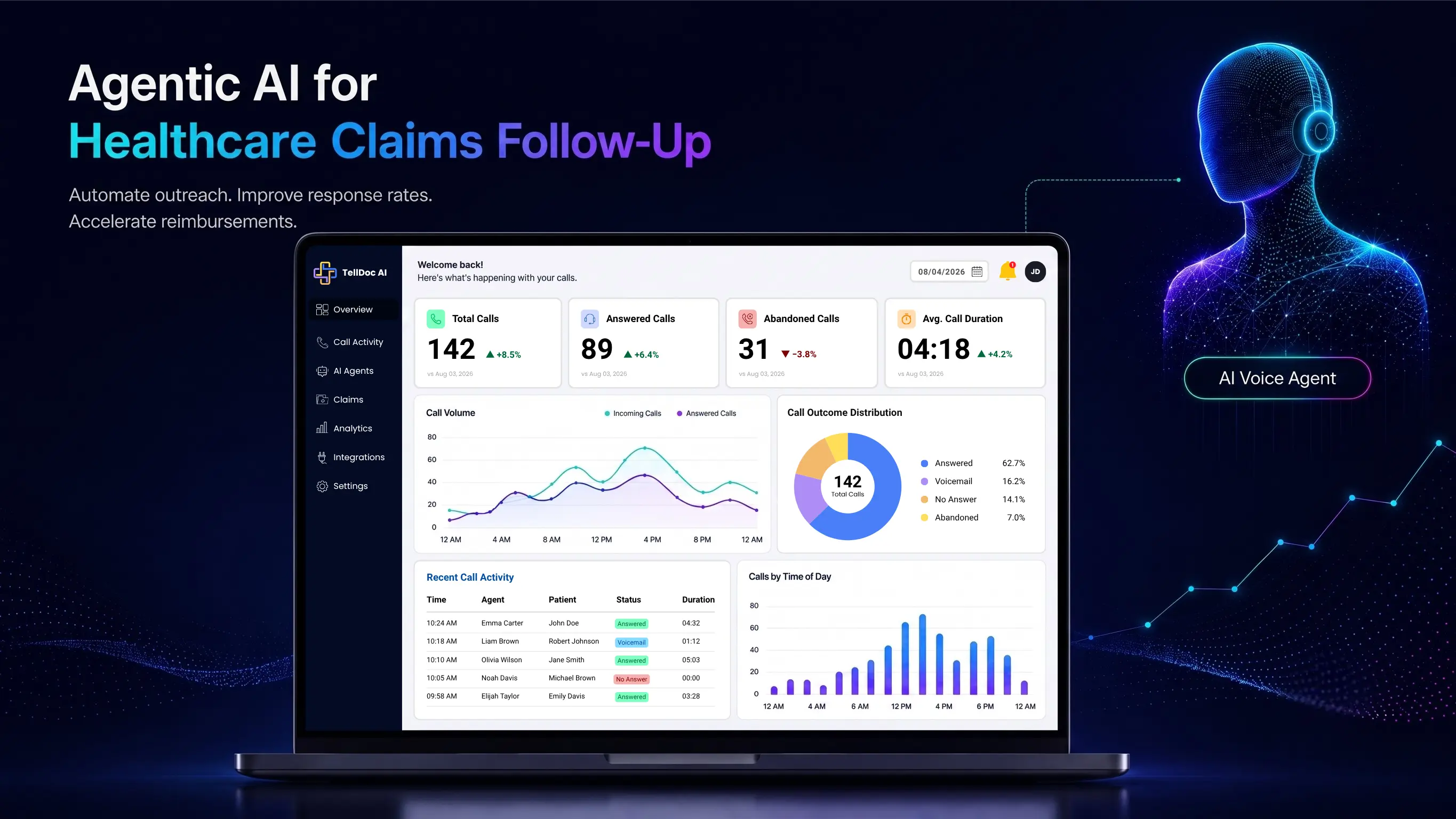
Checking claim status with a payer is a phone call, not a form, which is exactly why it's resisted automation for so long. A US-based healthcare RCM company had a revenue cycle team spending hours every day manually calling insurance payers just to check where a claim stood. Trigma built an agentic AI voice platform that places those calls directly, holding real conversations complete with follow-up questions and confirmation checks, the same way a trained agent would.
The result: 10x more calls handled per day, and a 40-60% reduction in follow-up labor costs.
4. Real Estate
Hand a deal analyzer agent a property listing and current price, and it comes back with an ROI projection, an appreciation forecast, and a confidence score, buy, hold, or pass. Work that used to eat an afternoon of spreadsheet math now takes minutes.
5. SaaS and Insurance Operations
A claim comes in. Instead of a human checking it line by line against policy rules, an agent reviews it, runs the fraud check, and pays out the straightforward ones on the spot. Only the cases that genuinely need judgment reach a person.
6. Marketing
Give a marketing agent your ideal customer profile, and it figures out the channels, the messaging, and the sequence, then runs the outreach. What used to take a team piecing together the same inputs by hand now runs largely on its own.
7. Hiring and Recruitment
A stack of a thousand resumes stops being a bottleneck. Recruitment agents parse the pile in minutes, screen for baseline requirements and certifications, and hand a recruiter only the candidates worth a second look.
8. Customer Support
Support tickets don't queue up waiting for business hours anymore. Agents resolve the recurring stuff, FAQs, order tracking, returns, immediately, and escalate the rest by exception instead of by default. The result is faster resolution and coverage that doesn't clock out at 5pm.
9. Legal Contract Review
A contract lands on an agent's desk before it lands on a lawyer's. It cross-checks the document against your internal playbook, flags risk clauses by jurisdiction, and hands back a marked-up starting point instead of a blank page, cutting real time off NDA, vendor, and compliance reviews.
10. Finance
Month-end reconciliation is one of the most repetitive jobs in finance, and one of the most time-consuming. Agentic AI takes on the data-matching itself, so the finance team's time goes toward analysis instead of chasing down discrepancies line by line.
11. Appointment Scheduling
A scheduling agent doesn't just check a calendar. It connects calendars, CRM, and messaging together to book, reschedule, and remind on its own. In healthcare specifically, it goes a step further and matches patients to the right provider based on symptoms and urgency, not just whichever slot happens to be open.
12. Sales Outreach and Lead Qualification
An agent finds the leads, verifies their contact details, sends personalized outreach, and asks the qualifying questions on budget and timeline itself. By the time a rep sees the lead, the admin work is already done, and what's left is the part reps actually want to do: sell.
13. Fraud Triage (BFSI)
Month-end reconciliation is one of the most repetitive jobs in finance, and one of the most time-consuming. Agentic AI takes on the data-matching itself, so the finance team's time goes toward analysis instead of chasing down discrepancies line by line.
14. Predictive Maintenance (Manufacturing)
Waiting for a machine to break, or servicing it on a fixed calendar whether it needs it or not, both waste money. An agent reads sensor data continuously and flags the specific machine that's about to fail, turning maintenance into a response to what's actually happening on the floor.
15. Supply Chain Exception Handling (Logistics)
A shipment gets delayed. Normally someone has to notice, investigate, and scramble to reroute. An exception-handling agent catches the disruption the moment it happens, checks the impact against current orders, and proposes or executes a fix before a small delay turns into a missed delivery.
Not Sure Which Use Case Fits Your Business?
Share what you're trying to solve, and one of our AI specialists will review it and get back to you with next steps.
Core Architectural Patterns Enabling Agentic AI
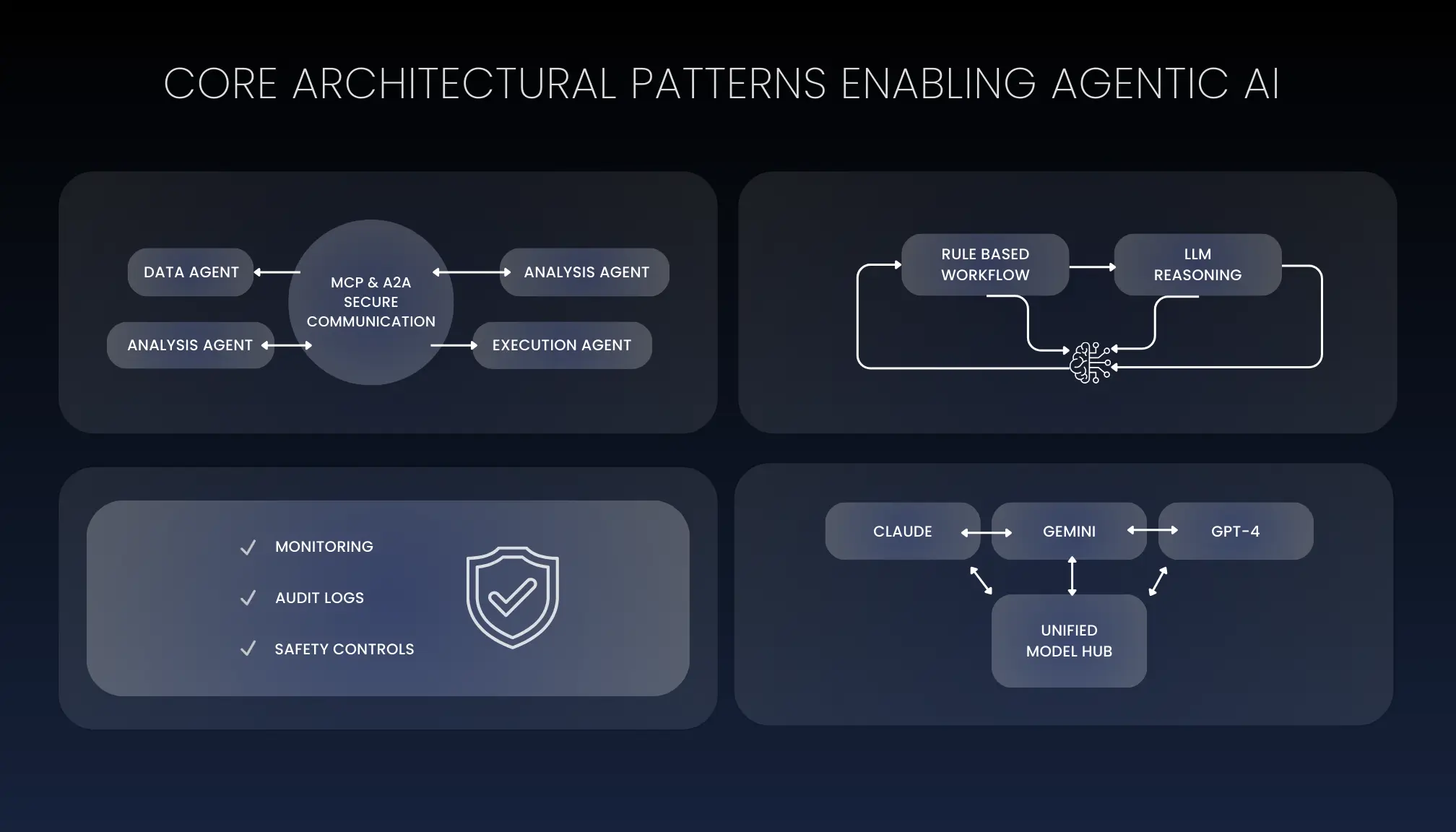
Successful agentic AI deployments share common architectural patterns that enable autonomous operation while ensuring governance and reliability.
Multi-agent orchestration
Instead of a single big AI system, enterprises use multiple specialized agents, each handling a specific task like data retrieval, analysis, execution, or compliance. These agents communicate through secure standards like MCP and A2A.
Hybrid reasoning systems
Enterprise AI combines fixed, rule-based workflows with flexible LLM reasoning. This ensures both reliability and adaptability, especially needed in regulated industries. Salesforce’s Atlas reasoning engine is an example of this approach.
Comprehensive observerability and governance
Modern AI platforms offer real-time tracking, testing environments, audit trails, human escalation options, and safety guardrails. These features build trust, ensure compliance, and allow safe deployment.
LLM agnostic architecture
Leading agentic AI platforms don’t depend on just one AI model. Instead, they integrate multiple models, such as claude, gemini through a unified system. This allows organizations to choose the best model for each task while maintaining consistent governance and performance.
How Trigma Helps Businesses Build and Deploy Agentic AI
Reading through fifteen use cases is one thing. Getting one running in your own operation is another.
Trigma's custom AI agent development team validates the business case first, builds a working prototype, and deploys a scalable solution integrated with the systems you already run on, CRMs, ERPs, EHRs, and everything in between. The healthcare claims example above is one look at what that process delivers in production, and the same approach applies whether the use case is fraud triage, contract review, or lead qualification.
FAQs
Can an AI agent help you make money?
Yes. A single agent scales to serve multiple users at once without added headcount, which is why businesses deploying AI agents are seeing real reductions in operational workload alongside a better customer experience, not a tradeoff between the two.
What's the timeline for building an AI agent?
A simple automation tool, like a lead qualification MVP, typically takes 3-6 weeks. A more complex, multi-step agentic system usually runs 3-8 months, depending on how many systems it needs to integrate with.
What does it cost to build an AI agent?
A simple AI agent typically runs $10,000 to $50,000. Complex, multi-agent systems can exceed $120,000, depending on scope and integration complexity.
What makes a good first agentic AI use case?
The strongest starting points share three traits: high volume, a repeatable structure, and a clear cost or time baseline to measure against. That's exactly why claim status calls, resume screening, and support ticket triage are usually where companies start.

Mehak is a Technical Content Writer at Trigma with experience in creating clear, research-driven content on emerging technologies and digital solutions. She focuses on translating complex concepts into accessible insights that help businesses make informed decisions and build a strong online presence.