+91-98558-85133
 +1(702)760-3099

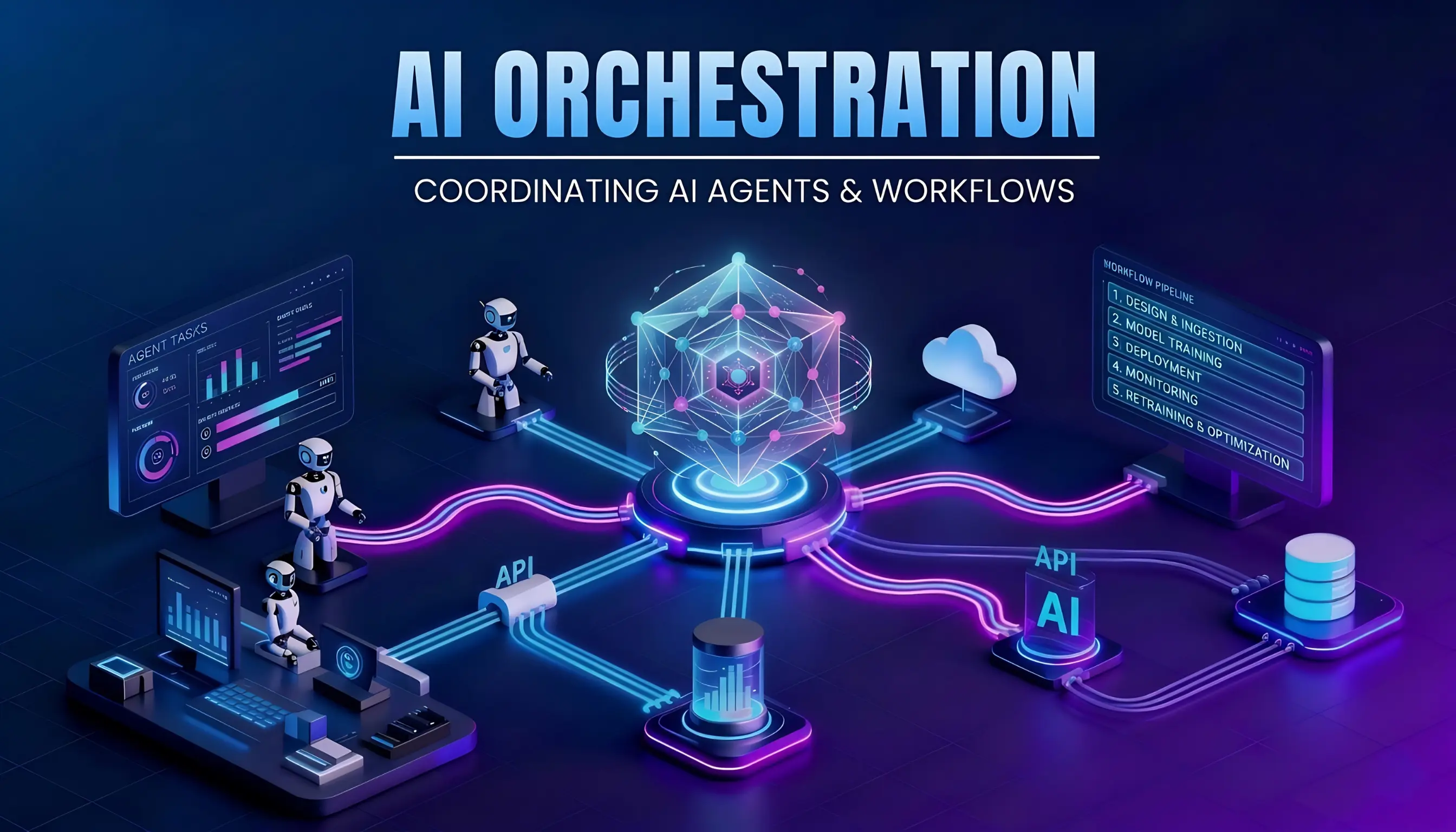
60-Second Summary
- AI orchestration is the practice of connecting multiple AI tools, agents and data systems so they work together as one coordinated system — not in isolation.
- It works through three layers:
- Intelligence Layer – understands intent and decides what to do
- Integration Layer – connects tools via APIs to execute actions
- Orchestration Layer – coordinates workflows, tracks progress and manages handoffs
- The result? Smoother workflows, faster decisions, better scalability and real financial impact.
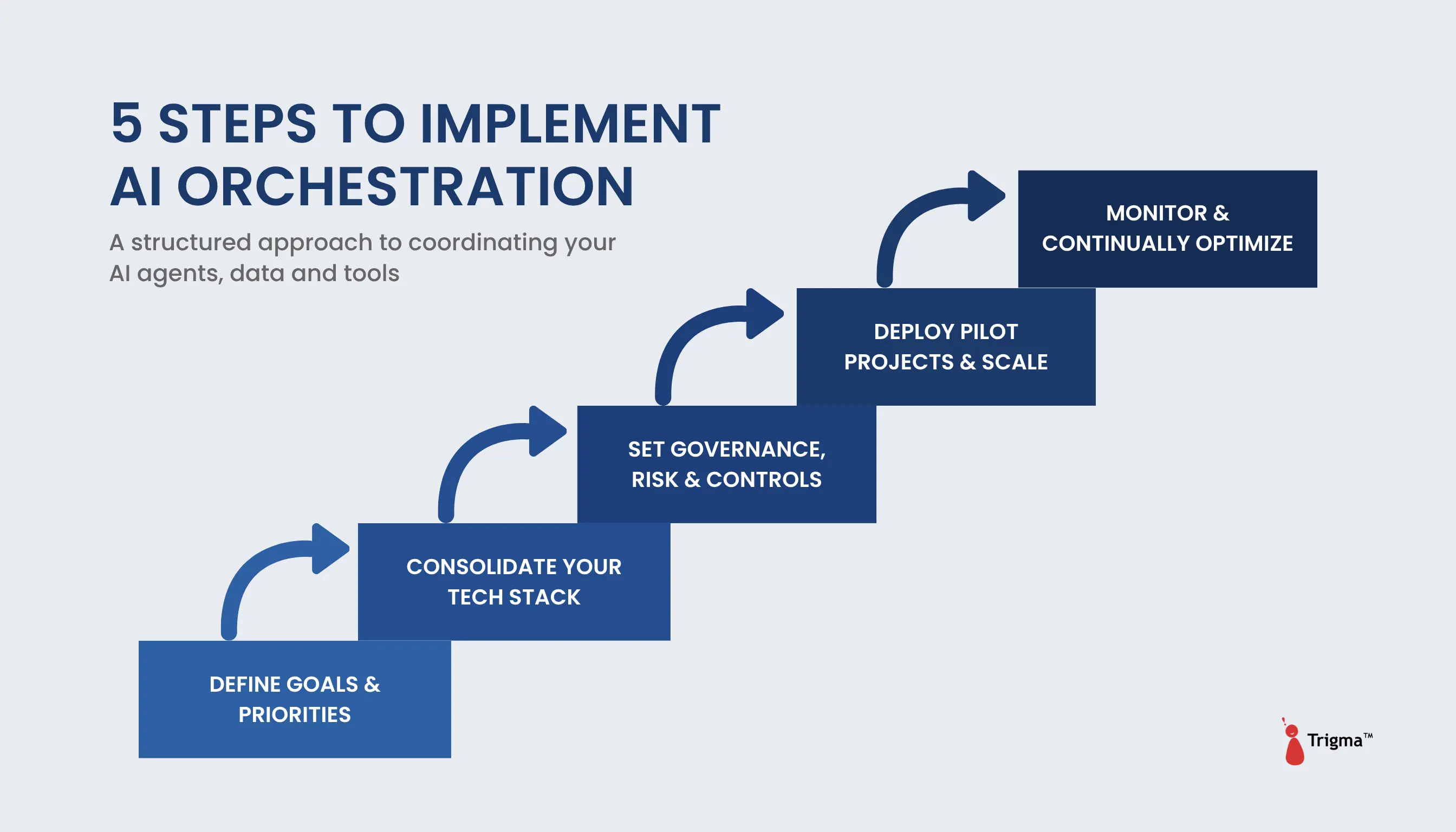
- Here's how to implement it in 5 steps:
- Define your business goals and prioritize use cases
- Audit and consolidate your existing tech stack
- Establish governance, risk controls and compliance frameworks
- Deploy pilot projects first, then scale what works
- Monitor continuously and optimize as you go
- Ready to orchestrate your workflows? Let's build it together.
Every enterprise is deploying AI. But deployment isn't the problem; coordination is.
Most organizations are running disconnected models, isolated agents and fragmented data pipelines. Each tool makes decisions in a vacuum. No shared context. No governance. No unified view of what's actually happening across the business.
The result? Duplicated costs, slower decisions and AI investments that don't compound.
AI orchestration fixes this by connecting your models, agents and infrastructure into one coordinated system where every tool knows its role, every decision has a chain of accountability and your AI stack scales without chaos.
Let’s break down what AI orchestration is, how it works, the business benefits it delivers and how to build a strategy that drives measurable outcomes not just technical progress.
What is AI Orchestration?
AI orchestration involves designing a system where multiple AI tools and humans work together to achieve a common goal. It's not about writing the prompt; it's about designing the system that connects everything.
This means the developer is no longer writing the code; they're designing the machine that does the work.
Take a customer support ticket, for example. Instead of one AI answering it, you design the workflow with a human in the loop framework.
One agent fetches the user data, another agent drafts a response, another checks for company policy. Before the message is sent, a human reviews and approves to ensure its accuracy.
While most enterprises focus on building AI agents, only a few are mastering orchestration.
Isolated Agent AI Orchestration
An isolated agent can answer questions, automate tasks and optimize micro workflows. AI Orchestration
- directs specialized agents across workflows,
- manages multi-step decision flows,
- controls execution flow and
- transforms fragmented tools into coordinated systems.
Working Process of AI Orchestration
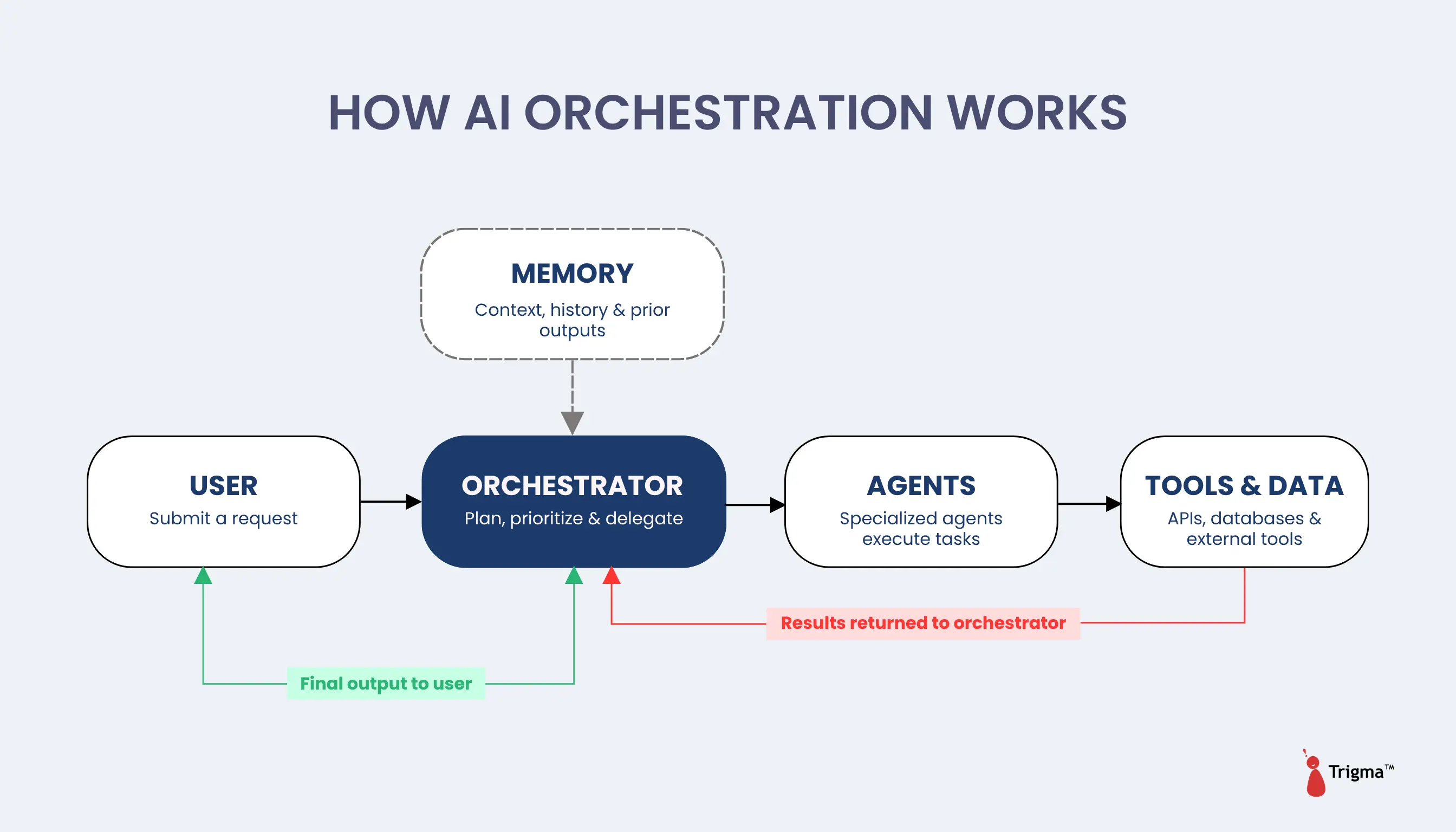
In AI orchestration, several components work together — models, data, AI agents, automation and workflows. These systems know what happened, why it happened and what they should do about it. Let's discuss these components in detail.
1. Intelligence Layer
The intelligence layer analyzes user input and uses reasoning to understand and interpret the intent behind it. It then decides what action to take.
This layer uses large language models and natural language processing to understand speech or text input. It also uses intent analysis to understand what the person actually wants and sentiment analysis to gauge how they're feeling.
It then generates relevant responses, determines the next best action and makes workflow decisions.
For example, if a customer messages your website chatbot about a missing order, the intelligence layer reads the complaint, understands the problem, interprets the customer's tone and sets out a plan of action to resolve the issue.
2. Integration Layer
The integration layer connects all the AI tools and databases needed to execute the intelligence layer's plan. Unlike the intelligence layer, which decides what to do, the integration layer actually does it.
These tools are connected through APIs, which link AI to your existing platforms such as Salesforce, Slack or Gmail.
So if your AI agent decides the best course of action is to issue a full refund, it connects with your ecommerce platform's API and webhooks to execute that refund.
For example, whenever a customer places an order on your Shopify store, a webhook automatically logs the order in your CRM, sends your shipping department a Slack alert and emails the customer a receipt.
3. Orchestration Layer
The orchestration layer coordinates the entire workflow. It decides which AI tools to use based on the specific event it's responding to, determines what steps to take and ensures all actions follow business rules.
This layer also tracks progress and coordinates contingency plans. For instance, if a customer is still unhappy after an action is taken.
It also decides which tasks should be handled autonomously and which should be handed off to human agents. It manages:
- Workflow engines (tools that let you design and execute step-by-step business processes)
- Event triggers (that start the workflow)
- Agent frameworks (frameworks that manage your AI agents, monitor task progress and select or connect different tools)
Benefits of AI Agent Orchestration
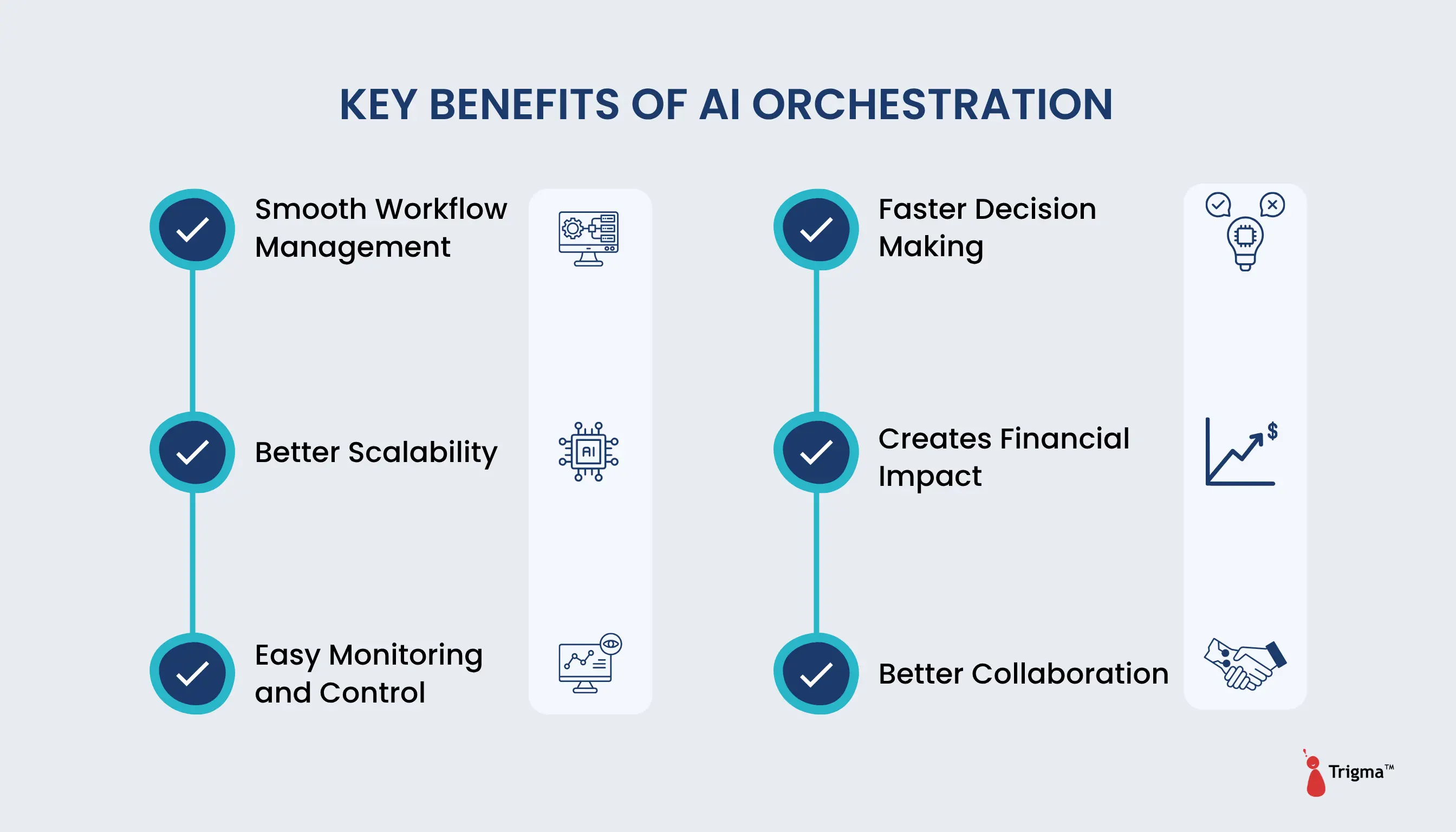
Here are a few key benefits of what AI agent orchestration can do for your business.
1. Smooth Workflow Management
It eliminates data silos across applications and communication channels, reduces redundancies and gives you visibility into AI application performance.
Instead of each AI tool working in isolation, AI orchestration coordinates different tools, models and data systems so they work together seamlessly with no manual coordination required.
2. Better Scalability
As AI projects grow, businesses begin using more models, tools and data systems that become difficult to manage manually. AI orchestration automates this process, making it easier to add or update models, data pipelines and APIs.
This allows businesses to scale their AI operations faster without manually managing every component.
3. Easy Monitoring and Control
AI orchestration frameworks make it easier to monitor the performance of AI models and systems. You can see which tasks are running, which have failed and where improvements are needed.
Because all models and AI agents are orchestrated, businesses can improve performance and control unnecessary costs.
4. Faster Decision Making
AI orchestration allows different AI models to collaborate in a closed loop, meaning more data can be analyzed, processed and acted on helping organizations make faster decisions.
For example, retailers use AI orchestration to connect systems such as product recommendations, inventory tracking and customer behavior analysis.
When a customer views a product, the system analyzes their behavior, checks inventory availability and instantly suggests similar products.
This enables faster decisions around stock, pricing and promotions.
5. Better Collaboration
In many organizations, different departments build their own AI systems that don't communicate with each other, causing duplicated work and siloed information.
AI orchestration solves this by connecting different AI models and tools so they work together. It also helps teams share knowledge, resolve problems faster and improve AI systems more effectively.
6. Creates Financial Impact
AI orchestration helps you achieve faster time-to-value on your AI investments by automating the deployment, training and integration phases of AI adoption.
By automating routine, low-value business processes end to end, it delivers shorter resolution times, lower risk of costly errors and better-optimized business resources.
How To Implement AI Orchestration For Your Business
Orchestrating AI systems isn't just about scaling; it's about creating a smooth transition that connects agents, data and tools together. Here's how to build your AI orchestration strategy in five steps.
1. Determine Your Business Goals and Prioritize Use Cases
Identify what you want to achieve with AI orchestration and how it supports your overall business goals. This prevents a "tech-first mindset" and ensures internal alignment from the start.
Once business goals are defined, identify specific, high-impact use cases such as ecommerce personalization, omnichannel virtual support agents or dynamic workforce planning.
2. Streamline Systems and Consolidate Your Tech Stack
Audit your existing tech stack and applications to identify redundancies, assess interoperability and review usage trends.
Use APIs and orchestration platforms to integrate everything into one collaborative, AI-powered system so everything you need is in one place.
3. Establish Governance, Risk Management and Controls
Create policies, guardrails and monitoring frameworks that ensure a compliant, secure and responsible approach to AI.
Consider forming a governance council to define compliance standards, create an AI governance policy and set protocols for monitoring and escalation. This includes:
- Audit logging
- AI bias and fairness checks
- Data retention and privacy strategies
- Approval workflows
- Model monitoring
4. Deploy Pilot Projects and Expand at Scale
Start with high-impact pilot projects. Focus on agile development, feedback loops and adaptability.
Then scale only proven workflows, prioritize reusable orchestration components like templates and connectors, and monitor analytics before gradually expanding. This prevents risky "big bang" rollouts and keeps momentum going.
5. Monitor and Continually Optimize
Treat your orchestration system as a living, evolving asset ; one you continually measure, learn from and improve.
Track KPIs such as time to deployment, reusability rate, adoption metrics and latency. Run A/B tests, review results with stakeholders regularly and automate alerts for cost anomalies or model performance drift.
How Trigma Can Help You Orchestrate AI Systems?
With Trigma, you can take your orchestration to the next level. By connecting AI agents directly to your business data, we help you create, optimize and monitor your agentic AI workflows ensuring your agents not only work together but align with your business goals.
Ready to Orchestrate Your AI at Scale?
We help enterprises connect agents, data and workflows into one governed, scalable system.
FAQs
How do I know whether building an in-house AI team or outsourcing is the right option?
If you want to launch AI MVP quickly and have a limited budget, outsourcing is the most practical option. However, if AI is a core part of your long-term product strategy, building your own in-house team may be the better investment.
Can outsourcing AI development be risky?
Yes, outsourcing can become risky when the vendor lacks domain expertise, uses outdated technology stacks, or has no security policies in place.
Can I build an in-house team while also outsourcing AI development?
Yes. A small in-house team can focus on core strategic decisions, while an outsourced agency handles execution and product development.