+91-98558-85133
 +1(702)760-3099


Key Insights
- Healthcare providers can automate patient registration, insurance verification and prior authorization to identify missing information earlier.
- AI-powered workflows can organize clinical records, identify documentation gaps and support accurate claim preparation.
- Automated payer follow-ups help teams track claim statuses, capture denial reasons and document required next actions.
- Automation can support payment posting, reimbursement reviews and patient billing activities.
- RPA, AI, Generative AI and Agentic AI can support different RCM tasks based on workflow requirements.
- Human oversight remains important for clinical decisions, coding judgment and complex claim resolution.
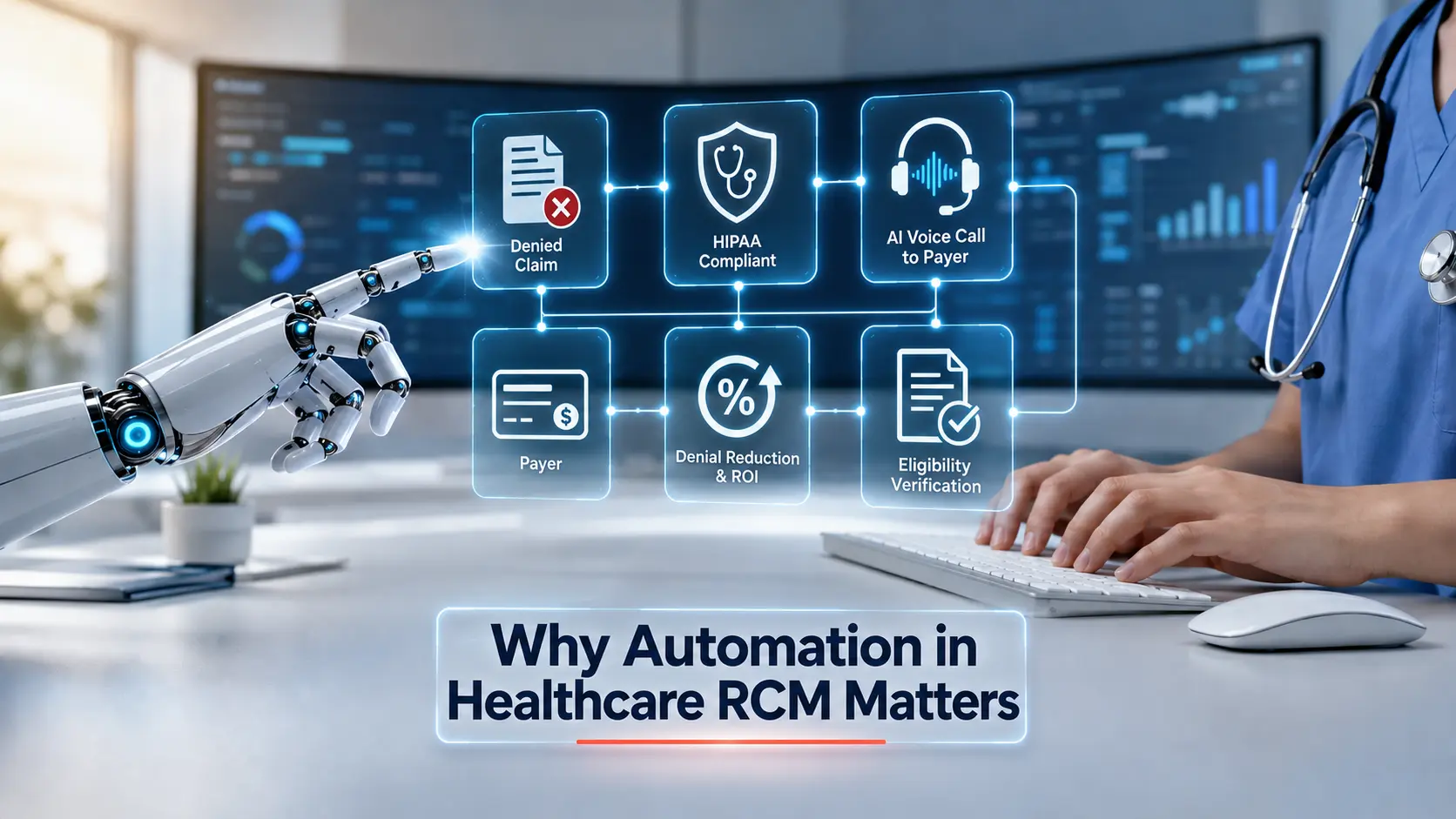
Healthcare RCM automation helps providers manage administrative and financial workflows, from patient registration and insurance verification to claims processing and payment follow-ups. It uses workflow automation, RPA and AI to reduce repetitive work, improve billing accuracy and streamline revenue cycle operations.
Claim denials remain a significant challenge for healthcare providers. According to Experian Health's 2026 State of Claims Report, 40% of surveyed providers reported that at least 10% of their claims were denied.
As healthcare organizations plan their 2027 revenue cycle priorities, automation offers opportunities to address administrative bottlenecks and improve workflows across the patient-to-payment journey. This article covers practical RCM automation use cases, the technologies involved and where human review remains necessary.
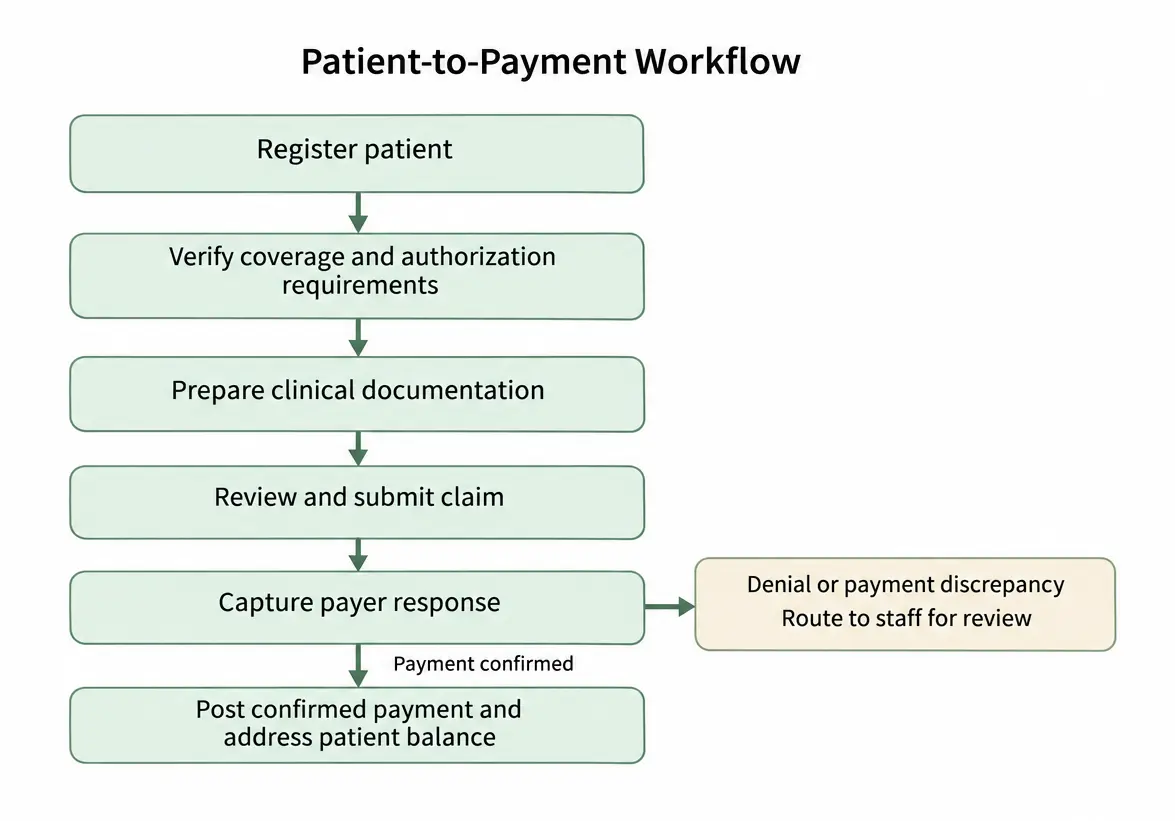
What Are the Key Healthcare RCM Automation Use Cases Across the Patient-to-Payment Journey?
Healthcare RCM automation can support workflows from patient registration and insurance verification to claims processing, payer follow-ups and payment resolution. The following use cases explain how automation can reduce manual work, improve information accuracy and help RCM teams manage outstanding accounts.
1. Automating Patient Registration and Data Capture
Automation helps RCM teams identify incomplete or inconsistent patient information before it creates downstream billing problems. It can compare registration records with retrieved insurance details and flag discrepancies for correction.
A mismatch may arise when a patient's insurance member ID differs between the registration form and payer records. The system can flag the discrepancy and create a correction task for the registration team.
2. Insurance Eligibility and Benefits Verification
Automated eligibility verification retrieves insurance information from payer systems and checks it against patient registration records. It helps identify coverage discrepancies, benefit limitations and payer-specific authorization requirements before services are provided.
When a payer returns an inactive coverage status for a scheduled patient, the system can flag the account so staff can confirm the patient's current insurance details before proceeding.
Eligibility confirmation does not guarantee claim payment. Unclear coverage details and benefit limitations still require appropriate verification.
3. Prior Authorization Preparation and Tracking
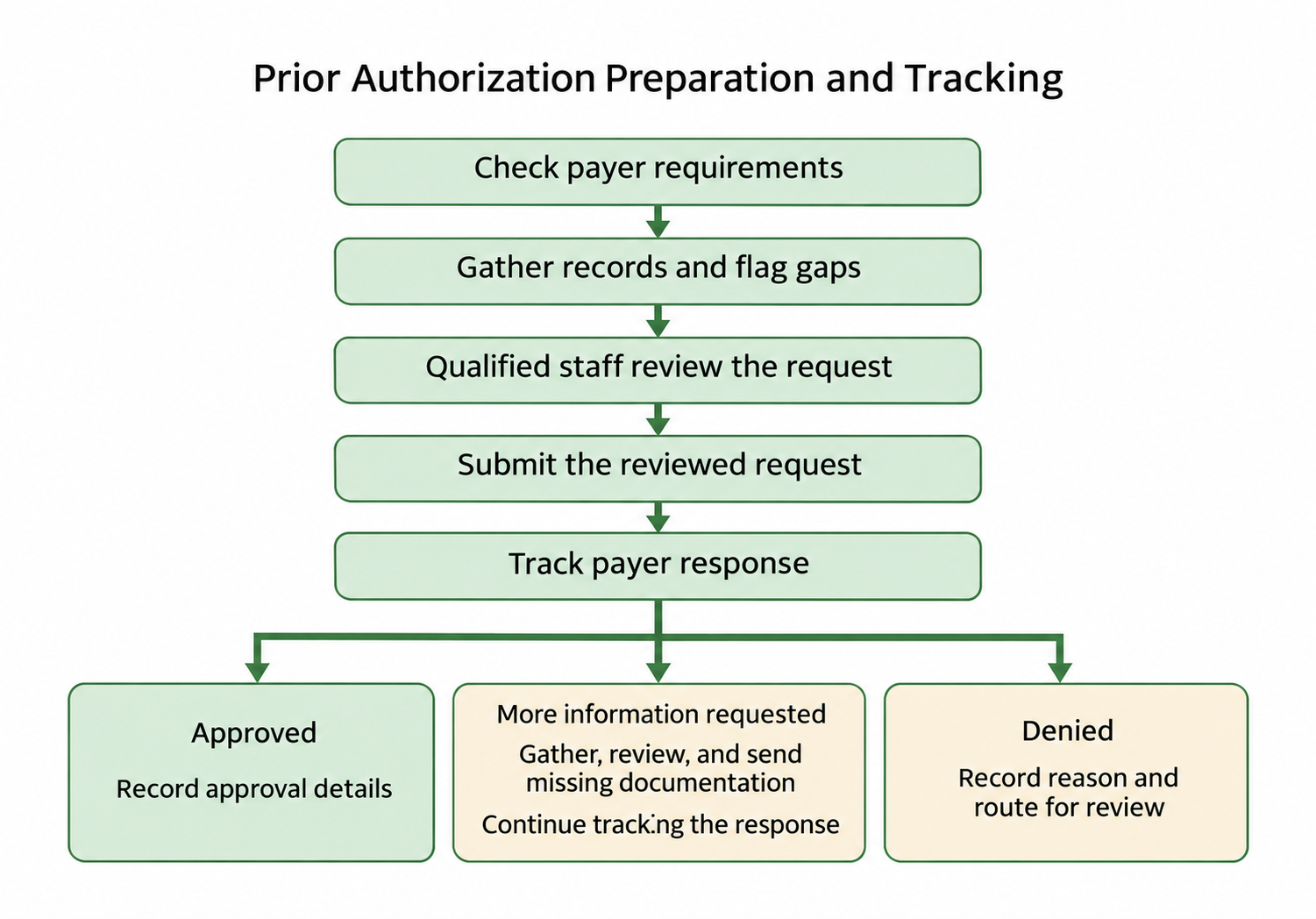
Automation helps RCM teams prepare authorization requests, organize supporting documentation and track payer responses. It reduces the manual effort involved in gathering clinical information and following up on outstanding requests.
Consider a request where a payer requires additional clinical notes before reviewing a treatment authorization. The system can identify the missing records and route the request to the appropriate team.
An AI agent can also check payer requirements, identify missing documents and prepare an authorization request using available records. It can then track the response and route additional information requests to the responsible team.
Approvals, denials and requests for additional information must remain separate statuses. Qualified professionals should retain responsibility for clinical statements and medical necessity decisions.
4. Streamlining Clinical Documentation and Case Preparation
Automation helps RCM teams consolidate clinical, patient and treatment information into structured case files. It can also identify missing records before the billing team begins claim preparation.
An AI-powered workflow can retrieve available clinical notes, patient demographics, insurance information and treatment details. It can organize these records and flag missing information for review.
A case file may arrive without a required treatment note or supporting clinical record. The system can identify the gap and notify the billing team before the claim moves forward.
5. Claim Scrubbing and Billing Error Detection
Automated claim scrubbing checks claim information against approved billing edits and supporting documentation before submission. It helps identify missing information, documentation gaps and authorization mismatches that could affect claim acceptance.
An AI-powered workflow can compare claim details with historical denial patterns for specific payers and procedures. When it identifies a recurring issue, it can flag the claim for billing review.
One common issue is a procedure code that does not match the available authorization details. The system can identify the discrepancy and route the claim for correction before submission.
The purpose is to identify potential errors before submission, not to replace qualified coding or billing review. These checks fit within a broader healthcare RCM automation approach that can connect claim validation with eligibility checks, payer follow-ups and denial triage.
6. Automating Claim Preparation and Submission
Automation helps organize the information needed for claim submission and identify details that require billing review. This includes clinical records, patient demographics, insurance information and treatment details.
A workflow can check service dates, provider information, diagnosis and procedure codes, modifiers and authorization details against available records. It can flag missing information before submission, while qualified professionals retain responsibility for final billing review.
A claim may be ready for submission but still contain incomplete provider information or missing authorization details. The system can flag the issue and route the claim back for correction.
7. AI-Powered Claims Status Tracking and Payer Follow-Ups
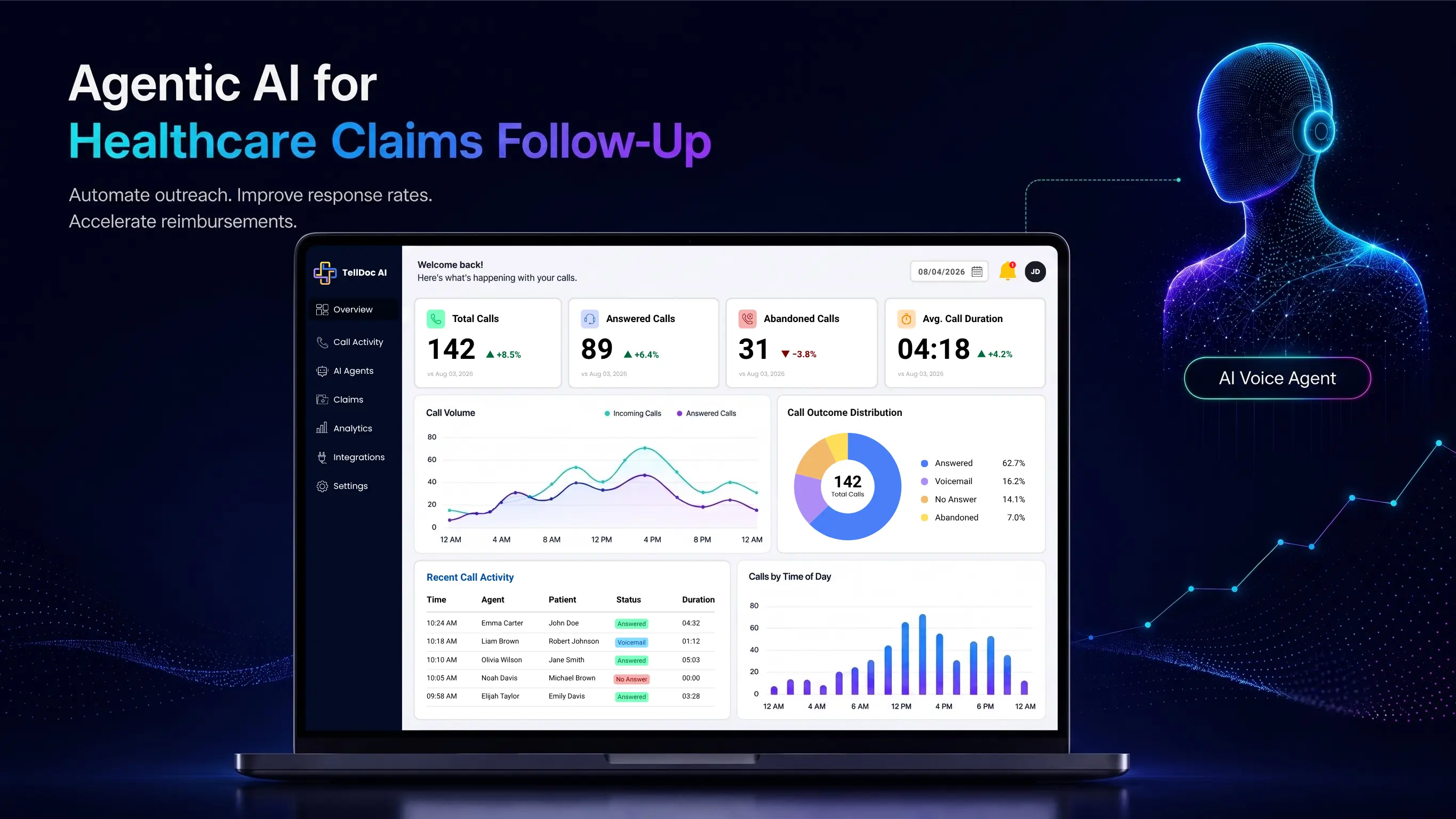
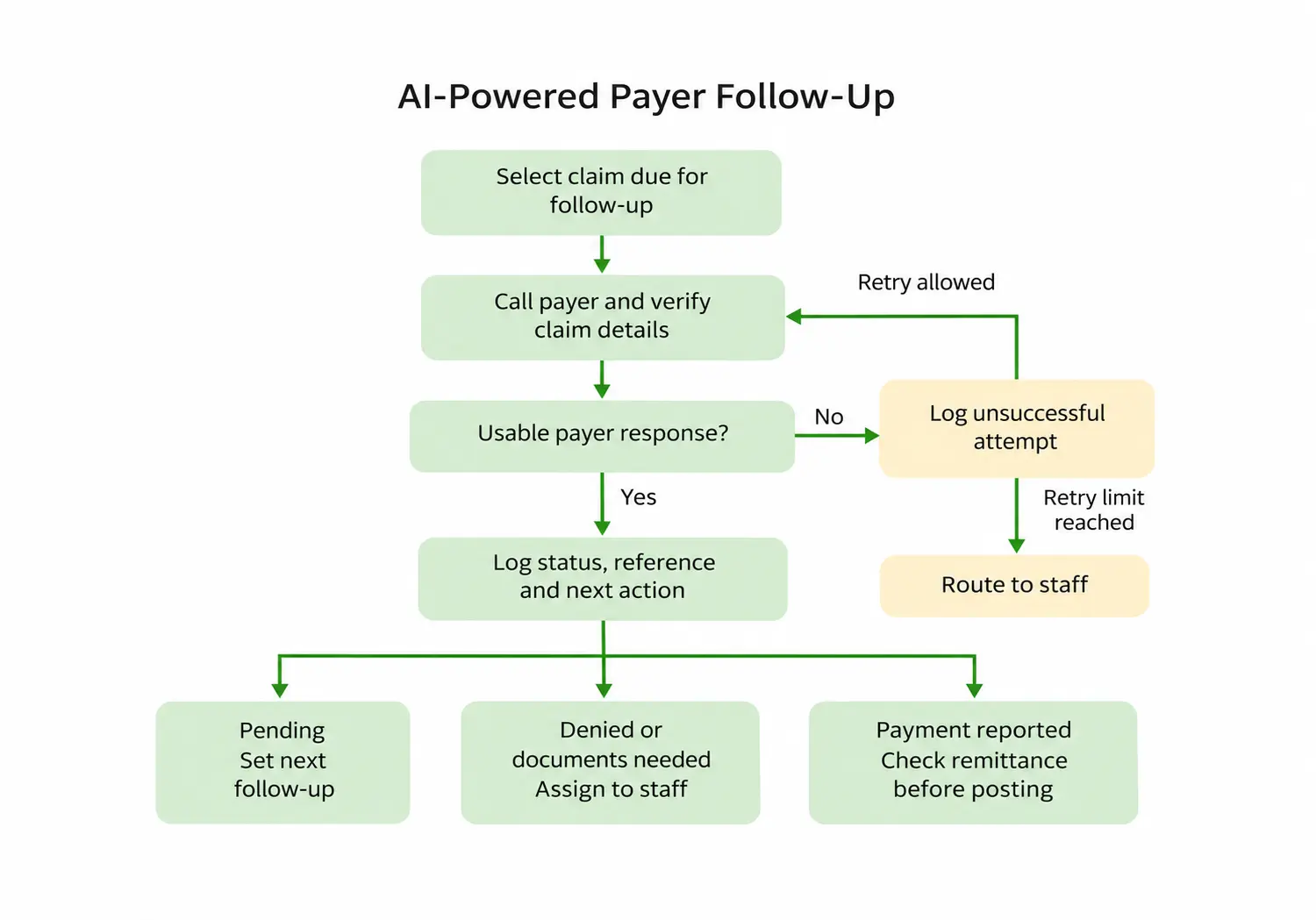
AI voice agents can automate routine payer calls to retrieve claim statuses, identify outstanding requirements and capture reimbursement updates. This helps RCM teams manage large insurance accounts receivable (A/R) worklists without making every call manually.
An AI agent can navigate interactive voice response (IVR) systems, communicate with insurance representatives and capture claim details, denial reasons and payer reference numbers. The information can then be recorded with call histories and follow-up actions for the responsible team.
During a payer follow-up, an insurance representative may confirm that a claim remains pending because supporting documentation is missing. The AI voice agent can capture the response, record the payer reference number and document the next follow-up action.
8. Denial Management and Appeal Preparation
Automation helps RCM teams organize denied claims, interpret payer responses and prepare the next action for unresolved accounts. It can also help prioritize cases based on filing deadlines, recovery potential and the effort required for resolution.
An AI agent can retrieve claim history, review the payer's stated denial reason and gather relevant supporting documentation. It can prepare correction tasks or appeal packets for specialist review before submission.
Consider a claim denied because the payer did not receive the required supporting documentation. The system can retrieve the denial details, identify the missing information and prepare a correction task for the denial management team.
The system should retain the evidence behind its recommendations and distinguish between an appeal that has been submitted and a denial that has actually been resolved.
9. Identifying and Recovering Underpayments
AI agents can help identify payments that fall below expected reimbursement and organize the information needed for further investigation. This helps reimbursement teams focus on potential payment discrepancies rather than reviewing every paid claim manually.
An agent can retrieve remittance information, claim details and applicable contract terms. A validated payment engine can calculate the expected reimbursement, allowing the agent to assemble the discrepancy for review by a reimbursement specialist.
A discrepancy can occur when a payer's remittance shows a payment below the expected contracted rate. The system can flag the difference and organize the claim and payment details for specialist review.
Contract terms, plan details, effective dates and legitimate payment adjustments must be verified before a difference is treated as recoverable revenue.
10. Patient Billing and Account Query Management
Automation helps RCM teams respond to patient billing questions by organizing approved account information and identifying the reason behind an outstanding balance. It can reduce the time representatives spend searching through claim and payment records before responding.
An AI agent can summarize account details and identify whether a query concerns a pending payer response, a posted payment or an existing patient balance. It can prepare an explanation or route the query to the appropriate team for further review.
When a patient questions an outstanding balance after insurance has processed a claim, the system can retrieve the available claim and payment information. It can then prepare an account summary for the billing representative.
Disputed charges and financial assistance decisions should remain subject to staff review. An unresolved insurance issue should not automatically result in a patient billing or collection action.
Which Technologies Support Healthcare RCM Automation?
Healthcare RCM automation uses a combination of rules-based systems, RPA, AI and system integrations to handle different administrative and financial tasks. These technologies can work together to validate information, process documents, manage payer interactions and coordinate workflows.
Rules-Based Automation
Rules-based automation follows predefined conditions to validate information, flag errors and route tasks. It works well for repeatable processes where the required actions and decision criteria are clearly defined.
Within RCM, a rules engine can check whether required claim fields are complete or hold a submission until an authorized professional approves it. It can also route records with missing information to the appropriate team for review.
Robotic Process Automation (RPA)
RPA handles repetitive, structured tasks by interacting with existing software applications. It can perform activities such as logging into systems, populating forms and transferring information between platforms.
For instance, RPA can retrieve claim information from a payer portal and enter the details into an internal billing system. However, it generally follows predefined instructions and may struggle when workflows require interpreting changing information or complex responses.
Artificial Intelligence, NLP and Generative AI
Artificial intelligence helps analyze information, identify patterns and support decisions within RCM workflows. Natural Language Processing (NLP) and Generative AI can also process unstructured information, including clinical notes, payer responses and call transcripts.
An AI-powered workflow can extract relevant details from clinical documentation and convert them into structured information for further review. Generative AI can also help summarize payer responses or prepare draft appeal documents using available claim information.
Conversational AI and Voice Engines
Conversational AI and voice technologies support automated communication with insurance payers. They use speech recognition and natural language processing to interpret spoken responses and handle conversations.
AI voice agents can navigate interactive voice response (IVR) systems, respond to prompts and communicate with insurance representatives. They can capture claim statuses, denial explanations and payer reference numbers for documentation and follow-up.
Agentic AI
Agentic AI coordinates multiple tasks by retrieving information, evaluating available responses and selecting approved next actions. Unlike traditional automation, which follows predefined steps, AI agents can adapt their actions based on new information within defined permissions.
An Agentic AI approach to healthcare RCM can retrieve claim history, review a payer's response, locate supporting documents and prepare a correction task or appeal for approval. It can also check whether the required action has been completed and route unresolved issues to the responsible team.
Healthcare System and API Integrations
System integrations connect automation technologies with the platforms that healthcare organizations already use. These connections allow information to move between EHRs, billing applications, payer systems and clearinghouses.
FHIR and HL7 interfaces, along with secure API gateways, can support data exchange between healthcare applications and automation workflows. This reduces manual information transfer and helps maintain continuity between different RCM processes.
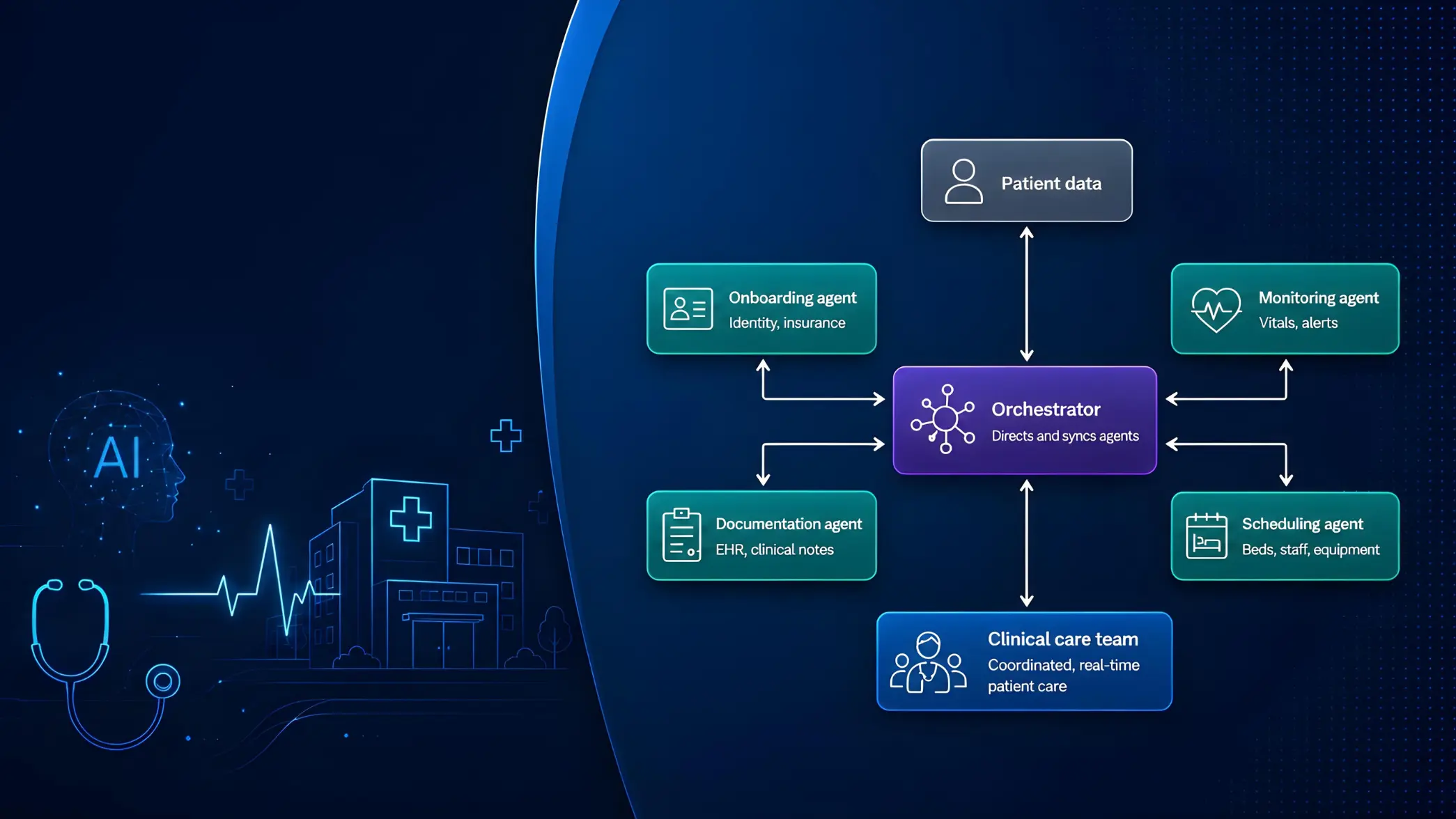
Applies permissions, monitors work, and routes exceptions to staff.
Uses rules, RPA, or AI suited to the task, including language processing, generative AI, voice AI, and AI agents.
Maps, validates, and exchanges data using supported APIs, HL7 FHIR or HL7 v2 interfaces, and X12 EDI transactions.
EHR/EMR, practice management and billing systems, clearinghouses, and payer systems.
How Can Healthcare Providers Measure RCM Automation Success?
Healthcare providers can measure RCM automation success by tracking processing time, billing accuracy, claim resolution, reimbursement performance and manual workload. Comparing these metrics before and after implementation helps teams identify improvements and determine whether workflows are delivering the expected results.
Key Metrics to Track Across RCM Workflows
|
Performance area |
Metrics to monitor |
What they indicate |
|---|---|---|
|
Patient registration and eligibility |
Registration error rate; eligibility verification turnaround time; incomplete records |
Accuracy of patient and insurance information |
|
Prior authorization |
Authorization turnaround time; pending requests; incomplete submissions |
Efficiency of authorization preparation and tracking |
|
Clinical documentation and billing |
Documentation error rate; charge capture accuracy; claim rework rate |
Quality of information before claim submission |
|
Claims processing |
First-pass claim acceptance rate; claim rejection rate; denial rate |
Accuracy of claim preparation and submission |
|
Claims follow-ups |
Pending claim volume; follow-up turnaround time; resolution time |
Effectiveness of payer communication |
|
Payment management |
Payment posting time; days in A/R; underpayment recovery |
Efficiency of reimbursement and payment resolution |
|
Patient billing |
Outstanding patient balances; billing query resolution time; collection rate |
Effectiveness of patient account management |
Monitor Processing Time and Manual Workload
Automation should reduce the time teams spend on repetitive activities, including retrieving payer information, preparing case files and conducting routine follow-ups. Tracking average handling time and manual interventions can help identify workflows where automation is reducing administrative effort.
For instance, an RCM team can compare the time required to prepare authorization cases before and after introducing automated document collection and case preparation. The comparison should use similar case types and volumes to produce meaningful results.
Track Billing Accuracy and Claim Resolution
Faster processing does not necessarily mean better RCM performance. Providers should also monitor claim errors, rejection rates, denials and the time required to resolve outstanding accounts.
A rise in automated claim processing volume, accompanied by more rejections or rework, may indicate that validation rules or source data need improvement.
Evaluate the Financial Impact
RCM automation should also be evaluated against its financial impact. Metrics such as days in accounts receivable (A/R), cost to collect, denial recovery and underpayment recovery can help providers assess whether operational improvements are supporting revenue collection.
Implementation costs should also be considered. These include software development, system integrations, maintenance, exception handling and ongoing human review.
Where Does Human Review Remain Essential in RCM Automation?
RCM automation can handle repetitive administrative tasks, but clinical decisions, coding judgment and complex financial matters still require qualified professionals. Human review helps verify automated outputs, resolve exceptions and maintain control over important billing decisions.
Clinical Documentation and Medical Necessity Review
Automation can collect clinical records, organize patient information and identify missing documentation before claim submission. However, qualified professionals must review clinical statements and determine whether the documentation supports the services being billed.
Medical Coding and Final Billing Approval
AI-powered workflows can flag missing information, identify potential coding inconsistencies and support billing reviews. Qualified coding and billing professionals should retain responsibility for coding judgment, reviewing complex cases and approving claims for submission.
Denial Resolution and Complex Appeals
Automation can retrieve denial reasons, organize supporting documents and prepare correction tasks or appeal packets. Specialists should review the available evidence, determine the appropriate response and approve complex appeals before submission.
Disputed Claims and Financial Adjustments
Unusual reimbursement discrepancies, disputed balances and complex account adjustments may require additional investigation. Automation can organize claim history and payment information, while reimbursement specialists review the findings and determine the appropriate action.
Patient Billing Disputes
Automated systems can retrieve account information and prepare responses to routine billing inquiries. However, disputed charges, financial assistance requests and complex balance questions should be routed to the appropriate billing or financial services representative.
The goal is not to remove professionals from the revenue cycle. It is to reduce repetitive work while giving RCM teams better information and more time to address cases that require their attention.
How Can Trigma Help With Healthcare RCM Automation?
Trigma develops AI healthcare RCM solutions that connect pre-authorization preparation, clinical information management, billing review and payer follow-ups. These solutions help RCM teams reduce manual preparation work, organize claim information and manage outstanding accounts.
Streamlining Authorization and Case Preparation
Trigma's AI healthcare RCM solution helps teams verify eligibility and benefits, organize clinical records and prepare authorization documentation. It can also track authorization status, approved services, units and validity dates when available.
The solution consolidates patient demographics, insurance information, clinical notes and treatment details into structured case files. It also identifies missing information for review before the case moves to billing submission.
Supporting Billing Review and Claim Submission
Incomplete documentation and inconsistent claim details can delay billing and create additional rework. Trigma's solution helps organize the information required for billing review and flags documentation gaps before claim submission.
Qualified professionals retain responsibility for reviewing clinical documentation, diagnosis and procedure codes, modifiers and authorization details before submission.
Automating Insurance Payer Follow-Ups
AI voice agents deployed by Trigma automate routine payer calls across insurance A/R worklists. They navigate IVR systems, communicate with insurance representatives and capture claim statuses, denial explanations, documentation requests and reimbursement updates.
The solution supports individual and batch calling, with transcripts, call histories, payer reference numbers and documented follow-up actions. Unresolved accounts can be routed to specialists for corrections, appeals or further investigation.
Supporting High-Volume RCM Operations
Trigma's healthcare RCM implementation includes parallel batch calling, real-time transcription, call tracking, retry controls and historical response logs. These capabilities help RCM teams manage large volumes of payer follow-ups while maintaining visibility into call outcomes.
The implementation also supports documented follow-up activity across insurance A/R worklists, giving teams a record of payer responses and next actions.
Discuss Your RCM Automation Requirements
Talk with Trigma about the workflows your team wants to streamline, the systems involved and the operational outcomes you need to measure.
FAQs
Can RCM teams track claims that have been reprocessed?
Yes. RCM automation can track pending, denied and reprocessed claims, capturing payer updates and identifying the next required action.
What happens when a payer requests additional documentation?
The system can record the documentation request and route it to the responsible team. Staff can provide the missing information and continue the follow-up process.
Can RCM specialists review previous payer interactions?
Yes. Call transcripts, interaction histories, payer reference numbers and recorded outcomes help specialists review previous conversations and follow-up activities.
Can authorization details be shared with the billing team?
Yes. Available authorization information, including approved services, units and validity dates, can be organized for billing review and claim preparation.
How are unresolved claims assigned for further action?
Unresolved accounts can be routed to the appropriate specialists for corrections, appeals or additional payer follow-ups, with documented ownership and next actions.